

| Status |
| |
|---|---|---|
| Owner | ||
| Stakeholders |
Purpose
The purpose of this document is to define the conversion approach to create Material Master-General Plant Data / S.Loc Data in S/4 HANA.
The General Plant Data/Storage view is one of the key views in the Material Master. It contains information about a material that is specific to a particular plant and storage location. This view is essential for plant-level operations and inventory management. Currently, in both ECC systems PF2 and WP2, materials are extended to specific plants and their respective storage locations. Source and Target structures mapping are provided below.
Conversion Scope
The scope of this document covers the approach for converting active Material Master-General Plant Data / S.Loc Data from Legacy Source Systems into S/4HANA following the DD-FUN-050 Master Data Standard - Material General Plant and Storage Data Master Data Design Standard.
As per KDD011 - Material Master Numbering Alignment All Syensqo's materials (finished, semi-finished, raw materials, spares etc.) will be represented by a unique material master number which will be assigned from a new number range
All materials created in the previous 6 months will be included unless flagged for deletion
- Material Types ZUNB, ZBOM, ZPRC will be included regardless of activity (unless flagged for deletion)
- We will only include materials that are extended to the following.
- Company Codes in scope
- Plants in scope
- Purchasing Orgs in scope
- Sales Orgs in scope
- Include only Material Types in scope
- We will include for migration all materials that have activity over the previous 3 years, to include:
- For procurement data use EKKO/EKPO tables (remove any records in EKKO/EKPO where LOEKZ = 'X') and use EKPO/AEDAT for previous 3 years filter
- For sales data use VBAK/VBAP tables
- For production data use AFKO/AFPO tables
- Additionally, we can check material movements by querying MKPF/MSEG tables. Link MKPF.MBLNR (Document Number) to MSEG.MBLNR and link MKPF.MJAHR (Year) to MSEG.MJAHR. Extract data by year or date (MKPF.BLDAT). WP2 may have to be broken down further due to the number of records. In MKPF.VGART (Transaction Types) add: IB,ID,IZ,RS,SI,WA,WE,WF,WH,WI,WL,WO,WQ,WR,WS,WV,WZ. Extract material and plant (MSEG.MATNR and MSEG.WERKS)
- We will include for migration all materials that have open documents including the following:
- Open PO
- Open contracts
- Open STO
- Open SO
- Open WO
- Have current stock/open inventory
For Open Inventory use the following tables:
MARD
MKOL (Consignment stock)
MSKA (Sales Order stock)
MSLB (Special stock)
MSPR (Project stock)
- We will include all BOM data for materials in scope using tables: MAST/STKO/STPO. We will also include all Plant Maintenance BOMs (regardless of activity).
- Materials with Deletion Flags will be excluded unless appearing in the following open transactions:
- Open PO
- Open contracts
- Open STO
- Open SO
- Open WO
- Deletion Flags (Table/Field) are as follows: MARA/LVORM = 'X' MARA/MSTAE = Z3, Z4, ZZ (PF2 system) Z0 (WP2 system)
- Materials with the word 'OBSOLETE' or 'DELETED' contained within the Short Description will be excluded. Also excluded are Materials where Short Description contains '**OBS', '**OBS**', '**OBS***', '*OBS*', '*OBS**', '***OBS***'
The data from legacy system includes:
that adhere to the CNV-2019 Materials Basic Data rules and have been deduplicated as per the Numbering Alignment process are in scope for plant extensions
The data from legacy system excludes:
- N/A
- Duplicates & materials not in scope of basic data
Serialization Profile Material Master MDS rules:
Serial Profile is mandatory and defaulted to "EAM1" if,
Material Type = UNBW and "Critical Part" field is checked
Material Type = ZIND and Material is Split valuated
| Source | Scope | Source Approx No. of Records | Target System | Target Approx No. of Records |
|---|---|---|---|---|
| PF2 | The Material Master Records will be extracted/collected via DCT. An initial extract of the relevant data will be provided in Google Sheet format to assist business in decision making on including any relevant data from Source Systems. | 1.2 Million (Depending on Plant consolidation) | S4H | TBC depending on Plant Consolidation |
| WP2 | The Material Master Records will be extracted/collected via DCT. An initial extract of the relevant data will be provided in Google Sheet format to assist business in decision making on including any relevant data from Source Systems. | 1.2 Million (Depending on Plant consolidation) | S4H | Consolidation |
| DCT | For Service Master Materials to be extended correctly a DCT page is required to assist the business with populating the relevant columns for all materials identified as Service Master Materials that need to be brought into the Material master. These materials will be extended with the material type ZSER. Potential Service materials are available in two places and need to be extracted to assist with population of template: 1) In legacy Mara. All materials with the material description wildcard of 'Service' ) Service Master Records from ASMD table these will be potential ZSER materials if accepted in the DCT. | TBC | S4H | TBC |
Additional Information
Multi-language Requirement
As per KDD055 - Multi-Language Support there are 8 languages in scope: English, French, Italian and Mandarin and Brazilian Portuguese, German, Spanish and Thai.
Legacy text for applicable records at Plant level are in-scope for Migration to support system functionalities (If anything is getting printed on output documents then the Text would be in scope
| Language Key | International Version | Language description | Notes |
| EN | E | English | |
| FR | F | French | |
| IT | I | Italian | |
| ZH | 1 | Mandarin | |
| ? | ? | Brazilian Portuguese | Language key for Brazilian Portuguese need to be confirmed by functional team |
| DE | D | German | |
| ES | S | Spanish | |
| TH | 2 | Thai |
Document Management
Not applicable
Legal Requirement
Not applicable
Special Requirements
Not applicable
Target Design
The technical design of the target for this conversion approach.
| Table | Field | Data Element | Field Description | Data Type | Length | ZDIR | ZIND | HERS | IBAU | NLAG | PIPE | UNBW | VERP | ZLEI | ZLEH | ZLER | ZABF | ZSER | ZBAS |
| MARC | AUSME | MATNR | Unit of issue | CHAR | 18 | C | C | N/A | N/A | N/A | N/A | C | N/A | C | C | C | C | N/A | N/A |
| MARD | LGPBE | LGPBE | Storage Bin | CHAR | 10 | C | C | N/A | N/A | N/A | N/A | C | N/A | C | C | C | C | N/A | N/A |
| MARD | LWMKB | MARD_KOBER | Picking Area | CHAR | 3 | N/A | N/A | N/A | N/A | N/A | N/A | N/A | N/A | N/A | N/A | N/A | N/A | N/A | N/A |
| MARA | TEMPB | TEMPB | Temp. Conditions | CHAR | 2 | C | N/A | N/A | N/A | N/A | N/A | N/A | N/A | N/A | N/A | N/A | N/A | N/A | N/A |
| MARA | RAUBE | RAUBE | Storage conditions | CHAR | 2 | R | N/A | N/A | N/A | N/A | N/A | N/A | N/A | R | R | R | R | R | N/A |
| MARA | BEHVO | BEHVO | Container reqmts | CHAR | 2 | N/A | N/A | N/A | N/A | N/A | N/A | N/A | N/A | N/A | N/A | N/A | N/A | N/A | N/A |
| MARA | STOFF | STOFF | Haz.material number | CHAR | 18 | N/A | N/A | N/A | N/A | N/A | N/A | N/A | N/A | N/A | N/A | N/A | N/A | N/A | N/A |
| MARC | ABCIN | ABCIN | CC phys. inv. ind. | CHAR | 1 | R | R | N/A | N/A | N/A | N/A | R | N/A | R | R | R | R | R | N/A |
| MARC | CCFIX | CCFIX | CC fixed | CHAR | 1 | R | R | N/A | N/A | N/A | N/A | R | N/A | R | R | R | R | R | N/A |
| MARA | WESCH | WESCH | Number of GR slips | QUAN | 13(3dec) | N/A | N/A | N/A | N/A | N/A | N/A | N/A | N/A | N/A | N/A | N/A | N/A | N/A | N/A |
| MARA | ETIAR | ETIAR | Label type | CHAR | 2 | N/A | N/A | N/A | N/A | N/A | N/A | N/A | N/A | N/A | N/A | N/A | N/A | N/A | N/A |
| MARA | ETIFO | ETIFO | Lab.form | CHAR | 2 | N/A | N/A | N/A | N/A | N/A | N/A | N/A | N/A | N/A | N/A | N/A | N/A | N/A | N/A |
| MARA | XGCHP | XGCHP | Appr.batch rec. req. | CHAR | 1 | N/A | N/A | N/A | N/A | N/A | N/A | N/A | N/A | N/A | N/A | N/A | N/A | N/A | N/A |
| MARA | XCHPF | XCHPF | Batch Management | CHAR | 1 | C | N/A | N/A | N/A | N/A | N/A | N/A | N/A | C | C | C | C | C | N/A |
| MARC | XCHPF | XCHPF | Batch Management (Plant) | CHAR | 1 | C | N/A | N/A | N/A | N/A | N/A | N/A | N/A | C | C | C | C | C | N/A |
| MARC | MAXLZ | MAXLZ | Max. Storage Period | DEC | 5 | N/A | N/A | N/A | N/A | N/A | N/A | N/A | N/A | N/A | N/A | N/A | N/A | N/A | N/A |
| MARC | LZEIH | LZEIH | Time Unit | UNIT | 3 | N/A | N/A | N/A | N/A | N/A | N/A | N/A | N/A | N/A | N/A | N/A | N/A | N/A | N/A |
| MARA | MHDRZ | MHDRZ | Min. Rem. Shelf Life | DEC | 4 | C | N/A | N/A | N/A | N/A | N/A | N/A | N/A | C | C | C | C | C | N/A |
| MARA | MHDHB | MHDHB | Total shelf life | DEC | 4 | C | N/A | N/A | N/A | N/A | N/A | N/A | N/A | C | C | C | C | C | N/A |
| MARA | IPRKZ | DATTP | Period Ind. for SLED | CHAR | 1 | C | N/A | N/A | N/A | N/A | N/A | N/A | N/A | C | C | C | C | C | N/A |
| MARA | RDMHD | RDMHD | Rounding rule SLED | CHAR | 1 | N/A | N/A | N/A | N/A | N/A | N/A | N/A | N/A | N/A | N/A | N/A | N/A | N/A | N/A |
| MARA | MHDLP | MHDLP | Storage percentage | DEC | 3 | N/A | N/A | N/A | N/A | N/A | N/A | N/A | N/A | N/A | N/A | N/A | N/A | N/A | N/A |
| MARA | SLED_BBD | SLED_BBD | Expiration Date | CHAR | 1 | R | N/A | N/A | N/A | N/A | N/A | N/A | N/A | R | R | R | R | R | N/A |
| MARA | SCM_MATURITY_DUR | /SAPAPO/MATURITY_DUR | Maturation Time | DEC | 11 | N/A | N/A | N/A | N/A | N/A | N/A | N/A | N/A | N/A | N/A | N/A | N/A | N/A | N/A |
| MARA | SCM_SHLF_LFE_REQ_MAX | /SAPAPO/SHELF_LIFE_REQ_MAX | Required Maximum Shelf Life | DEC | 11 | N/A | N/A | N/A | N/A | N/A | N/A | N/A | N/A | N/A | N/A | N/A | N/A | N/A | N/A |
| MARC | SGT_COVS | SGT_COVS | Segmentation Strategy | CHAR | 8 | N/A | N/A | N/A | N/A | N/A | N/A | N/A | N/A | N/A | N/A | N/A | N/A | N/A | N/A |
| MARC | SGT_DEFSC | SGT_DEFSC | Logistics handling group for workload calculation | CHAR | 40 | N/A | N/A | N/A | N/A | N/A | N/A | N/A | N/A | N/A | N/A | N/A | N/A | N/A | N/A |
| MARC | XMCNG | XMCNG | Negative stocks allowed in plant | CHAR | 1 | N/A | N/A | N/A | N/A | N/A | N/A | N/A | N/A | N/A | N/A | N/A | N/A | N/A | N/A |
| MARC | LOGGR | LOGGR | Logistics handling group for workload calculation | CHAR | 4 | N/A | N/A | N/A | N/A | N/A | N/A | N/A | N/A | N/A | N/A | N/A | N/A | N/A | N/A |
| MARC | SERNP | SERAIL | Serial Number Profile | Stock determination group | 4 | N/A | C | N/A | N/A | N/A | N/A | C | N/A | C | C | C | C | C | N/A |
| MARA | SERLV | SERLV | Level of Explicitness for Serial Number | CHAR | 1 | N/A | N/A | N/A | N/A | N/A | N/A | N/A | N/A | C | C | C | C | C | N/A |
| MARC | FPRFM | FPRFM | Distribution profile of material in plant | CHAR | 3 | N/A | N/A | N/A | N/A | N/A | N/A | N/A | N/A | N/A | N/A | N/A | N/A | N/A | N/A |
| MARC | PRCTR | PRCTR | Profit Center | CHAR | 10 | R | N/A | N/A | N/A | N/A | N/A | N/A | N/A | R | R | R | R | R | N/A |
| MARC | EPRIO | BF_GROUP | Stock determination group | CHAR | 4 | C | N/A | N/A | N/A | N/A | N/A | N/A | N/A | C | C | C | C | C | N/A |
| MARC | IUID_RELEVANT | IUID_RELEVANT | IUID-Relevant | CHAR | 1 | N/A | N/A | N/A | N/A | N/A | N/A | N/A | N/A | N/A | N/A | N/A | N/A | N/A | N/A |
| MARC | UID_IEA | UID_IEA | External Allocation of UII | CHAR | 1 | N/A | N/A | N/A | N/A | N/A | N/A | N/A | N/A | N/A | N/A | N/A | N/A | N/A | N/A |
| MARC | IUID_TYPE | IUID_TYPE | Structure Type of UII | CHAR | 10 | N/A | N/A | N/A | N/A | N/A | N/A | N/A | N/A | N/A | N/A | N/A | N/A | N/A | N/A |
Data Cleansing
| ID | Criticality | Error Message/Report Description | Rule | Output | Source System |
|---|---|---|---|---|---|
| As a part of this option, the material masters are de-duplicated, and one material master is created per valid material. The material numbers are automatically assigned by the system and are sequential with no intelligence | |||||
Conversion Process
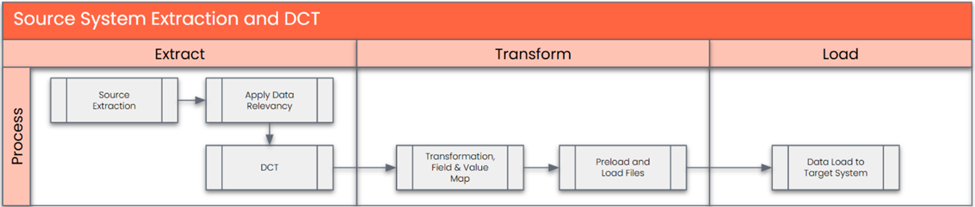
The high-level process is represented by the diagram below:
Data Privacy and Sensitivity
Extraction
Extract data from a source into . There are 2 possibilities:
- The data exists. connects to the source and loads the data into . There are 3 methods:
- Perform full data extraction from relevant tables in the source system(s).
- Perform extraction through the application layer.
- Only if ; cannot connect to the source, data is loaded to the repository from the provided source system extract/report.
- The data does not exist (or cannot be converted from its current state). The data is manually collected by the business directly in . This is to be conducted using DCT (Data Collection Template) in
The agreed Relevancy criteria is applied to the extracted records to identify the records that are applicable for the Target loads
Extraction Run Sheet
| Req # | Requirement Description | Team Responsible |
|---|---|---|
| 1) | Screen Records against MARA -ERSA to get the materials created in the last 3 years | Synity |
| 2) | Screen Records against Maintenance Status MARA -PSTAT like '%L%' & MARC like=%L% | Synity |
| 3) | Screen Records against plant specific Deletion Flag in MARC-LVORM ='NO' | Synity |
Selection Screen
| Selection Ref Screen | Parameter Name | Selection Type | Requirement | Value to be entered/set |
|---|---|---|---|---|
| N/A | ||||
Data Collection Template (DCT)
Target Ready Data Collection Template will be created for data with exception of some fields which require transformation as mentioned in the transformation rule.DCT Rules
| Field Name | Field Description | Tooltip |
|---|---|---|
| MATNR | Material Number | New Material Number for Service Materials |
| WERKS | Plant | Plant to which to extend the Material |
| LGORT | Storage Location | Storage Location of the Material for the Plant |
| AUSME | Unit of issue | Unit in which the material is issued from the warehouse, if different from the base unit of measure. e.g. Set to LB for plant, when base UOM is KG |
| LGPBE | Storage Bin | Identifies the storage bin within a storage location where the material is stored. Can be used for IM storage locations. |
| LWMKB | Picking Area | Groups together storage bins from the standpoint of picking strategies; that is, the storage bins are arranged in a strategically advantageous manner for the task of picking. |
| TEMPB | Temp. Conditions | Indicates the temperature conditions in which the material should be stored. |
| RAUBE | Storage conditions | Indicates what storage conditions are required for the material. Storage conditions plus shipping point and Plant are used to determine storage location for picking during delivery processing |
| BEHVO | Container reqmts | Key for the regulation that governs which type of container the material must be stored and shipped in. |
| STOFF | Haz.material number | Number that identifies the material as a hazardous material or as dangerous goods and assigns hazardous material data or dangerous goods data to it. The hazardous material number indicates that the material is dangerous, making special precautions necessary for its storage and shipment. |
| ABCIN | CC phys. inv. ind. | This indicator groups the materials together into various cycle counting categories. These categories correspond to the ABC analysis of the materials. |
| CCFIX | CC fixed | Specifies that the cycle counting indicator cannot be changed for cycle counting by an ABC analysis. |
| WESCH | Number of GR slips | Number of GR/GI slips to be printed - Specifies which quantity of the material, in the unit of entry, usually constitutes a pallet load. In the case of a goods receipt with reference to a purchase order or production order, the system automatically calculates the number of GR/GI slips to be printed for the material document item as a quotient from the goods receipt quantity and the quantity defined here. The value determined is always rounded up to the next higher whole number. If there is no value maintained in this field, the material document item is only printed on one goods receipt/issue slip. |
| ETIAR | Label type | Determines the way labels are created. The label type specifies, for example, whether labels are pre-printed by the supplier or created on a central printer. this key is used to print material document information on labels. The label type and form are used to determine • which labels are printed for which goods movement • how many labels are printed • which printer they are printed on |
| ETIFO | Lab.form | Determines the size and layout of the label. The label form specifies, for example, whether the label is an adhesive or a pin-on label. |
| XGCHP | Appr.batch rec. req. | This indicator is used to specify that the following activities may only be performed after the relevant batch record has been approved: • Making the usage decision for an inspection lot of the origin Goods receipt from production • Changing the batch status from Restricted to Unrestricted This indicator is only taken into account for batches that have been manufactured using a process order. This is only relevant for direct materials which are manufactured. |
| XCHPF | Batch Management | Specifies whether the material is managed in batches. When set, this applies to all plants, unless a plant is excluded using the Batch Management (Plant) field. Batch Management is activated for materials that require batch traceability, recording of batch characteristics, batch determination for picking and expiry date management. |
| XCHPF | Batch Management (Plant) | Specifies whether the material is managed in batches at the plant. Switched on if material is batch managed at client level unless plant specifically does not use batches. |
| MAXLZ | Max. Storage Period | The longest amount of time allowed for storing the material. The value displayed here is for informational purposes only. |
| LZEIH | Time Unit | Unit in which the maximum storage period of the material is measured. |
| MHDRZ | Min. Rem. Shelf Life | Minimum amount of time for which the material must keep upon goods receipt for the goods receipt to be accepted by the system. |
| MHDHB | Total shelf life | Period for which the material can be stored in total, that is, from the date of production to the shelf life expiration date. |
| IPRKZ | Period Ind. for SLED | The period indicator specifies the unit of measurement for a period of time. Required if SLED is being maintained. |
| RDMHD | Rounding rule SLED | In the material master, if the period indicator is based on weeks, months or years has been selected for the total shelf life, it is then possible to round the shelf life expiration date (SLED), that has been calculated from the production date and total shelf life, to the first or last day of the period chosen. |
| MHDLP | Storage percentage | Percentage specifying how much of the minimum remaining shelf life must be left if the material is to be sent to another plant (such as a store) from a central plant (such as a distribution centre). |
| SLED_BBD | Expiration Date | Sets the date type to Expiration Date or Shelf Life Expiration Date |
| SCM_MATURITY_DUR | Maturation Time | The period required by a product after production before it can be used for further production or by a customer. |
| SCM_SHLF_LFE_REQ_MAX | Required Maximum Shelf Life | Standard value for required maximum shelf life |
| SGT_COVS | Segmentation Strategy | A strategy that is a collection of business rules that define which stock materials should satisfy which demand objects. |
| SGT_DEFSC | Logistics handling group for workload calculation | Segment value, which is (from the material valuation point of view) representative for all segment value combinations |
| XMCNG | Negative stocks allowed in plant | Indicates that negative stocks of the material are allowed at the plant. |
| LOGGR | Logistics handling group for workload calculation | Grouping of materials that are comparable with regard to their handling. |
| SERNP | Serial Number Profile | Freely definable four-digit key that provides unique identification for a serial number profile. Used for some MRO materials. It is mandatory to enter the serial number profile in the material master record for materials that need serial numbers. This is not applicable for direct materials which are traditional raw material components. |
| SERLV | Level of Explicitness for Serial Number | Level on which the serial number must be unique. This is not applicable for direct materials which are traditional raw material components. |
| FPRFM | Distribution profile of material in plant | Control profile for Merchandise Distribution. |
| PRCTR | Profit Center | Key which together with the controlling area uniquely identifies a profit centre. |
| EPRIO | Stock determination group | The stock determination group combined with the stock determination rule at plant level creates a key for the stock determination strategy |
| IUID_RELEVANT | IUID-Relevant | Indicates that a unique item identifier (UII) must be created for the material. |
| UID_IEA | External Allocation of UII | Indicates that the unique item identifier (UII) was externally created. |
| IUID_TYPE | Structure Type of UII | Defines the IUID type. The IUID type determines the construct of a UII. |
Extraction Dependencies
| Item # | Step Description | Team Responsible |
|---|---|---|
| 1) | Collect needs to happen for Both MARA &MARC tables before ST* can be populated. | Synity |
| 2) | Connection needs to be setup with the correct authorisation for extract | Synity |
| 3) | Possible Scheduling of snapshot as MARC tables are generally big and may take some time | Synity |
| 4) | Plant/ Storage location design/consolidation needs to be finalised | Business/Functionals |
| 5) | Data is populated in the DCT or uploaded from downloaded Excel template | Business/Data Owners |
Transformation
The Target fields are mapped to the applicable Legacy field that will be its source, this is a 3-way activity involving the Business, Functional team and Data team. This identifies the transformation activity required to allow to make the data Target ready:
- Perform value mapping and data transformation rules.
- Legacy values are mapped to the to-be values (this could include a default value)
- Values are transformed according to the rules defined in
- Prepare target-ready data in the structure and format that is required for loading via prescribed Load Tool. This step also produces the load data ready for business to perform Pre-load Data Validation
Transformation Run Sheet
| Item # | Step Description | Team Responsible |
|---|---|---|
| 1 | Execute Collect to ensure PREP /Snapshot is up to date. | Synity / SyWay S2P Data Team |
| 2 | Execute Transform | Synity / SyWay S2P Data Team |
| 3 | Review & validate any Error Reports (Config etc) | Synity / SyWay S2P Data Team |
| 4 | Generate & validate Preload Report (Ensure proper Business names as per Data Dictionary) | Synity / SyWay S2P Data Team |
| 5 | Generate Load files | Synity / SyWay S2P Data Team |
Transformation Rules
| Rule # | Source system | Source Table | Source Field | Source Description | Target System | Target Table | Target Field | Target Description | Transformation Logic |
| 1 | PF2/WG2 | MARD | MATNR | Material Number | S4/ Hana | MARD | MATNR | Material Number | Follow the rule as per Material Master Basic Views about creation for new Material. |
| 2 | PF2/WG2 | MARD | WERKS | Plant | S4/ Hana | MARD | WERKS | Plant | Copy from Plant consolidation xref |
| 3 | PF2/WG2 | MARD | LGORT | Storage Location | S4/ Hana | MARD | LGORT | Storage Location | Copy from Storage location xref |
| 4 | PF2/WG2 | MARC | AUSME | Unit of issue | S4/ Hana | MARC | AUSME | Unit of issue | Copy from Source to target system |
| 5 | PF2/WG2 | MARD | LGPBE | Storage Bin | S4/ Hana | MARD | LGPBE | Storage Bin | Copy from Source to target system |
| 6 | PF2/WG2 | MARD | LWMKB | Picking Area | S4/ Hana | MARD | LWMKB | Picking Area | Copy from Source to target system |
| 7 | PF2/WG2 | MARA | TEMPB | Temp. Conditions | S4/ Hana | MARA | TEMPB | Temp. Conditions | Copy from Source to target system |
| 8 | PF2/WG2 | MARA | RAUBE | Storage conditions | S4/ Hana | MARA | RAUBE | Storage conditions | Copy from Source to target system |
| 9 | PF2/WG2 | MARA | BEHVO | Container reqmts | S4/ Hana | MARA | BEHVO | Container reqmts | Copy from Source to target system |
| 10 | PF2/WG2 | MARA | STOFF | Haz.material number | S4/ Hana | MARA | STOFF | Haz.material number | Copy from Source to target system |
| 11 | PF2/WG2 | MARC | ABCIN | CC phys. inv. ind. | S4/ Hana | MARC | ABCIN | CC phys. inv. ind. | Copy from Source to target system |
| 12 | PF2/WG2 | MARC | CCFIX | CC fixed | S4/ Hana | MARC | CCFIX | CC fixed | Copy from Source to target system |
| 13 | PF2/WG2 | MARA | WESCH | Number of GR slips | S4/ Hana | MARA | WESCH | Number of GR slips | Copy from Source to target system |
| 14 | PF2/WG2 | MARA | ETIAR | Label type | S4/ Hana | MARA | ETIAR | Label type | Copy from Source to target system |
| 15 | PF2/WG2 | MARA | ETIFO | Lab.form | S4/ Hana | MARA | ETIFO | Lab.form | Copy from Source to target system |
| 16 | PF2/WG2 | MARA | XGCHP | Appr.batch rec. req. | S4/ Hana | MARA | XGCHP | Appr.batch rec. req. | Copy from Source to target system |
| 17 | PF2/WG2 | MARA | XCHPF | Batch Management | S4/ Hana | MARA | XCHPF | Batch Management | Copy from Source to target system |
| 18 | PF2/WG2 | MARC | XCHPF | Batch Management (Plant) | S4/ Hana | MARC | XCHPF | Batch Management (Plant) | Copy from Source to target system |
| 19 | PF2/WG2 | MARC | MAXLZ | Max. Storage Period | S4/ Hana | MARC | MAXLZ | Max. Storage Period | Copy from Source to target system |
| 20 | PF2/WG2 | MARC | LZEIH | Time Unit | S4/ Hana | MARC | LZEIH | Time Unit | Copy from Source to target system |
| 21 | PF2/WG2 | MARA | MHDRZ | Min. Rem. Shelf Life | S4/ Hana | MARA | MHDRZ | Min. Rem. Shelf Life | Copy from Source to target system |
| 22 | PF2/WG2 | MARA | MHDHB | Total shelf life | S4/ Hana | MARA | MHDHB | Total shelf life | Copy from Source to target system |
| 23 | PF2/WG2 | MARA | IPRKZ | Period Ind. for SLED | S4/ Hana | MARA | IPRKZ | Period Ind. for SLED | Copy from Source to target system |
| 24 | PF2/WG2 | MARA | RDMHD | Rounding rule SLED | S4/ Hana | MARA | RDMHD | Rounding rule SLED | Copy from Source to target system |
| 25 | PF2/WG2 | MARA | MHDLP | Storage percentage | S4/ Hana | MARA | MHDLP | Storage percentage | Copy from Source to target system |
| 26 | PF2/WG2 | MARA | SLED_BBD | Expiration Date | S4/ Hana | MARA | SLED_BBD | Expiration Date | Copy from Source to target system |
| 27 | PF2/WG2 | MARA | SCM_MATURITY_DUR | Maturation Time | S4/ Hana | MARA | SCM_MATURITY_DUR | Maturation Time | Copy from Source to target system |
| 28 | PF2/WG2 | MARA | SCM_SHLF_LFE_REQ_MAX | Required Maximum Shelf Life | S4/ Hana | MARA | SCM_SHLF_LFE_REQ_MAX | Required Maximum Shelf Life | Copy from Source to target system |
| 29 | PF2/WG2 | MARC | SGT_COVS | Segmentation Strategy | S4/ Hana | MARC | SGT_COVS | Segmentation Strategy | Copy from Source to target system |
| 30 | PF2/WG2 | MARC | SGT_DEFSC | Logistics handling group for workload calculation | S4/ Hana | MARC | SGT_DEFSC | Logistics handling group for workload calculation | Copy from Source to target system |
| 31 | PF2/WG2 | MARC | XMCNG | Negative stocks allowed in plant | S4/ Hana | MARC | XMCNG | Negative stocks allowed in plant | Copy from Source to target system |
| 32 | PF2/WG2 | MARC | LOGGR | Logistics handling group for workload calculation | S4/ Hana | MARC | LOGGR | Logistics handling group for workload calculation | Copy from Source to target system |
| 33 | PF2/WG2 | MARC | SERNP | Serial Number Profile | S4/ Hana | MARC | SERNP | Serial Number Profile | RULE: Serial Profile is mandatory and defaulted to "EAM1" if, For others Copy. |
| 34 | PF2/WG2 | MARA | SERLV | Level of Explicitness for Serial Number | S4/ Hana | MARA | SERLV | Level of Explicitness for Serial Number | Copy from Source to target system |
| 35 | PF2/WG2 | MARC | FPRFM | Distribution profile of material in plant | S4/ Hana | MARC | FPRFM | Distribution profile of material in plant | Copy from Source to target system |
| 36 | PF2/WG2 | MARC | PRCTR | Profit Center | S4/ Hana | MARC | PRCTR | Profit Center | Copy from Source to target system |
| 37 | PF2/WG2 | MARC | EPRIO | Stock determination group | S4/ Hana | MARC | EPRIO | Stock determination group | Copy from Source to target system |
| 38 | PF2/WG2 | MARC | IUID_RELEVANT | IUID-Relevant | S4/ Hana | MARC | IUID_RELEVANT | IUID-Relevant | Copy from Source to target system |
| 39 | PF2/WG2 | MARC | UID_IEA | External Allocation of UII | S4/ Hana | MARC | UID_IEA | External Allocation of UII | Copy from Source to target system |
| 40 | PF2/WG2 | MARC | IUID_TYPE | Structure Type of UII | S4/ Hana | MARC | IUID_TYPE | Structure Type of UII | Copy from Source to target system |
Transformation Rules for DCT
| Rule # | Source system | Source Table | Source Field | Source Description | Target System | Target Table | Target Field | Target Description | Transformation Logic |
| 1 | DCT | MARD | MATNR | Material Number | S4/ Hana | MARD | MATNR | Material Number | Copy from DCT Direct Mapping |
| 2 | DCT | MARD | WERKS | Plant | S4/ Hana | MARD | WERKS | Plant | Copy from DCT Direct Mapping |
| 3 | DCT | MARD | LGORT | Storage Location | S4/ Hana | MARD | LGORT | Storage Location | Copy from DCT Direct Mapping |
| 4 | DCT | MARC | AUSME | Unit of issue | S4/ Hana | MARC | AUSME | Unit of issue | Copy from DCT Direct Mapping |
| 5 | DCT | MARD | LGPBE | Storage Bin | S4/ Hana | MARD | LGPBE | Storage Bin | Copy from DCT Direct Mapping |
| 6 | DCT | MARD | LWMKB | Picking Area | S4/ Hana | MARD | LWMKB | Picking Area | Copy from DCT Direct Mapping |
| 7 | DCT | MARA | TEMPB | Temp. Conditions | S4/ Hana | MARA | TEMPB | Temp. Conditions | Copy from DCT Direct Mapping |
| 8 | DCT | MARA | RAUBE | Storage conditions | S4/ Hana | MARA | RAUBE | Storage conditions | Copy from DCT Direct Mapping |
| 9 | DCT | MARA | BEHVO | Container reqmts | S4/ Hana | MARA | BEHVO | Container reqmts | Copy from DCT Direct Mapping |
| 10 | DCT | MARA | STOFF | Haz.material number | S4/ Hana | MARA | STOFF | Haz.material number | Copy from DCT Direct Mapping |
| 11 | DCT | MARC | ABCIN | CC phys. inv. ind. | S4/ Hana | MARC | ABCIN | CC phys. inv. ind. | Copy from DCT Direct Mapping |
| 12 | DCT | MARC | CCFIX | CC fixed | S4/ Hana | MARC | CCFIX | CC fixed | Copy from DCT Direct Mapping |
| 13 | DCT | MARA | WESCH | Number of GR slips | S4/ Hana | MARA | WESCH | Number of GR slips | Copy from DCT Direct Mapping |
| 14 | DCT | MARA | ETIAR | Label type | S4/ Hana | MARA | ETIAR | Label type | Copy from DCT Direct Mapping |
| 15 | DCT | MARA | ETIFO | Lab.form | S4/ Hana | MARA | ETIFO | Lab.form | Copy from DCT Direct Mapping |
| 16 | DCT | MARA | XGCHP | Appr.batch rec. req. | S4/ Hana | MARA | XGCHP | Appr.batch rec. req. | Copy from DCT Direct Mapping |
| 17 | DCT | MARA | XCHPF | Batch Management | S4/ Hana | MARA | XCHPF | Batch Management | Copy from DCT Direct Mapping |
| 18 | DCT | MARC | XCHPF | Batch Management (Plant) | S4/ Hana | MARC | XCHPF | Batch Management (Plant) | Copy from DCT Direct Mapping |
| 19 | DCT | MARC | MAXLZ | Max. Storage Period | S4/ Hana | MARC | MAXLZ | Max. Storage Period | Copy from DCT Direct Mapping |
| 20 | DCT | MARC | LZEIH | Time Unit | S4/ Hana | MARC | LZEIH | Time Unit | Copy from DCT Direct Mapping |
| 21 | DCT | MARA | MHDRZ | Min. Rem. Shelf Life | S4/ Hana | MARA | MHDRZ | Min. Rem. Shelf Life | Copy from DCT Direct Mapping |
| 22 | DCT | MARA | MHDHB | Total shelf life | S4/ Hana | MARA | MHDHB | Total shelf life | Copy from DCT Direct Mapping |
| 23 | DCT | MARA | IPRKZ | Period Ind. for SLED | S4/ Hana | MARA | IPRKZ | Period Ind. for SLED | Copy from DCT Direct Mapping |
| 24 | DCT | MARA | RDMHD | Rounding rule SLED | S4/ Hana | MARA | RDMHD | Rounding rule SLED | Copy from DCT Direct Mapping |
| 25 | DCT | MARA | MHDLP | Storage percentage | S4/ Hana | MARA | MHDLP | Storage percentage | Copy from DCT Direct Mapping |
| 26 | DCT | MARA | SLED_BBD | Expiration Date | S4/ Hana | MARA | SLED_BBD | Expiration Date | Copy from DCT Direct Mapping |
| 27 | DCT | MARA | SCM_MATURITY_DUR | Maturation Time | S4/ Hana | MARA | SCM_MATURITY_DUR | Maturation Time | Copy from DCT Direct Mapping |
| 28 | DCT | MARA | SCM_SHLF_LFE_REQ_MAX | Required Maximum Shelf Life | S4/ Hana | MARA | SCM_SHLF_LFE_REQ_MAX | Required Maximum Shelf Life | Copy from DCT Direct Mapping |
| 29 | DCT | MARC | SGT_COVS | Segmentation Strategy | S4/ Hana | MARC | SGT_COVS | Segmentation Strategy | Copy from DCT Direct Mapping |
| 30 | DCT | MARC | SGT_DEFSC | Logistics handling group for workload calculation | S4/ Hana | MARC | SGT_DEFSC | Logistics handling group for workload calculation | Copy from DCT Direct Mapping |
| 31 | DCT | MARC | XMCNG | Negative stocks allowed in plant | S4/ Hana | MARC | XMCNG | Negative stocks allowed in plant | Copy from DCT Direct Mapping |
| 32 | DCT | MARC | LOGGR | Logistics handling group for workload calculation | S4/ Hana | MARC | LOGGR | Logistics handling group for workload calculation | Copy from DCT Direct Mapping |
| 33 | DCT | MARC | SERNP | Serial Number Profile | S4/ Hana | MARC | SERNP | Serial Number Profile | Copy from DCT Direct Mapping |
| 34 | DCT | MARA | SERLV | Level of Explicitness for Serial Number | S4/ Hana | MARA | SERLV | Level of Explicitness for Serial Number | Copy from DCT Direct Mapping |
| 35 | DCT | MARC | FPRFM | Distribution profile of material in plant | S4/ Hana | MARC | FPRFM | Distribution profile of material in plant | Copy from DCT Direct Mapping |
| 36 | DCT | MARC | PRCTR | Profit Center | S4/ Hana | MARC | PRCTR | Profit Center | Copy from DCT Direct Mapping |
| 37 | DCT | MARC | EPRIO | Stock determination group | S4/ Hana | MARC | EPRIO | Stock determination group | Copy from DCT Direct Mapping |
| 38 | DCT | MARC | IUID_RELEVANT | IUID-Relevant | S4/ Hana | MARC | IUID_RELEVANT | IUID-Relevant | Copy from DCT Direct Mapping |
| 39 | DCT | MARC | UID_IEA | External Allocation of UII | S4/ Hana | MARC | UID_IEA | External Allocation of UII | Copy from DCT Direct Mapping |
| 40 | DCT | MARC | IUID_TYPE | Structure Type of UII | S4/ Hana | MARC | IUID_TYPE | Structure Type of UII | Copy from DCT Direct Mapping |
Transformation Mapping
| Mapping Table Name | Mapping Table Description |
|---|---|
| Plants | Mapping of Legacy Plants to Target System value (Value Mapping) |
| Storage Location | Mapping of Legacy Storage location to Target System value (Value Mapping) |
| Profit Center | Mapping of Legacy Profit center to Target System value (Value Mapping) |
Transformation Dependencies
List the steps that need to occur before transformation can commence| Item # | Step Description | Team Responsible |
|---|---|---|
| Transformation Rules to be determined | ||
| 1) | In General MARC records should be screened against MARA Target Table to ensure only Records that pass Validation in Header filters down to Plant view. | Synity |
| 2) | Check Tables for fields are up to date & complete | Synity |
| 3) | Value Mappings are according to latest design (Profit Center, Plant etc) | Synity |
| 4) | Ensure DCT is complete | Synity |
Pre-Load Validation
Project Team
Completeness
| Task | Action |
|---|---|
| Verify Record Counts | Row counts in PREP (Relevancy) should tie back to Count in Target Table |
| Verify DCT & Load File Count | SCM Data Team to verify that the total number of relevant records from the DCT is equal to the total number of records in the Preload and Load Sheets. Utility columns should indicate source |
Accuracy
| Task | Action |
|---|---|
| Conversion Accuracy | SyWay P2F Data Team to verify that all fields pass the following checks:
|
| Review Error Reports | Fields that fail checks due to Target Readiness etc. should be highlighted in error reports. These reports need to be flagged & decision can be made to Remediate values in initial Mock cycles but no remediation should be applied when doing final dress rehearsal. |
Verify Consent | Verify the appropriate consents for the records have been obtained by the business/Data Owners and properly recorded |
Business
Completeness
| Task | Action |
|---|---|
| Verify Record Counts | Business Data Owner/s to verify that the total number of relevant records from the the Relevancy Reports is equal to the total number of records in the Preload and Load Sheets. |
Verify Consent | Verify the appropriate consents for the records have been obtained by the business/Data Owners and properly recorded |
Accuracy
| Task | Action |
|---|---|
| Conversion Accuracy | Business Data Owner/s to verify that all the data in the load table/file is accurate as per endorsed transformation/mapping rules (and signed-off DCT data). |
| Review Error Reports | Review and correct the errors. Achieve a zero-error record count as much as possible. Raise defects for data remediated and requiring a correction in the source data. |
Load
The load process includes:
- Execute the automated data load into target system using load tool or product the load file if the load must be done manually
- Once the data is loaded to the target system, it will be extracted and prepared for Post Load Data Validation
Load Run Sheet
| Item # | Step Description | Team Responsible |
|---|---|---|
| 1. | Go to Load tool (Migrate your Data) | |
| 2. | Run Simulation & validate if any Errors are encountered | |
| 3. | If No errors encountered proceed with Prepare & simulate | |
| 4. | Once Approval has been given proceed with Migration | |
| 5. | Any Migration Errors need to be highlighted & and depending on volume & criticality of Mock cycle either be fixed & reloaded or Marked for correcting in subsequent Mocks | |
| 6. | Generate all Post-load Reports with summary information with counts that clearly show :
| |
| 7. | Check a sample of a few materials in S/4 HANA | |
| 8. | Garner validations/signoffs. |
Load Phase and Dependencies
Configuration
| Item # | Configuration Item |
|---|---|
| 1 | Check Tables configured in Target System. (Profit Centres/Controlling area's etc) |
Conversion Objects
| Object # | Preceding Object Conversion Approach |
|---|---|
| CNV-2019 Materials - Basic Data View | Basic Data to be completed as immediate predecessor |
| CNV-1073 Profit Centre | Profit Centre Completed |
Error Handling
| Error Type | Error Description | Action Taken |
|---|---|---|
| Missing Config | Controlling area/Profit Center /Storage Location etc not available area not available | |
Post-Load Validation
Project Team
Completeness
| Task | Action |
|---|---|
| Verify Count | SyWay P2FData Team to verify the record count created in target S/4 HANA by accessing post load reports in dspMigrate or standard reports from S/4 HANA |
Accuracy
| Task | Action |
|---|---|
| Verify Logs | Check if there is data that failed to load and perform the necessary actions (e.g. register as post load issue or attempt to load the record again, etc.). |
Business
Completeness
| Task | Action |
|---|---|
| Verify Count | Download Post Load Reports from dspMigrate and verify that the record count loaded in the target S/4 HANA is the same count as of the endorsed load file. |
Accuracy
| Task | Action |
|---|---|
| Conversion Accuracy | Verify that the Material data in target S/4 HANA were loaded correctly via dspMigrate post load reports or standard reports from S/4 HANA. |
Key Assumptions
- Master Data Standard is up to date as on the date of documenting this conversion approach and data load.
- Materials - Basic Data is in scope based on data design and any exception requested by business.
See also
Change log
| Change History | ||
|---|---|---|
|