

| Status |
| |
|---|---|---|
| Owner | ||
| Stakeholders |
Purpose
The purpose of this document is to define the conversion approach to create Attachment for open sales transaction in S/4 HANA.
Attachments in ECC are typically stored using Generic Object Services (GOS), which allow users to link files to sales documents (via transaction codes like VA02 or VA22). The attachments are managed via the Business Object Repository (BOR) object. Below are the object names with their document types.
BUS2031 - Customer Quotation *20260218 Remove as this is moved to R3
BUS2032 - Sales Order BUS2034 - Sales Contract *20260218 Remove as this is moved to R3BUS2035 - Sales Scheduling Agreement *20260108 Update this is descoped
BUS2094 - Credit memo request
BUS2096 - Debit memo request
Attachments in SAP S/4HANA are linked using the Attachment List Service (also used in Fiori apps). This conversion specification will capture the details on how to migrate the attachments for open sales documents in migration scope into S4 Hana to keep the business continuity.
Conversion Scope
The scope of this document covers the approach for converting Attachments for Open sales transaction from Legacy Source Systems (WP2/PF2) into S/4HANA.
The data from legacy system includes. *20260108 Update , to summarize, if the sales document in CNV-9062/9063/9065 is migrated, and there is attachment inside, the attachment will be migrated into S4 Hana together.
a. The open sales document is in migration scope and there is attachment uploaded by user manually in legacy system for the open sales documents. The potential object types will include below scenarios.
BUS2031 - Customer Quotation
BUS2032 - Sales Order (normal order and free of charge sales order)
BUS2034 - Sales Contract BUS2035 - Sales Scheduling Agreement *20260108 Update this is descoped
BUS2094 - Credit memo request
BUS2096 - Debit memo request
Above object types are equivalent to below sales document categories known by business. *added on 03/Nov/2025
"C" Standard order
"I" Order without charge
"K" Credit memo request
"L" Debit memo request
"H" Return order
"B" Quotation
"G" Contract
b. for the object type, it will include ATTA/URL (attachment and URL) as displayed in below screen.
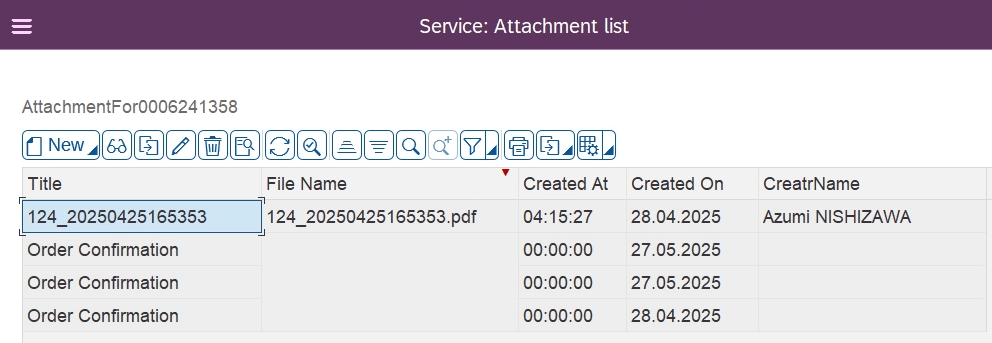
| Relevancy Criteria | Technical Information |
|---|---|
a. The open sales document is in migration scope and there is attachment uploaded by user manually in legacy system for the open sales documents. The potential object types will include below scenarios. BUS2031 - Customer Quotation b. for the object type, it will include ATTA/URL (attachment and URL) as displayed in below screen. | SRGBTBREL-INSTID_A is in (open sales documents) and SRGBTBREL-TYPEID_A in (BUS2031/BUS2032 /BUS2034/ |
The data from legacy system excludes:
- Attachment for sales documents in Completed status as the documents are not in migration scope.
- Attachment maintained outside of SAP ECC (WP2/PF2).
- Attachment generated by SAP output, such as the order confirmation.
| Source | Scope | Source Approx No. of Records | Target System | Target Approx No. of Records |
|---|---|---|---|---|
| WP2 | Attachment for open sales transaction | S4 Hana ROW | ||
| PF2 | Attachment for open sales transaction | S4 Hana ROW | ||
| WP2 | Attachment for open sales transaction | S4 Hana China | ||
| PF2 | Attachment for open sales transaction | S4 Hana China | ||
| WP2 | Attachment for open sales transaction | S4 Hana CUI | ||
| PF2 | Attachment for open sales transaction | S4 Hana CUI |
Additional Information
Multi-language Requirement
N/A
Document Management
The DMS approach is elaborated in KDD "KDD085 - Document Management in the SyWay Solution".
Legal Requirement
CMMC 2.0 is a mandatory DoD cybersecurity certification for contractors handling Controlled Unclassified Information (CUI) and Federal Contract Information (FCI). CUI includes sensitive technical data (e.g., design specs, system info) related to U.S. military and space applications. The Composites Business handles CUI and is therefore within CMMC scope. Without certification, the business risks disqualification from existing and future DoD programs.
It is mandatory to implement CMMC-compliant systems and processes to for all the organizations that are dealing with CUI.
Therefore, there will be one SAP instance specifically for CUI related entities.
Special Requirements
Different SAP Instance Migration Approach
Due to compliance requirement, there will be one SAP instance for Rest of the World (ROW), one for China and one for CUI. The open sales documents will be migrated into respective SAP instances. Therefore the attachments will be migrated into respective SAP instance following the open sales documents migration decision. When uploading the data into the 3 SAP instances, there should be separate file for each instances.
Target Design
The technical design of the target for this conversion approach.
| Table | Field | Data Element | Field Description | Data Type | Length | Requirement |
|---|---|---|---|---|---|---|
| SRGBTBREL | CLIENT | CLIENT | Client | C | 3 | Internal |
| SRGBTBREL | BRELGUID | BRELGUID | GUID | X | 16 | Internal |
| SRGBTBREL | RELTYPE | RELTYPE | Relationship type | C | 10 | Mandatory |
| SRGBTBREL | INSTID_A | INSTID_A | Instance ID | C | 70 | Mandatory |
| SRGBTBREL | TYPEID_A | TYPEID_A | Object Type | C | 32 | Mandatory |
| SRGBTBREL | CATID_A | CATID_A | Object Category | C | 2 | Mandatory |
| SRGBTBREL | INSTID_B | INSTID_B | Instance ID | C | 70 | Internal |
| SRGBTBREL | TYPEID_B | TYPEID_B | Object Type | C | 32 | Internal |
| SRGBTBREL | CATID_B | CATID_B | Object Category | C | 2 | Internal |
| SRGBTBREL | LOGSYS_A | LOGSYS_A | Logical System | C | 10 | Not in use |
| SRGBTBREL | ARCH_A | ARCH_A | Object Archived | C | 1 | Not in use |
| SRGBTBREL | LOGSYS_B | LOGSYS_B | Logical System | C | 10 | Not in use |
| SRGBTBREL | ARCH_B | ARCH_B | Object Archived | C | 1 | Not in use |
| SRGBTBREL | UTCTIME | UTCTIME | Short Time Stamp | P | 8 | Internal |
| SRGBTBREL | HOMESYS | HOMESYS | Logical System | C | 10 | Not in use |
| SOOD | OBJTP | OBJTP | Document class | C | 3 | Internal |
| SOOD | OBJYR | OBJYR | Object year | C | 2 | Internal |
| SOOD | OBJNO | OBJNO | Object number | C | 12 | Internal |
| SOOD | OBJLA | OBJLA | Doc. language | C | 1 | Internal |
| SOOD | OBJSRT | OBJSRT | Sort field | C | 10 | Not in use |
| SOOD | OBJNAM | OBJNAM | Document Name | C | 12 | Internal |
| SOOD | OBJDES | OBJDES | Document title | C | 50 | Mandatory |
| SOOD | OWNTP | OWNTP | Owner type | C | 3 | Internal |
| SOOD | OWNYR | OWNYR | Owner year | C | 2 | Internal |
| SOOD | OWNNO | OWNNO | Owner number | C | 12 | Internal |
| SOOD | OWNNAM | OWNNAM | Owner name | C | 12 | Internal |
| SOOD | CROTP | CROTP | User Type | C | 3 | Internal |
| SOOD | CROYR | CROYR | User year | C | 2 | Internal |
| SOOD | CRONO | CRONO | User number | C | 12 | Internal |
| SOOD | CRONAM | CRONAM | Created by | C | 12 | Internal |
| SOOD | CRDAT | CRDAT | Date created | D | 8 | Internal |
| SOOD | CRTIM | CRTIM | Created at | T | 6 | Internal |
| SOOD | FILE_EXT | FILE_EXT | File extension | C | 3 | Mandatory |
Data Cleansing
| ID | Criticality | Error Message/Report Description | Rule | Output | Source System |
|---|---|---|---|---|---|
| N/A | |||||
Conversion Process
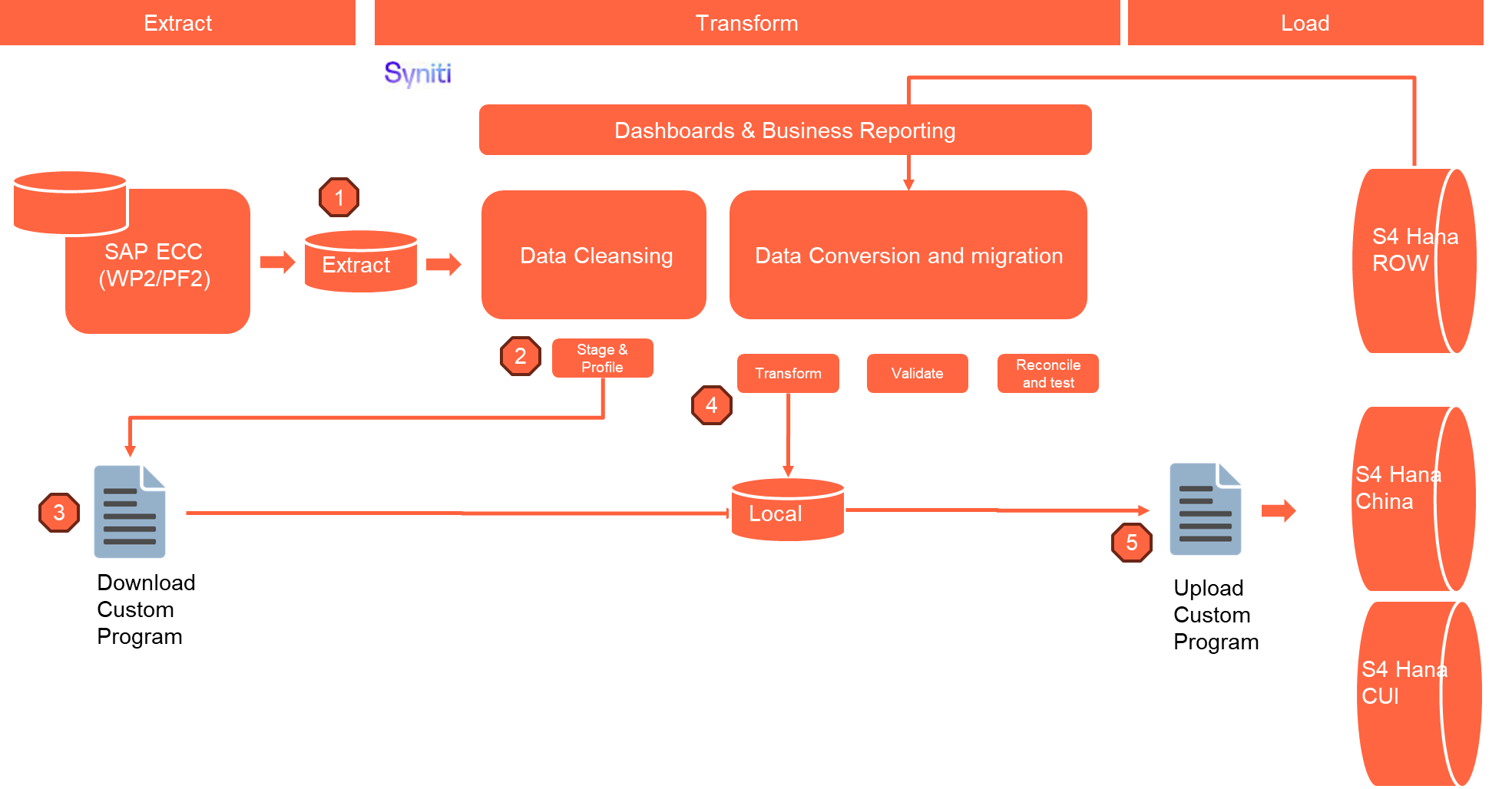
The high-level process is represented by the diagram below:
The ETL (Extract, Transform, Load) process is a structured approach to data migration and management, ensuring high-quality data is seamlessly transferred across systems. Here’s a breakdown of its key components:
1. Extraction
The process begins with extracting metadata and raw data from source systems, such as Syensqo ECC system (i.e., WP2/PF2) periodically. The extracted data is then staged for transformation.
2. Transformation
Once extracted, the data undergoes cleansing, consolidation, and governance. This step ensures data integrity, consistency, and compliance with business rules. The transformation process includes:
- Data validation to remove inconsistencies.
- Standardization to align formats across datasets.
- Business rule application to refine data for operational use.
3. Loading
The transformed data is then loaded into the target S4 Hana system. For attachment, it will be migrated via a custom program. The table below captures the major steps to perform this ETL process.
| 1 | Extract the table SRGBTBREL / SOOD for attachment information (such as attachment type, file name etc.) | Syniti | The Attachment is saved in the content server, this is just to capture the link between the attachment and ECC open sales documents. |
| 2 | Apply the relevancy rule and define the scope of attachment to be migrated | Syniti | The output will be an excel file includes the ECC attachment information relevant for migration |
| 3 | Based on Step 2, download the attachment to local | A custom program will be developed in ECC (WP2/PF2). By reading the excel file in step 2, it will download the attachments to local | |
| 4 | Perform transformation, i.e., convert the ECC sales document number to S4 sales document number | Syniti | The output will be an excel file includes the S4 data object and the attachment information (i.e., file name from step 2) |
| 5 | Based on Step 4, upload the attachment in S4 | A custom program will be developed in S4. By reading the excel file in step 4, it will upload the attachment from local (saved from Step 3) |
Data Privacy and Sensitivity
N/AExtraction
Extract data from SAP PF2/WP2 into Syniti Migrate for SAP ROW, SAP China, SAP CUI relevant entities.
Syniti Migrate connects to the source and loads the data into Syniti Migrate. There are 3 methods:
a. Perform full data extraction from relevant tables in the source system(s).
b. Perform extraction through the application layer.
c. Only if Syniti Migrate cannot connect to the source, data is loaded to the repository from the provided source system extract/report.
The agreed Relevancy criteria is applied to the extracted records to identify the records that are applicable for the Target loads.
Extraction Run Sheet
| Req # | Requirement Description | Team Responsible |
|---|---|---|
| 9067-001 | - Identify the source systems and databases involved. - Define the data objects (tables, fields, records) to be extracted. - Establish business rules for data selection. | Syniti Syniti / L2C Data team |
| 9067-002 | - Specify the extraction approach (full, incremental, or delta extraction). - Determine the tools and technologies used. - Define data filtering criteria to exclude irrelevant records. | Syniti |
| 9067-003 | - Establish execution timelines and batch processing schedules. - Assign responsibilities for extraction monitoring. - Document dependencies on other migration tasks. | Syniti |
| 9067-004 | - Define error handling mechanisms for extraction failures. | Syniti |
| 9067-005 | Run custom program based on the template below to download the attachments to local. Syniti will generate the file after applying the relevancy rule before extraction. | L2C Data |
Sample template to download the attachment from SAP (final template to be confirmed by technical team)
| System ID | Object Type | Object Key | GUID | File Name | MIME Type |
| WP2 | BUS2032 | 0000803515 | DOC123456 | invoice.pdf | application/pdf |
Selection Screen
| Selection Ref Screen | Parameter Name | Selection Type | Requirement | Value to be entered/set |
|---|---|---|---|---|
| N/A | ||||
Data Collection Template (DCT)
Target Ready Data Collection Template will be created for data with exception of some fields which require transformation as mentioned in the transformation rule.DCT Rules
| Field Name | Field Description | Rule |
|---|---|---|
| N/A | ||
Extraction Dependencies
| Item # | Step Description | Team Responsible |
|---|---|---|
| 1 | Source System Availability
| Syensqo IT |
| 2 | Data Structure
| Syniti |
| 3 | Referential Integrity
| Syniti |
| 4 | Extraction Methodology
| Syniti |
| 5 | Performance and Scalability Considerations
| Syniti |
| 6 | Security and Compliance
| Syniti |
Transformation
The Target fields are mapped to the applicable Legacy field that will be its source, this is a 3-way activity involving the Business, Functional team and Data team. This identifies the transformation activity required to allow Syniti Migrate to make the data Target ready:
- Perform value mapping and data transformation rules.
- Legacy values are mapped to the to-be values (this could include a default value)
- Values are transformed according to the rules defined in Syniti Migrate
- Prepare target-ready data in the structure and format that is required for loading via prescribed Load Tool. This step also produces the load data ready for business to perform Pre-load Data Validation
Transformation Run Sheet
| Item # | Step Description | Team Responsible |
|---|---|---|
| 1 | Identify target S/4HANA fields and determine applicable legacy source fields from both ECC systems WP2, PF2 | Functional Team (L2C)+ Data Team (L2C) |
| 2 | Map legacy field values to S/4HANA target values (including field-level mapping and technical names) | Data Team (L2C), Data Team (Syniti) |
| 3 | Define value mapping rules for fields requiring standardization or harmonization across the two source systems WP2, PF2 | Functional Team (L2C)+ Data Team (L2C) |
| 4 | Identify and agree on default values where legacy data is incomplete or inconsistent | Business Team + Functional Team (L2C) |
| 5 | Configure transformation rules in Syniti Migrate | Data Team (Syniti), Data Team (L2C) |
| 6 | Review transformation logic and mappings with Business for confirmation | Business Team + Functional Team (L2C) |
| 7 | Perform initial transformation run and generate draft target-ready dataset | Data Team (Syniti), |
| 8 | Review draft target-ready data for structure and completeness | Data Team (L2C), Functional Team (L2C) |
| 9 | Share transformed data with Business for Pre-load Validation | Business Team |
| 10 | Incorporate feedback from Business and refine mappings or transformation logic as needed | Data Team (L2C) |
| 11 | Finalize and approve transformed data as Target Ready Load File | Business + Functional (L2C) + Data Team (L2C) |
| 12 | Handover final file to Load Team or trigger the load via Syniti Load Workbench | Data Team (Syniti), Data Load Team |
Transformation Rules
| Rule # | Source system | Source Table | Source Field | Source Description | Target System | Target Table | Target Field | Target Description | Transformation Logic |
|---|---|---|---|---|---|---|---|---|---|
| 1 | WP2/PF2 | SRGBTBREL | CLIENT | Client | S4 Hana | SRGBTBREL | CLIENT | Client | The field is Internal in SAP. In the upload template, this field can be used to map the SAP instances. The SAP instances will be determined based MAP_BUKRS. Use the VBAK-BUKRS_VF to map the company code then derive the SAP ROW/CHINA/CUI instances. The reason why not use sales org mapping here is because the SAP instances mapping are maintained in Company Code sheets, so we should follow the single source of truth to map. |
| 2 | WP2/PF3 | SRGBTBREL | BRELGUID | GUID | S4 Hana | SRGBTBREL | BRELGUID | GUID | Internal - |
| 3 | WP2/PF4 | SRGBTBREL | RELTYPE | Relationship type | S4 Hana | SRGBTBREL | RELTYPE | Relationship type | Copy - include type ATTA/URL (Attachment/URL) |
| 4 | WP2/PF5 | SRGBTBREL | INSTID_A | Instance ID | S4 Hana | SRGBTBREL | INSTID_A | Instance ID | Xref - Map ECC sales document number to S4 sales document number based on mapping table MAP_VBELN |
| 5 | WP2/PF6 | SRGBTBREL | TYPEID_A | Object Type | S4 Hana | SRGBTBREL | TYPEID_A | Object Type | Copy - It will include below object types. BUS2031 - Customer Quotation |
| 6 | WP2/PF7 | SRGBTBREL | CATID_A | Object Category | S4 Hana | SRGBTBREL | CATID_A | Object Category | Default - BO |
| 7 | WP2/PF8 | SRGBTBREL | INSTID_B | Instance ID | S4 Hana | SRGBTBREL | INSTID_B | Instance ID | Internal - |
| 8 | WP2/PF9 | SRGBTBREL | TYPEID_B | Object Type | S4 Hana | SRGBTBREL | TYPEID_B | Object Type | Default - MESSAGE |
| 9 | WP2/PF10 | SRGBTBREL | CATID_B | Object Category | S4 Hana | SRGBTBREL | CATID_B | Object Category | Default- BO |
| 10 | WP2/PF11 | SRGBTBREL | LOGSYS_A | Logical System | S4 Hana | SRGBTBREL | LOGSYS_A | Logical System | Not in Use - |
| 11 | WP2/PF12 | SRGBTBREL | ARCH_A | Object Archived | S4 Hana | SRGBTBREL | ARCH_A | Object Archived | Not in Use - |
| 12 | WP2/PF13 | SRGBTBREL | LOGSYS_B | Logical System | S4 Hana | SRGBTBREL | LOGSYS_B | Logical System | Not in Use - |
| 13 | WP2/PF14 | SRGBTBREL | ARCH_B | Object Archived | S4 Hana | SRGBTBREL | ARCH_B | Object Archived | Not in Use - |
| 14 | WP2/PF15 | SRGBTBREL | UTCTIME | Short Time Stamp | S4 Hana | SRGBTBREL | UTCTIME | Short Time Stamp | Internal - |
| 15 | WP2/PF15 | SRGBTBREL | HOMESYS | Logical System | S4 Hana | SRGBTBREL | HOMESYS | Logical System | Not in Use - |
| 16 | WP2/PF2 | SOOD | OBJTP | Document class | S4 Hana | SOOD | OBJTP | Document class | Internal. SOOD can be joined with SRGBTBREL using SRGBTBREL-INSTID_B field, the underscore part in below sample value. FOL25000000000004EXT41000000440415 |
| 17 | WP2/PF2 | SOOD | OBJYR | Object year | S4 Hana | SOOD | OBJYR | Object year | Internal. SOOD can be joined with SRGBTBREL using SRGBTBREL-INSTID_B field the underscore part in below sample value. FOL25000000000004EXT41000000440415 |
| 18 | WP2/PF2 | SOOD | OBJNO | Object number | S4 Hana | SOOD | OBJNO | Object number | Internal. SOOD can be joined with SRGBTBREL using SRGBTBREL-INSTID_B field, the underscore part in below sample value. FOL25000000000004EXT41000000440415 |
| 19 | WP2/PF2 | SOOD | OBJLA | Doc. language | S4 Hana | SOOD | OBJLA | Doc. language | Internal |
| 20 | WP2/PF2 | SOOD | OBJSRT | Sort field | S4 Hana | SOOD | OBJSRT | Sort field | Not in use |
| 21 | WP2/PF2 | SOOD | OBJNAM | Document Name | S4 Hana | SOOD | OBJNAM | Document Name | Internal |
| 22 | WP2/PF2 | SOOD | OBJDES | Document title | S4 Hana | SOOD | OBJDES | Document title | Copy for both upload and download template |
| 23 | WP2/PF2 | SOOD | OWNTP | Owner type | S4 Hana | SOOD | OWNTP | Owner type | Internal |
| 24 | WP2/PF2 | SOOD | OWNYR | Owner year | S4 Hana | SOOD | OWNYR | Owner year | Internal |
| 25 | WP2/PF2 | SOOD | OWNNO | Owner number | S4 Hana | SOOD | OWNNO | Owner number | Internal |
| 26 | WP2/PF2 | SOOD | OWNNAM | Owner name | S4 Hana | SOOD | OWNNAM | Owner name | Internal |
| 27 | WP2/PF2 | SOOD | CROTP | User Type | S4 Hana | SOOD | CROTP | User Type | Internal |
| 28 | WP2/PF2 | SOOD | CROYR | User year | S4 Hana | SOOD | CROYR | User year | Internal |
| 29 | WP2/PF2 | SOOD | CRONO | User number | S4 Hana | SOOD | CRONO | User number | Internal |
| 30 | WP2/PF2 | SOOD | CRONAM | Created by | S4 Hana | SOOD | CRONAM | Created by | Internal |
| 31 | WP2/PF2 | SOOD | CRDAT | Date created | S4 Hana | SOOD | CRDAT | Date created | Internal |
| 32 | WP2/PF2 | SOOD | CRTIM | Created at | S4 Hana | SOOD | CRTIM | Created at | Internal |
| 33 | WP2/PF2 | SOOD | FILE_EXT | File extension | S4 Hana | SOOD | FILE_EXT | File extension | Rule. For both download and upload template "MIME Type" field, Concatenate 'application/' & this field value |
Transformation Mapping
| Mapping Table Name | Mapping Table Description |
|---|---|
| MAP_VBELN | Sales Document Mapping Table |
Transformation Dependencies
List the steps that need to occur before transformation can commence| Item # | Step Description | Team Responsible |
|---|---|---|
| 1 | Source Data Integrity - Ensure extracted data is complete, accurate, and consistent. - Validate that data types and formats align with transformation requirements. | Syniti |
| 2 | Referential Integrity - Ensure dependent records are transformed together or in advance, such as CNV-3007 Business Partner General and DMS server migration | Syniti |
| 3 | Transformation Logic and Mapping - Define data mapping rules between source and target schemas. | Data Team |
| 4 | Performance and Scalability Considerations - Optimize transformation processes for large datasets. - Ensure system resources can handle transformation workloads | Syniti |
| 5 | Logging and Error Handling - Maintain detailed logs of transformation activities. - Define error-handling procedures for failed transformations | Syniti |
Pre-Load Validation
Project Team
Completeness
| Task | Action |
|---|---|
| Compare Data Counts |
|
| Validate the mandatory fields | Validate there is value for all the mandatory fields |
| Validate Primary Keys and Unique Constraints |
|
| Test Referential Integrity | Confirm dependent records exist in related tables, such as the Open sales order, open sales contract etc. |
Accuracy
| Task | Action |
|---|---|
| Validate the transformation | Validate the fields which require transformation have the value after transformation instead of the original field value |
| Check Data Consistency |
|
| Ad-hoc check | Select few documents from the preload file, checking the attachments (file names, file counts) mapped to those documents, then log into PF2/WPS to compare the information is identical or not. |
Business
Completeness
| Task | Action |
|---|---|
| Compare Data Counts |
|
Accuracy
| Task | Action |
|---|---|
| Check Data Consistency |
|
| Ad-hoc check | Select few documents from the preload file, checking the attachments (file names, file counts) mapped to those documents, then log into PF2/WPS to compare the information is identical or not. |
Load
The load process includes:
- Execute the automated data load into target system using load tool or product the load file if the load must be done manually
- Once the data is loaded to the target system, it will be extracted and prepared for Post Load Data Validation
Load Run Sheet
| Item # | Step Description | Team Responsible |
|---|---|---|
| 1 | Confirm readiness of final approved data sets for each ECC source system WP2 and PF2 | Business / Functional Team |
| 2 | Validate transformation rules and mappings in Syniti tool | Data Team (L2C-Data) |
| 3 | Generate target-ready load files based on S/4HANA condition table format | Data Team (Syniti) |
| 4 | Review and approve load files before execution | Business / Functional Team |
| 5 | Execute the custom loading program in the S/4HANA system | Data Load Team |
| 6 | Monitor load progress and capture load statistics (records loaded, errors, duplicates, etc.) | Data Team (Syniti) / Technical Team |
| 7 | Extract loaded data from S/4HANA for post-load validation | Data Team (Syniti) |
| 8 | Perform post-load data validation (compare target data with source/approved files) for all loaded attachments | Data Team (L2C-Data) |
| 9 | Log and resolve any data load errors or mismatches identified during validation | Data Team (L2C-Data) + Functional Team |
| 10 | Obtain business sign-off on successful load and validation | Business Team |
| 11 | Archive load logs, error reports, and validation results for audit/compliance | Data Team (L2C-Data) / Data Team (Syniti) / PMO |
This object will be loaded via a custom program. The custom program will use the upload template below. (final template to be confirmed by technical team)
| Instance | Object Type | Object Key | File Path (to-be filled by uploader) | File Name | MIME Type |
| ROW | BUS2032 | Sales document number | C:\GOS\PO.pdf local directory | PO.pdf | application/pdf file type |
Load Phase and Dependencies
The Attachment for customer master data will be loaded in the pre-cutover period.
Before loading, it will have dependency on the DMS server migration completion.
Configuration
| Item # | Configuration Item |
|---|---|
| N/A | |
Conversion Objects
| Object # | Preceding Object Conversion Approach |
|---|---|
| 9065 | Open Sales Orders - Standard/Rush/FOC/Consignment/Intercompany/Thirdparty/Returns/Credit Memo/Debit Memo |
*20260108 Update this is descoped | |
| 9062 | Open Quotations with long text with customized fields |
| 9063 | Open Sales Contracts with long text with customized fields |
Error Handling
| Error Type | Error Description | Action Taken |
|---|---|---|
| Technical | There is error message when using the upload program | Raise ticket to the technical team |
Post-Load Validation
Project Team
Completeness
| Task | Action |
|---|---|
| Validate the data count in the database | SE16N to do record count based on table SRGBTBREL, apply below Object Type list, then compare the source data count BUS2031 - Customer Quotation |
| Validate the attachment in the BP | Open the Manage Sales Order app in Fiori and open the Attachment tab, then validate the number of attachments with the number in ECC |
Accuracy
| Task | Action |
|---|---|
| Compare uploaded data against source file | Open the Manage Sales Order App in Fiori and open the Attachment tab, then display the attachment content with the ECC attachment content for consistency |
| Validate the file size | Compare the file size remain the same in S4 Hana system with the ECC file size |
Business
Post-load validation is a critical step in data migration, ensuring that transferred data is accurate, complete, and functional within the target system.
1. Ensuring Data Integrity
After migration, data must be consistent with its original structure. Post-load validation checks for missing records, incorrect mappings, and formatting errors to prevent discrepancies.
2. Business Continuity
Faulty data can disrupt operations, leading to financial losses and inefficiencies. Validating post-load data ensures that applications function as expected, preventing downtime.
3. Error Detection and Resolution
By validating data post-migration, businesses can detect anomalies early, reducing the cost and effort required for corrections
Completeness
| Task | Action |
|---|---|
| Verify the attachment count |
|
| Validate the post load report | Check the Syniti post-load report to see if there is error |
Accuracy
| Task | Action |
|---|---|
| Compare uploaded data against source file |
|
Key Assumptions
- Attachment for Open Sales documents is in scope.
- There will be 3 SAP instances, one for ROW, one for China and one for CUI only.
See also
Change log
| Change History | ||
|---|---|---|
|
Workflow history
| Workflow Report | ||||||
|---|---|---|---|---|---|---|
|