

| Status |
| ||||||
|---|---|---|---|---|---|---|---|
| Owner | Prasad Naidu | ||||||
| Stakeholders |
Purpose
The purpose of this document is to define the conversion approach to create Business Partners - FI Customer Collection Management (FLCU00) in S/4 HANA.UDM00)
Business Partner - FI Customer Role captures the Customer’s FI data attributes such as Reconciliation Account, Tax Code, etc. at the Company Code level.
Conversion Scope
The conversion scope of this document covers the approach for converting active Customer Master Data from
Legacy Source Systemslegacy source systems into S/4HANA Business Partner
CollectionCollections Management (
UDM00)UDM000) master data, in line with the defined Master Data Design Standard.
The CNV-3007 Business Partners – General (Role 000000) relevancy criteria will also be used for this conversion document.
Customer Master Data - General Information
The data from legacy system includes:
1. Customer with AR Balance under the company codes within S4 Hana implementation scope (BSID-KUNNR).
2. or (Customer doesn't have central deletion indicator (KNA1-LOEVM="") AND Customer has active sales view data within the sales organizations in scope(KNVV-KUNNR)) and there is usage within 4 years. * modified on 16/Oct/2025
3. or (Customer doesn't have central deletion indicator and customer has active company code view within the company codes in scope) and there is usage within 4 years. * modified on 16/Oct/2025
4. or there is customer consignment stock and the plant for the consignment stock is within S4 Hana implementation scope.
5. or Customer is set as the credit account for other customers, and either the customer or credit account customer is not deleted. (if both customer or credit account is deleted, then not in migration scope)
6. Intercompany customer will be defined based on the Enterprise structure. (To identify Intercompany customer, trading partner will be used. In the meantime, Group field(KNA1-KONZS) from customer general data will be used. For WP2/PF2, Group value = 0000810135 (Syensqo) )
7. or the customer in the partner function is active, then the parent customer will also be migrated. * added on 16/Oct/2025
8. or the customer is active in Salesforce and there are activities within 48 months.* added on 16/Oct/2025
9. or there is an existing forecast for the customer in Kinaxis. * added on 16/Oct/2025
10. or there is active master data for the customer, such as active Pricing Condition records. * added on 16/Oct/2025
or (Customer doesn't have central deletion indicator AND Customer has active sales view data within the sales organizations in scope) and there is usage within 4 years.
Select KUNNR from KNA1 where KNA1-LOEVM="" and KNVV-KUNNR = KNA1-KUNNR AND KNVV-VKORG in (Sales Org in scope) and KNVV-LOEVM = "" and usage within 4 years.
- Accounting document (Select MAX(BSAD/BSID-CPUDT) where BSAD/BSID-KUNNR =KNA1-KUNNR and BSAD/BSID-BUKRS = (Company code in scope) )
- Sales Document (Select MAX(VBAK-ERDAT) WHERE VBAK-VBELN=VBPA-VBELN AND VBPA-KUNNR = KNA1-KUNNR)
- Delivery Document (Select MAX(LIKP-ERDAT) WHERE LIKP-VBELN=VBPA-VBELN AND VBPA-KUNNR = KNA1-KUNNR)
- Billing (Select MAX(VBRK-ERDAT) WHERE VBRK-VBELN=VBPA-VBELN AND VBPA-KUNNR = KNA1-KUNNR)
or (Customer doesn't have central deletion indicator and customer has active company code view within the company codes in scope) and there is usage within 4 years
Select KUNNR from KNA1 where KNA1-LOEVM="" and KNB1-KUNNR = KNA1-KUNNR AND KNB1-BUKRS in (Company code in scope) and KNB1-LOVEM = "" and usage with 4 years
- Accounting document (Select MAX(BSAD/BSID-CPUDT) where BSAD/BSID-KUNNR =KNA1-KUNNR and BSAD/BSID-BUKRS = (Company code in scope) )
- Sales Document (Select MAX(VBAK-ERDAT) WHERE VBAK-VBELN=VBPA-VBELN AND VBPA-KUNNR = KNA1-KUNNR)
- Delivery Document (Select MAX(LIKP-ERDAT) WHERE LIKP-VBELN=VBPA-VBELN AND VBPA-KUNNR = KNA1-KUNNR)
- Billing (Select MAX(VBRK-ERDAT) WHERE VBRK-VBELN=VBPA-VBELN AND VBPA-KUNNR = KNA1-KUNNR)
Select KNVP-KUNNR INNER
JOIN KNA1 as a WHERE KNVP-KUNNR = a.kunnr and a.loevm = X and KNVP-VKORG in 'Sales Org in scope'
inner join kna1 as b where knvp-kunn2 = b.kunnr and b.loevm = '' and kunn2 in rule 2
Two reports will be provided.
iCare - If (there is value in field 'PRS Code (Account)' or 'RCS code (Account)') and 'Last Activity' is within 48 months and Type <> "Inactive Customer". then the account is in scope. 'PRS Code (Account)' is mapped to PF2 customer number, 'RCS code (Account)' is mapped to WP2 customer number.
Core CRM - If (there is value in field 'PRS ID / RCS ID') and 'Last Activity' is within 48 months and 'Account Organization' = 'SCO' and 'Status'<>"Rejected", then the account is in scope. 'PRS ID / RCS ID' need to split using "/" to get the PRS/RCS code and 'GBU' in (Novecare, Technology Solutions).
- This will be parked for now
or there is relevant Pricing Condition records maintained for the customer 4 years ago.
a. The relevant condition table will be provided, which includes the customer field
b. The price valid-from date is >= current date - 4 years
c. Based on the selection criteria mentioned in a&b to select the condition header index table (KONH), then use it to match the customer number. If there is match, then the customer is taken into consideration.
Select KNA1-KUNNR from KONH where KONH-KOTABNR IN (List to be provided) and KONH-DATAB >= current date - 4 years and KONH-VAKEY CS KNA1-KUNNR
Customer relevancy has already been determined through CNV3007, and once the customers in scope are finalized and extracted, the Collections Management fields for those customers will be reviewed in the legacy system. The necessary transformation rules will then be applied according to the defined source-to-target mappings.
Currently, Collections Management is handled through a third-party system (PCM).
As part of the S/4HANA migration, two options have been identified. This conversion specification approval by Syniti team is valid only if Option 2 is used.
Option 1: Automated Derivation:
- This will be achieved through the implementation of BADI UDM_CHNG_SGMT_DATA_C, which is triggered by program UDM_CHANGE_SEGMENT (transaction code UDM_BP_GRP).
- Step 1:
- Transaction code - UDM_BP_PROF
- This mass update program can be used for the first 2 steps in separate runs:
- Assign the Collection Management role
- Assign Collection Profile
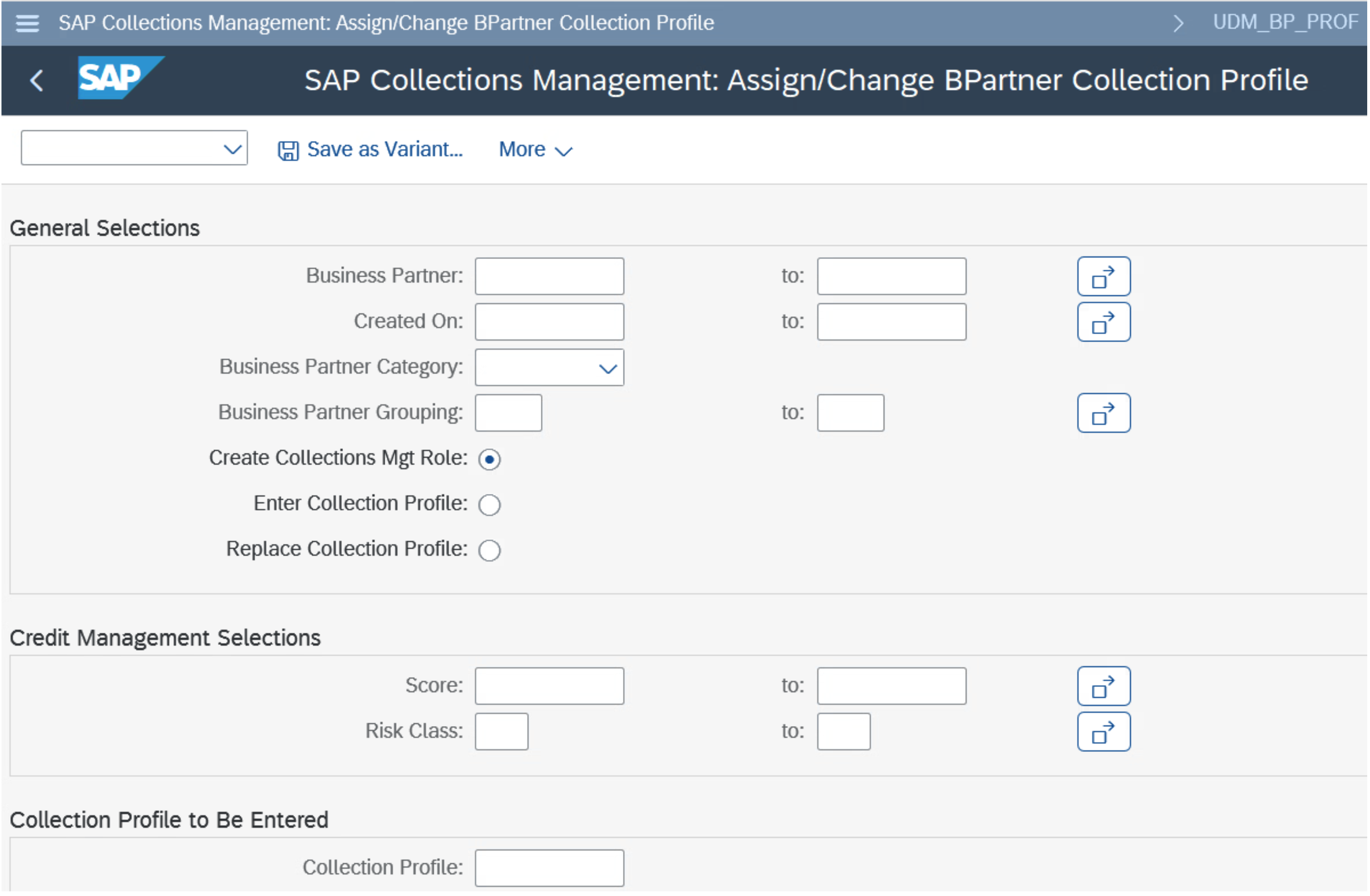
- Step 2:
- Transaction Code - UDM_BP_GRP
- Can be used for the last 2 steps:
- Assign Collection Group
- Assign Collection Specialist

Option 2: Static Load via Data Collection Template (DCT):
The required Business Partner (BP) role for Collections Management must first exist in the S/4HANA system, after which the existing Business Partner (customer) will be extended with the Collections Management role.
- Step 1:
- Transaction code - UDM_BP_PROF
- This mass update program can be used for the first 2 steps in separate runs:
- Assign the Collection Management role
- Assign Collection Profile
- Step 2:
- The required Collections Management data will be collected using a Data Collection Template (DCT) and subsequently loaded into S/4HANA
The preferred option is Option 1: Automated Derivation, where all Collections Management migration elements are automated and logic is implemented to automate the assignment of the :
- Collection Management Role
- Collection Profile
- Collection Segment
- Collection Group
- Collection Specialist
If full automation is not feasible for any reason, the alternative option is Option 2: Static Load via Data Collection Template (DCT).
List of source systems and approximate number of records:
| Source | Scope | Source Approx. No. of records | Target System | Target Approx. No. of records |
|---|---|---|---|---|
| PF2 | Customer Master Data General Information | 55371 | S4 | 4200 |
| WP2 | Customer Master Data General Information | 36983 | S4 | 24000 |
Additional Information
Multi-language Requirement
NA
Document Management
NA
Legal Requirement
NA
Special Requirements
NA
Target Design
Below is the target design relevant to Option 2: Static Load via Data Collection Template (DCT)
| Table | field | Data Element | Field Description | Data Type | Length | Requirement |
|---|---|---|---|---|---|---|
| UDMBPSEGMENTS | PARTNER | BU_PARTNER | Business Partner | CHAR | 10 | System generates the value. |
| UDMBPSEGMENTS | COLL_SEGMENT | COLL_SEGMENT | Collection Segment | CHAR | 10 | System generates the value. |
| UDMBPSEGMENTS | COLL_GROUP | COLL_GROUP | Collection Group | CHAR | 10 | System generates the value. |
| UDMBPSEGMENTS | COLL_SPECIALIST | COLL_SPECIALIST | Collection Specialist | CHAR | 12 | System generates the value. |
| UDMBPSEGMENTS | VALID_FROM | VALID_FROM | Valid From | DATS | 8 | System generates the value. |
| UDMBPSEGMENTS | VALID_TO | VALID_TO | Valid to | DATS | 8 | Conditional |
| UDMBPSEGMENTS | LAST_CONTACT | LAST_CONTACT | Main Contact Person | CHAR | 10 | System generates the value. |
| BUT100 | RLTYP | BU_PARTNERROLE | BP Role | CHAR | 6 | Mandatory |
Data Cleansing
NA
Conversion Process
NA
Data Privacy and Sensitivity
NAExtraction
NA
Extraction Run Sheet
NA
Selection Screen
| Selection Ref Screen | Parameter Name | Selection Type | Requirement | Value to be entered/set |
|---|---|---|---|---|
| N/A | ||||
Data Collection Template (DCT)
Below is the DCT is relevant to Option 2: Static Load via Data Collection Template (DCT)
| Field | Field Description | Rule |
|---|---|---|
| UDMBPPROFILE - PARTNER | Business Partner | Map from source to target using Business Partner mapping table. |
| UDMBPPROFILE - COLL_PROFILE | Collection Profile | One collection profile and will be provided by functional team |
| UDMBPSEGMENTS- COLL_SEGMENT | Collection Segment | This will be provided by functional team |
| UDMBPSEGMENTS-COLL_GROUP | Collection Group | This will be provided by functional team |
| UDMBPSEGMENTS-COLL_SPECIALIST | Collection Specialist | Details in attached spreadsheet |
Extraction Dependencies
NA
Transformation
Below is the transformation is relevant to Option 2: Static Load via Data Collection Template (DCT)
The Target fields are mapped to the applicable Legacy field that will be its source, this is a 3-way activity involving the Business, Functional team and Data team. This identifies the transformation activity required to allow Syniti ADMM to make the data Target ready:
- Perform value mapping and data transformation rules.
- Legacy values are mapped to the to-be values (this could include a default value)
- Values are transformed according to the rules defined in Syniti ADMM
- Prepare target-ready data in the structure and format that is required for loading via prescribed Load Tool. This step also produces the load data ready for business to perform Pre-load Data Validation
Transformation Run Sheet
NA
Transformation Rules
| Rule # | Source system | Source Table | Source Field | Source Description | Target System | Target Table | Target Field | Target Description | Transformation Logic |
|---|---|---|---|---|---|---|---|---|---|
| 1 | DCT | N/A | N/A | N/A | S/4HANA | UDMBPSEGMENTS | PARTNER | Business Partner | Map from source to target using Business Partner mapping table. |
| 2 | DCT | N/A | N/A | N/A | S/4HANA | UDMBPSEGMENTS | COLL_SEGMENT | Collection Segment | Copy from DCT |
| 3 | DCT | N/A | N/A | N/A | S/4HANA | UDMBPSEGMENTS | COLL_GROUP | Collection Group | Copy from DCT |
| 4 | DCT | N/A | N/A | N/A | S/4HANA | UDMBPSEGMENTS | COLL_SPECIALIST | Collection Specialist | Copy from DCT |
| 5 | PF2/WP2 | N/A | N/A | N/A | S4HANA | BUT100 | RLTYP | BP Role | Default to UDM000 |
Transformation Mapping
Mapping Table Name | Description |
|---|---|
Legacy Customer-BP Master Mapping | Legacy to S4 Business Partner customer mapping |
Transformation Dependencies
List the steps that need to occur before transformation can commence| Item # | Step Description | Team Responsible |
|---|---|---|
| 1 | Source Data Integrity - Ensure extracted data is complete, accurate, and consistent. - Validate that data types and formats align with transformation requirements. | Syniti |
| 2 | Referential Integrity - Ensure dependent records are transformed together or in advance | Syniti |
| 3 | Transformation Logic and Mapping - Define data mapping rules between source and target schemas. | Data Team |
| 4 | Performance and Scalability Considerations - Optimize transformation processes for large datasets. - Ensure system resources can handle transformation workloads | Syniti |
| 5 | Logging and Error Handling - Maintain detailed logs of transformation activities. - Define error-handling procedures for failed transformations | Syniti |
The data from legacy system excludes:
- One time customer (Account group is Z004 or ZCPD)
One time customer (Account group is Z004)
List of source systems and approximate number of records
Additional Information
Multi-language Requirement
Document Management
Legal Requirement
Special Requirements
Target Design
The technical design of the target for this conversion approach.
Data Cleansing
Conversion Process
The high-level process is represented by the diagram below:

Data Privacy and Sensitivity
Extraction
Extract data from a source into . There are 2 possibilities:
- The data exists. connects to the source and loads the data into . There are 3 methods:
- Perform full data extraction from relevant tables in the source system(s).
- Perform extraction through the application layer.
- Only if ; cannot connect to the source, data is loaded to the repository from the provided source system extract/report.
- The data does not exist (or cannot be converted from its current state). The data is manually collected by the business directly in . This is to be conducted using DCT (Data Collection Template) in
The agreed Relevancy criteria is applied to the extracted records to identify the records that are applicable for the Target loads
Extraction Run Sheet
Selection Screen
Data Collection Template (DCT)
Target Ready Data Collection Template will be created for data with exception of some fields which require transformation as mentioned in the transformation rule.DCT Rules
Extraction Dependencies
Transformation
The Target fields are mapped to the applicable Legacy field that will be its source, this is a 3-way activity involving the Business, Functional team and Data team. This identifies the transformation activity required to allow to make the data Target ready:
- Perform value mapping and data transformation rules.
- Legacy values are mapped to the to-be values (this could include a default value)
- Values are transformed according to the rules defined in
- Prepare target-ready data in the structure and format that is required for loading via prescribed Load Tool. This step also produces the load data ready for business to perform Pre-load Data Validation
Transformation Run Sheet
Transformation Rules
| Rule # | Source system | Source Table | Source Field | Source Description | Target System | Target Table | Target Field | Target Description |
| 1 | PF2/PI2/WP2 | KNB1 | KUNNR | Customer Account Number | S/4HANA | BP000 | PARTNER | Business Partner Number |
| 2 | PF2/PI2/WP2 | KNB1 | BUKRS | Company Code | S/4HANA | BP001 | BUKRS | Company Code |
| 3 | PF2/PI2/WP2 | KNB1 | AKONT | Reconciliation Account | S/4HANA | BP001 | AKONT | Reconciliation Account |
| 4 | PF2/PI2/WP2 | KNB1 | ZTERM | Payment Terms | S/4HANA | BP001 | ZTERM | Payment Terms |
| 5 | PF2/PI2/WP2 | KNB1 | ZWELS | Payment Methods | S/4HANA | BP001 | ZWELS | Payment Methods |
| 6 | PF2/PI2/WP2 | KNB1 | VZSKZ | Payment Block | S/4HANA | BP001 | VZSKZ | Payment Block Indicator |
| 7 | PF2/PI2/WP2 | KNB1 | XPORE | Individual Payment | S/4HANA | BP001 | XPORE | Individual Payment Indicator |
| 8 | PF2/PI2/WP2 | KNB1 | ZUAWA | Sort Key | S/4HANA | BP001 | ZUAWA | Sort Key |
| 9 | PF2/PI2/WP2 | KNB1 | DTAWS | Instruction Key | S/4HANA | BP001 | DTAWS | Instruction Key |
Transformation Mapping
Mapping Table Name | Description |
Legacy Customer-BP Master Mapping | Legacy to S4 Business Partner customer mapping |
Business Partner deDupe mapping (Global Data) | dedupe Golden-child (Global) mapping |
Company Code Mapping | Legacy to S4 Company Code Mapping |
Payment Terms Mapping | Legacy to S4 Payment Terms Mapping |
Payment Method Mapping | Payment Method Mapping |
Tax Category Mapping | Legacy to S4 Tax Category Mapping |
Reconciliation Account Mapping | Legacy to S4 Reconciliation Account Mapping |
Sort Key Mapping | Legacy to S4 Sort Key Mapping |
Planning Group Mapping | Legacy to S4 Planning Group Mapping |
deDupe customer Company Code Nominations Mapping | Golden-Child Company Code data Mapping |
Transformation Dependencies
List the steps that need to occur before transformation can commence| Item # | Step Description | Team Responsible |
|---|---|---|
1 | Extract PF2/PI2/WP2 source tables – KNB1 | Data |
2 | Ensure that Business Partner – General is loaded | Data |
2 | Ensure all Customer master data collection templates, deduplication and cleansing completeness and no errors | Data |
3 | Ensure that all required Configurations are in S/4HANA | Data |
Pre-Load Validation
Project Team
Completeness
| Task | Action |
|---|---|
Verify count |
|
| Validate the mandatory fields | Validate there is value for all the mandatory fields that the record count in the pre-load file is the same as the record count based on the approved DCT records |
Accuracy
| Task | Action | ||
|---|---|---|---|
Data Accuracy | Data team to verify that all the data in the load table/file is accurate as per signed-off transformation rules and DCT contents | ||
| Validate the transformation | Validate the fields which require transformation have the value after transformation instead of the original field value | ||
| Check Data Consistency |
| Mapping Error Reports | Verify that all necessary error reports have been validated, and that errors have been addressed. |
Business
Completeness
| Task | Action |
|---|---|
Verify Count for all customers | Verify that the record count in the pre-load file is the same as the record count based on the relevancy (including deduplication) results |
Verify Relevancy Rules | Verify that the relevancy rules were correctly applied |
Accuracy
| Task | Action |
|---|---|
Verify Data Accuracy | Verify that all the data in the load table/file is accurate as per signed-off transformation rules and DCT contentsrules |
Review Error Reports | Verify that all necessary error reports have been validated, and that errors have been addressed. |
Verify Transformation Rules | Verify that the transformation rules are correct and have been carried out correctly |
Load
The load process includes:
A custom program will be built to load the Collection Profile, Collection Group, and Collection Agent in one go through Syniti ADMM.
Load Run Sheet
Item # | Step description | Team responsible |
|---|---|---|
1 | Load Sample Business Partners | Data |
2 | Validate sample Business Partners | Data |
3 | Load remaining Business Partners | Data |
4 | Validate data loaded for Business Partners | Data |
5 | Load Sample BP Type – Customer Contact Persons | Data |
6 | Validate sample BP Type – Customer Contact Persons | Data |
7 | Load remaining BP Type – Customer Contact Persons | Data |
8 | Validate data loaded for BP Type – Customer Contact Persons | Data |
9 | Load Sample BP Type – Vendor Contact Persons | Data |
10 | Validate sample BP Type – Vendor Contact Persons | Data |
11 | Load remaining BP Type – Vendor Contact Persons | Data |
12 | Validate data loaded for BP Type – Vendor Contact Persons | Data |
13 | Load Sample BP Type - Bank Contacts (First Name, Last Name) | Data |
14 | Validate sample BP Type - Bank Contacts (First Name, Last Name) | Data |
15 | Load remaining BP Type - Bank Contacts (First Name, Last Name) | Data |
16 | Validate data loaded for BP Type - Bank Contacts (First Name, Last Name) | Data |
17 | Load Sample BP Type – BP General, FI Customer, FI Vendor | Data |
18 | Validate sample BP Type – BP General, FI Customer, FI Vendor | Data |
19 | Load remaining BP Type – BP General, FI Customer, FI Vendor | Data |
20 | Validate data loaded for BP Type – BP General, FI Customer, FI Vendor | Data |
21 | Load Sample Vendors Default Partner | Data |
22 | Validate sample Vendors Default Partner | Data |
23 | Load remaining Vendors Default Partner | Data |
24 | Validate data loaded for Vendors Default Partner | Data |
25 | Load Sample BP - General for remaining customer roles | Data |
26 | Validate sample BP - General for remaining customer roles | Data |
27 | Load remaining BP - General for remaining customer roles | Data |
28 | Validate data loaded for BP - General for remaining customer roles | Data |
29 | Load Sample BP – Customers with Default Partner | Data |
30 | Validate sample BP – Customers with Default Partner | Data |
31 | Load remaining BP – Customers with Default Partner | Data |
32 | Validate data loaded BP – Customers with Default Partner | Data |
33 | Load Sample BP - Bank Role | Data |
34 | Validate sample BP - Bank Role | Data |
35 | Load remaining BP - Bank Role | Data |
36 | Validate data loaded BP - Bank Role | Data |
37 | Load Sample BP Relationship Contact Person to Organisation (Will create KNVK records) | Data |
38 | Validate sample BP Relationship Contact Person to Organisation (Will create KNVK records) | Data |
39 | Load remaining BP Relationship Contact Person to Organisation (Will create KNVK records) | Data |
40 | Validate data loaded for BP Relationship Contact Person to Organisation (Will create KNVK records) | Data |
41 | Load Sample BP - Carrier | Data |
42 | Validate sample BP - Carrier | Data |
43 | Load remaining BP - Carrier | Data |
44 | Validate data loaded BP - Carrier | Data |
45 | Load Sample BP - Credit Management | Data |
46 | Validate sample BP - Credit Management | Data |
47 | Load remaining BP - Credit Management | Data |
48 | Validate data loaded BP - Credit Management | Data |
49 | Load Sample BP Collections Management | Data |
50 | Validate sample BP Collections Management | Data |
51 | Load remaining BP Collections Management | Data |
52 | Validate data loaded BP Collections Management | Data |
Load Phase and Dependencies
Configuration
| Item # | Configuration Item |
|---|---|
1 | Obtain the approved upload USER ID’s to be used (e.g. Firefighter ID) |
2 | SAP USER profile (SU3) Date and Decimal Notation Formats are in sync with the load format |
3 | Company Code Configuration |
| 4Incoterms Configuration | BP Grouping |
| 5Plant Configuration | Customer Account Group |
| 6 | Confirmation Control Configuration |
7 | Payment Terms Configuration |
8 | Payment Method Configuration |
9 | Reconciliation Account Configuration |
10 | Withholding Tax Types ConfigurationBP Number Range |
Conversion Objects
| Object # | Preceding Object Conversion Approach | |||
|---|---|---|---|---|
| Intercompany Business Partners | Business Partner - Contact | Business Partner – General | GL AccountsNA |
Error Handling
| Error Type | Error Description | Action Taken |
|---|---|---|
Configuration | <configuration> is not valid/missing | If it is a missing configuration item then engage Functional team to expedite and fix the error in the system. |
Invalid Data | <parameter> is not valid. | The parameter entry needs to be reviewed (ex. invalid payment terms). If it is an invalid data, business needs to review and correct the source of the data either in PF2/PI2/ |
WP2 | ||
Technical Setup | Interface / Connection issue within target system’s landscape | N/A – the data will be loaded directly to S/4HANA environment |
Post-Load Validation
Project Team
Completeness
| Task | Action |
|---|
| Perform Data Count |
Validate that migrated data matches source records. | |
| Perform Source-to-Target Comparisons | Validate all the mandatory fields are populated as per the loading file |
Accuracy
| Task | Action |
|---|---|
Data Accuracy | Data team to verify that all the data in the load table/file is accurate as per signed-off transformation rules and DCT contents |
Error Reports | Verify that all necessary error reports have been validated, and that errors have been addressed. |
Business
Completeness
| Task | Action | ||
|---|---|---|---|
Verify full Count of Customers | Verify that the record count in the post-load file is the same as the record count based on the relevancy (including deduplication) results | ||
| Action | |||
| Perform Source-to-Target Comparisons | Validate that migrated data matches source records counts. | ||
| Conduct Post-Migration Reconciliation | Go through reports comparing pre- and post-migration data provided by Syniti. | Validate Loaded Data | Validate, as per the loads files signed-off, that all records were created |
Accuracy
| Task | Action |
|---|---|
Verify Data Accuracy | Data team to verify that all the data in the load table/file is accurate as per signed-off transformation rules and DCT contentsrules |
Review Error Reports | Verify that all necessary error reports have been validated, and that errors have been addressed. |
Validate Loaded Data | Validate, as per the loads files signed-off, that all records were created |
Key Assumptions
- Master Data Standard is up to date as on the date of documenting this conversion approach and data load.
- is in scope based on data design and any exception requested by business.
See also
Change log
| Change History | ||
|---|---|---|
|
Workflow history
| Workflow Report | ||||||
|---|---|---|---|---|---|---|
|