

| Status |
| |
| Owner | ||
| Stakeholders |
Issue
The detailed design phase has commenced, during which standard SAP functionalities were reviewed in collaboration with the GBUs. This process revealed notable differences in operational approaches across GBUs, highlighting the need for alignment. To address this, a series of targeted workshops were conducted per GBU, resulting in a harmonized business process model accepted as a global template. Concurrently, the business expressed interest in revisiting the potential replacement of Labware/LIMS with standard SAP QM. A comprehensive demo was conducted to showcase complex business processes—particularly those not covered during the conceptual design phase and in light of the CUI topic. To further explore system capabilities, the Labware team conducted a reverse demo to better understand the intricacies involved.
The list of used LIMS is in the below:
Recommendation
When an organization is undergoing a transformation program, choosing SAP over a standalone LIMS for inspection results recording can offer strategic advantages that go beyond just functionality. Below are the key recommendations and rationale:
- End-to-End Integration Across Business Processes
- SAP QM is natively integrated with modules like MM, PP, EWM, and PM.
- Inspection results can directly trigger follow-up actions (e.g., stock postings, usage decisions, batch status changes) without middleware.
- Reduces data silos and ensures harmonized workflows across procurement, production, and logistics.
- Single Source of Truth for Master Data
- Material Master, Inspection Characteristics, and Quality Info Records are centrally maintained.
- Avoids duplication and misalignment that often occurs when LIMS operates as a separate system.
- Supports global harmonization and standardization—perfect for transformation programs aiming for operational excellence.
3. Compliance and Audit Readiness
- SAP’s audit trails, electronic signatures, and role-based access controls are built-in.
- Inspection results are traceable to batches, vendors, and production orders.
- Facilitates compliance with GxP, ISO, and other regulatory frameworks without needing external validation layers.
4. Cost and Complexity Reduction
- Eliminates the need for complex LIMS-SAP interfaces (e.g., QM-IDI or custom RFCs).
- Reduces and simplifies change management during transformation.
- Leverages existing SAP infrastructure and licenses.
5. Real-Time Analytics and Reporting
- Inspection results feed directly into SAP’s analytics tools (e.g., Fiori apps, SAC dashboards).
- Enables proactive quality monitoring and decision-making.
- Supports KPI tracking aligned with transformation goals.
Background & Context
There are some requirements to be considered in context together with topic of this KDD.:
- The table below illustrates the SAP vs LIMS Usage for the GBUs.
Process | AS-IS | Novecare | SpP | Composite | TS |
Master Dara Management | SAP & Labware | SAP & Labware | SAP & Labware | SAP & Labware | SAP & Labware |
Inspection Lot creation | SAP & Labware | SAP & Labware | SAP | Labware | SAP & Labware |
Sample Management | Labware | Labware | Labware | Labware | Labware |
Inspection Results Recording | SAP & Labware | SAP & Labware | Labware | Labware | Labware |
Usage Decision | SAP & Labware | SAP & Labware | SAP | Labware | Labware |
Stock Posting | SAP | SAP | SAP | SAP | SAP |
Certificate of Analysis | SAP & Labware | SAP & Labware | SAP | Labware | SAP |
SAP should be able to cover the above activities.
Composite GBU specific requirements to be covered are the below:
- Manage Customer Specifications.
- Manage Production In-Process Controls for the Parent Batches.
- Manage Quality Inspection for the Produced Stock Batches.
- Manage “Conditional” Inspections (To be inspected if a previous Inspection Characteristic fails).
- Manage Calculated Characteristics depending on the previous results of other Characteristics.
- Manage Inspection Lot consolidation where an Inspection Lot should be automatically rejected if the previous Inspection Lot was rejected.
- Manage complex Sampling Procedures.
- Manage PRT Usage during the Quality Inspection Process.
- A Material against multiple specs:

- Sales Orders against Multiple Specs:
The same customer can ask for the same product certified under different specs.
Some distributors ask certification in all possible specs to be able to sell to any requirement.

- One Process Order - Multiple Rolls against Multiple Specs:

The rest of the GBUs shares the below requirements:
- To be able to effectively manage Master Data.
- Create Inspection Lots based on the different scenarios such as Incoming Goods or Production GR.
- Record Inspection Results.
- Manage Sampling Procedures based on different rules like Quantities or based on the Production duration.
- Effectively manage the UDs based on the Inspection Results recorded.
- Effectively retrieving the CoA of different inspection Batches.
The initial Integration model validated between SAP and LIMS is the below:

POOVADAN-ext, Vineet Kumar @Andrew Liguori @Scott Tinlin @Bryan Cupples |
Issue
A request was made by the Syensqo Manufacturing excellence team to consider the option of having one Quality system across Syensqo.
Rationale behind the request:
- No Standardized process within and across the GBUs.
- No standardized reports possible within the plants in a GBU and across GBU .
- Currently Labware is configured in a way which the local sites want to define it.
- In Labware / Web LIMS the Samples are generated manually without any trigger from upstream processes, resulting in a lack of control and process integration.
- In Labware / Web LIMS the operator can freely define whether execute a test or carry over previous results, without any predefined control.
Recommendation
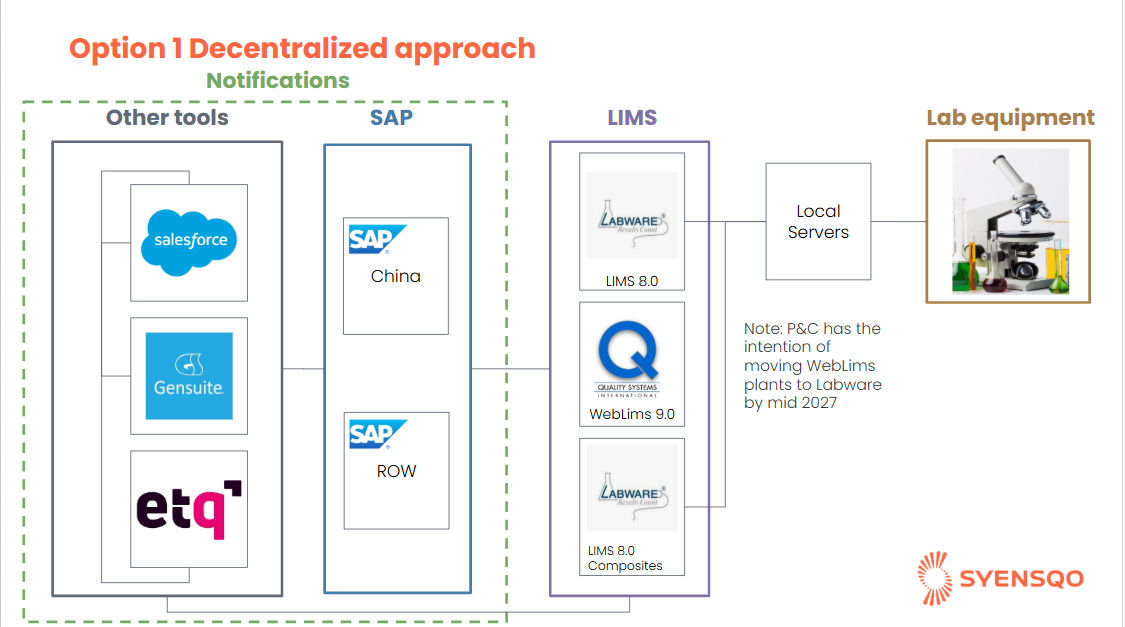
This KDD recommends the continuation of a decentralised approach for Quality Management, labelled as Option 1 in this document.
It must be noted that the original recommendation of SyWay was for Option 4 (unified Labware system), in order to allow for full process standardization, however the resources and effort required to implement this option were significant and introduced the risk of delaying the overall SyWay program timelines. When also considering the cost of implementation, integration, and change management impacts, it was decided to move forward with Option 1. This approach allows each GBU to maintain its current Quality Management setup, with existing LIMS/Labware versions and configurations continuing to operate across different sites.
This decision was made following a comprehensive evaluation and was presented to the SteerCo on 26th November 2025, where the endorsement to proceed with Option 1 was received.
Importantly, as part of this approach, SyWay will redesign the interfaces using the latest frameworks. This will lay the groundwork for future harmonization and standardization efforts, aligning with our long-term ambition to create a more unified and efficient system across all GBUs. By taking this step, we are ensuring operational continuity while also positioning ourselves to progressively achieve greater integration and consistency in our Quality Management processes.
Note:Subsequent to the decision to proceed with Option 1, the P&C GBU has initiated a program to decommission WebLIMS and replace it with Labware. Consequently, the integration between SAP S/4HANA and WebLIMS will be out of scope for SyWay. If the migration program does not meet the SyWay timelines, the alternate option will be to manage the inspection process offline. Integration of S4 with Labware is still in scope of SyWay.
Background & Context
Current Status and Challenges:
Syensqo currently operates with a distributed Quality Organization, where quality management responsibilities, processes, and systems are spread across multiple business units and sites. Over time, each GBU/plant has implemented its own technology landscape, leading to the coexistence of different Quality Management Systems, LIMS, and data management tools.
- Lack of Standardization Across GBUs and Sites
- There is no standardized process within or across the Global Business Units (GBUs)
- Measured values vary because LabWare configurations and test setups differ across sites.
- Inconsistent Reporting and Configuration
- It is not possible to generate standardized reports either within a GBU or across GBUs due to differences in local configurations.
- LabWare and WebLIMS are currently configured independently by each site, based on local preferences and practices, leading to different data models and test definitions.
- Lack of Integration and Process Control
- In LabWare / WebLIMS, samples can be created manually without any trigger from upstream processes (e.g., production, batch release, or quality notification).
- This results in a lack of integration and limited traceability between quality results and operational data.
- Operators can manually decide whether to execute a test or reuse previous results, this step is ad-hoc and without predefined system controls or approval steps.
- In LabWare / WebLIMS, samples can be created manually without any trigger from upstream processes (e.g., production, batch release, or quality notification).

Assumptions
- Master Data creation and maintenance will be in SAP S/4HANA for SpP.
- Master Data creation and maintenance will be in SAP S/HANA and Labware for P&C and Composites.
- Inspection Lot creation will remain in SAP S/4HANA when is needed and the sample will be created in Labware.
- Usage Decision will be taken in S/4HANA in order to be able to manage Stock Posting.
- Lab Equipment will remain integrated into Labware.
- The P&C-Novecare Plants not using S/4HANA for the QM Results Recording will be migrated to Labware.
Constraints
Various lab test equipment are currently deployed across multiple sites, but the full inventory of interfaces and underlying technologies remains undefined. This lack of visibility makes it difficult to accurately estimate the technical effort required to develop SAP integrations for test result capture. Therefore the continuation of the existing decentralised approach is recommended as a pragmatic solution (i.e. Option 1).
Impacts
The Selected approach does not have an impact on the infrastructure, other SAP modules or systems and inflight projects, It does have an impact on the business processes and the interfaces.
The Business process models needs to be adjusted based on the recommended option, Interface will be added to scope to connect S/4HANA with Labware.
The SpP Master Data currently stored in Labware needs to be migrated to SAP, as SAP will become the new central repository for all Master Data.
Assumptions
- To enable seamless inspection result recording, laboratory equipment should be interfaced directly with the SAP system, allowing automated data capture, improved accuracy, and real-time integration into quality management workflows and analytics.
- To enable automated sample drawing during the production process, a clearly defined sampling procedure or rule must be communicated. If sampling occurs randomly without a consistent or logical pattern, the process will default to manual execution.
- The proposed solution must support the inclusion of additional inspection samples throughout the quality control process, ensuring flexibility in response to evolving production conditions or specific quality concerns.
- "The solution must support the recording of inspection results against multiple specifications, enabling flexible evaluation criteria tailored to diverse product requirements, regulatory standards, or customer-specific needs.
Constraints
N/A
Impacts
Business Rules
All Inspection Lot triggers are properly defined (e.g., Goods Receipt, Production Order, Stock Transfer).
The Inspection Types defined during the Detailed Design are correctly assigned to the Material Master
..
Automate
sample size calculation where logical rules exist.selection of specifications based on material, Customer/Vendor, or batch attributes.
Define valuation logic (e.g., accepted, rejected, conditional acceptance).
Link usage decisions to follow-up actions like stock postings or notifications.
Automate decisions where possible based on recorded results and valuation codes
.Ensure seamless data flow between QM and IM, Manufacturing, EWM,S2P and A2D.
Options considered:
Option A: Keep the AS-IS system usage
Currently, SpP, TS, and Composite business units utilize Labware for inspection results recording, while Novecare operates on WebLIMS. One proposed option under consideration is to maintain their existing systems, allowing each unit to continue using its current platform to avoid disruption, preserve validated workflows, and minimize revalidation efforts.
The SAP S/4H integration model will be as the below:

Advantages:
Since LIMS is already fully configured and operational, no additional effort is required to adapt SAP S/4HANA for inspection results recording. This minimizes the need for system reconfiguration, reduces training demands for end users, and significantly lowers change management complexity. Moreover, maintaining the existing setup avoids triggering customer revalidation processes, ensuring continuity and compliance with current quality and regulatory standards.
Option B: Use only SAP for the Results Recording
The second option involves leveraging the full capabilities of SAP S/4HANA’s Quality Management (QM) module for inspection results recording. This approach enables seamless integration across procurement, production, and logistics, eliminates interface complexity, and ensures a unified source of truth for master data. It also delivers real-time analytics, embedded compliance features, and end-to-end traceability—making it a strategic fit for harmonized global operations and enterprise transformation initiatives.
This option will involve the Development for the below activities in SAP:
Standard SAP
Development
Link Customer Specifications to the Inspection Lot
X
√ Medium
Managing Spec ID
√
−
Managing In-process Controls - IPL
√
−
Managing ATL Inspections
√
−
Managing Reject of next Roll - Inspection Lot Consolidation
X
√ Medium
Sampling Procedures
√
−
Non-ISO standard Unit of Measure that are unique to Composite
√
−
MIC results that are calculated based on other results of MICs previously entered in the Inspection lot
√
−
Interface lab equipment to S/4 HANA (Not composite specific)
X
√ High
Option C: SpP, Novecare and TS will use SAP for the Results Recording and Composite will remain in the Labware.
Following are the options proposed:
Option 1 – Decentralized Approach
Under this approach, each GBUs continues operating its existing Quality Management setup. Different LIMS versions and configurations remain in use across sites, which means data structures, reporting formats, and inspection results will continue to vary.
Option 2 - Hybrid Approach (CM As-Is / P&C and SpP Standardised)
Under this approach, Composites retains its current configuration (“As-Is”), while other GBU’s standardize their quality processes and integrate with SAP S/4HANA. This hybrid model promotes partial standardisation while reducing disruption to ongoing CM operations. This option will also enable Syensqo to roll out a centralised Quality Management Organization.

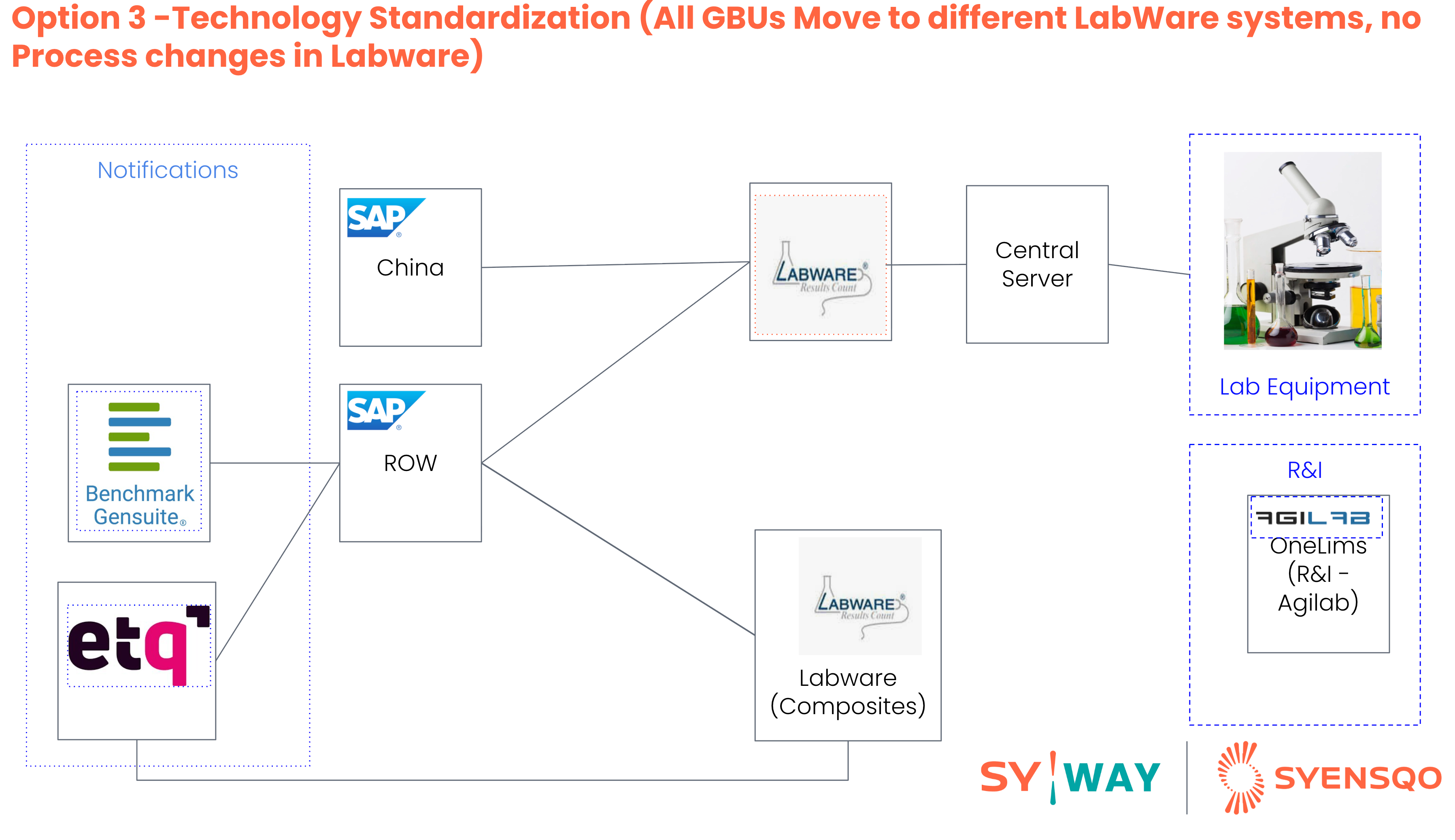
Option 3 – Technology Standardisation (All GBUs Move to different LabWare systems, no Process changes in Labware)
This option envisions a complete migration where all GBUs (including P&C, SpP, and CM) move to a unified LabWare Technology(One instance for CM and other instance for rest of GBU’s). This option acknowledge the possibility for P&C to unify their plants in the current Labware implementation, removing WEBLIMS.
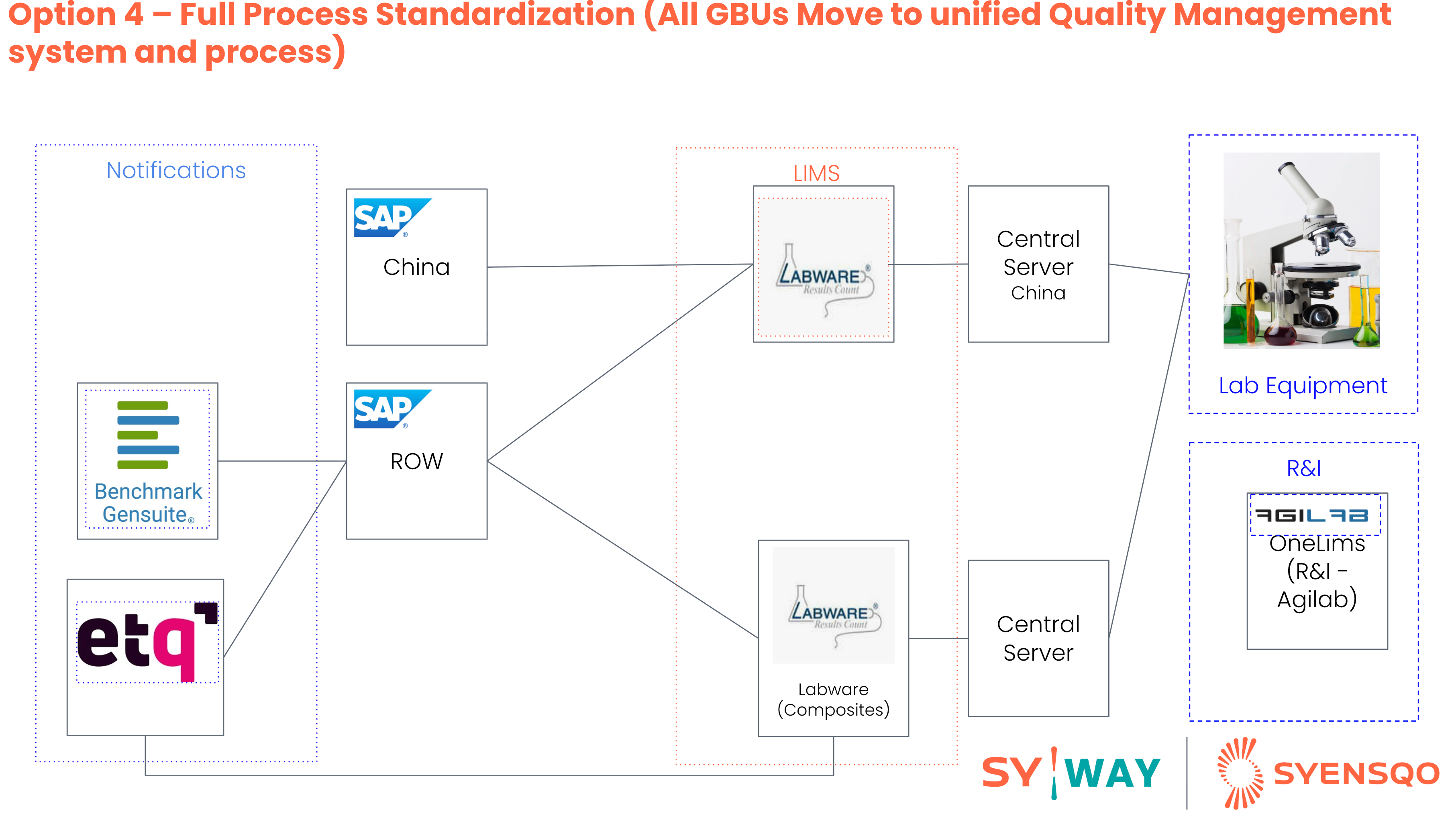
Option 4 – Full Process Standardisation (All GBUs Move to unified Labware Design)
This option envisions a complete migration where all GBUs (including P&C, SpP, and CM) move to a unified LabWare Design (One instance for CM and other instance for rest of GBU’s).. Quality processes would be fully standardised across the enterprise, ensuring consistent data structures, harmonised reporting formats, and a single source of truth for all inspection results. It requires a deep redesign of the Labware implementation.
Evaluation
Criteria | Option 1 – Decentralised | Option 2 - Hybrid Approach (CM As-Is / P&C and SpP Standardized) | Option 3 – Technology Standardization (All GBUs Move to different LabWare systems, no Process changes in Labware) | Option 4 – Full Process Standardization (All GBUs Move to unified System and Design) |
|---|---|---|---|---|
Process Standardization |
|
|
|
|
Master Data Standardization |
|
|
|
|
Organizational Standardization |
|
|
|
|
Syensqo Benefits (Strategic) |
|
|
|
|
Operational Benefits |
|
|
|
|
Timeline Feasibility |
|
|
|
|
Scalability |
|
|
|
|
Operational Risk |
|
|
|
|
Project Risk |
|
|
|
|
Change Impact |
|
|
|
|
Technical Constraints |
|
|
|
|
Technical Solution Complexity |
|
|
|
|
Effort Estimate |
|
|
|
|
See also
| Widget Connector | ||
|---|---|---|
|
| Widget Connector | ||
|---|---|---|
|
| Widget Connector | ||
|---|---|---|
|
| Widget Connector | ||
|---|---|---|
|
| Widget Connector | ||
|---|---|---|
|
| Widget Connector | ||
|---|---|---|
|
Under this option, SpP, Novecare, and TS will transition to SAP S/4HANA for inspection results recording, while Composite will continue operating within Labware to preserve its validated setup. This approach avoids additional development for Composite-specific requirements, enables harmonization and standardization across the other business units, and delivers the benefits of Option A—without incurring the integration and revalidation challenges associated with Option B.
Evaluation
Option A
As-Is
Option B
All SAP
Option C
Hybrid
Standardization

Each LIMS may store and structure data differently, making it difficult to consolidate inspection results, enforce uniform reporting formats, or maintain a single source of truth.

This is the only full std SAP and fully integrated option and in a different context should be the way to go.
This option provides a reasonable level of process standardization while avoiding the complexities and risks associated with full harmonization. It strikes a pragmatic balance—delivering alignment across key areas without introducing the additional challenges linked to system consolidation, revalidation, or extensive change management.
Timeline
This option is feasible in project Timeline.
This option is feasible in project Timeline.
This option is feasible in project Timeline.
Technical Constraints
No specific technical constraints.
No specific technical constraints.
No specific technical constraints.
Costs and effort
Significant RICEF for Interfacing Labware and WebLims to SAP S/4H.
Significant RICEF for linking the Test Equipment to SAP and developing the new Composite requirements into the system.
Significant RICEF for linking the Test Equipment to SAP
Scalability
LIMS should be reassessed for each Plant integrating the LIMS in the QM Inspection Results Recording.
Standard Solution fully scalable.
Fully scalable for the GBUs using SAP S/4H but not scalable for the GBUs staying on LIMS.
| Attachments | ||||||
|---|---|---|---|---|---|---|
|
Change log
| Change History | ||
|---|---|---|
|