
| Status |
| |
| Owner | LEIGHTON-ext, Dean Leighton | |
| Stakeholders |
Issue
The purpose and structure of this This Key Decision Document (KDD) for the Permit to Work solution serves as a comprehensive guide outlining critical decisions, considerations, and recommendations essential to the implementation and management of the a Permit to Work solution. Firstly, the document It aims to clarify the rationale behind exploring and evaluating different digital permit-to-work systems in comparison to the existing paper-based system. It highlights the benefits
Key areas covered in this document include:
- Benefits and drawbacks of each solution, including factors such as efficiency, accuracy, safety, and compliance
- Overview & Background
- Design Options
- Evaluation
- Recommendation
- Business & Project Impacts
, Design Options & Recommendation, Business Rules, Business & Project Impacts. Each section serves a distinct purpose, ranging from providing background information to outlining recommendations and assessing potential impacts. Overall, the purpose and structure of the KDD ensure clarity, transparency, and accountability throughout the process of adopting and utilising work permits within Syensqo.
Recommendation
Based on the comprehensive evaluation using the decision matrix provided,S/4HANA Work Clearance Management (WCM) emerges as the recommended choice for digitally enabling and managing Permits to Work over the use of Sphera or a purely manual paper-based process.
Background & Context
Syenqo’sSyensqo’s Permit to Work solution has been established to comply with safety regulations and standards known as “Life Saving Rules” by ensuring that proper precautions are taken before maintenance activities begin.
Permit to work systems facilitate risk management by identifying potential hazards associated with maintenance tasks and implementing control measures to mitigate risks. By requiring approval from authorised personnel before work begins, Syensqo can assess the risks involved and implement appropriate safety protocols.
Approval is required from authorised personnel to ensure that the necessary checks and verifications have been performed before work commences, reducing the likelihood of errors or oversights.
The Permit to work solutions serves as an essential tool for promoting safety, managing risks, ensuring compliance, optimising operations and enhancing accountability within asset maintenance.
As-Is Summary
Currently, Permits to Work within Syensqo are managed manually, presenting challenges such as errors, incorrect information, and jeopardised maintenance activities due to reliance on paper-based processes. Thousands of permits are handled monthly, with most sites operating entirely offline, while some attach risk assessments to facilitate manual permits based on risk identification. However, one site, Tavaux, is on the verge of initiating a trial for a digital solution named E-Work Permit.
Opportunities
Standardizing the permit-to-work process across Syensqo promises numerous benefits, including ensuring consistency in safety practices, adhering to regulatory requirements, and enhancing overall efficiency and effectiveness.
The upcoming integration of S/4HANA brings about opportunities for Syensqo with the introduction of new functionality through the WCM module, digitally overseeing the management of Work Permits.
Assumptions
Utilising the Permit to Work feature within the S/4HANA Work Clearance Management (WCM) module necessitates SAP S/4HANA 2023 FPS012022 FPS02 or later.
Constraints
No Constraints identified. Further updates may be determined during the detailed design phase.
Impacts
Implementing S/4HANA Work Clearance Management (WCM) permit to work as part of the ERP Build Project will have various business and project impacts
SAP Modules: Integration with other SAP modules, such as Production Planning (PP) and Environment, Health, and Safety (EHS), may be necessary EHS with Industrial Hygiene to manage risks and possibly with Occupational Health, to ensure seamless data flow and process integration across the organisation.
Languages: Multilingual will be required to accommodate users in different regions with diverse language preferences.
Automation: S/4HANA WCM enables automation of permit management processes, reducing manual intervention and streamlining workflows. Automation features, such as auto-approval rules, notifications, and alerts, enhance efficiency, compliance, and productivity.
In-flight Projects: The implementation of S/4HANA WCM may impact the ongoing Star Factory e-Work Permit project. Proper change management and project coordination are essential to minimise disruptions.
Licensing: SAP Work Clearance Management for SAP S/4HANA is required for access to the Permit to Work functionality
Sustainability: Transitioning to a paperless solution is a crucial strategy in our collective effort to achieve sustainability and reduce carbon emissions
Deployment Approach: There are a couple of options available with this solution:
- Deploy the digital Permit to Work solution, replacing all paper-based permits (Option B).
- Deploy the digital Permit to Work solution in conjunction with retaining selected paper-based permits to allow the business to transition to a paperless solution gradually (Option B + C).
Business Rules
Currently, no specific business rules have been identified. Further updates may be determined during the detailed design phase.
Options considered
Option A: Shera Sphera - Permit to Work
SheraSphera's Permit to Work Software offers a comprehensive range of functionality functionalities designed to streamline permit management processes, enhance safety compliance, and optimise optimize operational efficiency.
Pro’s
Con’s
Sphera's software
helps streamline permit management processes, facilitating better adherence to safety regulations and standards.Cost: Implementing Shera's software requires upfront investment in software licences, implementation services, and ongoing support and maintenance.
Permit Templates: The software provides customizable permit templates for various work activities, allowing organisations to define specific permit requirements, controls, and approval workflows tailored to their needs.
Complexity: Integrating Shera's software with S/4HANA requires Development, customisation, Data Mapping and Transformation
Risk Assessment: Shera facilitates risk assessment processes by enabling users to identify, assess, and mitigate potential hazards associated with work activities, ensuring compliance with safety regulations and standards.
Data Security and Compliance: Storing permit-related data in a digital system managed by a 3rd party vendor
Real-time Monitoring: Users can monitor permit statuses, track work progress, and receive notifications/alerts for critical events in real-time, enabling proactive management of permit-related activities.
Training and Adoption: Adopting new software requires training for employees to learn how to use the system effectively.
digitizes the entire workflow, covering creation, approval, and real-time management of permits.
- Workers can easily access and follow the correct procedures on the go, completing tasks using the digital permits.
- Managers can monitor task completion in real-time and integrate data from permits, hazards and maintenance schedules.
- Dashboards provide a comprehensive view of critical worker assignments, giving managers the necessary information to make informed operational decisions
Option B: S/4HANA - WCM – Permit to Work
S/4HANA's Work Clearance Management (WCM) module, including the Permit to Work (PTW) software component, offers a robust set of functionalities designed to facilitate safe and efficient work execution.
Process flow of the Permit to Work solution in Maintenance Management

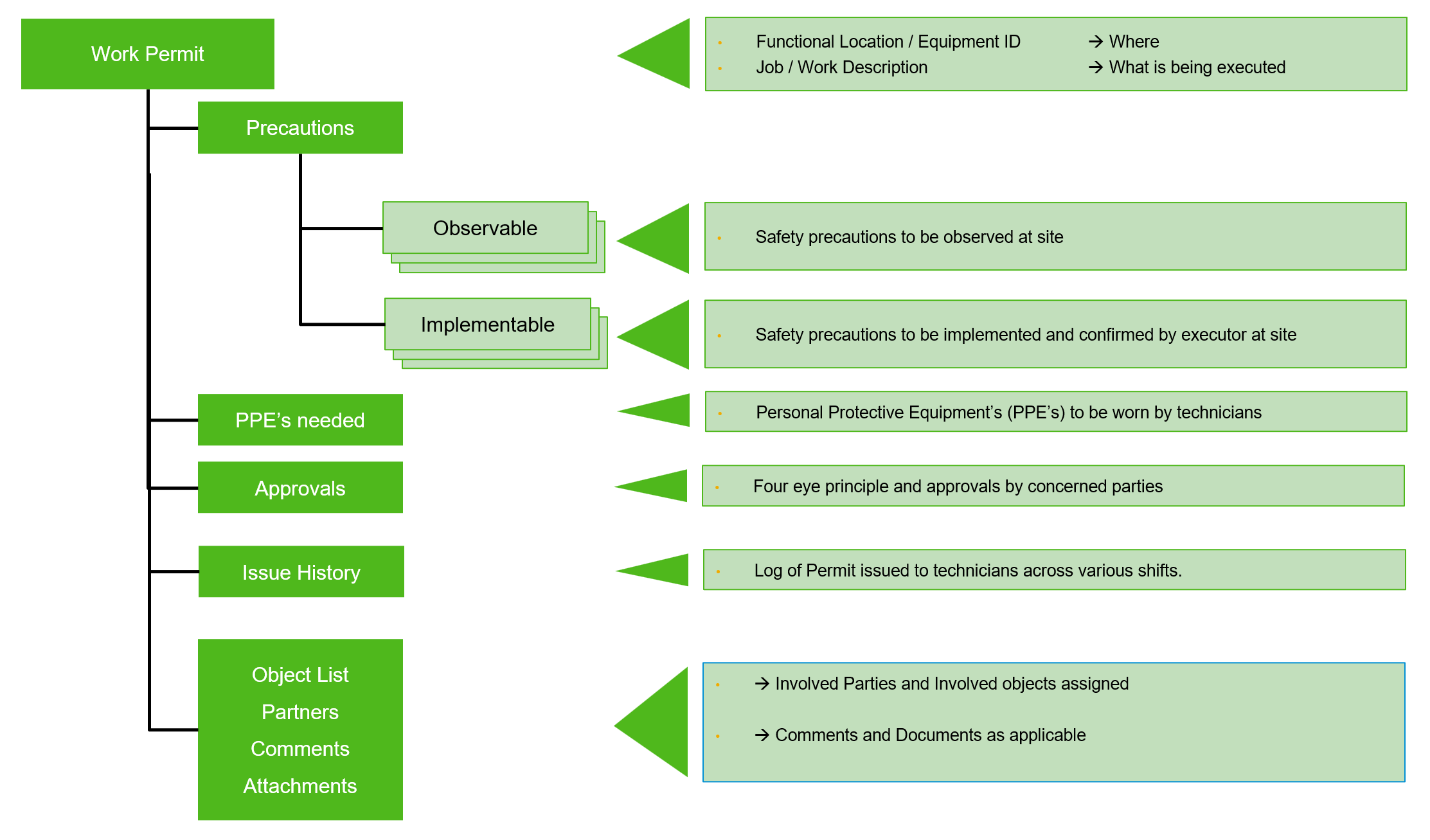
Work Permit Structure:
Option C: Paper-Based Permit to Work
Syensqo has relied on a paper-based permit to work solution across their plants worldwide. This approach has served Syensqo well over the years, providing a familiar and straightforward method for managing permits, authorizations, and safety procedures in various work environments.
The table below provides a detailed breakdown of the functionalities of the options discussed above.
| Functional Criteria | Option A - Sphera | Option B - S/4HANA WCM | Option C - Paper based |
|---|---|---|---|
| Improved Safety Compliance: | PRO: Streamline permit management processes, facilitating better adherence to safety regulations and standards. | PRO: Streamline permit management processes, facilitating better adherence to safety regulations and standards. | CON: Manual processes inherent in paper-based systems can lead to inefficiencies and delays in permit processing, potentially impacting production schedules. |
| Permit Templates: | PRO: Sphera provides customizable permit templates for various work activities, allowing organisations to define specific permit requirements, controls, and approval workflows tailored to their needs. | PRO: S/4HANA WCM-PTW offers customizable permit templates based on industry best practices and regulatory requirements. Standardised permit templates ensure consistency in permit issuance and compliance with organisational policies. | CON: Paper based templates need to continually print and physically stored |
| Risk Assessment: | PRO: Risk assessment processes by enabling users to identify, assess, and mitigate potential hazards associated with work activities, ensuring compliance with safety regulations and standards. | PRO: |
Pro’s
Con’s
Integration with Maintenance Processes: S/4HANA WCM integrates seamlessly with maintenance management processes, enabling coordination between work permits and maintenance activities. This integration ensures that permits are issued only when assets are safely prepared for maintenance tasks.
Training and Adoption: Adopting new software requires training for employees to learn how to use the system effectively.
| Tools for conducting risk assessments associated with work activities, identifying hazards, and implementing control measures to mitigate risks. This functionality helps ensure compliance with safety regulations and standards. |
Data Construction: Templates for Permits and Risk assignments will need constructed based on EHS requirements
| CON: Risk Assessment is a manual paper based, Time consuming and Prone to errors | |
| Real-Time Tracking: | PRO |
| : Users can monitor permit statuses and work progress in real-time, facilitating proactive management of work activities. The software provides alerts and notifications for critical events, enabling timely intervention to address potential safety issues. |
Permit Templates: S/4HANA WCM-PTW offers customizable permit templates based on industry best practices and regulatory requirements. Standardised permit templates ensure consistency in permit issuance and compliance with organisational policies.
Mobility: accessible via mobile devices, allowing field personnel to access permit information, perform inspections, and complete permit-related tasks onsite
Option C: Paper-Based Permit to Work
Syensqo has relied on a paper-based permit to work solution across their plants worldwide. This approach has served Syensqo well over the years, providing a familiar and straightforward method for managing permits, authorizations, and safety procedures in various work environments.
| PRO: Users can monitor permit statuses and work progress in real-time, facilitating proactive management of work activities. The software provides alerts and notifications for critical events, enabling timely intervention to address potential safety issues. | CON: challenging to track permit status and monitor compliance in real-time with paper-based systems. | ||
| Integration & Complexity: | CON: Integrating Sphera's software with S/4HANA requires Development, customisation, Data Mapping and Transformation | PRO: S/4HANA WCM integrates seamlessly with maintenance management processes, enabling coordination between work permits and maintenance activities. This integration ensures that permits are issued only when assets are safely prepared for maintenance tasks. | PRO: Paper-based do not |
Pro’s
Con’s
Change Management: No change required, continue to follow as is manual paper-based process
Manual Data Entry: Paper-Based requires the permits to be completed manual. Time consuming and Prone to errors
require any software interfaces or customization. They also do not rely on internet connectivity or electronic devices, making them suitable for environments with limited access to technology or in remote locations. CON: Difficulty in tracking the status of permits and approvals. | |||
| Mobility: | PRO: accessible via mobile devices, allowing field personnel to submit permit requests, access permit details, and perform inspections onsite, enhancing mobility and convenience. | PRO: accessible via mobile devices, allowing field personnel to access permit information, perform inspections, and complete permit-related tasks onsite | CON: Paper-Based permits are not available on the mobile device with the rest of the job pack |
| Cost | CON: Implementing Sphera's software requires upfront investment in software licenses, implementation services, and ongoing support and maintenance. | CON: SAP Work Clearance Management for SAP S/4HANA License is required for access to the Permit to Work functionality | PRO: Paper-based systems have lower costs since they don't require investment in software |
| licenses or hardware infrastructure. | |||
| Training and Adoption: | CON: Adopting new software requires training for employees to learn how to use the system effectively. | CON: Adopting new software requires training for employees to learn how to use the system effectively. | PRO: Current solution, no change management required |
| Change Management | CON: Resistance to change among employees can impede the adoption of new processes | CON: Resistance to change among employees can impede the adoption of new processes |
No Real-Time Tracking: It's challenging to track permit status and monitor compliance in real-time with paper-based systems.
Inefficiency and Delays: Manual processes inherent in paper-based systems can lead to inefficiencies and delays in permit processing, potentially impacting production schedules.
| PRO: No change required, continue to follow as is manual paper-based process | |||
| Language: | PRO: Configurable in multiple languages to meet country-specific requirements | PRO: Configurable in multiple languages to meet country-specific requirements | CON: Permit Templates must be updated and stored in all required languages |
| Manual Data Entry | PRO: Limited data entry required | PRO: Limited data entry required with data valuation | CON: Paper-Based requires the permits to be completed manual. Time consuming and Prone to errors |
| Data Construction / Migration: | CON: Despite Syensqo's extensive use of template creation in line with EHS standards, there will be data requirements to ensure that all paper-based permits are available in digital form. | CON: Despite Syensqo's extensive use of template creation in line with EHS standards, there will be data requirements to ensure that all paper-based permits are available in digital form. | PRO: No data construction / migration required |
Evaluation
The decision matrix provided below offers a structured approach to evaluating and comparing three options for permit to work software: Option 1 - SheraSphera, Option 2 - S/4HANA WCM, and Option 3 - Paper-Based. Each option is assessed based on various criteria, including compliance and regulatory adherence, mobility, real-time monitoring, user experience, integration, scalability, efficiency, traceability, cost, and change management. These criteria are assigned weights (on a scale of 1 to 10) based on their relative importance to the decision-making process. For each option, ratings are assigned to indicate how well it meets each criterion. The ratings are then multiplied by the corresponding weights, and the weighted scores are summed up to calculate the total score for each option.
Criteria | Weight |
(1-10)
Option 1 |
Sphera | Option 2 S/4HANA WCM | Option 3 Paper-Based |
Compliance and Regulatory |
VH |
9
9
Very High | Very High | Medium |
Mobility |
VH |
High |
High |
Low |
Real-time Monitoring |
H |
Very High |
High |
Low |
User Experience |
VH |
High |
High |
Low |
Integration |
H |
Medium |
Very High |
Low |
Scalability |
H |
High |
High |
Medium |
Efficiency & Traceability |
H |
High |
Very High |
Low |
Cost & |
Licenses |
M |
Medium |
High |
Very High |
Change Management |
M |
Medium |
Medium |
Very High |
Overall |
|
Medium |
High |
Low |
Based on the comprehensive evaluation using the decision matrix provided, Option 2 - S/4HANA WCM emerges as the recommended choice for the Permit to Work software.
While all options have their merits and drawbacks, Option 2 demonstrates the highest total score of 543overall ranking, indicating its overall alignment with the specified criteria and weighted priorities. S/4HANA WCM offers robust features such as integration with maintenance processes, tools for risk assessment, real-time monitoring capabilities, standardised permit templates, and mobility via mobile devices. These functionalities contribute to improved safety compliance, efficiency, and traceability in permit management processes.
Though Option 1 - Shera Sphera also performs ranked well, scoring 515 points. SheraSphera's Permit to Work Software provides notable benefits such as improved safety compliance, customizable permit templates, risk assessment tools, real-time monitoring, and mobility features. However, concerns regarding integration complexity and cost implications may impact its overall.
In contrast, Option 3 - Paper-Based, while presenting some advantages such as minimal technical complexity, low cost, and familiarity with existing processes, scores significantly lower at 363 points. This score reflects the inherent limitations of paper-based systems in terms of compliance, real-time monitoring, user experience, and efficiency, which may hinder operational effectiveness and safety compliance in the long run.
See also
The following section describes relevant documentation:
Document Name | DescriptionLink | |
RFP used to identify and select a digital solution to manage work permits related to the industrial maintenance process | ||
High level requirements based on User Stories for digital Permit to Work Solution https://docs.google.com/document/d/1j5H2ig0vcq5BmiRvbhoJZIba5t_rwKzw/edit?usp=sharing&ouid=111115748197219646542&rtpof=true&sd=true | ||
Permit to Work in Work Clearance Management (WCM) Overview | https://drive.google.com/file/d/14FuDB8S_uxTflfFU_euMqHjSK1wXPukr/view?usp=drive_link |
Business Definitions (Glossary)
Acronym / Term | Definition | KDD | Key Design Document |
PTW | Permit to Work | ||
WCM | Work Clearance Management | ||
LSR | Life Saving Rules |
Change log
| Change History | ||
|---|---|---|
|
Workflow history
| Workflow Report | ||||||
|---|---|---|---|---|---|---|
|