

| Status |
| |
| Owner | ||
| Stakeholders | Najaite Nidboufker |
Issue
Issue
During the process of arranging transport with carriers there are several business functions that require integration with carriers. These business functions are:
- Spot Tendering
- Call-Off Management
- Slot Scheduling
- Track and Trace
- Charge Settlement
- Extra Cost Dispute Management.
To cater for these functions, SAP provides an online platform
For Road Freight order placement, tendering, track and trace and carrier settlement regions utilise the following TMS solutions:
- EMEA - Transwide
- NAM - BlueJay
- LAM - n/a
- APAC - n/a
For these functions SAP offers a cloud based solution: SAP Business Network for Logistics (BNLBN4L).
This document is to provide more information on the SAP BNL solution. BNL could be considered to replace Transwide and possibly BluJay for Road Freight.
As LAM and APAC is currently not using a TMS solution, BNL could be utilised in these regions.

Recommendation
As BNL is THE solution for SAP to integrate with trucking companies, it makes sense for Syensqo to include it in the To-Be landscape.
As the functionality of BNL is overlapping with Transwide, then this system will be retired.
For North America the decision is solely based on the decision what is going to happen with BluJay (KDD). If BluJay stays operational, then it makes sense to integrate with BluJay.
Background & Context
Overview of SAP TM with BNL
To be be able to assess if SAP TM with integration to BNL is a fitting solution for Syensqo, an understanding of the SAP TM processes is essential. In this section a more detailed explanation is provided how the process works in this system configuration.
System Landscape
SAP Business Network for Logistics is SAP's new collaborative cloud network that empowers logistics businesses to work together. There are two submodules within BNL:
SAP Business Network Freight Collaboration improves supply chain efficiency by connecting business partners on a collaborative network that supports jointly managing transactions, exchanging documents, and sharing insights across the value chain. For instance, upon invitation from a shipper, a carrier can onboard onto the network and collaborate with shippers on freight tendering, subcontracting, freight settlement and dock appointment scheduling.
The aim of SAP Business Network Global Track and Trace is to capture, process and store tracking information about tracked business processes. Then, it allows business users to get real-time transparency of the execution of those processes. They can query any tracked process and display its retrieved data from end to end.
Following image provides a simplified view of the system landscape:

Process Flow
The functionality of this setup will be explained by the following process steps:

Transportation Planning
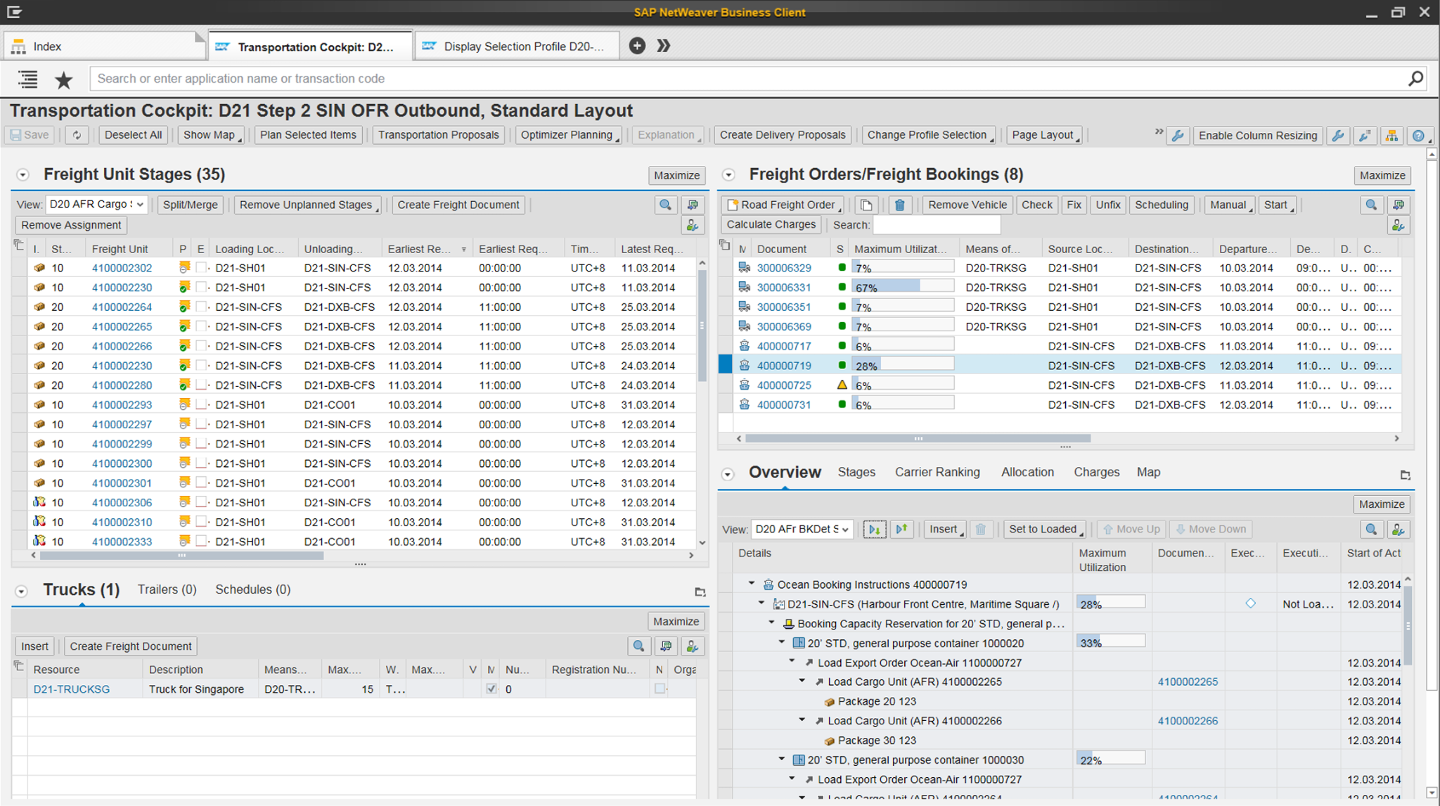
During Transportation Planning, Freight Orders (Road and Rail) or Freight Bookings (Air and Ocean) are created. These transportation orders are the starting point for integration to BNL and communication with carriers. There are multiple ways how these transportation orders are created:
- Manual Planning in the Transportation Cockpit.
- Manual creation from the Freight Unit or Container Unit.
- Short cut planning where a Freight Order is created directly from delivery.
- Automated planning.
Tendering
SAP TM supports peer-to-peer tendering, broadcast tendering or a combination of the two.
Peer-to-Peer Tendering initiates the tendering process with one or more carriers sequentially. This means that the system will wait for a (negative) response from the first carrier before contacting the second (or third and so on) carrier.
Broadcast Tendering is executed in which several carriers are contacted simultaneously. With a 'best offer' mechanism the carrier is selected that quoted the best price within a pre-defined timeframe. With a 'first acceptable offer' mechanism the carrier is selected that has the fastest response with a quote below a specific price limit (price limits can be communicated or can be hidden from carrier).
With a combination of the two tendering approaches, the most likely process is that first a peer-to-peer tendering step is completed. If these carriers are not accepting the orders, then a broadcast tender can be performed to a selected group of carriers.
The tendering approach is defined in a Tendering Profile. This tendering profile can be selected by the user in the Freight Order, or it can be automatically selected by the system.
Example of Tendering Profile:

Monitoring tendering status with response of carriers in Freight Order:

Example of Request for Quotation that is send to carrier for response:

Dock Appointment Scheduling
As a shipper, you can use dock appointment scheduling functionality in SAP Business Network Freight Collaboration to book dock appointments for a loading point on behalf of the carrier for loading or unloading services in the docking locations of your organization.
Key features:
Enable collaboration on dock appointments and gate-in and gate-out processesStarting from planning and scheduling of dock appointments to check-in and check-out at the gates as
well as loading and unloading.
Share responsibilities between shipper and (external) warehouse / yard operators
Share master data as well as operational data instantly across the involved parties.
Integrate into logistics backend systems for seamless processes
Open APIs available for integration into SAP Logistics suite and 3rd party systems. Standard integration
available for SAP Yard Logistics.
Manage dock appointments centrally
Configure master data and share with business partners e.g. on appointment creation, define docking
locations and loading points.
Leverage calendar view and color coding to keep track of dock appointment status.
Maintain gate master data related to docking locations and docking points.
View dock appointments and access worklists to assign gates, perform check-in, add notes and
attachments.


Transportation Execution
Transportation execution comprises all activities involved with handling and documenting shipments in transit. It is more than just tracking a vehicle on the road, and includes recording any changes to the planned transport and handovers to other business partners or entities.
With the SAP Business Network Global Track and Trace solution, you can seize each moment by connecting the physical movement of orders and goods with the flow of information – providing situational awareness beyond milestone reporting
Key features:
Track your order fulfillment progress and goods in-transitMonitor shipments standalone (Freight Orders and Freight Bookings) or as part of the end-to-end order fulfillment (Sales Orders and Purchase Orders) for maximum insight with milestone monitoring and exception management
Understand the impact of deviations from the plan
Conduct impact analysis and view the document flow. Benefit from event correlation between orders, deliveries, shipments and external identifiers
Inform stakeholders of progress and exceptions
Set up exception and information notifications, such as an email with tracking link upon order confirmation, and notify stakeholders when an exception occurs
Enrich milestones monitoring by real-time visibility
Perform geolocation tracking with predictive expected time of arrival across multiple modes of transport, integrated out-of-the-box with visibility vendors for parcel, road, ocean and air
Ease transacting with your logistics service providers
Receive milestone updates via API or EDI (ANSI X12)
Flexible and extensible setup, supported by standard apps & templates
Supports customer-defined fields, event types and event-to-action scripts. Or build custom scenarios from scratch
Standard / extractor-based integration via Idocs. Provide insights to end users in their preferred working environment


Self-Billing
Depending on your system integration with SAP
Business Network for Logistics, carriers can upload
their freight-order based invoices to your system.
• Assign charge types and condition types that you use
in your transportation system to a set of unified charge
codes in SAP Business Network for Logistics.
• Dispute unplanned freight costs in invoices that the carrier has submitted.
• Manage all the disputes submitted by the carrier. For
each disputed charge you can choose to accept the
carrier’s proposal, propose a change, or reject the
carrier’s proposal.
• Collaborate on the disputes from your carrier, either
from within SAP Business Network for Logistics or from
your transportation management system.
• Configure and apply tolerance rules for disputes created from invoices or self-billing documents.
• After resolving charge disputes in SAP Business
Network for Logistics, the freight order in your transportation management system will be automatically updated with the new charges. Note, this is only possible with Transportation Management (TM) on SAP S/
4HANA 1809 FPS03 and upwards.
• Restrict the dispute documents that the user can see to
only those that belong to the purchasing organizations
that are assigned to the user ID of the shipper.
• Enable a multi-step dispute approval process within
your organization before submitting the dispute to the
carrier.
Business operations • Monitor the inbound and outbound messages that are
processed from SAP Business Network for Logistics.
Experience management • Request feedback from your business partners via surveys about logistics processes.
SAP Business Network for Logistics is SAP's new collaborative cloud network that empowers logistics businesses to work together more easily than ever before. It consists of the solutions and add-ons below. SAP Business Network for Logistics is a cloud-service solution based on SAP Business Technology Platform.
SAP Business Network Freight Collaboration
SAP Business Network Freight Collaboration improves supply chain efficiency by connecting business partners on a collaborative network that supports jointly managing transactions, exchanging documents, and sharing insights across the value chain. For instance, upon invitation from a shipper, a carrier can onboard onto the network and collaborate with shippers on freight tendering, subcontracting, freight settlement, milestone reporting and dock appointment scheduling.
SAP Business Network Global Track and Trace
The aim of SAP Business Network Global Track and Trace is to capture, process and store tracking information about tracked business processes. Then, it allows business users to get real-time transparency of the execution of those processes. They can query any tracked process and display its retrieved data from end to end.
SAP Business Network Logistics Provider
SAP Business Network for Logistics is a cloud-based suite of solutions specifically built to connect logistics business partners to collaborate across companies and jointly manage transactions, exchange documents, and share insights. This page is the central entry point for carriers and data contributors into SAP Business Network Freight Collaboration and SAP Business Network Global Track and Trace to find all relevant assets regarding activation, integration and operation of SAP Business Network for Logistics.
SAP Business Network Material Traceability
SAP Business Network Material Traceability improves transparency, visibility, sustainability, and efficiency by connecting the entire supply chain. It is augmented by blockchain technology.
SAP Business Network, Intelligent Insights Add-On
SAP Business Network, intelligent insights add-on is a highly-customizable data visualization and reporting platform that presents real-time insights on your supply chain execution.
SAP Business Network, project44 Add-Ons
With the add-ons for project44 visibility services, SAP Business Network for Logistics users can benefit from the availability of actual shipment execution insights, such as shipment location and event status updates for full truckload, air and ocean shipments, as well as real-time milestone status for less than truckload shipments.
Assumptions
n/a
Constraints
SAP Inputs that are required
Some information is available online, but SAP might be better able to give more insight into the following points.
- Is there a way to determine which Syensqo carriers are currently using BNL?
- How does BNL integrate back to TM directly, or should Event Management be included?
Impacts
- Infrastructure: Integration with cloud based BNL needs to be set up.
- Project scope: Account for about 30 days of consulting to set up basic BNL integration.
Business Rules
n/a
Options considered
Pros and Cons
Option 1
Exclude BNL from project scope. SAP TM will be integrated with Transwide and BuJay.
 This will limit project scope
Users will keep using their current system
 No deployment of TMS functions in LAM and APAC.
- Integration will be built from Freight Order to Transwide and BluJay.
- Orders can be placed with truckers using Transport Order Forms and emails.
- No integration on track and trace.
Option 2
Include BNL as project scope for LAM and APAC. Integrate with Transwide and BluJay.
Option for integrated network for LAM and APAC.
Flexibility for regions on how to organise their transport.
Multiple systems that have similar functions.
Currently Syensqo uses two TMS solutions that are also catering for these business functions: Transwide (in EMEA countries) and BluJay (in North America). As BluJay is scoped to be replaced, there is a separate KDD focused on the decision of the way forward with BluJay: KDD048 - Way Forward with BluJay.
This KDD will focus on the standard solution for Syensqo globally. Here the decision is to be made which online platform Syensqo should use to integrate with carriers other than the scope of KDD048.
Recommendation
In the light of standardisation of processes and simplification of the landscape, the recommendation is to retire Transwide and utilise the BN4L platform as the standard platform for carriers and freight forwarders to integrate to. BN4L will be deployed in EMEA countries where currently Transwide is utilised, but will also be deployed globally where no integration platform is currently used.
The full features of BN4L will be utilised including Tendering, Call-Off Management, Dock Appointment Scheduling, Transportation Execution (for OTIF and Route Accuracy Management), Carrier Invoicing and Dispute Management (for avoiding invoice rejections).
Background & Context
Overview of SAP TM with BN4L (Option A)
To be be able to assess if SAP TM with integration to BN4L is a fitting solution for Syensqo, an understanding of the SAP TM processes is essential. In this section a more detailed explanation is provided how the process works in this system configuration.
| Expand |
|---|
System LandscapeSAP Business Network for Logistics is SAP's collaborative cloud network that empowers logistics businesses to work together. There are two submodules within BN4L: SAP Business Network Freight Collaboration improves supply chain efficiency by connecting business partners on a collaborative network that supports jointly managing transactions, exchanging documents, and sharing insights across the value chain. For instance, upon invitation from a shipper, a carrier can onboard onto the network and collaborate with shippers on freight tendering, subcontracting, freight settlement and dock appointment scheduling. The aim of SAP Business Network Global Track and Trace is to capture, process and store tracking information about tracked business processes. Then, it allows business users to get transparency of the execution of those processes. They can query any tracked process and display its retrieved data from end to end. Following image provides a simplified view of the system landscape:
Process FlowThe functionality of this setup will be explained by the following process steps:
Transportation PlanningDuring Transportation Planning, Freight Orders (Road and Rail) or Freight Bookings (Air and Ocean) are created. These transportation orders are the starting point for integration to BN4L and communication with carriers. There are multiple ways how these transportation orders are created:
Call-Off Management During planning Freight Orders and Freight Bookings are created. The system will execute carrier ranking automatically and the system will automatically select the preferred carrier. After carrier assignment, Freight Documents are sent to carrier through BN4L. Carrier can view these Freight Documents with all details in BN4L where carrier confirms or rejects the Freight Order back to the Syensqo planner.
TenderingWhen a Freight Order is not assigned to a carrier as a call-off order, then users can decide to execute a spot tender. SAP TM supports peer-to-peer tendering, broadcast tendering or a combination of the two. Peer-to-Peer Tendering initiates the tendering process with one or more carriers sequentially. This means that the system will wait for a (negative) response from the first carrier before contacting the second (or third and so on) carrier. Broadcast Tendering is executed in which several carriers are contacted simultaneously. With a 'best offer' mechanism the carrier is selected that quoted the best price within a pre-defined timeframe. With a 'first acceptable offer' mechanism the carrier is selected that has the fastest response with a quote below a specific price limit (price limits can be communicated or can be hidden from carrier). With a combination of the two tendering approaches, the most likely process is that first a peer-to-peer tendering step is completed. If these carriers are not accepting the orders, then a broadcast tender can be performed to a selected group of carriers. The tendering approach is defined in a Tendering Profile. This tendering profile can be selected by the user in the Freight Order, or it can be automatically selected by the system. Example of Tendering Profile:
Monitoring tendering status with response of carriers in Freight Order:
Example of Request for Quotation that is send to carrier for response:
Dock Appointment Scheduling The dock appointment scheduling functionality is integrated with the freight orders from SAP TM. A freight order is created in the BN4L system for the carrier. With relevant settings have been maintained, when the carrier confirms the freight order, the system creates an appointment request for this freight order. In the app Self Book Dock Appointments, the carrier can see the list of orders that require appointment scheduling. The system displays available time slots based on the dock’s scheduling and current availability. Carriers can choose an available time slot that fits the schedule. The platform typically allows carriers to select and confirm a time slot directly within the interface. Carriers can manage, modify, or cancel appointments through the same BN4L platform. Changes will be updated in real time and visible to relevant parties. Key features:
Transportation ExecutionTransportation execution comprises all activities involved with handling and documenting shipments in transit. It is more than just tracking a vehicle on the road, and includes recording any changes to the planned transport and handovers to other business partners or entities. With SAP BN4L, you can seize each moment by connecting the physical movement of orders and goods with the flow of information. Capturing key process events among which; arrival dates, departure dates, delays and POD events (relevant for OTIF and route accuracy management). Including relevant attachment documents. Key features:
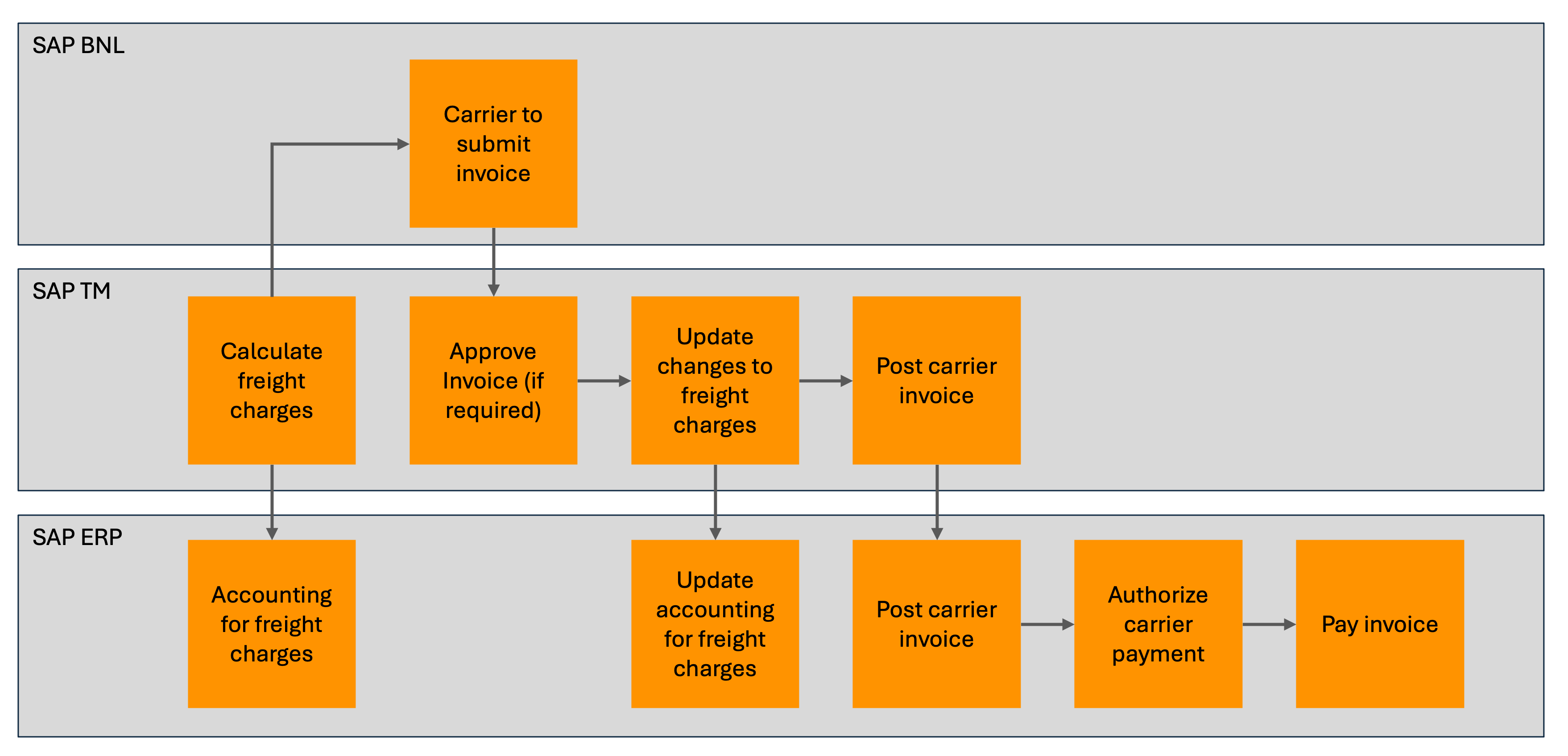
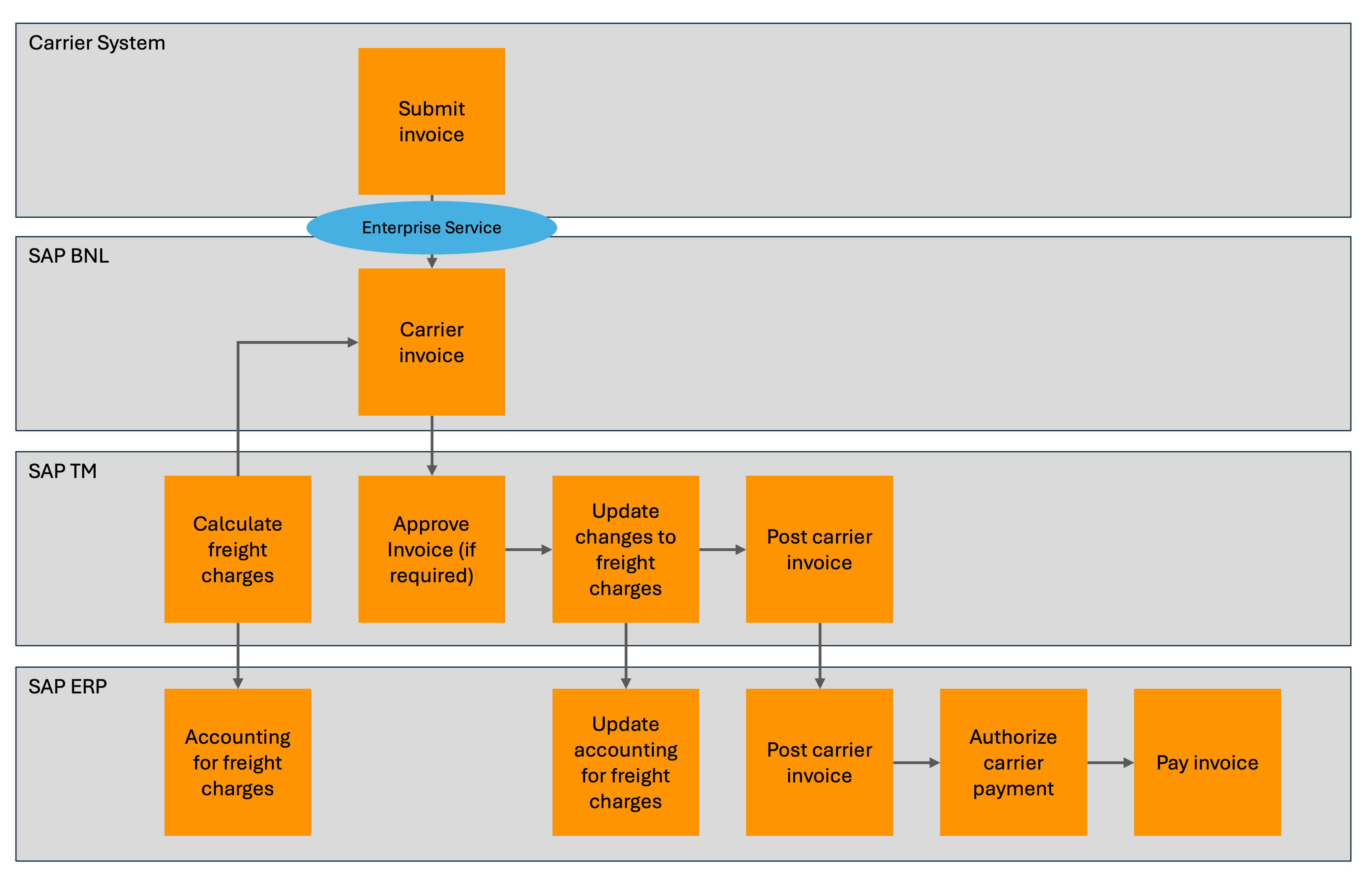
Extra costs and Dispute Management Freight costs as calculated by Syensqo on the Freight Document, can be reviewed by the carrier in BN4L. Here the carrier can update freight costs, include assessorial charges, penalties or update quantities like gross weight. When these discrepancies have been reported, the system will generate a dispute case that will be send to Syensqo for acceptance or rejection. A freight settlement dispute case is an individual business document that captures differences in logistics item quantities or charge amounts in a Freight Document or carrier invoice. As a requester of transportation services, such as a shipper, you own the information in the Freight Document. Your provider of transportation services, such as your carrier, checks the accuracy of the charge and logistics details in your Freight Document. In the review of freight charges process, the service provider uses BN4L to create a dispute case against a Freight Document. In the invoice submission process, the process of settlement between you and your service provider is based on an invoice that your service provider submits to you for a Freight Document. Your service provider can use the SAP BN4L portal to submit such an invoice. For example, your service provider can submit an invoice that contains changes to logistics details such as gross weight or gross volume, or changes to charge details such as rate or an additional charge line for an unplanned charge (specified by the corresponding charge type that can be selected by the carrier). In these situations, the system captures the changes in a dispute case and links the dispute case to the invoice your service provider submits. This avoids unnecessary rejections of invoices when they have been received. If the dispute case fails the tolerance limits you specify in Customising, you must manually review the dispute case on the Freight Settlement Dispute Cases app.
Charge-verification / Carrier Invoicing Standard invoicing process follows invoice verification through a standard Service PO, with standard VIM processing.SAP Business Network for Logistics adds two other options for carrier invoices; self-billing process or carrier invoicing through upload of Freight Document based invoices. Charge-verification Once the Freight Document is sent to the carrier, a new document is created within the "Invoice Freight Document" app, marked with the status "To Be Invoiced." Subsequently, the carrier user can generate an invoice for this document by utilising the "Create Invoice" button within the app. This action triggers the creation of an invoice document in the "Manage Invoice" app, labelled with the status "Draft," concurrently adjusting the Freight Document status to "Invoicing in Progress." As the carrier submits the invoice, the document status transforms to "Submitted," while the Freight Document status evolves to "Awaiting Ordering Party Response." At this juncture, the system initiates the transmission of the invoice to the Transportation Management (TM) system. Upon successful creation of the invoice in TM, the carrier invoicing status undergoes an update within the Freight Document, subsequently relayed to BN4L. This transition culminates in setting the Freight Document status to "Completely Invoiced," marking the successful completion of the invoicing process.
Carrier Invoicing Carrier can create an invoice for Freight Documents using the Provider API for Invoicing. Additionally, users can view the Freight Document for invoicing in the Invoice Freight Documents app in SAP BN4L. If there is any mismatch in the charges, the system creates a dispute either in the ordering party’s SAP Business Network for Logistics ordering party tenant or the external transportation system depending on the settings. Carrier On-Boarding to SAP Business Network for LogisticsThe Invite Business Partners app is designed for managing all the business partners that you want to be part of your network. You can use this app to select and invite business partners to join your business network and check their participation status. Carriers can choose to use BN4L from the launchpad (online), or they can set up integration using the following API's (EDI is also available):
Project 44 Add-OnSAP provides SAP Business Network with project44 add-ons that provide visibility content. These add-on services leverage the project44 multi-mode carrier network with its established B2B connectivity to carrier and logistics provider systems, electronic logging devices, and so on. Project 44 visibility content is available to SAP Business Network users through supplementary, add-on licenses from SAP. |



Option B: SAP TM integrated with Transwide
Transwide is the current TMS solution used in Europe and a few countries outside of Europe. The features used in from Transwide are:
- Tendering
- Carrier Determination
- Slot Scheduling
- Status Tracking
- Exception Management
- Additional Cost and Settlement
Transwide is currently used for road transportation, and in lesser amount for ocean (with BDP), but can be extended to other modes of transport.
Transwide is owned by Alpega and the solution has been renamed to Alpega TMS. Alpega TM is a combination of Inet and Transwide.
When integrating with Transwide, the integration objects will be Freight Order and Freight Booking. Once these documents are created, they are interfaced to Transwide for further processing.
For track and trace functions the design will follow similar design as with BN4L, where Project 44 is integrated with Transwide and Syensqo internal systems also send updates to Transwide where required. From Transwide the updates are propagated to SAP system.

*Note: decision for North America for replacement of BluJay is not taken into account in this KDD. Next to Transwide, E2Open TMS4S will be part of system landscape.
Option C: SAP TM integrated with E2Open TMS4S deployed internationally
BluJay, which is used in North America, will be replaced by E2Open TMS4S. TM4S is a complete, integrated software solution that manages the entire logistics operation from front to back, handling multiple languages, currencies, and time zones. It allows shippers to manage all multimodal transportation activities for one shipment. TMS4S will be used by most GBUs in North America region.
Features:
- Contracts & tariffs management
- Load optimisation
- Mode and carrier determination
- Electronic booking
- Freight cost calculation (planned & unplanned costs)
- Collaborative status tracking
- Transport reporting (carrier compliance, freight costs, KPIs…)
- Freight audit
- Freight payment
Part of this KDD is to consider if TMS4S is to be deployed globally. In that case Transwide would be replaced and all Freight Orders and Freight Bookings are integrated with TMS4S.
More detail on BluJay and TMS4S is provided in KDD048 - Way Forward with BluJay.

Assumptions
Execution systems can report events to portal
Execution systems owned by Syensqo, like Selfy, FDTMS or other mobile apps, can be integrated with the chosen portal solution. This can be SAP BN4L, Transwide or TMS4S. If this integration is not possible, then it will be considered to integrate these systems directly with SAP TM (this will be custom development). This decision will be taken during detail design.
Project 44
Project 44 will be included in project scope to receive shipment updates from ocean shipping liners.
Carriers can adopt SAP BN4L
With the information provided by SAP, carriers are able to utilise the launchpad online, or they can use API's provided by SAP.
Impacts
Carriers to adopt SAP BN4L
Carriers that are currently not using SAP BN4L will have to use the SAP BN4L Launchpad, or invest in integration using the BN4L API or EDI interfaces.
Preferred carriers
Carriers that are operational on SAP BN4L will be preferred carriers. It might require Syensqo to incentivise carriers adopt SAP BN4L.
User experience
With the use of SAP TM in combination with SAP BN4L, Syensqo users will work only in SAP TM and they can monitor progress of Tendering, Carrier Selection and Execution in the SAP TM system. When other systems are involved then users will need to switch between SAP and third party systems.
Business Rules
Freight charges to be updated in SAP TM
In either solution, freight charges have to be reported back to SAP TM transportation documents. This is to cater for accrual postings. The charges are distributed over the cargo and are posted as accruals in accounting.
Evaluation
Evaluating the functionalities between SAP BN4L and Transwide, there are not many differences. Ocean and Air freight shipments are not supported through Transwide. Since for these mode of transports the only option is to integration through BN4L, the recommendation is to retire Transwide and recognise SAP BN4L as the default global platform for carrier integration.
The E2Open TMS4S solution will be focussed on integration with USA and Canadian road carriers. There is no direct benefit of deploying TMS4S globally. Instead it will lack the benefit of the seamless integration that BN4L can offer.
The recommended option is Option A.
Option A: SAP TM with BN4L | Option B: Integrate SAP TM with Transwide | Option C: Integrate SAP TM with E2Open TMS4S | |
|---|---|---|---|
Functionality |
|
| |
User experience |
|
|
|
Costs |
|
|
|
Risks |
|
|
|
Network |
|
|
|
Change log
| Change History | ||
|---|---|---|
|
Option 3
Replace Transwide and deploy BNL to LAM and APAC. Integrate with BluJay.
Transwide can be retired
Option for integrated network for LAM and APAC.
NAM can keep using BluJay, which they are familiar with.
Dual solution.
Option 4
Global rollout of BNL and replace Transwide and BluJay for road freight.
Transwide can be retired
Option for integrated network for LAM and APAC.
Higher scope and project risk for successful deployment.
Can BNL be a good enough replacement for BluJay?
Other modes of transport might keep the integration with BluJay necessary.
Evaluation
n/a
See also
https://help.sap.com/docs/business-network-for-logistics?locale=en-US
Change log
Version
Date
Author
Change log
0.1
13 Jun 24
Nico van Os
Workflow history
| Workflow Report | ||||||
|---|---|---|---|---|---|---|
|