

| Status |
| ||||||
| Owner | |||||||
| Stakeholders |
Purpose
The purpose of this document is to define the conversion approach for the object 2012 - Material Master Accounting View 1 in S4HANA.
The document details out the field list, extraction criteria, scoping, mapping, transformation logic, generation of the pre-load file and loading of the same with respect to the object 2012- Accounting View 1 of the Material Master.
The accounting view governs how a material is valuated financially within a specific valuation area (typically plant or company code). It directly influences inventory valuation, cost accounting, and integration with the General Ledger Accounting.
Key data/fields maintained in the Material Master- Accounting View 1 are as below:
General Valuation Data
These section of the Accounting View 1 of the Material Master contains the fields that controls the valuation behavior behaviour and integration.
- Material Master - Field MBEW-MATNR
This field represents the Material Master for which the accounting and costing views are created. The material number must exist in the table MARA (basic table for Materials) - Total Stock - Field MBEW-LBKUM
This field stores the valuated quantity. The quantity gets updated upon the movement of stocks such as goods receipt, goods issue or scrapping. This field is available for display and not directly maintained in the Accounting View 1. The field gets updated in the MBEW table upon valuation. - Valuation Class- Field MBEW-BKLAS
Determines the G/L account for inventory postings based upon the account determination configuration (Table T030) - Valuation Category - Field MBEW-BWTTY
This is used for split valuation i.e. to valuate a material differently, e.g. in-house or external. In Syensquo, this field is not to be used in S4HANA as per the MDSThis is will be used for spares relevant for split valuation under material type ZIND (applicable for refurbishment). - Valuation Type - Field MBEW-BWTAR
This is used for split valuation i.e. to valuate a material differently, e.g. in-house or external. In Syensquo, this field is not to be used in S4HANA as per the MDSThis is will be used for spares relevant for split valuation under material type ZIND (applicable for refurbishment). - Price Determination - Field CKMLHD-MLAST
This field controls how prices are calculated in the Material Ledger. Below values are available to be maintained- 2: Transaction-based price- this indicator to be used for the case when ML actual costing is not active
- 3: Periodic Price - this indicator to be used for the case where actual costing to be run for the material
Prices and Value
These section of the Accounting View 1 of the Material Master contains the fields that stores the prices and values of a Material.
- Standard Price - Field MBEW-STPRS
This is the standard price of the material applicable for the valuation area (plant). The field is updated with numerical value - Moving Average Price - Field MBEW-VERPR
This is the moving average price of the material applicable for the valuation area (plant). The field gets updated with numerical value upon goods receipts, invoice postings, and price changes when Price Control = V. This field also denotes the periodic unit price that gets updated upon actual costing if the material ledger is active and relevant for costing of the material. - Unit Price- Field MBEW-PEINH
This field represents the Unit price for the different prices. In order to avoid rounding impacts, it is recommended to set the unit price to 100 or 1000 units - Price Control- Field MBEW-VPRSV
This field indicates the price control used to valuate stock/quantity of the material. There are two options available:- S: Standard Price
- V: Moving Average Price
- Total Value- Field MBEW-SALK3
This field stores the values i.e. total quantity multiplied by the price
The Accounting View 1 and 2 of the Material Master in S4HANA is similar to that of ECC which is defined by the table MBEW and MBEWH however below changes in S4HANA become important considerations for the conversion:
- The Table MBEW is still applicable but due to introduction of Universal Journal, the costing data is integrated
- Material Ledger activation is mandatory in S4HANA even though actual costing for some Company Codes may not be applicable
In SAP ECC, the Accounting View 1 is maintained for Materials which are mainly as below
Reference: PF2 - where the total value is more than 0.
- Approx 112220 plus records across 94 valuation areas
- The Valuation Classes and the count of Material are as below in PF2 where material has a value (MBEW-SALK3 not equals to 0) as on 22nd Sept'2025
Index Valuation Class Valuation Class Description Records with Price Control S Records with Price Control V Total 1 Z000 Main Raw Materials 1247 59 1306 2 Z049 Interplant Raw Material 2 0 2 3 Z050 Other Raw Materials 112 93 205 4 Z051 Packaging 800 340 1140 5 Z053 Semi-Finished Goods 2 0 2 6 Z054 Utilities 3 1 4 7 Z055 Gen & tec goods non packg 2423 89963 92385 8 Z057 Waste 39 7 46 9 Z058 Spare Parts 5 8397 8402 10 Z05A Assets- Quantity mgmt 1 167 168 11 Z05L Solid Fuels 0 4 4 12 Z05P Light Fuel Oil 0 1 1 13 Z05R* Gen & tec goods non packg 0 7 7 14 Z05Y* Utilities 0 2 2 15 Z061* Semi-Finished Goods 50 24 74 16 Z100 Finished Goods 2985 2324 5309 17 Z101 Finished Goods Purch. 100 3168 3172 Total 7770 104458 112228
Note:
- Valuation Classed marked with * to be confirmed as these seem to be duplicate.
- There are 2 records which do not have a valuation class. (not included above)
- The above numbers do not include the materials which have been set with "mark for deletion"
Reference: WP2 - where the total value is more than 0.
- Approx 145580 plus records across 243 valuation areas
- The Valuation Classes and the count of Material are as below in WP2 where material has a value (MBEW-SALK3 not equals to 0) as on 22nd Sept'2025
Index Valuation Class Valuation Class Description Records with Price Control S Records with Price Control V Total 1 Z100 CS Raw Materials 4987 378 5365 2 Z110 CS Packaging 1946 573 2519 3 Z120 CS Spare Parts 0 126159 126159 4 Z125 CS Spare Parts assets IFRS 0 33 33 5 Z130 CS Trading Goods 1171 59 1230 6 Z140 CS Intermediates 1232 0 1232 7 Z150 CS Finished Products 6166 1 6167 8 Z160 CS Spare Parts consum>BOM 0 2265 2265 9 Z170 CS Other operating supplies 0 442 442 10 Z175 CS Office supplies 0 156 156 Total 15502 130066 144568
Note:
- Valuation Classed marked with * to be confirmed as these seem to be duplicate.
- There are 17 records which do not have a valuation class. (not included above)
- The above numbers do not include the materials which have been set with "mark for deletion"
The target design in S4HANA for maintaining the Accounting View is as below
- Price Valuation: All materials that participates to manufacturing or semi-finished of finished goods (part of the BOM) should be managed at standard price with actual costing activated.
- The rest of materials should manage at moving average price without actual costing.
Note: In case of by-products, the price will be at standard price but without actual costing - Apart from above the accounting classification will also be another factor in maintaining this view based on valuation class.
- The field MBEW-MLMAA (ML Active) is set to active in S4HANA by default
The converted records for Material Master - Accounting View 1 will be The converted records will be loaded into the target S/4HANA system as overall load of Material Masters including different view, using standard SAP mechanisms such as BAPIs (e.g., BAPI_OBJCL_CREATE or BAPI_MATERIAL_SAVEDATA), IDOCs, or direct table loads where applicable, ensuring that all materials in scope have consistent and appropriate information related to Accounting Views of the relevant MaterialsLTMC.
Conversion Scope
The scope of this document covers the conversion approach for the the Object 2012 - Material Master Accounting View 1 from Legacy Source Systems into S/4HANA following the Data Object 2012 DD-FUN-050 Master Data Design Standard. Standard_2012-Materials Accounting 1
The materials relevant for valuation will be either having the price control indicator (MBEW-VPRSV) as S-Standard or V-Moving Average and accordingly the applicable price will be either maintained upon creation of a new material or updated based on the material movements.
For the purpose of the conversion, the standard price will be maintained in the field MBEW-STPRS (Standard Price) along with relevant price determination which will be used to arrive at the Total Value (MBEW-SALK3) upon the initial stock upload using movement type 561.
Data Relevancy for object 20152012:
The data from legacy system includes:
- Active Material Master that are in use (Production or Procurement) -Materials relevant for Accounting and Costing views have reference to table MARC (Plant Data for Material)
- The Materials must exit exist in table MBEW for Valuation Area (reference table T001K) or Company Code (Reference Table T001) in scope for conversion
- Active Material Masters where one of the Prices, Standard (Fields MBEW-STPRS) or Moving Average (Field MBEW-VERPR) is not blank
- Materials are used in the Costing Runs or exit in a BOM used in Costing Sheet
- The BOM must exist if the Material has "With Quantity Structure" (Field - MBEW-EKALR) indicator active
- The total value of the material is not equal to 0 i.e. field MBEW-SALK3 is not blank.
The data from legacy system excludes:
- Materials which are not in use either for Production or for Procurement
- Materials belong to Plants or Company Codes which are not in scope for S4HANA
- Materials are not in use in Costing
- Materials for which neither of the standard or moving average prices (Fields MBEW-STPRS or MBEW-VERPR) are maintained
- Materials for which there is no value available in "Total Value" (Field MBEW-SALK3)
For the purpose of conversion, only those records which is active and have a stock value will be considered. Accordingly, below approximated number of records are considered as scope for conversion, which may be reduced after cleansing.
Source Approx No. of Records
No. of Records
For the purpose of conversion, only those records which are active in Base table MARA and have a stock value will be considered. Accordingly, below approximated number of records are considered as scope for conversion, which may be reduced after cleansing.
| Source | Scope | Source Approx No. of Records | Target System | Target Approx No. of Records |
|---|---|---|---|---|
| PF2 | Materials Masters, active in table MARA, with value (MBEW-SALK3) not equals to 0 (Zero) | 112250 | S4HANA | 112250 |
| WP2 | Materials Masters, active in table MARA, with value (MBEW-SALK3) not equals to 0 (Zero) | 144600 | S4HANA | 144600 |
Additional Information
Multi-language Requirement
Not applicable
Document Management
Not applicable
Legal Requirement
Not applicable
Special Requirements
Below are the special requirements with respect to Material Master Accounting View 1:
- As the Material Ledger is going to be active in S4HANA by default, the price control indicator of the source materials needs to align where applicable
- The costing run in the legacy system must have been completed has part of the month end activity in the cutover month
- The standard price must be maintained before the initial Material Load happens with movement type 561
No localization or specific requirements
No third-party system relevant for source
Target Design
The to be target design relevant for Accounting View 1 of the Material Master based upon the MDS "DD-FUN-050 Master Data Standard_2012-Materials Accounting 1" is as below:
The technical design of the target for this conversion approach.
Additional Information
Multi-language Requirement
Document Management
Legal Requirement
Special Requirements
Target Design
The technical design of the target for this conversion approach.
Table | Field | Data Element | Field Description | Data Type | Length (Decimals) | Requirement |
MBEW |
MATNR |
MATNR |
Material Number | CHAR |
18 |
Required |
The controlling area is the highest organizational unit in Controlling.
Type: Text
Length: 80
MBEW | BWKEY | BWKEY | Valuation Area | CHAR |
4 |
Required |
Key which together with the controlling area uniquely identifies a profit center.
Use
You can make an organizational assignment of a profit center to a controlling object (an order, cost center,…). The system posts automatically on the profit center when you make a posting on controlling object (an order, cost center,…).
Type: Text
Length: 80
When you create an object, the beginning date to which object is valid is defined here.
Type: Date
When you create an object, you use the ending date to define as of when the object is valid.
Type: Date
Language in which profit center texts are saved. If the language is not filled, logon language is used as default to save the profit center text.
Type: CHAR
Length: 80
General description of the object. The profit center name is used for online displays and evaluations that do not have enough space for the profit center description.
Type: CHAR
Length: 20
A text that describes the profit center to which it refers in greater detail.
Type: Text
Length: 40
Name of the person in charge of the profit center.
Type: CHAR
Length: 20
In this field, you can enter the user ID of the person responsible for the profit center. This user ID is stored in the SAP user master record.
Type: CHAR
Length: 80
Each profit center must be assigned to a node in the standard hierarchy for its controlling area. This ensures that the standard hierarchy contains all the profit centers in the controlling area.
Type: CHAR
Length: 12
This field contains the name of the department to which the profit center belongs.
Type: CHAR
Length: 12
Segment for Segmental Reporting.
Note: Field Segment must be filled with leading zeros if it is numeric data. Example: if the segment value is 9999, enter 0000009999 in the XML file.
Type: CHAR
Length: 10
Title for Address data.
Type: CHAR
Length: 15
Name 1 of the customer/supplier address.
Type: CHAR
Length: 35
Name 2 of the customer/supplier address.
Type: CHAR
Length: 35
Name 3 of the customer/supplier address.
Type: CHAR
Length: 35
Name 4 of the customer/supplier address.
Type: CHAR
Length: 35
Street and house number as part of the address.
Type: CHAR
Length: 35
Name of the city as a part of the address.
Type: CHAR
Length: 35
Supplement to city name or district.
Use
The entry is appended to the city name with a hyphen by the automatic address formatting function.
(Exceptions: Germany, United Kingdom/Ireland and Japan)
Type: CHAR
Length: 35
The country/region key contains information which the system uses to check entries such as the length of the postal code or bank account number.
The two-character ISO code in accordance with ISO 3166, which is delivered by SAP as a default, is usually used.
Type: CHAR
Length: 80
Number of telebox for electronic mail.
Type: CHAR
Length: 15
First telephone number
Type: CHAR
Length: 16
Second telephone number for communication.
Type: CHAR
Length: 16
Number under which a business partner's telefax machine can be reached.
Use
The number is used by the system if you send a message by telefax to your business partner from within an SAP transaction.
Type: CHAR
Length: 31
Number under which a business partner's teletex machine can be reached.
Teletex is a service for the transmission of text and data. In comparison with a telex, however, the transmission times of teletex messages are shorter and the range of characters available is greater.
Use
The number is determined by the SAP system if you send a teletex message to your business partner from within an SAP transaction.
Type: CHAR
Length: 30
Number under which the telex machine can be reached.
Teletex is a service for the transmission of text and data. In comparison with a telex, however, the transmission times of teletex messages are shorter and the range of characters available is greater.
Type: CHAR
Length: 30
Data communication line no.
Line number (telephone line). Dialing this number enables you to establish a link with another computer at a different location.
Type: CHAR
Length: 14
Printer name for profit center
Type: CHAR
Length: 4
Max. length of input must not exceed 15 digits.
The tax jurisdiction is used for determining the tax rate. It defines to which tax authorities you must pay your taxes. It is always the city to which the goods are supplied.
If Vertex is activated (esp. on US installations) the tax jurisdiction code will be determined by the business object's address. If the given postal code/Zip code is not accurate as possible, Vertex will determine more than one tax jurisdiction code for one record, the migration of this record will fail. You will then get the error message "No unique jurisdiction code can be determined".
Type: CHAR
Length: 15
PO Box for address.
Type: CHAR
Length: 10
This field contains the postal (zip) code for the house address (street and city).
Type: CHAR
Length: 10
Postal code needed to allocate the P.O. Box.
Use
This field is used for a country/region where:
- the postal code (zip code) used to send letters to a customer's/vendor's P.O. Box is different to that used to send letters to a customer's/vendor's company address.
- large companies have their own postal code and no P.O. Box.
Type: CHAR
Length: 10
In some countries/regions, the region forms part of the address. The meaning depends on the country/region.
Type: CHAR
Length: 80
You can use the lock indicator to lock a profit center for postings. The lock only applies to the selected time interval. If the profit center is assigned to an object that receives a posting, the system displays an error message and the data is not posted.
This is an indicator field. If the criterion is met, enter X. If not, leave the field empty.
Type: CHAR
Length: 1
Template for Formula Planning in Profit Centers
Contains functions, which are used to find plan values using formula planning.
A template is assigned to the profit centers for which it is to be valid, in master data maintenance. It can be used for more than one profit center.
Type: CHAR
Length: 10
Data Cleansing
ID
Criticality
Error Message/Report Description
Rule
Output
Source System
1.
Can load, but business process will fail
Lock any Profit Centre not being used for last 5 years
TBD
Report
MBEW | LBKUM | LBKUM | Total Value | QUAN | 13 | This field will be updated upon initial stock upload |
MBEW | BWTAR | BWTAR | Valuation Type | CHAR | 10 | Optional Note: May be required in case of materials relevant for split valuation. |
| MBEW | BKLAS | BKLAS | Valuation Class | CHAR | 4 | Required |
MBEW | MLAST | MLAST | Price determination indicator | CHAR | 1 | Required |
MBEW | PEINH | PEINH | Unit price | DEC | 5 | Required |
MBEW | BWTTY | BWTTY | Valuation Category | CHAR | 1 | Optional Note: May be required for materials which are relevant for split valuation. Material type ZIND. |
MBEW | STPRS | STPRS | Standard Price | CURR | 13 | Required |
MBEW | MLMAA | CK_ML_MAAC | Material Ledger Active | CHAR | 1 | System Derived |
MBEW | EKLAS | EKLAS | Valuation Class for Sales Order Stock | CHAR | 4 | Not Used |
MBEW | QKLAS | QKLAS | Valuation Class for Project Stock | CHAR | 4 | Not Used |
MBEW | VPRSV | VPRSV | Price Control | CHAR | 1 | Required |
MBEW | VERPR | VERPR | Moving Avg Price | CURR | 13 | Optional |
MBEW | SALK3 | SALK3 | Inventory value | CURR | 13 | System Derived. This field will be updated upon initial stock upload |
MBEW | ZKPRS | ZKPRS | Future Price | CURR | 13 | System Generated (updated by the system during costing run) |
MBEW | ZKDAT | ZKDAT | Future Price From | DATS | 8 | System Generated (updated by the system during costing run) |
MBEW | STPRV | STPRV | Previous Price | CURR | 13 | System Generated (updated by the system during costing run) |
| MBEW | LAEPR | LAEPR | Date of last price change | DATS | 8 | System Generated (updated by the system during costing run) |
Data Cleansing
For the purpose of the Object 2012 - Material Master Accounting View 1, the data cleansing should happen in the source systems PF2, WP2 as per below cleansing activity. The business cleansing is expected to be done by the business.
- Data cleansing will be based on the relevancy as defined in Conv Spec 2010 (Materials - General Plant Data / S.Loc Data) and 2019 (Materials – Basic View).
Conversion Process
The generic high-level process steps for the conversion are as below:
- Extraction:
- Extract from the source systems: Apply the selection parameters and data relevancy as mentioned in this specification, from the relevant tables
- DCT: The DCT to be prepared if the data to be transformed and is part of the load file is not available in the Source system
- Transform
- Transform fields by applying the fields and value mapping in the Syniti
- Generate and validate Pre-load files
- Load
- Load the validated Pre-load file using SAP's LTMC or the custom upload program as applicable.
However, with respect to object 2012- Material Master - Accounting View 1, the conversion process will depend upon the overall cutover/migration strategy <To be finalised by Functional team>, in view of the mandatory Material Ledger activation in S4HANA. The common practice/approach and steps followed are as below:
- Master Data: Load Material Master
Load material master data with all relevant views including Accounting and Costing views
The price control S or V as decided is set in the Accounting View - Material Valuation: Load Material Valuation
Data to be loaded includes Price Control, current standard price, current moving average price (if the price control is V) - Open PO, Production orders
Load open Purchase Orders and Production Orders if any - Load Inventory balances
Data to be loaded for stock quantity per plant/valuation area
This will update the total stock and value view in the accounting view - Material Ledger Costing - If the price control is S
Run costing (CK40N) in the S4HANA
As of now, this conversion specification is meant for updating the Accounting View 1 of the Material Master as part of the Material Master Load.
Standard LTMCs for Material Master and Material Valuations to be used.
Data Privacy and Sensitivity
Not applicable except materials having export control.
Extraction
Extract data from a source into Syniti.
There are 2 possibilities:
- The data exists. Syniti connects to the source and loads the data into Synity. There are 3 methods:
- Perform full data extraction from relevant tables in the source system(s).
- Perform extraction through the application layer
- Only if Synity cannot connect to the source, data is loaded to the repository from the provided source system extract/report
- The data does not exist (or cannot be converted from its current state). The data is manually collected by the business directly in Synity This is to be conducted using DCT (Data Collection Template) in Synity
The agreed Relevancy criteria is applied to the extracted records to identify the records that are applicable for the Target loads
Extraction Run Sheet
Req # | Requirement description | Team responsible |
1. | Extract from table MBEW all MATNR (material masters) where MBEW-BKLAS (Valuation Class) is not blank | Syniti Team |
2. | Extract from table MBEW all MATNR (material masters) for the in-scope materials defined in conversion specifications 2010 (Materials - General Plant Data / S.Loc Data) and 2019 (Materials – Basic View). | Syniti Team |
3. | Repeat Req # 1 to 2 if required | Syniti Team |
Selection Screen
In-scope materials as per conversion spec 2010 (Materials - General Plant Data / S.Loc Data) and 2019 (Materials – Basic View) will be extracted.
Data Collection Template (DCT)
Target Ready Data Collection Template will be created for Object 2012 Material Master - Accounting View 1 data with exception of some fields which require transformation as mentioned in the transformation rule. (only for enrichment, as of now this is a provision for DCT)2012 - Material Master 1 Accounting View
DCT Rules
Field Name | Field description | Rule |
MBEW-MATNR | Material | This is a required field Material Number for which Price needs to be maintained |
MBEW-BWKEY | Valuation Area | This is a required field Business to enter Plant of the Material |
MBEW-BWTAR | Valuation Type | This is an optional field Business to enter valuation type only for materials which are relevant for split valuation (e.g. spares) |
MBEW-BKLAS | Valuation Class | This is a required field Business to enter the correct valuation class. The GL account for material postings get derived based on valuation class. Hence it is important to enter the correct valuation class. |
MBEW-MLAST | Price determination indicator | Business to enter price determination indicator as 2 for the case without ML actual costing, or MAP or 3 for the case of actual costing to be run for the material |
MBEW-PEINH | Unit Price | This is a required field Business to enter price unit if the Material Price unit is changing from legacy |
MBEW-BWTTY | Valuation Category | This is an optional field Business to enter valuation type only for materials which are relevant for split valuation (e.g. spares) i.e. material type ZIND (relevant for refurbishment). |
MBEW-STPRS | Standard Price | Business to enter standard price if the Material has price control as S |
MBEW-VPRSV | Price Control | Business to enter S for Standard or V for Moving Average Price |
MBEW-VERPR | Moving Average Price | Business to enter standard price if the Material has price control as V |
Extraction Dependencies
Below dependencies apply for extraction.
Item # | Step description | Team responsible |
1. | Any period / year end close activities including costing runs have been fully completed | Business |
2. | Data Cleansing (such as setting the Flag for Deletion at Master level) has been done | Business |
3. | The total value is reconciled in MM and FI | Business |
4 | The prices and units to be loaded have been confirmed and reconcile to total value to be loaded | Business |
Transformation
The Target fields are mapped to the applicable Legacy field that will be its source, this is a 3-way activity involving the Business, Functional team and Data team. This identifies the transformation activity required to allow Syniti to make the data Target ready:
- Perform value mapping and data transformation rules.
- Legacy values are mapped to the to-be values (this could include a default value)
- Values are transformed according to the rules defined in Syniti
- Prepare target-ready data in the structure and format that is required for loading via prescribed Load Tool. This step also produces the load data ready for business to perform Pre-load Data Validation
Transformation Run Sheet
Item # | Step description | Team responsible |
1. | Ensure all the fields that require value mapping, as stipulated Mapping tables, have the latest signed-off mapping files imported into Syniti | Data team |
2. | Ensure that signed off value mappings have been maintained in the Syniti | Syniti team |
3. | Confirm the value mappings as maintained in the Syniti | Data team |
4. | Ensure that Signed off DCT from business has been received and maintained in Syniti | Syniti/Data team |
5 | Execute transformation for the object | Syniti team |
6 | Monitor the transformation progress and ensure performance and completion is within allowed timeframe | Syniti/Data team |
7. | Generate Pre-Load reports. | Syniti team |
8. | Generate data load count. | Syniti team |
9. | Log errors as defects, if any and address resolutions. Close defects. | Syniti/Data team |
10. | Re-transform and re-validate the Pre-load reports if necessary. | Syniti/Data team |
11. | Validate the transformed file as part of pre-load validation, raise data defects or provide the pre-load sign-off. | Business |
12. | Analyse and resolve any pre-load defects logged by business. | Syniti/Data team |
13. | Repeat steps 5 to 11 if necessary | Syniti/Data team |
14. | Proceed to pre-load validations | Data team |
Transformation Rules for legacy Extraction
Rule # | Source system | Source Table | Source Field | Source description | Target system | Target Table | Target Field | Target description | Transformation logic |
1 | PF2/WP2 | MBEW | MATNR | Material | S4HANA | MBEW | MATNR | Material | XREF of the materials loaded before as part of basic view |
2 | PF2/WP2 | MBEW | BWKEY | Valuation Area | S4HANA | MBEW | BWKEY | Valuation Area | Value Mapping for Valuation Area/ Valuation Class |
3 | PF2/WP2 | MBEW | BWTAR | Valuation Type | S4HANA | MBEW | BWTAR | Valuation Type | Copy legacy values where available. |
4 | PF2/WP2 | MBEW | BKLAS | Valuation Class | S4HANA | MBEW | BKLAS | Valuation Class | |
5 | PF2/WP2 | MBEW | MLAST | Price determination indicator | S4HANA | MBEW | MLAST | Price determination indicator | Copy legacy values 2 for the case without ML actual costing, or MAP 3 for the case of actual costing to be run for the material |
6 | PF2/WP2 | MBEW | PEINH | Unit price | S4HANA | MBEW | PEINH | Unit price | Copy legacy value |
7 | PF2/WP2 | MBEW | BWTTY | Valuation Category | S4HANA | MBEW | BWTTY | Valuation Category | Copy legacy values where available. |
8 | PF2/WP2 | MBEW | STPRS | Standard Price | S4HANA | MBEW | STPRS | Standard Price | Copy legacy values |
9 | PF2/WP2 | MBEW | VPRSV | Price Control | S4HANA | MBEW | VPRSV | Price Control | Copy legacy values |
10 | PF2/WP2 | MBEW | VERPR | Moving Average Price | S4HANA | MBEW | VERPR | Moving Average Price | Copy legacy values |
Transformation rules for DCT
PF2 / PI2 / WP2
Conversion Process
The high-level process is represented by the diagram below:
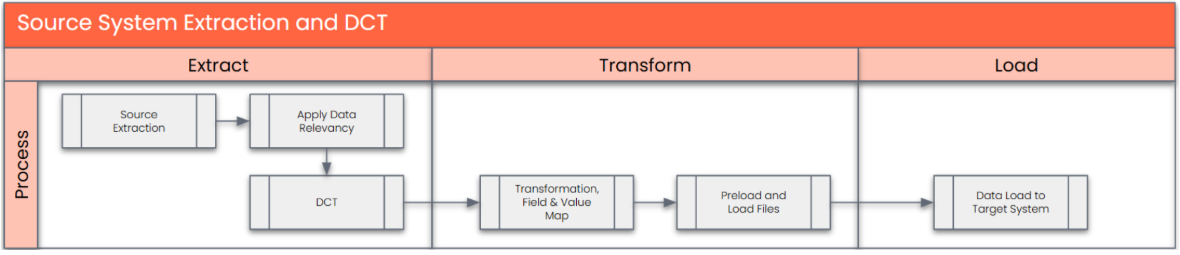
Data Privacy and Sensitivity
Extraction
Extract data from a source into . There are 2 possibilities:
- The data exists. connects to the source and loads the data into . There are 3 methods:
- Perform full data extraction from relevant tables in the source system(s).
- Perform extraction through the application layer.
- Only if ; cannot connect to the source, data is loaded to the repository from the provided source system extract/report.
- The data does not exist (or cannot be converted from its current state). The data is manually collected by the business directly in . This is to be conducted using DCT (Data Collection Template) in
The agreed Relevancy criteria is applied to the extracted records to identify the records that are applicable for the Target loads
Extraction Run Sheet
Req #
Requirement description
Team responsible
1.
Ensure source tables CEPC and CEPCT are extracted in tool according to the agreed cut-off date in the project plan
Ensure DCT is collected for the Profit Centres based on the collection template
Data team
2.
Perform preliminary completeness check documented in section 5.2.8.1.1
Data team
3.
Raise issues as defects if Req # 1 to 2 are not met
Data team
4.
Repeat Req # 1 to 3 if required
Data team
5.
Report extraction result to person in charge of APOI conversion
Data team
Selection Screen
Data Collection Template (DCT)
Target Ready Data Collection Template will be created for data with exception of some fields which require transformation as mentioned in the transformation rule.DCT Rules
Field Name | Field description | Rule |
CEPC-PRCTR | Profit Centre | Business to enter content as per data type and length permitted |
Suggestion to add:
Decimal validation - Check table TCURX for the document currency key and if Decimals (TCURX-CURRDEC) is ‘0’, validate that no decimal value is populated.
Extraction Dependencies
Item # | Step description | Team responsible |
1. | Any period / year end close activities have been fully completed | Business |
2. | Reconciliation for intercompany payables have been completed, and adjustment made in legacy SAP system | Business |
3. | Reconciliation of migrated Purchase Order is completed before the extraction of Accounts Payable Open Items | Business and Data |
Transformation
The Target fields are mapped to the applicable Legacy field that will be its source, this is a 3-way activity involving the Business, Functional team and Data team. This identifies the transformation activity required to allow to make the data Target ready:
- Perform value mapping and data transformation rules.
- Legacy values are mapped to the to-be values (this could include a default value)
- Values are transformed according to the rules defined in
- Prepare target-ready data in the structure and format that is required for loading via prescribed Load Tool. This step also produces the load data ready for business to perform Pre-load Data Validation
Transformation Run Sheet
Item # | Step description | Team responsible |
1. | Ensure all the fields that require value mapping, as stipulated Mapping tables, have the latest signed-off mapping files imported into toolMigrate. | Data team |
2. | In tool, select the Trial Balance object PY. | Data team |
3. | Go to Process Area Launch and Process the Object - Trial Balance object - R4 Trial Balance PY. | Data team |
4. | Launch the Objects to execute transformation. | Data team |
5. | Monitor the transformation progress and ensure performance and completion is within allowed timeframe | Data team |
6. | Generate Pre-Load reports . | Data team |
7. | Generate data load count. | Data team |
8. | Log errors as defects, if any and address resolutions. Close defects. | Data team |
9. | Re-transform and re-validate the Pre-load reports if necessary. | Data team |
10. | Validate the transformed file as part of pre-load validation, raise data defects or provide the pre-load sign-off. | Business |
11. | Analyse and resolve any pre-load defects logged by business. | Data team |
12. | Repeat steps 6 to 11 if necessary | Data team |
13. | Proceed to pre-load validations | Data team |
Transformation Rules
Rule # | Source system | Source Table | Source Field | Source description | Target system | Target Table | Target Field | Target description | Transformation logic |
1 |
Construct |
NA |
NA |
The controlling area is the highest organizational unit in Controlling.
Type: Text
Length: 80
The controlling area is the highest organizational unit in Controlling.
Type: Text
Length: 80
Key which together with the controlling area uniquely identifies a profit center.
Use
You can make an organizational assignment of a profit center to a controlling object (an order, cost center,…). The system posts automatically on the profit center when you make a posting on controlling object (an order, cost center,…).
Type: Text
Length: 80
Key which together with the controlling area uniquely identifies a profit center.
Use
You can make an organizational assignment of a profit center to a controlling object (an order, cost center,…). The system posts automatically on the profit center when you make a posting on controlling object (an order, cost center,…).
Type: Text
Length: 80
When you create an object, the beginning date to which object is valid is defined here.
Type: Date
When you create an object, the beginning date to which object is valid is defined here.
Type: Date
When you create an object, you use the ending date to define as of when the object is valid.
Type: Date
When you create an object, you use the ending date to define as of when the object is valid.
Type: Date
Language in which profit center texts are saved. If the language is not filled, logon language is used as default to save the profit center text.
Type: Text
Length: 80
Language in which profit center texts are saved. If the language is not filled, logon language is used as default to save the profit center text.
Type: Text
Length: 80
General description of the object. The profit center name is used for online displays and evaluations that do not have enough space for the profit center description.
Type: Text
Length: 20
General description of the object. The profit center name is used for online displays and evaluations that do not have enough space for the profit center description.
Type: Text
Length: 20
A text that describes the profit center to which it refers in greater detail.
Type: Text
Length: 40
A text that describes the profit center to which it refers in greater detail.
Type: Text
Length: 40
Name of the person in charge of the profit center.
Type: Text
Length: 20
Name of the person in charge of the profit center.
Type: Text
Length: 20
In this field, you can enter the user ID of the person responsible for the profit center. This user ID is stored in the SAP user master record.
Type: Text
Length: 80
In this field, you can enter the user ID of the person responsible for the profit center. This user ID is stored in the SAP user master record.
Type: Text
Length: 80
Each profit center must be assigned to a node in the standard hierarchy for its controlling area. This ensures that the standard hierarchy contains all the profit centers in the controlling area.
Type: Text
Length: 12
Each profit center must be assigned to a node in the standard hierarchy for its controlling area. This ensures that the standard hierarchy contains all the profit centers in the controlling area.
Type: Text
Length: 12
This field contains the name of the department to which the profit center belongs.
Type: Text
Length: 12
This field contains the name of the department to which the profit center belongs.
Type: Text
Length: 12
Segment for Segmental Reporting.
Note: Field Segment must be filled with leading zeros if it is numeric data. Example: if the segment value is 9999, enter 0000009999 in the XML file.
Type: Text
Length: 10
Segment for Segmental Reporting.
Note: Field Segment must be filled with leading zeros if it is numeric data. Example: if the segment value is 9999, enter 0000009999 in the XML file.
Type: Text
Length: 10
Title for Address data.
Type: Text
Length: 15
Title for Address data.
Type: Text
Length: 15
Name 1 of the customer/supplier address.
Type: Text
Length: 35
Name 1 of the customer/supplier address.
Type: Text
Length: 35
Name 2 of the customer/supplier address.
Type: Text
Length: 35
Name 2 of the customer/supplier address.
Type: Text
Length: 35
Name 3 of the customer/supplier address.
Type: Text
Length: 35
Name 3 of the customer/supplier address.
Type: Text
Length: 35
Name 4 of the customer/supplier address.
Type: Text
Length: 35
Name 4 of the customer/supplier address.
Type: Text
Length: 35
Street and house number as part of the address.
Type: Text
Length: 35
Street and house number as part of the address.
Type: Text
Length: 35
Name of the city as a part of the address.
Type: Text
Length: 35
Name of the city as a part of the address.
Type: Text
Length: 35
Supplement to city name or district.
Use
The entry is appended to the city name with a hyphen by the automatic address formatting function.
(Exceptions: Germany, United Kingdom/Ireland and Japan)
Type: Text
Length: 35
Supplement to city name or district.
Use
The entry is appended to the city name with a hyphen by the automatic address formatting function.
(Exceptions: Germany, United Kingdom/Ireland and Japan)
Type: Text
Length: 35
The country/region key contains information which the system uses to check entries such as the length of the postal code or bank account number.
The two-character ISO code in accordance with ISO 3166, which is delivered by SAP as a default, is usually used.
Type: Text
Length: 80
The country/region key contains information which the system uses to check entries such as the length of the postal code or bank account number.
The two-character ISO code in accordance with ISO 3166, which is delivered by SAP as a default, is usually used.
Type: Text
Length: 80
Number of telebox for electronic mail.
Type: Text
Length: 15
Number of telebox for electronic mail.
Type: Text
Length: 15
First telephone number
Type: Text
Length: 16
First telephone number
Type: Text
Length: 16
Second telephone number for communication.
Type: Text
Length: 16
Second telephone number for communication.
Type: Text
Length: 16
Number under which a business partner's telefax machine can be reached.
Use
The number is used by the system if you send a message by telefax to your business partner from within an SAP transaction.
Type: Text
Length: 31
Number under which a business partner's telefax machine can be reached.
Use
The number is used by the system if you send a message by telefax to your business partner from within an SAP transaction.
Type: Text
Length: 31
Number under which a business partner's teletex machine can be reached.
Teletex is a service for the transmission of text and data. In comparison with a telex, however, the transmission times of teletex messages are shorter and the range of characters available is greater.
Use
The number is determined by the SAP system if you send a teletex message to your business partner from within an SAP transaction.
Type: Text
Length: 30
Number under which a business partner's teletex machine can be reached.
Teletex is a service for the transmission of text and data. In comparison with a telex, however, the transmission times of teletex messages are shorter and the range of characters available is greater.
Use
The number is determined by the SAP system if you send a teletex message to your business partner from within an SAP transaction.
Type: Text
Length: 30
Number under which the telex machine can be reached.
Teletex is a service for the transmission of text and data. In comparison with a telex, however, the transmission times of teletex messages are shorter and the range of characters available is greater.
Type: Text
Length: 30
Number under which the telex machine can be reached.
Teletex is a service for the transmission of text and data. In comparison with a telex, however, the transmission times of teletex messages are shorter and the range of characters available is greater.
Type: Text
Length: 30
Data communication line no.
Line number (telephone line). Dialing this number enables you to establish a link with another computer at a different location.
Type: Text
Length: 14
Data communication line no.
Line number (telephone line). Dialing this number enables you to establish a link with another computer at a different location.
Type: Text
Length: 14
Printer name for profit center
Type: Text
Length: 4
Printer name for profit center
Type: Text
Length: 4
Max. length of input must not exceed 15 digits.
The tax jurisdiction is used for determining the tax rate. It defines to which tax authorities you must pay your taxes. It is always the city to which the goods are supplied.
If Vertex is activated (esp. on US installations) the tax jurisdiction code will be determined by the business object's address. If the given postal code/Zip code is not accurate as possible, Vertex will determine more than one tax jurisdiction code for one record, the migration of this record will fail. You will then get the error message "No unique jurisdiction code can be determined".
Type: Text
Length: 15
Max. length of input must not exceed 15 digits.
The tax jurisdiction is used for determining the tax rate. It defines to which tax authorities you must pay your taxes. It is always the city to which the goods are supplied.
If Vertex is activated (esp. on US installations) the tax jurisdiction code will be determined by the business object's address. If the given postal code/Zip code is not accurate as possible, Vertex will determine more than one tax jurisdiction code for one record, the migration of this record will fail. You will then get the error message "No unique jurisdiction code can be determined".
Type: Text
Length: 15
PO Box for address.
Type: Text
Length: 10
PO Box for address.
Type: Text
Length: 10
This field contains the postal (zip) code for the house address (street and city).
Type: Text
Length: 10
This field contains the postal (zip) code for the house address (street and city).
Type: Text
Length: 10
Postal code needed to allocate the P.O. Box.
Use
This field is used for a country/region where:
- the postal code (zip code) used to send letters to a customer's/vendor's P.O. Box is different to that used to send letters to a customer's/vendor's company address.
- large companies have their own postal code and no P.O. Box.
Type: Text
Length: 10
Postal code needed to allocate the P.O. Box.
Use
This field is used for a country/region where:
- the postal code (zip code) used to send letters to a customer's/vendor's P.O. Box is different to that used to send letters to a customer's/vendor's company address.
- large companies have their own postal code and no P.O. Box.
Type: Text
Length: 10
In some countries/regions, the region forms part of the address. The meaning depends on the country/region.
Type: Text
Length: 80
In some countries/regions, the region forms part of the address. The meaning depends on the country/region.
Type: Text
Length: 80
You can use the lock indicator to lock a profit center for postings. The lock only applies to the selected time interval. If the profit center is assigned to an object that receives a posting, the system displays an error message and the data is not posted.
This is an indicator field. If the criterion is met, enter X. If not, leave the field empty.
Type: Text
Length: 1
You can use the lock indicator to lock a profit center for postings. The lock only applies to the selected time interval. If the profit center is assigned to an object that receives a posting, the system displays an error message and the data is not posted.
This is an indicator field. If the criterion is met, enter X. If not, leave the field empty.
Type: Text
Length: 1
Template for Formula Planning in Profit Centers
Contains functions, which are used to find plan values using formula planning.
A template is assigned to the profit centers for which it is to be valid, in master data maintenance. It can be used for more than one profit center.
Type: Text
Length: 10
Template for Formula Planning in Profit Centers
Contains functions, which are used to find plan values using formula planning.
A template is assigned to the profit centers for which it is to be valid, in master data maintenance. It can be used for more than one profit center.
Type: Text
Length: 10
Transformation Mapping
Mapping Table Name | Mapping Table Description |
Profit Centre | Mapping of legacy Profit Center to target system value |
Person Responsible | Mapping of legacy Person Responsible to New Person Responsible |
User ID | Mapping of legacy User ID |
Hierarchy Group | Mapping of Legacy Hierarchy Group to Hierarchy Group |
Transformation Dependencies
List the steps that need to occur before transformation can commenceEnsure Profit Centre hierarchies are loaded into target S/4HANA
NA | S4HANA | MBEW | MATNR | Material | As per DCT | ||||
2 | Construct | NA | NA | NA | S4HANA | MBEW | BWKEY | Valuation Area | As per DCT |
3 | Construct | NA | NA | NA | S4HANA | MBEW | BWTAR | Valuation Type | As per DCT. To be left blank if the material is not relevant for split valuation. |
4 | Construct | NA | NA | NA | S4HANA | MBEW | BKLAS | Valuation Class | As per DCT |
5 | Construct | NA | NA | NA | S4HANA | MBEW | MLAST | Price determination indicator | (Value as per DCT) Enter “2” for the material without ML actual costing, or MAP Enter “3” for the material relevant for actual costing |
6 | Construct | NA | NA | NA | S4HANA | MBEW | PEINH | Unit price | As per DCT |
7 | Construct | NA | NA | NA | S4HANA | MBEW | BWTTY | Valuation Category | As per DCT. To be left blank if the material is not relevant for split valuation. |
8 | Construct | NA | NA | NA | S4HANA | MBEW | STPRS | Standard Price | As per DCT |
9 | Construct | NA | NA | NA | S4HANA | MBEW | VPRSV | Price Control | As per DCT |
10 | Construct | NA | NA | NA | S4HANA | MBEW | VERPR | Moving Average Price | As per DCT |
Transformation Mapping
Below value mapping tables should be constructed in SynitiMapping Table Name | Mapping Table Description |
Material | Mapping of Old vs New Material based on the Source MATNR number to target MATNR |
Valuation Area | Mapping of legacy ECC valuation area to S4HANA valuation area |
Valuation Class | Mapping of legacy ECC valuation area to S4HANA valuation area |
Transformation Dependencies
List the steps that need to occur before transformation can commence| Item # | Step Description | Team Responsible |
|---|---|---|
| 1 | Ensure all the fields that require value mapping, as stipulated Mapping tables, have the latest signed-off mapping files imported into Syniti | Data team |
| 2 | Ensure that signed off value mappings have been maintained in the Syniti | Syniti team |
| 3 | Confirm the value mappings as maintained in the Syniti | Data team |
| 4 | Ensure that Signed off DCT from business has been received and maintained in Syniti | Syniti/Data team |
| 5 | Confirm on the extracted values | Syniti, Data and business |
Pre-Load Validation
Project Team
The Pre Load validations are performed by Project TeamCompleteness
Task | Action |
Generation of | Mandatory field check.
|
Record Count | Record Count Confirm the record counts in preload summary report
|
Business Confirmation | Data team after the initial validation of Pre-Load validation based on the pre agreed validation checklist To send the Pre-Load file to the Business Representatives for all plants/valuation area in scope for conversion Business Representatives to validate the pre-load file Agree with data team on the next steps for erroneous records |
Exception | Establish exception rules and get approval, if applicable |
Accuracy
Task | Action |
Mandatory field mapping and transformation | Obtain a list of the fields to be populated with values from mapping files and ensure all these fields contain S/4HANA values.
Review the data report to ensure mapping value is not missing in tool. |
Integration/Reference checks | Validate links to tables MARA, MARC, and valuation classes in T025 |
Business Value Checks |
(above checks are to be done for overall accounting and costing views of the material master) |
Records in Errors | Review and correct the errors. Achieve a zero-error record count as much as possible. Raise defects for data remediated and requiring a correction in the source data. |
Business
The following pre-load validations will be performed by business.Completeness
| Task | Action |
|---|---|
| Check Data load register count | Business Data Owner/s to verify that the total number of relevant records to be converted is equal to the total number of records in the Preload file and Load Sheets for the valuation areas (plants) in scope. |
Accuracy
| Task | Action |
|---|---|
| Conversion accuracy | To check and validate the load files with all the transformation and mapping rules, to be signed off. |
Pre-Load Validation
Project Team
Completeness
Task
Action
Generation of
Pre-load reports
Mandatory field check.
Profit Centres are mapped to new values
Profit Centre Hierarchy Mapped to new values
Person Responsible / HR positions mapped to new values
Record Count
Confirm the record counts in preload summary report
Total Records:
Valid Records:
Invalid Records:
Accuracy
Task
Action
Mandatory field mapping and transformation
Obtain a list of the fields to be populated with values from mapping files and ensure all these fields contain S/4HANA values.
Review the data report to ensure mapping value is not missing in tool.
Capture errors in the Data Error report.
Business
Completeness
Confirm the Preload File contains all the records in scope of migration ( Based on list of profit centres mapped from old to new )
Accuracy
Verify Profit Centres are transformed accurately as per endorsed transformation/mapping rules.
Review error reports in tool for any mismatch or missing transformed values.
In legacy system, execute ECC tcode SE16N to display table CEPC to confirm copied fields are accurately copied.
If any of the sum is different, raise defect and flag the relevant record as error.Load
The load process includes:
- Execute the automated data load into target system using load tool or produce the load file if the loading of records to be done using LTMC cockpit object of Profit CentreMaterial Master and Material Valuation.
- Once the data is loaded to the target system, it will be extracted and prepared for Post Load Data Validation with side by side check of each fields in scope of the objects with fields to be displayed as XXXX_ECC, XXXX_S4HANA, XXXX_MATCH ( As TRUE or FALSE) with an additional column denoting fields not matching and status of loading in S/4HANA as LOADED_IN_S4HANA ( As TRUE or FALSE) )
| View file | ||||
|---|---|---|---|---|
|
Load Run Sheet
Item | Step description | Team responsible | ||
1Ensure | the load tools are transported into the correct tool instanceGo to load file and pick 5 data records, load manually without any tool. See what happens. If all okay, proceed with the next step. | Data team | ||
2Ensure DCTs and all required mappings are submitted and complete | Go to load file and pick 10 records and load them with the tool. No action if the previous step has fallen. If not, then continue to load 10 records with the tool. Check if everything went okay. | Data team | ||
3Ensure Pre-load sign-offs are obtained. | Proceed with the full load if steps one and two were succeed else fix the issue with records | Data team | ||
4Execute upload of Profit Centre Object using Migration Cockpit Object for Profit Centre Upload | Validate few records loaded by accessing standard transactions from S/4HNA e.g. MM03 | Data team | ||
5 | Generate the post load reports in tool.report if step 5 is validated | Data team | ||
6 | Log errors as defects, if any and address resolutions. Close defects. | Data team | ||
7 | Resolve defects by reupload and re-generate post load reports if necessary. | Data team | ||
8 | Business to validate the post load files as part of post-load validation, raise data defects or provide the post-load sign-off. | Business | ||
9 | Repeat steps 1 to 5 to 7 if necessary. | Data team | if necessary. | Data team |
Load Phase and Dependencies
The load phase for this object is ideally relevant for Pre-Cutover. TBC by S2P team.Load Phase and Dependencies
Configuration
Item # | Configuration item |
1. | Controlling Area configuration |
2. Standard Hierarchy is Maintained | Plants (WERKS) should exist |
3. | Currencies (currency keys, decimal places in currencies) |
Conversion Objects
Error Handling
Error type | Error description | Action taken |
P | Posting period is blocked for posting | Review project / cutover plan and ensure posting periods can be opened for postings |
Profit Centre does not exist | Profit centre does not exist in company code | Ensure the profit centre mapping is correct and or create the profit centre if it is valid |
Company Codes (BUKRS) should exist | |
4 | Valuation Class (BJLAS) should exist |
5 | Material Type Configuration |
6 | Account determination for GL accounts in OBYC for valuation classes maintained |
Conversion Objects
| Object # | Preceding Object Conversion Approach |
|---|---|
| 2019 | Material Master Basic View |
Error Handling
The table below depicts some possible system errors for this data object during data load. All data load error is to be logged as defect and managed within the Defect Management
Error type | Error description | Action taken |
Posting Period | Posting period is blocked for posting | Review project / cutover plan and ensure posting periods can be opened for postings |
Valid Master | Material Master is not available | Ensure the material master has been created |
ML active | Plant is not active for Material Ledger | Review project / cutover plan and ensure step for ML activation for all plants in S4 has been done |
Post-Load Validation
Project Team
Completeness
| Task | Action |
|---|---|
| Reconciliation of Record Count | Record Count - Count and check how many records were loaded vs. Records in the load file (Each mock has it's own data record count) Check for logs from Load and fix erroneous records, if any |
Post-Load Validation
Project Team
Completeness
| Task | Action |
|---|---|
| Reconciliation of Record Count | Total number of records loaded for TB Balance ( PY ) will be generated in the Post-load reports in tool based on the target table and fields mentioned in section 3. The reconciliation needs to be executed on the total number of ‘valid’ records and currency amount per company code in the source compared to total number of records and currency amount in S/4HANA Record Count Check the sum of record count of the open items in the load file is the same as S/4HANA. The record count for TB Balance ( PY ) will be done on the group basis. The fields in the group are consist of: Company Code, Vendor Account Check Amount in Document Currency and Local Currency Check on line item level that the sum of the amount in Document Currency and Local Currency in the load file is the same as posted in S/4HANA. If any of the sum is different, flag the record as error. |
Accuracy
| Task | Action |
|---|---|
| Check values in key fields for accuracy | Post-load reports will have the same structure as the load file and some additional columns as required to facilitate the post load validation. Leverage on tool to create a Post Load report that reports S/4HANA loaded records along with the legacy values side-by-side to allow for 100% check of all these fields in the shortest possible time. Any mismatch will be reported under the Post Load - Error report. |
Business
Completeness
| Task | Action |
|---|---|
| Record Count Check | Review the record count report from the Data Team and ensure it is correct by cross-checking with the record count confirmed during Pre-load Business Validations |
Accuracy
| Task | Action | ||
|---|---|---|---|
| Open items totals | Check business partner open item totals by Business partner, Company code, profit centre. Totals should be checked in Document, Local and Group currency. | ||
| Field Checks | Check the price unit (i.e. in KGs or other UOM) is correctly maintained Check the right price control | ||
| Value Check | Check values from the preload and post load. Check quantities are matching | Spot check | Business should choose some business partners and perform comprehensive check of open items, payment terms etc Such partners should have huge number of open items or be critical for payment runs in S4 or have certain complexity in conversion. |
Key Assumptions
- Master Data Standard is up to date as on the date of documenting this conversion approach and data load.
- Object 2012 is in scope based on data design and any exception requested by business.
- The load for this object will be performed along with/ as parr of overall Material Master Load
Change log
| Change History | ||
|---|---|---|
|
Workflow history
| Workflow Report | ||||||
|---|---|---|---|---|---|---|
|