

DATE : 2016-07-12
UniEnergy Technologies (UET), the leading flow battery provider in North America and Europe, will supply a 100kW/400kWh ReFlex energy storage system for a collaborative project among the utility EPB of Chattanooga and three U.S. national laboratories. The project will identify and understand the benefits and challenges of energy storage integration with electric utilities. The UET ReFlex system will enable an islandable microgrid at the operations center of EPB, which serves the greater Chattanooga, Tennessee, area. The system will be integrated with EPB's 1 MW photovoltaic (PV) array and its advanced fiber communication network.
Researchers from Oak Ridge National Laboratory (ORNL), Pacific Northwest National Laboratory (PNNL), and Sandia National Laboratories (SNL) will provide analysis of the value streams, operational modes, and optimal utilization of the solar-plus-energy storage system. The three labs will also provide technical evaluation of ramping services, islanding support, and future sizing for an additional 2MW of planned PV.
The project is part of the U.S. Department of Energy's (DOE) Grid Modernization Initiative (GMI), a comprehensive effort led by DOE's Office of Electricity Delivery and Energy Reliability (OE) to help shape the future of our nation's grid, including utilizing storage to integrate renewable and conventional energy sources into the grid.
The EPB project is one of four energystorage projects awarded by the GMI. The $2.5 million effort will commence this summer and continue for at least two years. "Cost-effective, reliable, and longer-lived energy storage is necessary to truly modernize the grid," said Dr. Imre Gyuk, the DOE OE's energy storage program manager. "As third-generation vanadium flow batteries gain market share, it is essential to increase our understanding of storage value and optimization to accelerate adoption of integrated storage and renewable energy solutions among utilities."
UET's core technology is an advanced vanadium flow battery, with a breakthrough electrolyte first developed at Pacific Northwest National Laboratory (PNNL) with OE's support. UET has improved the electrolyte further and patented those improvements in addition to innovations in system integration and other technology. Globally only UET has megawatt-scale fully containerized flow battery systems deployed and operating in the field. UET now has almost 20MW/80MWh of energy storage systems deployed, ordered, or awarded by customers, including utility, military, microgrid, and commercial and industrial applications. "Our vanadium flow energy storage systems partner well with solar energy because of the long-life of the batteries and their ability to facilitate the integration of increasing renewable resources into the grid," said UET Senior Vice President of Global Sales Blake Frye. "By working together with a leading utility and national laboratories, we will develop metrics for evaluating renewable energy and storage integration and demonstrate the benefits of leading energy storage technology to our nation's grid modernization efforts."
"At EPB we are committed to building and growing a reliable, sustainable electric power network and enhancing our services with high-quality environmentally-friendly energy sources, like solar power," said David Wade, President of EPB. "We're excited to learn more about how energy storage, and specifically flow batteries, will contribute to the overall efficiency and reliability of our grid. We look forward to working with UET and the national labs to maximize the potential and value of renewables and storage on our system."
About UET : produces integrated advanced vanadium flow battery storage solutions for savings, stability, and security in utility, independent power producer, microgrid, and commercial and industrial applications. UET's breakthrough products the 500kW/2MWh Uni.System and the 100kW/400-500kWh ReFlex - are the result of U.S. innovation and close collaboration with affiliated companies in China for high-precision, volume manufacture. UET's customers consistently cite the value of fade-free performance, unrestricted duty cycle, and 20-year life as key deciders in selecting UET over competitors. Other considerations include rapid deployment, compact footprint, safety, and nearly 100 percent recyclability. UET headquarters and 60,000 square foot manufacturing facility are located in Mukilteo, Washington, in the Seattle metropolitan area.
About EPB : established as an independent board of the City of Chattanooga in 1935, EPB is a municipally-owned utility that provides electricity and fiber optic services as a means of promoting economic development and enhancing quality of life across the local area. In addition to being the first major utility to earn the USGBC's PEER certification for having a highly automated, modernized electric power grid, EPB's fiber optic communications network delivers the world's fastest Internet speeds (up to 10 Gigabits per second across the community-wide network). EPB serves more than 170,000 homes and businesses in a 600 square-mile area that includes greater Chattanooga, as well as parts of surrounding counties and areas of North Georgia.
About Oak Ridge National Laboratory : ORNL is managed by UT-Battelle for the DOE's Office of Science, the single largest supporter of basic research in the physical sciences in the United States. DOE's Office of Science is working to address some of the most pressing challenges of our time. For more information, please visit science.energy.gov.
About Pacific Northwest National Laboratory : Interdisciplinary teams at Pacific Northwest National Laboratoryaddress many of America's most pressing issues in energy, the environment and national security through advances in basic and applied science. Founded in 1965, PNNL employs 4,400 staff and has an annual budget of nearly $1 billion. It is managed by Battelle for the U.S. Department of Energy's Office of Science. As the single largest supporter of basic research in the physical sciences in the United States, the Office of Science is working to address some of the most pressing challenges of our time. For more information visit www.pnnl.gov.
About Sandia National Laboratories : Sandia National Laboratories is a multi-program laboratory operated by Sandia Corporation, a wholly owned subsidiary of Lockheed Martin Corp., for the U.S. Department of Energy's National Nuclear Security Administration. With main facilities in Albuquerque, N.M., and Livermore, Calif., Sandia has major R&D responsibilities in national security, energy and environmental technologies and economic competitiveness.
Source Platts
DATE : 2016-06-13
- Investment due to rising demand for high-quality UV/EB acrylates
- Additional capacities available as of the 3rd quarter of 2016
BASF is extending its existing production facilities for Laromer® UV/EB acrylates, which are part of BASF’s C3-Verbund system, at its Ludwigshafen site in Germany. By significantly increasing its production capacities, BASF is responding to the rising demand for high-quality UV/EB acrylates and strengthening its position as one of the world’s leading manufacturers of UV/EB resins used as binders for energy-curable coatings and inks. The additional capacities will be available as of the 3rd quarter of 2016.
“We have experienced a considerable increase in global demand for our high-quality UV/EB acrylates over the last few years. This investment is our response to rising demand. The additional capacities will help us increase our supply reliability and show our commitment to provide customers with high-quality UV/EB acrylates,” says Ulf Neidlein, Vice President, who is responsible for BASF’s resin and additive business in Europe.
UV/EB-curable acrylates are one of BASF's pillars of growth. In response to the demand, BASF began setting up additional capacities at its site in Meaux, France early in 2014.
Customers use Laromer® resins as binders to formulate coatings for furniture and flooring, inks and overprint varnishes as well as coatings for plastics and metal substrates. In addition, BASF offers a broad portfolio of complementary resins such as polyisocyanates, dispersions and additives.
Source BASF.com
DATE : 2016-05-27
China’s Huayu Rubber shut down its 100,000 tonne/year butadiene (BD) unit on 26 May because of weak market sentiment, a company source said on Friday.
The restart date has not been fixed yet, the source said.
The plant was restarted in late April after prolonged shutdown, according to an earlier story from ICIS.
The plant is located at Heze, eastern Shandong province.
Source Icis News
DATE : 2015-05-12
Arkema is in talks with partner Jurong about acquiring more acrylic acid capacity at the Taixing Sunke Chemicals joint venture in China, the company said on Wednesday, after declining an option to increase its stake in the venture earlier in the year.
Arkema decided against an option in early 2016 to invest €200m in the venture to access an additional 160,000 tonnes/year of capacity, but has continued discussions with Jurong about other options for the plant.
Under the new negotiations, which the company says may be concluded imminently, the two companies would agree a 50/50 split of the new capacity rights, the company said.
A deal would see Arkema acquire an additional 80,000 tonnes/year of acrylic acid capacity from the plant for a limited cash-out of around €40m, instead of paying €200m for 160,000 tonnes.
Arkema currently has access to 160,000 tonnes/year of acrylic acid from Taixing, located in China’s Jiangsu province, the capacity of one of the two acrylic acid product lines operational at the site whenArkema invested in the unit in early 2014.
The company had an option to acquire the output produced at a third line, which started up in 2015, but opted against it last January citing market conditions.
“As the financial terms of the option no longer reflect current market conditions for acrylics in China,Arkema has decided not to exercise this option,” the company said at the time.
CEO Thierry Le Henaff remained bearish on the project further into 2016.
“We considered the cost of the second line, [and] even if we could negotiate something a little bit improved… with the conditions of acrylics in China, looking at the economics, [it] was not something we wanted to do,” he said, speaking at a press conference in March.
Source Icis News
DATE : 2016-05-09
Synthos’s acquisition of INEOS Styrenics' expandable polystyrene (EPS) business is set to boost its overall styrene capacity by 76% to 600,000 tonnes/year from 340,000 tonnes/year, aninvestment bank said on Monday.
The €80m transaction, set to be concluded between Poland-based synthetic rubber producer Synthos and Switzerland-headquartered chemical major INEOS in the second half of this year, would potentially result in new annual revenue of zloty (Zl) 1.3bn (€293.5m) for the buyer, WOOD & Company added.
That revenue level would be attainable at the current EPS market price of €1,430/tonne and an 80% utilisation rate of the unit’s installations, said Maciej Wardejn, an analyst at the Prague-based bank.
WOOD roughly estimated the 2016 earnings before interest, tax, depreciation and amortisation (EBITDA) potential at Zl 65m.
Under the agreement subject to customary regulatory approval, INEOS Styrenics’ production facilities at Wingles and Ribecourt in northern France and Breda in the Netherlands will be transferred to Synthos.
Synthos currently produces EPS and PS at its Czech and Polish plants, with capacities standing at 210,000 tonnes/year of EPS and 130,000 tonnes/year of PS.
“The purchase price of €80m, or around Zl 350m, is close to [what we gave as our] estimated Synthos dividend payment of Zl 330m for 2015. We therefore see this acquisition as the chief reason for the suspension of the payout this year, and we do not see it as a threat to Synthos’ solvency,” said Wardejn.
Source Icis News
DATE : 2015-05-12
US acrylic acid and acrylic esters producers are expected to push hard for increases in May free-market contract values, but sources said on Wednesday that price talks are off to a slow and unclear start.
Each of the major domestic acrylates producers separately announced plans to increase freely negotiated May contract prices by 3-4 cents/lb ($66-88/tonne). None of the producers cited rationale, but most buyers say the initiatives are margin-improvement efforts since April feedstock propylene increased by only 1 cent/lb.
Before that, producers separately sought increases totalling 4-5 cents/lb during March and April despite the fact that March propylene increased by 1.5 cents/lb and dropped in February by 1.5 cents/lb. April contracts broadly settled below producers’ targets.
In the acrylates markets, the prior month’s propylene settlement typically sets the current month’s acrylates pricing in contracts tied to propylene, but also strongly influences current-month pricing in free-market negotiations.
April glacial acrylic acid (GAA) contract prices are in a range of 76-80 cents/lb FD (free delivered), as assessed by ICIS.
The quests for better margins - and some short-term pressure on 2-ethylhexyl acrylate (2-EHA), a source said - will put pressure on negotiated pricing because feedstock prices have risen for the last two months, even if only incrementally, a buyer said.
US May propylene contracts remain unsettled, with producers nominating a slight increase.
However, buyers are pushing for a propylene rollover or decrease because recent and near-term propylene restarts may lengthen supply.
For example, US-based Dow Chemical restarted its propane dehydrogenation (PDH) unit in Freeport, Texas, earlier this week after completing maintenance, the company confirmed.
One acrylates buyer said it has already negotiated some rollovers for 2-EHA and butyl acrylate (butyl-A), with formula-based prices rising on April propylene and natural gas input costs. Most contract negotiations are still under way, however.
Another buyer said it might choose imports if its US suppliers push hard for May increases. It said imported glacial acrylic acid (GAA), for example, could be had for about 2 cents/lb less than domestic product.
“I've been offered import material at very competitive price levels," a large buyer said. "Methyl acrylate (methyl-A) is more readily available via import than butyl-A or 2-EHA right now since several Asian producers are currently in turnarounds.”
Demand from adhesives, water treatment and super-absorbent polymer (SAP) markets was described as soft to typical for this time of year. The cyclical architectural coatings market was said to be better year on year, but not robust.
Also upstream, n-butanol (NBA) and 2-ethylhexanol (2-EH) oxo-alcohols markets, freely negotiated May contract talks were still in early stages, some sources said.
Seasonal demand improvement prompted talk that prices may increase, but by only a portion of the proposed 5 cents/lb, which surfaced despite the small increase in April propylene.
US acrylates producers include Arkema, Dow and BASF.
Source Icis News
DATE : 2016-05-05
South Korea's Hanwha Total Petrochemicals plans to expand its styrene monomer capacity by another 600,000 mt/year in 2018 by building a No. 3 plant at Daesan, a market source said Wednesday.
It already has the 400,000 mt/year No. 1 SM plant and 650,000 mt/year No. 2 unit at Daesan.
The expansion will make Hanwha Total the biggest SM producer in Asia, with a total nameplate capacity of more than 1.6 million mt/year, the source added.
Currently, Taiwan's Formosa Chemicals and Fibre Corp. with a capacity of 1.2 million mt/year is the largest SM producer.
By 2018, Hanwha Total will account for around 42% of South Korea's total capacity of around 4 million mt/year.
South Korean SM plays a major role in the Asian spot market, accounting for 19% of the region's total capacity.
China, the worlds top SM buyer, imported 33% of its annual SM requirement from South Korea in 2015, according to customs data.
SOURCE Platts
DATE : 2016-04-28
Could this industrial power be a big player in energy?
Energy storage has finally captured the imagination of the energy industry. It could be the industry's next growth segment and make a grid with more variable renewable energy operate efficiently.
GTM Research recently concluded that U.S. energy storage grew 243% in 2015 to 112 MW, more than doubling the amount of storage installed. By 2020, they predict the market will be 1.7 GW annually. And now there may be a new entrant into the market.
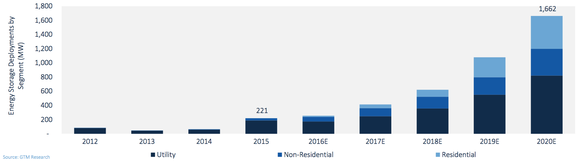
IMAGE SOURCE: GTM RESEARCH.
Today's battery systems aren't fully developed
Lockheed Martin has revealed that it is pursuing energy storage in a bold move into the electricity business. The opportunity is too big to ignore and with smaller companies, with weaker balance sheets, dominating the business today it could have a place in the future. The company's first idea is to build a lithium ion battery system that aims to lower balance of system costs.
A lot of companies have entered the market buying commodity batteries from suppliers in Asia and building the brains behind charging and utilizing the system. Lockheed Martin says it wants to work on the entire balance of system design (everything beyond the battery itself), making installation, integration, and operations more efficient. That's where, the company argues, the opportunity lies.

MOST ENERGY STORAGE SYSTEMS TODAY ARE BIG, BULKY BOXES, WHICH LOCKHEED MARTIN IS TRYING TO CHANGE. IMAGE SOURCE: SUNEDISON.
Right now, the company says it is launching a 250 KWh and 500 KWh system, which is larger than Tesla Motors' 100 kWH Powerpack. Now, Lockheed Martin just has to show that it can live up to its talk about lowering costs on the balance of systems.
The next level of energy storage
The bigger move may be in long duration energy storage, which could be the big market long-term. Long duration wouldn't be used for storage hour to hour, as a lithium battery is, but rather allow for operation all night or even storage of energy from sunny summer to winter months. And it's those applications that could prove to ultimately disrupt energy even more than the fast-charging lithium ion battery.
Lockheed Martin thinks it has technology that will make flow batteries economical enough to work in grid applications. Product manager Brad Fiebig called the product a "fundamentally new flow-battery chemistry" that uses more common materials and will have lower costs than competitors. With a flow battery energy "flows" through a cell stack from one storage tank to another, leading to almost limitless amounts of storage capacity (limited by the tanks). And if someone can make the concept economical it could be nothing short of transformative for the energy industry.
Again, time will tell if these claims become industry leading products. There's a place in the industry for both fast charging and long-duration energy storage, so if Lockheed can make a compelling product it could be a large untapped market.
Why this exciting for energy storage
I have no idea if Lockheed Martin is really serious about energy storage long-term or if this is a side project for the company. However, the fact that a company with billions in revenue in adjacent markets to energy is taking notice of energy storage is a big deal. It validates that this is an infant industry worth keeping an eye -- that's notable in and of itself. As more and more players begin taking an interest in energy storage, it becomes increasingly likely that a breakthrough is on the horizon.
A secret billion-dollar stock opportunity
The world's biggest tech company forgot to show you something, but a few Wall Street analysts and the Fool didn't miss a beat: There's a small company that's powering their brand-new gadgets and the coming revolution in technology. And we think its stock price has nearly unlimited room to run for early-in-the-know investors! To be one of them, just click here.
SOURCE The Motley Fool
DATE : 2016-04-22
Lockheed Martin has more than 100,000 employees worldwide, a market cap of $69.1 billion and was the recipient of nearly 10 percent of the funds paid out by the Pentagon in 2013.
Lockheed Martin's energy group is raising its profile in a bid to enter the energy storage market with an offering of lithium-ion battery systems, in addition to its new flow-battery chemistry. The energy storage market is tricky but growing. The big international conglomerates and equipment providers have taken notice of this shift in grid architectures -- and battle lines are being drawn. AES Energy Storage, Panasonic, LG Chem, Samsung, Saft, S&C Corporation, ABB and GE's Current are all in the mix, as well as loads of newcomers including Tesla, Stem, Alevo and Green Charge Networks.Lockheed Martin comes to the battle with more than 100,000 employees worldwide and a market cap of $69.1 billion, as well as the advantage of being the recipient of nearly 10 percent of funds paid out by the Pentagon in 2013 (here's a spreadsheet from the GSA).These firms are compelled by a dynamic, rapidly growing energy storage market across utility, commercial and industrial, and residential segments.
Figure: Annual U.S. Energy Storage Deployments (MW), 2012-2020E
The first is the integration of lithium-ion systems. Brody noted that while lithium-ion battery prices are falling, "We've seen precious little innovation and cost reduction in the balance of system."
He said that the typical approach taken by battery vendors is to house the system in a human-habitable shipping container with fire suppression and lighting. He added, "A battery for the grid should be like any industrial piece of equipment -- a purpose-built design that's built, integrated and backed by one company, just like every other power product designed for the grid."
"We designed a complete, integrated AC lithium-ion system," said Brody, adding, "Everything is in there: batteries, battery management, thermal management, and the AC interconnections – all engineered for single-side access."
The system is sized at 250 kilowatts/500 kilowatt-hours, but can be configured for smaller or larger deployments in C&I applications and small to medium-size utility projects.
"We only source from top-tier suppliers," said Brody, pointing out that some companies are in the integration business "to drag through sales of their own components. We have the freedom to select the best components."
The company pointed to the usual C&I applications: demand-charge reduction, peak shaving, solar-plus-storage and self-consumption -- but also suggested that those behind-the-meter assets can still provide services to the grid and stacked revenue streams to stakeholders.
"We think lithium-ion can address a significant portion of the applications on the grid" with known limitations in cycle life, depth of discharge and scalability, said Fiebig, "but for longer durations, we think flow batteries are the better solution."

Lockheed Martin's other energy storage effort is in commercializing a new flow-battery technology.
In 2014, the aerospace giant acquired "substantially all of the assets of Sun Catalytix Corporation" for an undisclosed amount. Approximately 25 employees were transferred to Lockheed Martin as part of the deal.
When we spoke with Sun Catalytix investor and board member Bob Metcalfe back in 2010, he told us that Sun Catalytix aimed to commercialize a new, affordable catalyst that splits water into oxygen and hydrogen. According to Metcalfe, MIT professor Daniel Nocera discovered a process that "mimicked photosynthesis with inorganic chemistry." The science underpinning Sun Catalytix was an amorphous cobalt-phosphate catalyst in solution at neutral pH at 1 atmosphere that can electrolyze water to hydrogen and oxygen. Metcalfe said the materials involved were nontoxic, "dirt-cheap," earth-abundant materials that "you could buy at Home Depot."
The Cambridge, Massachusetts-based startup later shifted its technology and business plan from the difficult-to-commercialize hydrolysis technology to the difficult-to-commercialize flow-battery energy storage technology.
And that's the same technology Lockheed Martin is looking to bring to market.
Fiebig said that incumbent flow battery vendors "depend on expensive materials," and that's "a fundamental limit for cost reduction" for those particular chemistries. Flow battery materials such as zinc-bromide or vanadium and their solutes are "caustic," and that makes siting "a big deal."
Additionally, materials which are that aggressive require expensive materials to transport and contain them. Electrodes also have to be replaced more often in harsh environments, according to Fiebig.
He said that most flow-battery materials systems are electrochemical couples or plating technology that depend on one or two elements of the periodic table, and that means "your room for innovation is limited."
Fiebig claims that the Sun Catalytix technology relies on "an engineered molecule" that is a platform for combinations of transition metal ions and ligands. Rather than the acids used in many flow batteries, Lockheed Martin uses an aqueous electrolyte with a "mild pH (like soapy water)" that allows the use of conventional materials in the balance-of-system components, such as PVC tubing, while still providing a "good energy density" that's "better than vanadium."
He called it a "fundamentally new flow-battery chemistry" that allows the use of low-cost materials, adding that competitors using traditional flow-battery chemistries "can't scrub cost from the system."
Flow batteries have made some recent progress in commercialization, but developing new energy storage technology remains a time- and capital-intensive effort. Perhaps Lockheed Martin has the wallet and patience to bring this science to market.
FIGURE: Flow Battery System Vendors

Source: GTM Squared flow industry survey
Tout ce qu’il faut savoir sur les pesticides
There are also some key figures for end usages + some interesting specific links I invite you to read.
maud
DATE : 2016-03-17
Solvay Specialty Polymers, a leading global supplier of high-performance polymers, announced today that Zeniva polyetheretherketone, one of the four products comprising its family of Solviva Biomaterials offered for use in implantable devices, has successfully passed the biocompatibility testing at the China Food and Drug Administration's Tianjin Medical Device Quality Supervision and Inspection Center.
'Obtaining this important biocompatibility testing report facilitates the strategic implementation and launching of Solviva Biomaterials in the China market place,' said Kendra Shoulders, Director of Global Regulatory Affairs for Healthcare, Solvay Specialty Polymers. 'This essential recognition will help local medical OEMs to gain regulatory approval from the China Food and Drug Administration for their implantable devices.'
The inspection center at Tianjin is recognized as the most influential testing agency in the field of orthopedics in China. The test took over a year to complete and during this lengthy process, properties of Zeniva PEEK such as sensitization, intracutaneous toxicity, acute systemic toxicity, sub-chronic toxicity, genotoxicity and bone implant compatibility tests were rigorously examined to ensure biological safety in the human body, an absolute priority for implantable medical devices.
'Solvay's experience as a key materials supplier to the healthcare industry spans more than 25 years. With our broad product portfolio we are firmly positioned as a strategic supplier to the Chinese healthcare industry,' added Dr. Luke Du, Managing Director Asia, and Executive Vice President Solvay Specialty Polymers. 'Obtaining this local and important biocompatibility testing report for Zeniva PEEK signals our further commitment to both national and multi-national medical OEMs.'
Zeniva PEEK boasts a modulus very close to that of cortical bone plus excellent fatigue resistance and toughness. It is offered for use in implantable medical devices for spine, orthopedics, cardiovascular and dental applications. In addition, ZenivaPEEK offers numerous advantages over metals, such as reduction of stress shielding, no heavy metal allergy or ion erosion, and has radiolucent properties which allow x-ray and CT scanning procedures without interference.
Solvay's family of Solviva Biomaterials has been commercially available in China since 2013. In addition to Zeniva PEEK, the product line features Veriva polyphenylsulfone (PPSU), which combines unsurpassed toughness with transparency and excellent biocompatibility and Eviva polysulfone (PSU), a transparent, biocompatible polymer that offers high strength and toughness.
Solviva Biomaterials can be sterilized using all conventional methods including gamma radiation, ethylene oxide, and steam. These sterilizable products are available in grades for injection molding or extrusion, as well as stock shapes for machined components.
The entire range of thermoplastic Solviva Biomaterials is manufactured in an ISO 13485 registered facility and under the relevant aspects of current Good Manufacturing Practices. Solvay's biomaterial manufacturing processes are carefully validated, and enhanced controls provide product traceability. In addition, all materials are tested in an ISO 17025 accredited lab.
Source ENP Newswire
DATE : 2016-03-15
Lockheed Martin Corp. is going to market with its energy portfolio, announcing Tuesday it was creating a new line of business called Lockheed MartinEnergy.
The Bethesda-based company is trying to get ahead of a shift in the global demand for energy. Frank Armijo, the newly appointed vice president of Lockheed MartinEnergy, said he anticipates that the need for new energy generation capacity will be driven by renewable sources — as much as 70 percent of new energy generation in the U.S. alone — in the years to come.
“We see energy as a global security and economic imperative,” Armijo said Tuesday at Lockheed’s 2016 Media Day.“It’s changing rapidly, the population is growing quite rapidly. ... The need for power is going to continue to grow."
For decades, the Lockheed energy businesses were captive and dispersed among its several divisions. The company began its foray into this particular line of business to meet customer cost savings and energy efficiency requirements on unrelated contract work. Through these ancillary jobs, executives said, Lockheed built up its energy chops and began attracting commercial and utilities clients.
Since January, Lockheed Martin Energy has booked $150 million in new work. The company said Tuesday it won a $43 million contract to build a bioenergy plant in Herten, Germany, which expects to take in 50,000 tons of raw waste a year and transform it into enough energy to power 5,000 homes and businesses.
Lockheed Martin Energy has five core areas: energy management, energy storage, nuclear systems, ocean technologies and bioenergy.
Energy management provides, as the name suggests, energy management and efficiency programs including smart grid technologies for utility customers. Theenergy storage line is focused on selling short- and long-duration energy storagetechnologies, a portfolio that was built up following Lockheed's August 2015 acquisition of Cambridge, Massachusetts-based Sun Catalytix Corp.
Bioenergy is related to the work in Herten, Germany, taking waste and converting it to energy. Ocean technologies will harness tides and temperature gradients to create energy. And nuclear systems — at 60 years old, one of the oldest of Lockheed’s energy businesses — is focused on Lockheed’s nuclear systems powering U.S. Navysubmarines and aircraft carriers and its digital systems monitoring nuclear plant safety.
In January, Lockheed divested $5 billion in government IT services and sold those assets to Reston-based Leidos Holdings Inc. , realigning its business units in the process. Prior to that strategic move, Lockheed's energy work was scattered throughout the corporation's several divisions.
Lockheed Martin Energy is a collection of the nuclear safety systems and energy storage businesses that once resided in its Missiles and Fire control unit, while its ocean technologies and bioenergy work came from Mission Systems and Training and the energy management systems and smart grid technology came from the recently divested Information Systems and Global Solutions portfolio.
These have all been consolidated into Lockheed Martin Energy, and will operate as a part of Missiles and Fire Control. The majority of Lockheed’s customers are commercial and utilities clients.
Source Washington Business Journal
DATE : 2016-03-15
New Teaming Agreement Signed to Grow Business Opportunities
Five thousand homes and businesses in Herten, Germany, will soon benefit from a clean, renewable energy source as Lockheed Martin and Concord Blue begin phase two of a new power generation facility that will transform waste into energy.
Under phase two, Concord Blue has awarded Lockheed Martin Energy a $43 million contract to proceed with all engineering, procurement and construction of the 5 megawatt plant with a planned completion date in 2017.
In 2014, the two companies announced plans to build the facility and have since successfully completed all planning, simulation, supplier logistics and preliminary design, clearing the way for the build to begin.
"The Herten bioenergy facility will provide real benefits to the local area while demonstrating the promising capabilities and international potential of our bioenergy technologies," said Mo Vargas, director of Bioenergy at Lockheed Martin Energy. "We are proud to partner with Concord Blue to help change the way our world addresses the growing challenges of clean energy and waste management."
The bioenergy facility transforms forestry waste to power using Concord Blue's Reformer® technology, which converts waste to energy through a process called advanced gasification. The technology can convert nearly any kind of organic waste into clean, sustainable energy. Unlike other available processes that use hazardous incineration methods, Concord Blue's patented solution converts waste material using heat transfer, which results in no harmful byproducts.
The facility's 5 megawatts of energy output is enough to power about 5,000 homes and businesses. To create its power, the plant will process 50,000 tons of raw waste per year, significantly reducing the need for landfill use.
"The construction of the Herten Project marks an important milestone for our partnership with Lockheed Martin. We continue to be extremely pleased with the quality of work and value they provide to this project and will provide for many projects to come," said Charlie Thannhaeuser, Chairman and CEO of Concord Blue.
Teaming Agreement Extended
Additionally, Lockheed Martin and Concord Blue signed a modification to the existing teaming agreement established in 2013 to extend the partnership ten years though 2026, with options for further extension.
The agreement enables Lockheed Martin to serve as Concord Blue's Engineering, Procurement and Construction (EPC) contractor for future bioenergy conversion projects and to continue serving as the exclusive manufacturing provider of the Concord Blue Reformer.
Concord Blue's unique technology benefits the environment, fulfilling all international, Environmental Protection Agency and European regulations for renewable energy and air emissions. Concord Blue operates globally, with offices in the United States, Germany and India.
Lockheed Martin Energy is a line of business within Lockheed Martin that delivers comprehensive solutions across the energy industry to include demand response solutions, energy efficiency, energy storage, nuclear systems, ocean energy technologies and bioenergy generation.
"Our bioenergy technology is a key element of our portfolio and has the potential to be a true game-changer for both the energy generation and waste management markets," said Frank Armijo, vice president of Lockheed Martin Energy.
Source Stockwatch
DATE : 2016-02-23
Sunchem Group is in plans to startup a new styrene monomer (SM) plant in China. A Polymerupdate source in China informed that the plant is likely to come on-stream by end-2016. To be located at Dalian, China, the plant will have a production capacityof 400,000 mt/year.
Source Polymer Update
DATE : 2016-02-23
Sunchem Group is in plans to begin commercial operations at its new styrene monomer (SM) plant in China. A Polymerupdate source in China informed that the plant is likely to come on-stream by end-Feb 2016. Construction of the plant has been completed. The SM produced at this plant is most likely to be used at its downstream EPS facilities in China. The company operates two EPS plants namely 360,000 mt/year plant at Jiangyin in eastern China and 120,000 mt/year plant at Dalian. Located at Hainan, China, the new SM plant has a production capacity of 100,000 mt/year.
Source Polymer Update