Table of Contents
Scope
1. Remove the icon(s) when not applicable

2. Add countries when the procedure is for a specific country (optional)
ERP
3. Remove the icon(s) when not applicable


References
4. Add the link to SAP procedures (when it exists)
Attachments
5. Add the link to attachments (to be stored in AODocs or GDrive) or external links
1.Objective and Scope
1.1 Objective of this Procedure
The objective of this procedure is to explain the Non Concur Process from start to end including user actions, payment process and monitoring.
1.2 Scope
The scope of this procedure includes trainees, apprentices, VIE, temporary workers and some spot cases (guests, expatriates family, etc) which do not have access to Travel & Expenses Concur tool.
2. Reference Documents
Presentation - Official presentation sent to employees which includes the 3 steps from the user's side.
Record file - To keep record of information such as vendor creation, audit, current known population and payment monitoring.
Vendor creation form - Sent by users to request vendor creation which contains all information relevant for vendor creation (users send another document with the bank details).
D&A team's record file - Used by Data & Analyses team to keep record of all the vendors created for this process.
Gform - Users fill this form to request the bookings through the Travel Agency.
Expenses submission form - Sent by users to request expense reimbursement where it is also included the posting file used by the T&E operator to send to payment.
Affidavit - This document is a declaration of honor used when there is a missing receipt or the user can not obtain any other document to justify expenses.
3. Definitions
PTP - Procure to Pay
T&E - Travel & Expenses
Concur - Travel & Expenses tool to submit expenses and arrange business trips bookings.
Non Concur - Employees who do not have access to Concur
EMEA - Europe, Middle East and Africa
PF1 - SAP scope for Solvay legacy
WP1 - SAP scope for Rhodia legacy
PI1 - SAP scope for CICC
D&A - Data & Analysis
Vendor - A profile in SAP which contains employees data used for payments created by the D&A team
Solvay Internal Referent - The person inside Solvay which will assume the costs and is our direct contact for the Non Concur use (responsible person).
4. Introduction
The submission of expense reports happens due to business trips.
We have the T&E Concur tool which allows to submit expenses and make reservations, however this program uses information from the HR system and some employees will not appear due to not having a profile created, therefore they were excluded and this procedure was created - in some countries this population has profile created in HR but it was decided to exclude it entirely.
The process operator will audit all the expense reports to avoid any fraud and non compliance that could be made by the users.
The trips and expenses are managed by themselves and, for legal reasons, no corporate cards will be delivered to this population, therefore the costs are handled with their own credit card and then reimbursed by Solvay.
5. Audit
5.1 Audit Rules
Expenses require a receipt/document to justify its spending.
When receipts are available no other proof of payment is required.
A receipt is any document that contains the following five fiscal elements:
Name of vendor (person or company which provided service)
- Transaction date (when the expense was paid)
- Detailed description of good or services purchased (what was bought)
- Amount paid
- Form of payment (how it was paid - cash, check, or last digits of credit card)
If there is no receipt available then it is mandatory that the user fills the Affidavit provided by the auditor and sends it on the same ticket.
Expenses that do not require a receipt:
- Kilometers
- Tips
- Allowances - #2174530
Keep in mind:
- Bank fees need to have attached a full view of the bank statement where these are included.
- Comments are not enough justification for a missing receipt, an affidavit has to be added.
- Non T&E related expenses, should be sent back and request submission in the correct department (out of policy).
6. Profile Creation
6.1 Requirements
In order to have all of the necessary information for payment in one place, users are created as vendors.
They are created based on a form each employee has to fill and have the manager send to us (it can be the user sending the request if the manager is in copy of the ticket).
When we receive this ticket we need to complete the fields in our record file - Vendor tab:

This form includes the following information:
- Address, postal code, city (professional);
- Employee number (if they have one);
- Solvay company code;
- Solvay Internal referent name (responsible contact);
- Bank account information.
It is required that, together with the form, the user needs to send a document with bank details on the side.
For Portuguese users, we need to request the Tax ID number (NIF) and the current address for us to prove that this is a real user. If the user refuses to give the number explain that these business expenses are associated with company's own Tax ID number, it is not related with user's income and there will be no taxes charged to him. All of the expenses will be charged to account "6150000001 Entertainment" which is Non Deductible for SBS.
For German users, since it is very difficult for them to request an official document with the bank details, we accept a card photo, confirming that it shows all the necessary information (name, IBAN, BIC).
We need to always register who is the user's referent name in our record file in the population's tab. This is important in case we need to confirm the approval in future submission of expense claims and to assign any orphan lodge transactions that belong to Non Concur users.
After confirming everything is in order send it to Data & Analysis team - they will create the vendor profile.
Properties of the ticket being sent to D&A team are the following:
- Group: PTP D&A EMEA
- PTP-Process: Data & Analysis
- PTP-Subprocess: Vendor Master Data
- PTP-Category: Creation
The tickets are kept on their side unless the user has sent an expense submission form in the same ticket, therefore we need to add a note requesting to have the ticket being returned to T&E.
If any information is missing or is incorrect in the form ask the employee to confirm.
You can search the master data (if available) of the user in SAP PP2 in transaction PA20 and compare.
7. Expense Claim Submission
7.1 Record
When we receive the ticket we need to fill the record file - Audit tab (of current year).

- T&E: the team operator who is processing the expense report
- Ticket: Helpdesk ticket number where the expense claim is being requested reimbursement
- Audit date: date that the operator starts the processing of the expense report
- Employee name: in this field there is a drop down which is obtaining information from the Population tab, if the name does not appear look if the employee has been added in there
- Vendor, SAP, Company Code, CC/Order/WBS: these fields will fill automatically once chosen an employee from the list, with information in the Population tab
- Amount: introduce the total amount of the expense claim
- Decision: as well a drop down to identify what is the process stage of the expense claim - options are Delay (waiting actions from employee), Approved (processing payment), Rejected (no response from user/not compliance)
There is also a column "Reason for delay" which has to be filled with a small comment explaining the reason the process was put in delay.
When opening the template we need to confirm if our information matches the information available in the header. We should question changes that the user makes and/or add is any is missing but is available in our file.
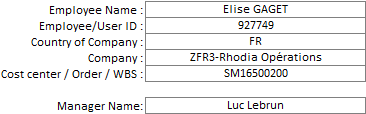
Fill information on tabs with the following order:
- Before audit - T&E | Ticket | Audit date | Employee name | Amount
- After audit - Decision | Reason for delay
- After posting - Posting date | Posting document
The tabs "Payment date" and "Payment document" are filled by the Payments team, all other fields are locked for them.
The CICC (payment tool) code added in the "Payment document" column is used by us to match the payment transactions in SAP and the submission of expenses when performing clearing.
7.2 Posting
When the audit is complete, all the information has been confirmed and is now correct, we can continue the process.
The expenses submission template has a posting file hidden, which gathers all information from the form and makes it easier/faster to perform the posting in SAP, by simply uploading the file in a transaction and running it automatically. This file was created by Diogo Oliveira (he is the contact if any issue with the excel's macro occurs).
SAP will let you know of any errors in the posting however, we can avoid this by checking the errors before sending the posting.
1) Correction of the form
Header
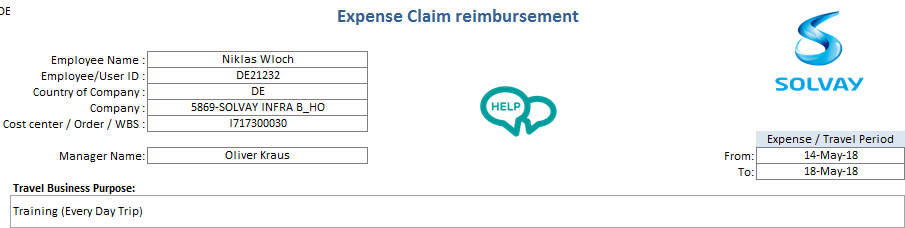
- Employee/User ID: no special characters
- Correct mismatch information: compare details in the monitoring file and the expense submission template (ex: company code, country...)
NOTE: Company code needs to be the same that was assigned to the user's vendor
NOTE: Cost center/Order/WBS need to belong to the selected Company code - Dates: dates have a specific format, must be xx-xx-xxxx and it will update accordingly
- Dates: range needs to include all expense dates
- Business Purpose: can not be empty
Expenses details


- Amount: always in commas
- Currency: must be according to country of the user (ex: if user is from a Company code of the UK the currency will be GBP, any not GBP expenses need to be converted)
- Expense type: can not be empty; correct if user mistaken - this will define the account for each expense in SAP
- Dates: dates have a specific format, must be xx-xx-xxxx and it will update accordingly
- Total amount: at the bottom we need to check that the total amount is correct
2) Posting file
Open the posting file
Unhide the posting file with a Right Click from the computer's mouse on the Expense Claim separator:

Open Posting File option:

Possible cause for errors - to check
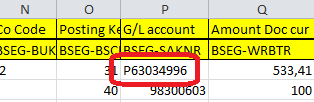
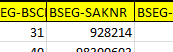
- G/L account (first cell): delete the entire content, enter the cell and put the user's vendor
NOTE: It was agreed to add a P at the start of all vendors which would allow to distinguish Non Concur users from actual Vendors, however this interferes with the posting and therefore we substitute the entire field with the correct vendor created by D&A team. Some users also do not use the vendor that was provided, it is another reason why we need to substitute and pay attention to this.
- WBS/Order instead Cost center: if the user provides a WBS or Order we need to change its location


Proceed with posting
- After checking all the fields for errors, click Start at the top left corner of the posting file, insert the password "teonly", choose Step 1, add the ticket number and save:


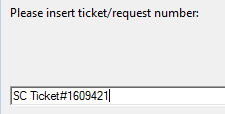
- Verify if all lines have Cost Center (remember if it's a WBS or Order it needs to be moved to the correct place).

- Save the file in the desktop and open the SAP system which will be used (PF1/WP1)


- Click Start again, choose the Step 2 and wait for it to signal that the posting is complete
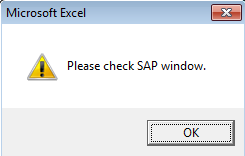
NOTE: If the SAP triggers any errors, analyse again, it won't upload until everything is in order. In case no error is detected, download a new template and fill from scratch.
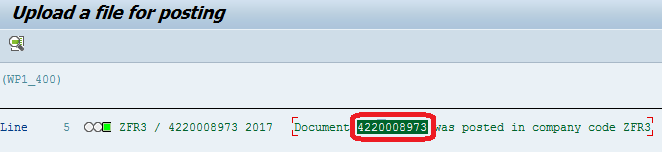
- Copy the document number with CTRL+Y on your keyboard, then CTRL+C and put in the monitoring file on the Posting doc. column
- Finally, zip the paste with the form and receipts inside, double click to enter the posted document and attach it as below:


7.3 Posting Germany Exception
When performing a posting for a German Company Codes we encountered the following error which refers to a requirement when creating an invoice for a foreign vendor - the user's address is not German. It also is required if the document currency is not the same as the local currency, or payment is effected via a foreign bank.
Error: "Please fill central bank indicator and supplying country"


Example:
Mr. Joachim Schmidt is in Germany with information all regarding Company Code 4060, however his address is defined as French. Only for Germany this error will appear.
Solution:
- Enter the mountain icon and open the credit line of the vendor
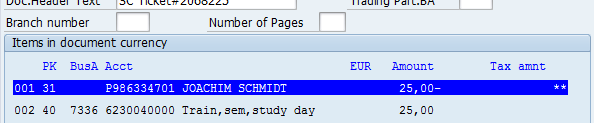
- Enter the option "More data"
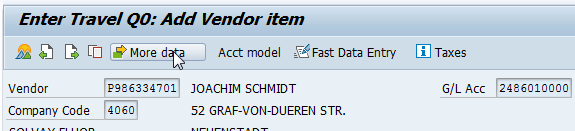
- Open the list of the option "SCB Ind." and select indicator 540 (or simply type it)

- Return to the mountain icon and it's ready to complete posting
7.4 Corrections
If something was incorrect during the posting and the Payments team has yet not processed it we can make the necessary adjustments:
1) Open SAP system (PF1/WP1)
2) Transaction FB02 - Change document
3) Click the Reverse Document icon as seen below

4) Fill with the necessary information

There are some options in the reversal reason. If the reverse of the posting is performed:
- the same period of the posting we should use 01 and add the posting date
- in a different posting period (period already close) we should use 05 and add the day of the posting
5) Open another tab from SAP

6) Transaction FB01 or FBR2 (Post with reference)
7) Select: Post with reference

8) Insert deleted document and its company code

9) Make the necessary corrections and finish the posting
10) CTRL+Y in your keyboard and copy/paste the new document in our record file (add the previous document to the comment to keep record of T&E team actions)

7.5 Payment Process
It has been defined a procedure to monitor the payments after the postings have been performed:
- Every Tuesday, in the end of the day, we send a ticket to the Payments team, with information of all the pending payments for the Non Concur process
- Every Wednesday the payments team will run the job for these pending documents, with payment day of the next Thursday
- And finally, every Monday we will check and perform the clearings
NOTE: Non Concur payments are performed through CICC with exception Butachimie Non Concur users which are paid together with Butachimie regular employees. Payments team runs a variant which includes a range of 900000 to 999999 and with the company code ZFR9 for all normal Concur Butachimie payments. You may notice all vendors in WP1 for Non concur are created with 9XXXXX which means this variant will grab also Non Concur Butachimie pending payments. They run this variant on Tuesdays at the start of the day with value day Wednesday that follows.
Copy from the Monitoring file the new information in the columns:
| Employee Name | Vendor | SAP | Company Code | CC / Order / WBS | Amount | Posting date | Posting doc. | Paym. ticket |
In Helpdesk create a ticket asking to perform these payments, to the following group:

8. Clearing of Accounts
When payments are complete, we need to perform the clearing between the submission and the payment so both amounts do not remain as open.
8.1 PF1 Companies
All payments performed through CICC Online become open in the following G/L bank accounts and we need to match with the submission that is available inside each user vendor.
- Transaction: FBL3N
- G/L Accounts PF1: 50600EUR23/ 50600EUR24/ 50601EUR22
- Variant: TE Clearing
- User: PT300121
- Layout: Non Concur

Result:

Find amounts pending clearing and to whom it belongs
In this extraction you will be able to find all of the amounts open (not cleared) in the T&E payment accounts.
In the Assignment column will be available the CICC code which will match the code of the Monitoring file > Audit tab > Paym. Doc column - this is how we match the payment in the bank account with the submission in the vendor.

Normally the ones linked with Non Concur process don't have information in the text. To confirm if it is a payment for this process we check if the assignment code is in our file with CTRL+F and by removing the initial zeros.
Example:


Following the example above, the payment amount from 16.02.2018 with CICC Session 0000027320 is linked with Lisa Vanetti.

If you open the vendor in PF1 with this user you will be able to find the counterpart document.
Transaction: FBL1N
Add the vendor number, the related Company Code and execute:
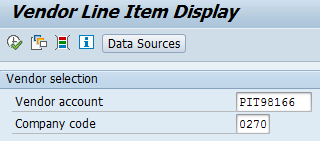

Result:

Perform a clearing between both
Transaction: F-44 (clear with vendor)
Transaction: F-03 (clear with account)
The steps for both transactions are the same although with small differences according with nature of the account (both perform clearing but starting differently).
Using the Transaction F-44 as an example:
- Copy the user's vendor from the file and open F-44
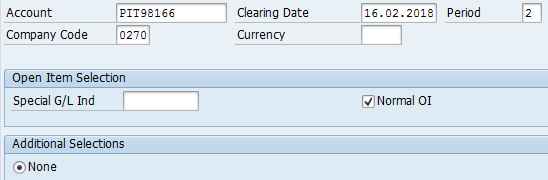

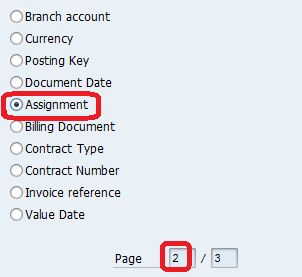
NOTE: If F-03 select others and then Assignment as seen below - to move to the 2nd page, click Page Down on your keyboard.


- Select the line to be cleared, then the mountain icon and proceed to Choose open items


- Add the Company Code
- Add the G/L account where the counterpart document is available
- Add an S in Account type
NOTE: S - For G/L Accounts (F-44) and K - For Vendor Accounts (F-03) - In the "Additional selections" choose the Assignment (if F-03 Select None) and then Process open items

- Add the assignment (CICC code) and then Process open items
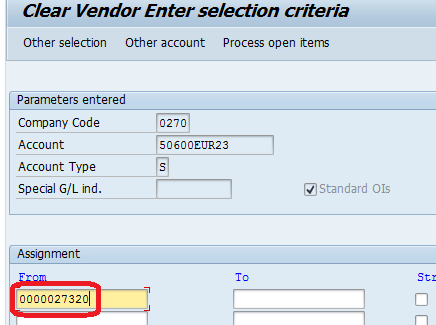

- If the balance is 0 you can complete by posting the clearing. If the balance is not 0 you need to make another selection, the amounts have to match.


- Inside the cleared items of the vendor (FBL1N) you will now see the submission (Q0) is cleared with the payment - green.

8.2 WP1 Companies
For WP1 companies the CICC document will be directly allocated to the vendor, therefore the clearing is automatic. However if it's not, perform it following the instructions from PF1 but with the following account: 58999920

9. Non Compliance
9.1 Chasing in Delay
When a report has something incorrect we need to warn the employee and keep record of all the changes we make throughout the process in the "Reason for delay" column of our file.
To review the issues with the employee we must send him an email (ticket) and describe everything that is wrong and explain what should be done for each different situation.
After everything is solved, do not forget to update the status of the expense claim on the Monitoring file (Audit tab).
9.2 Inconsistency of Data
1) Company Code belongs to a different SAP system (PF1/WP1) than the one used when creating the vendor.
Check vendor's company code
- Open SAP system (PF1/WP1)
- Transaction: FK03
- Copy/paste the vendor (available in the record file) and proceed as shown below

- Paste again the vendor in place and execute - select employee from the list


- If you simply click ENTER it will give you the name and which company the vendor was created:

2) The Cost Center/WBS/Order is incorrect (or doesn't exist) - request another to the employee.
Check Cost center/WBS/ORDER's company code
- Open SAP system (PF1/WP1)
- Transaction: Cost center - KS03 / WBS - CJ03 / Order - KO03
- Copy from the expense submission form:

- Fill in the fields (choose random controlling area - remove it when you are inside) and click ENTER:


- Look for the one which ends in 9999 (current) and ENTER:

- In the first page you will find the Company Code which is associated:
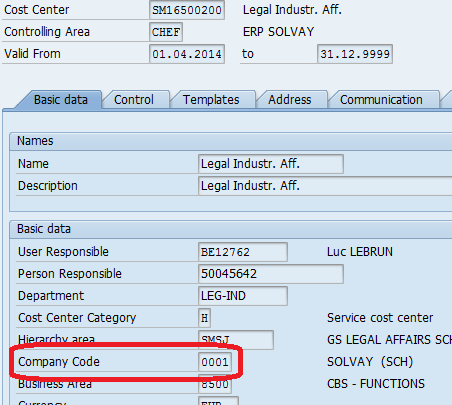
NOTE: If the company code of either the Cost center/WBS/ORDER, or in which the vendor was created, is different than the one provided on the form, confirm with employee which should be used. Keep the manager in copy of the emails, some employees might not be aware - if necessary, request D&A team to perform changes in the vendor.
10. Travel Process
The Travel process is handled between the employee (Non Concur user) and the travel agency (AMEX GBT) but we may assist with some doubts of which we have the knowledge.
The Non Concur user will have to send information to the travel agency, by filling the AMEX GBT form, so they can create a profile on their system.
1) Choose country's form

2) Choose the Non Concur/external option (last question of the first page)

3) Enter the Solvay Internal Referent information
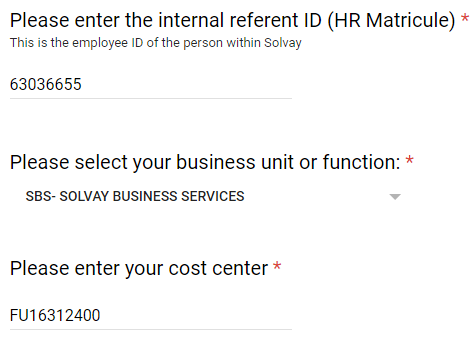
4) Add remaining trip details throughout following pages
5) The form will only be complete after clicking Submit at the last page:

11. Frequently Asked Questions
1) What is my Solvay Internal Referent?
R: The person inside Solvay which will assume the costs and is our direct contact for the Non Concur use - responsible person.
2) What is my Cost Center/Company Code?
R: Employee must request this information to manager or the local HtR.
> END OF OP <