Table of contents
This document presents the general process for managing LTL rates and routes in WP1 system.
This process applies to all tariffs and deliveries to be processed in the EMEA zone (except Gorzow in Poland), and exclusively with regard to sales transport.
SD : Shipment Document. This file is a summary of all the elements necessary for carrying out a transport: route, carrier used, point of departure, point of arrival, mode of transport used ...
SCD : Shipment Cost Document. It is generated during the implementation (= ex works) of the transport mentioned in the SD where the accrual of the transport cost is created.
SHIPPING POINT : This is a code assigned to each site according to the nature of the product transported and the type of transport used (Ex: Collonges = 0151).
TARIFF ZONE : Division of a country to avoid having to enter the same tariff as many times as there are departments in the same geographical area (Ex: ZT Rhône-Alpes can include 01, 38, 69, 42)
EMEA : Europe, Middle East and Africa
TRANSPORT PLANNING POINT (TPO) : This is a code assigned to each administrative entity. It defines which site is responsible for organizing and paying for each transport.
RDT : Route Determination Table. This table allows that a route populate automatically in an order.
GOOGLE FORM : It is a way that allows sites to make emergency route requests.
WHO? | WHAT? | HOW? | ||
Purchasing EMEA Local (For weekly updates and tenders) SBS-OTC LOGISTICS DATA |
| Via e-room/Gsheet TK11 or TK14/ ZWOC90B |
On the road pack, we have two different TDA's to be managed:
LTL (Less Truck load =small packages) and the FTL (Full Truck Load = complete truck. To better manage the information of the rates the calculation rules are the same for all GBU's
In order to find the negotiation for FTL you need to follow the indications below:
AODocs=> EMEA Logistics Purchasing => FTL/LTL =>Rates/Tarifs → 1 - LTL Tender
The rates in LTL are created with the same rules of FTL except that the rates are not a lump sum price but a price per TON, by using gross scale.
Rate creation:
The rates are created for the flows defined in AODocs as Primary and backup.
All the necessary information to create rates for LTL are available in AODocs and the correct selection of the key combination must be respected.
The list of the necessary element for rate creation are:
To create a rate we use the transaction TK11: Create condition records 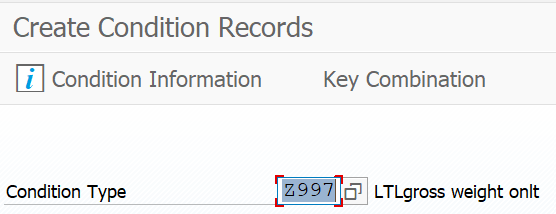

The first two lines are used for shipment with temperature under control, defined with transport groups: 0002 and 0013. The information can be found in eroom on the column "Thermo-Shipment surcharge":
The remaining lines inside the key combination are used for standard material without transport groups.
Example of rate creation in SAP:
To set the rate in SAP, the information should be added respecting the predefined spaces: 
After the insertion of the components for rate creation it is needed to add the corresponding scale. To do it we double click on the line and the following board will appear: 
The scale used in LTL is 251999.

Once the scale ID is added, click on enter and insert the rates provided by Purchasing on AODocs. 
To finalize the process click on save. 
The process of rate creation can be done in two ways:
WHO? | WHAT? | HOW? | ||
Purchasing EMEA Global (Bruxelles) Tender file Purchasing EMEA Local (EPA) weekly updates
GBU Sites SBS-OTC LOGISTICS DATA |
| Via e-room/ Gsheet Google form 0VTC/ ZWOC42A |
The routes are only created for Primary flows.
The request for a route creation can come by google form( for spot requests) or by a weekly update on AODocs.
Procedure :

You will found the following board:
Inside the board you can add all the necessary information to find the route.
Route stucture LTL
The necessary elements to create a route are:
These elements for route creation must be provided by Purchasing (AODocs/Gsheet) or by the GBU through Google form.
Create route in SAP:
Enter transaction 0VTC –Route definition:
Select the pencil to create 
All routes have a specific codification depending on the mode of transport used, for road is "3" e.g: 300001. To respect the sequence of the existing routes we select the last route created by going to the icon positions: 
Once the final route code is discovered we use the subsequent number e.g: If the last number is 304772, the new route will be 304773.
A route for road packed doesn't have any connection point, therefore it can be used by other sites, with this we can affirm that all the road pack road are multisite (Can be used by other GBUs/sites)
The process of route creation covers two steps:

Once the information is completely inserted, press enter and save
Once the route is saved it is necessary to translate to the other available languages. The process is made to ensure that route description appears on sales order/ purchase orders at the time that the route is used, regardless of the language choose in SAP.
To start the process is necessary to go to the Icon Edit and select translation:
then a board will appear with several languages, it is necessary to select all. It can be made by pressing the Green button and after Enter:
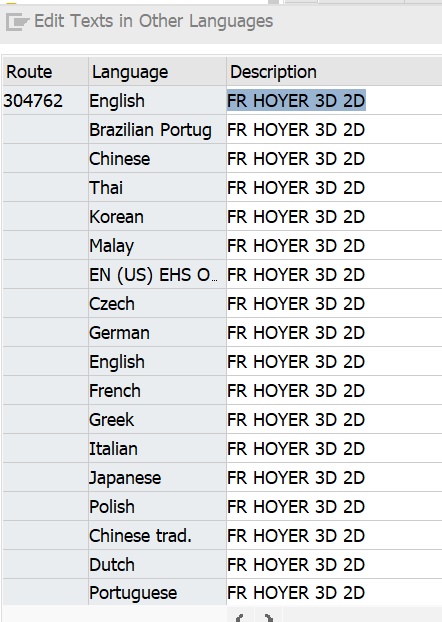
Once you press enter, a new board will appear with the languages and the route selected. What is required is to copy paste the description to all the languages as shown below and save at the end.
It can happen to receive a request for a route modification by the GBUs. The requests are usually linked to a modification of lead time, transit time, service agent, factory calendar, etc...
Before doing the requested modifications it is necessary to analyze possible options.
3 possible solution :
🡺The route already exists and in this case instead of creating a new one and double, the available route code is delivered to the GBU.
🡺The route code doesn't exist: Check if the mentioned route to be modified is not being used by another GBU.( TDA or shipment document)
🡺If not, modify the route itself..
Before modifying a route it is necessary to see if it is not being used by another GBU by checking the route table determination( TDA), transaction ZWOC46A. 
and execute 

