| Status | |
| Owner | |
| Stakeholders | Vincent Desthieux, Sandrine Rochat, Julie Anne Hubert, Nicolas Thomas, Martina Gatti |
Issue
Syensqo currently uses SAP functionalities in ECC to cover HSE requirements relating to Safety Datasheets, Labelling, Dangerous Goods Management, Substance Volume Tracking and Compositions. These SAP functionalities are covered by SAP Product Compliance with S/4 HANA.
S/4HANA offers the option to implement a 'Classic Version' or a 'New Version' for SAP Product Compliance. A decision is required, which version of S/4HANA Product Compliance (New or Classic) should be implemented considering scope and timelines.
Recommendation
The recommendation is to implement the S/4HANA for Product Compliance 'Hybrid Version' (Option 4).
This is driven by the following key points:
- S/4HANA Product Compliance 'New Version' (Option 1) is only available for implementation in the S/4HANA 2023 product, however will only attain its full functionality from 2027 onwards. Until then, the new version will have significant functionality gaps as compared to the 'classic version'.
- Remaining with ECC 'On Premise' would mean a very restrictive longevity and poses a major draw back on integration with other core functions such as Logistics, Transportation Management, Product Master etc. It should be ruled out on the basis of S/4HANA adoption being the core of ERP Rebuild. Further, the feasibility to maintain an ECC6 stack for this option would be question. Hence the continuation with ECC6 (Option 3) is not viable.
- The implementation of S/4HANA Product Compliance 'Classic Version' (Option 2) requires a new re-implementation project (big bang) before the end of support of the 'classic version' is reached in 2036. This would effectively be a greenfield implementation of Product Compliance as the data models are not compatible.
- S/4HANA for Product Compliance 'Hybrid Version (Option 4) enables the phased use of New Version functionality when it becomes available. It decouples SAP scope availability from the timeline of the ERP Rebuild project. The recommendation enables Syensqo to implement newly available S/4HANA Product Compliance functionality based on business readiness. Implementation projects are expected to be of smaller scale due to phased approach. The hybrid option gives the business the benefits of new features to cover future requirements without having to cover scope gaps with additional enhancements.
Background & Context
S/4 HANA for Product Compliance includes the following components (upon full scope availability in 2027 as per SAP roadmap):
- Dangerous Goods (DG) Management including:
- Regulatory/country specific data management
- DG classification
- DG checks
- DG data integration for outputs and EDI
- Product Marketability and Compliance including:
- Composition management
- Product Master integration
- Checks incl. marketability, supplier material
- Substance Volume Tracking (SVT)
- Safety Datasheet SDS and Label Management including:
- SDS/label generation for country specific requirements
- SDS check integration with logistics processes
- Automated and manual SDS shipments
The SAP strategy is focused on the complete renewal of Product Compliance in SAP S/4HANA. At a high level S/4 HANA for Product Compliance offers two sets of capabilities in Private Cloud.
- Classic Version - existing capabilities.
- New Version - new capabilities.
The database model and code is very different between 'Classic Version' and 'New Version'. The 'Classic Version' continues to use the Specification Database Workbench, the same as ECC6.0. The 'New Version' uses a CDS-based data model (SAP Core Data Services) and a new process model. SAP CDS is an infrastructure for data modelling that enables data models to be defined and consumed on the database server rather than the application server. A full-on migration/re-implementation is needed to transition between 'Classic Version' and New Version.

HSE Landscape As Is

Assumptions
It is assumed that:
- S/4HANA Product Compliance 'Classic Version' includes all capabilities required by Syensqo. SAP currently states that almost all features of SAP Product Safety and SAP Product and REACH Compliance are available. The features of MSDS Maker is not available in the 'Classic Version' and has been replaced with CosSta (Conditions for Safety Statements), a functionality within SAP EHS Rule Editor.
- Any impacts of this KDD on other ERP Rebuild EHS KDDs will be managed via the subsequent KDDs of the relevant ERP Rebuild EHS components.
- ERP Rebuild does not end up with an unsupported platform following platform license negotiations and that a supported version of S/4 will be the core platform (see related KDDs in 'References').
- S/4HANA Product Compliance 'Classic Version' is supported by EML as per SAP 'CAL EML Getting Started Guide v2' for SAP S4HANA Cloud Private Edition 2023 (added to references).
- Current licence for 3E ERC Suite (Enterprise Regulatory Content) as already in use with Syensqo may need enhancing to incorporate 3E ERC+ suite.
Constraints
- S/4 SAP EHS does not offer different sets of capabilities in Private Cloud. S/4 HANA EHS includes the following components:
- Emissions Management
- Waste Management
- Incident Management
- Industrial Hygiene
- Occupational Health
- A decision for 'Classic Version' would need to consider that a reimplementation of Product Compliance will be required before 2036 for a greenfield implementation of 'New Version' for S/4 HANA Product Compliance.
- SAP have not been able to provide clear guidance on the roadmap and alignment beyond 2025 of S/4HANA features at the time of writing.
Impacts
- All capabilities of business area "Product Compliance" are available in S/4HANA, the exact scope may vary compared to the ECC-based products. Options are:
- Licensed "SAP S/4HANA" and "SAP S/4HANA for Product Compliance": choice to either use the so-called "classic functionality" or the "new functionality".
- Subscribed to "SAP S/4HANA Cloud, private edition" and "SAP S/4HANA Cloud for product compliance, private edition": choice to either use the "classic functionality" or the "new functionality".
- Subscribed to "SAP S/4HANA Cloud, public edition" and "SAP S/4HANA Cloud for product compliance, public edition": the Product Compliance "new functionality" can be used.
- Current licence for 3E ERC Suite (Enterprise Regulatory Content) as already in use with Syensqo may need enhancing to incorporate 3E ERC+ suite.
Business Rules
Business rules to support the alignment between new and classic version of Product Compliance may apply e.g. SDS version management.
Options considered

Option 1: New Version
- New process model, SAP Fiori apps.
- New data model, CDS-based.
- New integration into product master, sales, delivery, procurement, transportation.
- Better integration into logistics processes.
- No full scope yet, innovation roadmap. Scope at present:
- Product marketability
- Dangerous goods management
- SDS Management
- No full SDS authoring available
- Available from 2027 with limited scope only with S/4 HANA 2023. Full scope available with S/4 HANA 2027.
Option 2: Classic Version
- All features of the SAP ERP based product safety and product compliance solutions
- SAP GUI and Web Dynpro transactions
- Specification database, workbench approach
- Full scope, no functional enhancements.
- Available now.
- SAP standard maintenance available 2029 to 2036.
- Requires new project for greenfield implementation of Product Compliance between 2027 and 2036.
- A migration or re-implementation project will be required to move to the 'New Version' of Product Compliance after it attains feature parity with the 'Classic' solution (currently planned for 2027), and before it goes out of SAP Support in 2036. Due to the significant data model differences, this will be a considerable project and not a straightforward technical upgrade.
Option 3: Continue with ECC 6.0 'On premise'
- Option to continue with SAP ECC 6.0 'on premise', supported until the end of 2027.
- Post 2027 extended support from SAP is available, which is chargeable.
- Assumes continuation of As Is on ECC 6.0 'On premise' systems.
- Requires new project for greenfield implementation of Product Compliance between 2027 and 2030.
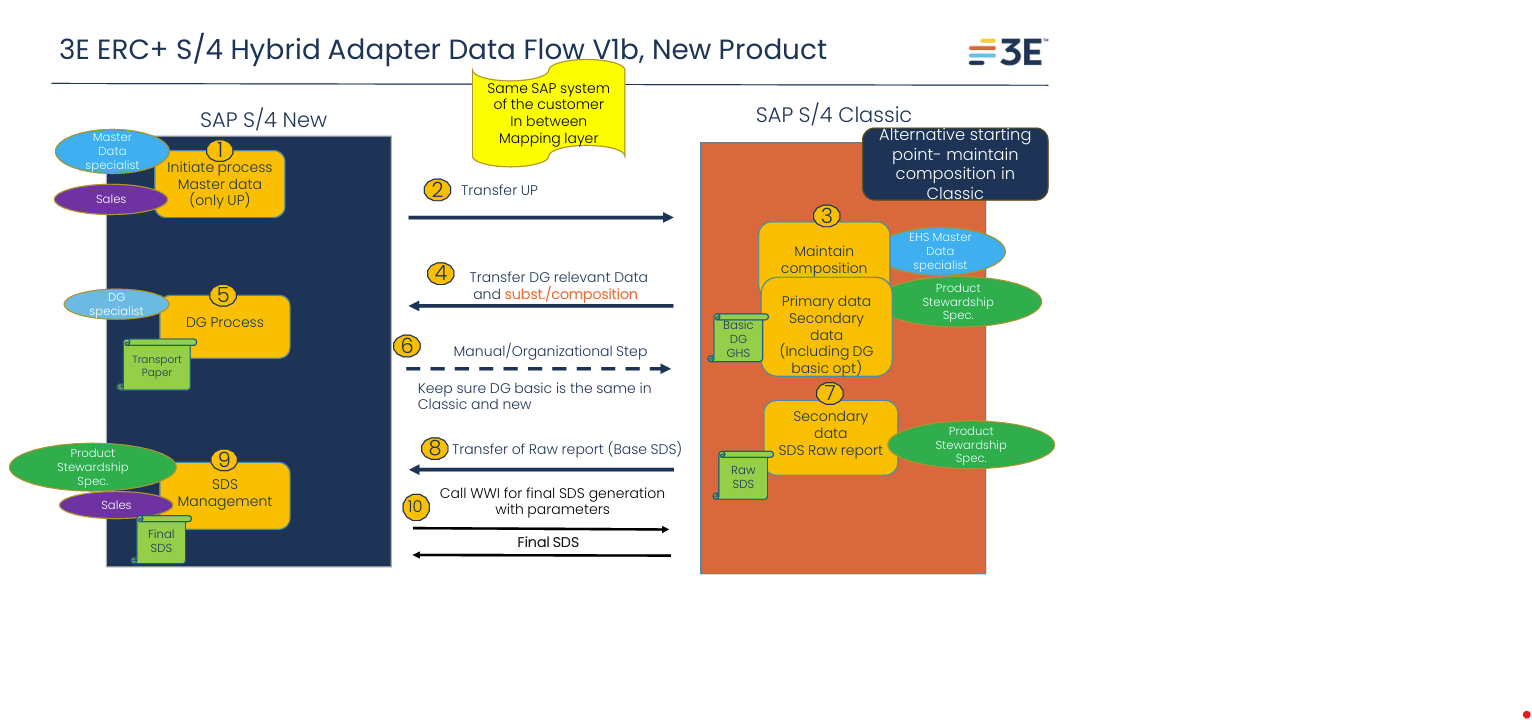
Option 4: Hybrid using both Classic and New Versions, enabled by 3E Hybrid Adapter
- Hybrid using selected parts of both the Classic and New Versions, with the 3E Hybrid Adapter synchronising data between the data models in the S/4HANA system.
- 3E Adapter links S/4HANA 'New version' processes with 'Classic version', and replicates data that is maintained in the Classic data model to the data model of the New version.
- The 3E Adapter is an ABAP add-on. Both the New and Classic data models can co-exist in the same S/4HANA system along with the 3E Hybrid Adapter. A separate system is not required.
- Provides embedded regulatory data and multi-lingual phrase library.
- Functionalities implemented from Classic to New Version in phased approach bridging capability gaps.
- Means smaller scale implementations spread over time rather than 'Big Bang' from Classic to New Version.
- Limited user impact as users continue to access the same S/4HANA system, but would simply use traditional SAP transactions and Web Dynpro apps when interacting with Classic functionality.
- The Hybrid adapter can be used in two deployment modes. The most suitable option for Syensqo will be decided as part of the detailed design phase:
- A - Compositions maintained in 'New version', then transferred to 'Classic version'
- B - Compositions maintained in 'Classic version', then transferred to 'New version'
Option 4A: Compositions maintained in New Version

Option 4B: Compositions maintained in Classic Version
Evaluation
An evaluation overview based on the detailed Pros and Cons for each capability in the subsequent table further clarify the reasoning behind the recommendation.
| Capabilities | Option 1 Product Compliance NEW | Option 2 Product Compliance CLASSIC | Option 3 Product Compliance in ECC | Option 4 Product Compliance HYBRID |
|---|---|---|---|---|
| Compliance | Medium | High | Medium | High |
Risk | Low | Medium | Medium | High |
| Business Impact | Low | Medium | Medium | Medium |
| Complexity | Low | Medium | Low | Medium |
| Integration | Low | Medium | Low | High |
| Longevity | Medium | Medium | Low | High |
| Overall |
| Capabilities | Option 1 - NEW | Option 2 - CLASSIC | Option 3 - ECC | Option 4 - HYBRID |
|---|---|---|---|---|
| Compliance |
|
|
|
|
Risk |
|
|
|
|
| Business Impact |
|
|
|
|
| Complexity |
|
|
|
|
| Integration |
|
|
|
|
| Longevity |
|
|
|
|