| Status | |
| Owner | |
| Stakeholders |
Issue
Syensqo requires a CRM system as part of its sales lifecycle and uses salesforce.com to meet its current CRM needs.
Syensqo's current CRM architecture, designed to support distinct business models inherited from previous M&A legacy, has resulted in the development of two separate and overly customized Salesforce instances (Core CRM and iCARe). Although this dual-instance setup was initially necessary to accommodate different business processes, it has now become a source of significant operational inefficiencies and complexity. These inefficiencies are increasingly misaligned with Syensqo's strategic objectives of simplification, agility, and innovation.
This architecture presents several challenges, including the following:
- Inconsistent Processes and User Experience: The presence of different types of GBUs (Solvay and Syensqo) has led to the CRM being tailored to distinct business models, resulting in customized processes within the Core CRM and iCARe instances. This fragmentation has caused inconsistencies in process maturity and user adoption, hindering efforts to deliver a unified and seamless customer experience across Global Business Units (GBUs).
- Customization Overload: Both CRM instances are heavily customized, particularly in areas such as Quotation, Contract, and Pricing management. These custom solutions are resource-intensive to maintain and evolve, especially when considering the need for frequent updates and alignment with industry best practices.
- Complex and Redundant Integrations: The architecture relies on intricate, multi-instance integrations with backend systems (PRS, PF1, WP1) and point solutions (e.g., Dynasys, Gensuite, Qualtrics, Mappy), which are further complicated by the use of WebMethods technology. This results in duplicated efforts and increased risk of errors, particularly when integrating webshops and portals specific to each GBU.
- Collaboration Barriers: The existence of two separate CRM instances creates barriers to collaboration among GBUs, particularly when managing key customers that span multiple units (transversal processes). This separation restricts the ability to operate with a unified, holistic view of customer interactions, resulting in inefficiencies and missed opportunities.
- Resource-Intensive Maintenance: The extensive customizations across both instances require significant resources, including specialized tools and expertise, to manage regressions and ensure system stability during each release cycle. This ongoing maintenance is not only costly but also hinders the organization's agility in responding to new business needs and opportunities.
- Misalignment with Strategic Objectives: The current CRM setup hinders Syensqo’s ability to align with its strategic goals of adopting a Simple and Standard approach. The dual-instance architecture adds unnecessary complexity and prevents the organization from achieving the desired levels of operational efficiency, scalability, and customer-centricity.
Recommendation
Following the split between Solvay and Syensqo, all Global Business Units (GBUs) have embraced a unified mindset focusing on innovation, exploration, and growth. This presents a critical opportunity to implement a new, integrated CRM platform that supports these strategic objectives.
Key points of the recommendation:
- Unified CRM Platform: We recommend a greenfield implementation of a single, unified CRM solution to replace the current fragmented system. This approach will consolidate multiple CRM instances, streamline key processes, and standardize operations across all GBUs, resulting in improved efficiency and scalability.
- Standardization and Simplification: Adopting a standardized, out-of-the-box approach will simplify and optimize critical functions, including pricing, quotation management, complaint handling, quality inspections, and sample management. This will not only enhance efficiency, but improve data consistency, and ensure data integrity.
- Enhanced Collaboration: A single CRM instance will enable seamless day-to-day collaboration across GBUs, particularly for key accounts shared by Specialty Polymers, Composite Materials, and other GBUs. This aligns directly with the future state vision of integrating the One ERP system.
- Foundation for Innovation: The unified CRM platform will serve as a robust foundation for future initiatives, including key Generative AI projects, by ensuring that CRM data is consistent, reliable, and readily accessible across the organization
- Reduction of Total Cost of Ownership (TCO): By consolidating into a single CRM instance, we can significantly reduce the complexity and costs associated with maintaining multiple systems and integrations. This streamlined approach will lead to lower operational costs, reduced duplication of efforts, and more efficient resource allocation.
- New Integration Layer: To support this unified approach, we propose introducing a new integration layer (to be detailed in the design phase). This will simplify the overall architecture, reduce integration-related costs, and accelerate time-to-market for new requirements, enabling Syensqo to become a more agile and innovative organization.
This recommendation not only addresses the immediate challenges of the current CRM setup but also aligns with Syensqo’s long-term strategic goals of simplification, standardization, and growth. Implementing a unified CRM platform is essential to ensure that the company remains competitive and continues to drive innovation in the marketplace.
Background & Context
Syensqo's current customer relationship management (CRM) processes are supported by a complex architecture that involves multiple applications, including two Salesforce instances, integration to both On-Premise and Cloud applications, and various manual and automated system interfaces.

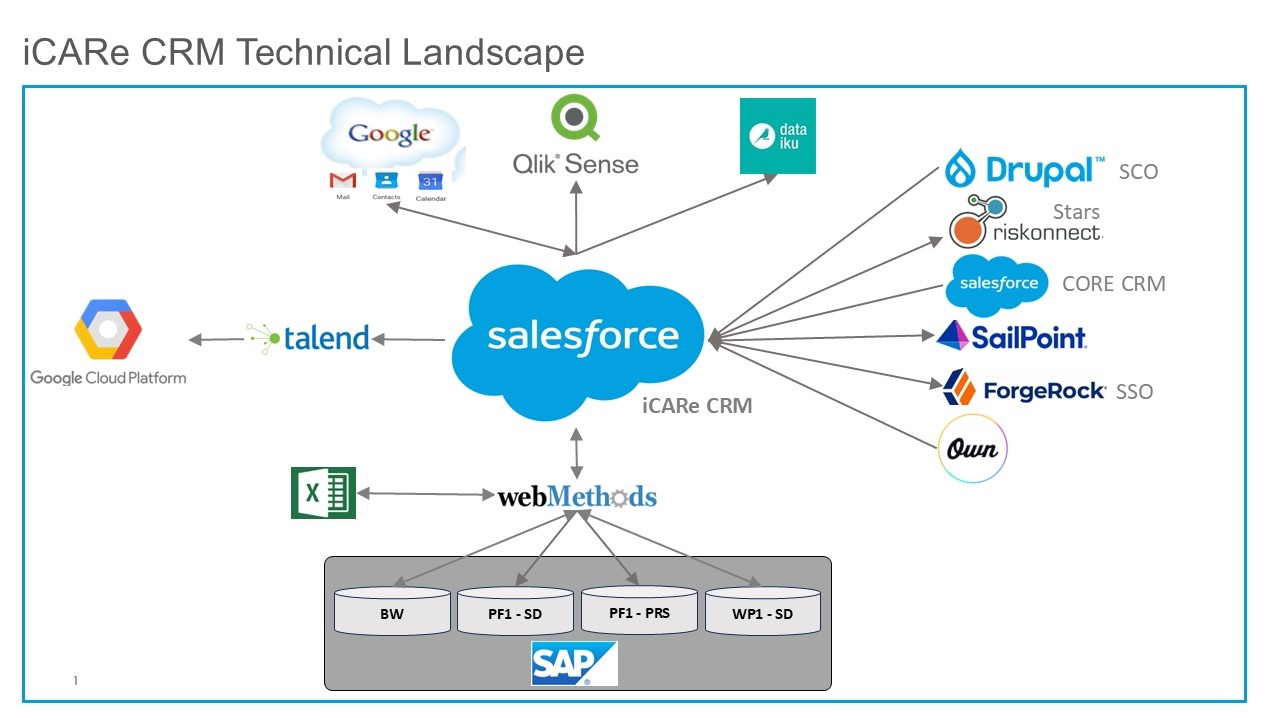
See below two links for existing integration landscape:
Core CRM interface provider.pdf
Core CRM interfaces consumer.pdf
The existence of two instances, along with heavy customizations and bespoke developments, presents the following challenges to all GBUs across Syensqo.
Customization Complexity: The two CRM instances have undergone extensive customization to meet the demands of various Global Business Units (GBUs). However, this customization has led to complexity in managing existing functions and delayed the go-to-market of new functions, thereby defying the benefits of cloud application. E.g., OneQuote is a completely bespoke functionality developed to handle quotation management, but it has not been fully adopted by all GBUs. On the other hand, contract management is not being used for its intended purpose of tracking contracted sales executed, but rather only for reminder notifications.
Interoperability Barriers: GBUs have to devote considerable time and resources to managing master and transactional processes, particularly for key customers who require cross-functional (transversal) support. As Strategic Key Customers of iCARe share customers with Core CRM, this complicates day-to-day communications across teams. Also, Commercial samples management is entirely manual, relying on emails for inventory management, material records, and transactions, leading to significant communication challenges and time wasted.
Integration Constraints: The WebMethods architecture is becoming a bottleneck, hindering performance and scalability due to the large number of interfaces (over 100) across both instances. Notably, 30% of the incident backlog is attributed to interface-related issues. Furthermore, maintaining two instances results in duplicated effort, as each new interface requires double the development and implementation work.
Governance & Strategic Sponsorship: There is no top management sponsorship to implement a standard and simple solution on the current SaaS platform, and GBU requests are implemented with customizations, resulting in increasing maintenance costs year after year.
Further details on the current functional documentations related to customizations are available in the appendix.
Assumptions
- The choice of technology for the new CRM platform will be addressed in a later phase.
- SAP S/4HANA will serve as the ERP (Enterprise Resource Planning) application for managing and executing customer records, sales contracts, sales orders, logistics, warehousing, transportation, billing, and rebates.
- Orders generated globally from ecommerce solutions (Salesforce + SAP) represent only 4% of total orders for 2023.
- A separate KDD will be created, focusing on pricing strategy, optimization, approval processes, and execution.
Constraints
- Gaining buy-in from stakeholders who may be attached to existing customizations and interfaces.
- A clear and strong Governance is key to achieve agreement (especially innovative GBUs like Novecare) to use standard solutions offered by the cloud provider.
- Securing proper sponsorship and executive support to drive transformational change, ensure resource allocation, and champion the initiative across the organization.
- The current Salesforce platform is used for other processes, such as Marketing Automation, Partner Management, Self-Service Portals, and Net Promoter Score (NPS) Voice of the Customer
Impacts
- Process streamlining will impact certain GBUs, requiring change management efforts to ensure a smooth transition.
- Ongoing projects
- OneQuote Implementation for Composites: Planned for H1 2025
- Pricing Module Improvement: Expected in October 2024, this change will unify List Price and Recommended Price into a single field, reducing complexity.
Business Rules
No business rules identified in this phase to implement the recommended solution. Further assessments will be done in detailed design phase.
Options considered
Option A: Greenfield CRM implementation with Single Instance for all GBU's
Objective: This solution represents a strategic initiative to develop a new, unified, collaborative cloud-based CRM platform for all Global Business Units (GBUs). It aims to align processes, foster collaboration, and achieve efficiencies across all units while maintaining data visibility and flexibility to support specific needs justified by a strong business case.
Key Advantages:
- Promotes cross-GBU collaboration and alignment by standardizing processes on a unified platform.
- Enables a comprehensive 360-degree view of customer interactions, enhancing decision-making and customer experience.
- Implements a CRM with enhanced and automated cross-GBU lead-to-contract processes, integrated complaint and sample management linked to ERP.
- Reduces long-term IT maintenance costs and GBU support by leveraging the cloud solution's out-of-the-box features, freeing up resources for innovation and growth.
- Simplifies integration with other IT systems and implementation of global projects, reducing complexity.
- Facilitates seamless integration of new acquisitions (M&A) with minimal disruption, enabling quicker alignment and operational integration.
Key Challenges:
- Strategic change management and executive sponsorship are required to drive adoption and alignment.
- High stakeholder involvement is needed to design and agree on new, unified processes across diverse Global Business Units (GBUs).
- Complex data migration and system integration are expected due to the consolidation of multiple legacy systems into a single instance.
- Managing security and privacy requirements across diverse global units may pose potential complexity.
- This solution represents a strategic initiative to develop a new, unified, collaborative cloud-based CRM platform for all Global Business Units (GBUs). It aligns with manufacturing best practices to standardize operations across all units, ensuring common business processes while maintaining data visibility independence. The platform can also support specific GBU needs, but only when a strong business case is identified.
Option B: Refine and streamline existing processes and integrations, retaining current two CRM instances.
Objective: This solution involves re-engineering the processes within the existing CRM solutions (Core & iCare) to align with best practices and standardize operations across all GBUs while maintaining two separate Salesforce instances. The goal is to optimize current systems without full consolidation, retaining the flexibility of separate instances while standardizing where possible.
Key Advantages:
- Maintains continuity by using existing systems, reducing disruption and the learning curve for users.
- Allows for phased improvements, providing flexibility in timing and minimizing immediate operational impact.
- Retains the autonomy of separate instances, allowing tailored configurations that meet specific GBU requirements.
Key Challenges:
- Gaining buy-in from stakeholders who are attached to existing customizations and legacy processes.
- Potential disruptions in daily activities during process re-engineering and alignment efforts.
- Ongoing complexity in managing and aligning two systems, which may limit full collaboration and process standardization.
- Accumulation of technical debt in maintaining two separate instances, which could hinder future upgrades and integrations.
Option C: Merge the two existing instances of CRM into one.
Objective: This solution involves consolidating the remaining GBUs into one of the existing Salesforce instances (Core or iCare) with minimal changes to existing processes. The goal is to reduce operational complexity and streamline CRM management by decommissioning one of the CRM instances.
Key Advantages:
- Streamlines operations by consolidating systems, leading to more straightforward governance and lower long-term maintenance costs.
- Reduces duplication of effort and systems, improving efficiency and consistency across GBUs.
- Limits the scope of disruption to only the GBUs involved in the merge, making the transition more manageable.
Key Challenges:
- Complexity in aligning new GBUs to the existing system, potentially requiring significant process adjustments.
- Technical challenges in merging data and systems due to existing customizations and legacy technical debt.
- Perceived fairness and emotional resistance from impacted GBUs, which may see the merger as unequal or disruptive.
- Potential difficulty in maintaining a consistent customer experience during the transition period.
Option D: Maintain existing CRM solution in the current state, retaining current two CRM instances.
Objective: This solution involves maintaining the current state of the existing CRM solutions (Core & iCare) without making significant changes, focusing only on adapting systems as necessary to align with the ERP program. The goal is to avoid major disruptions while ensuring compliance with ERP changes.
Key Advantages:
- Avoids the high costs and disruptions associated with major system changes or consolidation efforts.
- Maintains continuity by keeping existing processes and systems in place, minimizing the learning curve and operational disruptions.
- Allows for focused resource allocation on necessary ERP adaptations rather than widespread changes.
Key Challenges:
- Continued management of two separate CRM systems, leading to ongoing operational complexity and potential inefficiencies.
- Increased technical debt over time as systems age and customizations accumulate, potentially complicating future upgrades and integrations.
- Limited ability to standardize and optimize processes across GBUs, which may lead to inefficiencies and hinder collaboration.
- No alignment with ERP Rebuild program objectives to standardize & simplify the IT ecosystem, potentially leading to strategic misalignment and missed opportunities for synergies.
Evaluation
Option A - Greenfield CRM implementation with single instance for all GBU's | Option B - Refine and streamline existing processes and integrations, retaining current CRM instances | Option C - Merge the two existing instances into one. | Option D - Maintain Salesforce in its current state, retaining current CRM instances | |
|---|---|---|---|---|
| Alignment with "Simplification principle" |
|
|
|
|
| Alignment with "Standardisation principle" |
|  Two separate instances hinder full standardization and collaboration. Two separate instances hinder full standardization and collaboration. | Adaptation to non-standard processes in retained instance limits standardization. | Retaining customizations and multiple instances prevents standardization. |
| Total Cost of Ownership |  Single instance reduces maintenance costs and minimizes integration risks, lowering overall TCO. Single instance reduces maintenance costs and minimizes integration risks, lowering overall TCO. | Higher TCO due to maintaining multiple instances and duplicated efforts. | Merging reduces interfaces, simplifying maintenance and lowering TCO. | Maintaining multiple instances increases complexity and overall TCO. |
| User Adoption and Experience & Change Management | Requires significant change management, impacting short-term adoption and UX. |
| Higher training efforts needed as users adapt to new processes. | Tailored experiences for each business unit with minimal change management required. |
| Collaboration | Enables day-to-day collaboration across GBUs, improving efficiency in managing shared customers. | Data fragmentation in two instances hinders collaboration on key transversal accounts. | Single instance improves collaboration across GBUs, especially on shared customers. | Data fragmentation hinders collaboration and efficiency in managing shared customers. |
| Project Governance & Stakeholder Engagement | High GBU availability and commitment needed for defining new processes and ensuring sponsorship. | High availability required for streamlining, with challenges in gaining stakeholder buy-in. | High availability required for merging and adapting to retained instance processes. | Minimal impact on availability and sponsorship, as existing systems and processes are retained. |
| Customer Experience Impact | Unified CRM enhances customer experience through consistent processes and interactions across GBUs. | Inconsistent processes and data across instances may lead to a fragmented customer experience. | Merged instances improves customer experience by reducing inconsistencies. | Maintaining the current state may lead to a disjointed customer experience due to inconsistencies. |
| Legal & Compliance | New instance must comply with CMMC L1; all GBUs must follow specific guidelines. | Two instances allow for specific legal and compliance requirements. | Retained instance must comply with CMMC L1; all GBUs must follow specific guidelines. | Two instances allow for specific legal and compliance requirements (iCARe is more secure). |
| Integration and Data Management | Single instance simplifies integration and data management, improving quality and integrity. | Benefits limited unless existing interfaces are optimized. | Aligning custom integrations and data for merged GBUs is challenging. | Over 100 existing interfaces create ongoing maintenance challenges. |
| Scalability & Future-Proofing | Single instance is highly scalable, easily accommodating future growth and technology advancements. | Two instances limit scalability and complicate future upgrades. | Merged instance is scalable, but customizations may limit future flexibility. | Maintaining the current state limits scalability and adaptability to future needs. |