| Status | |
| Owner | |
| Stakeholders | The business stakeholders involved in making, reviewing, and endorsing this decision. Type @ to mention people by name |
Purpose
The purpose of this document is to define the conversion approach to create Business Partners - General in S/4 HANA.
In SAP ECC, customer and vendor master data are maintained separately as distinct entities. Customers are managed through Customer Master Data, while vendors are handled via Vendor Master Data. These records store essential details such as company name, address, payment terms, and tax information.
In SAP S/4HANA, the Business Partner (BP) concept replaces the traditional customer and vendor master data approach. The BP model integrates both customer and vendor roles into a single entity, simplifying data management and ensuring consistency across different business functions
Conversion Scope
The scope of this document covers the approach for converting active Customer Master Data General and Vendor Master General from Legacy Source Systems into S/4HANA Business Partner (BP) General (Role 000000) Master Data Design Standard.
Customer Master Data - General Information
The data from legacy system includes:
- Customer with AR Balance under the company codes within S4 Hana implementation scope.
- or (Customer doesn't have central deletion indicator AND Customer has sales transaction within the sales organizations in scope within 5 years), e.g., the customer is used as any partner function in the sales document, such as sales order, delivery or billing.
- or (Customer doesn't have central deletion indicator and customer has financial posting under the company codes within S4 Hana implementation scope within 5 years)
- or Customer is part of Customer Hierarchy Higher Node, and the sales area data is part of the sales areas within migration scope
- or there is customer consignment stock and the plant for the consignment stock is within S4 Hana implementation scope.
- or (Customer is created within 1 year and there is not central block) and it has sales view within sales organization in scope
- or or (Customer is created within 1 year and there is not central block) and it has company code view within company code in scope
The data from legacy system excludes:
- Customer/Vendor has central deletion indicator and without AR/AP Balance under the company codes within S4 Hana implementation scope.
- or (Customer is not used in any sales transaction under the sales organizations in scope for more than 5 years AND without any financial posting under the company codes in scope for more than 5 years)
Vendor Master Data - General Information
The data from legacy system includes:
The data from legacy system excludes:
| Source | Scope | Source Approx No. of Records | Target System | Target Approx No. of Records |
|---|---|---|---|---|
| WP2 | Customer Master Data General Information | 50000 | S4 Hana System | 50000 |
| PF2 | Customer Master Data General Information | 50000 | S4 Hana System | 50000 |
Additional Information
Multi-language Requirement
The customer and vendor general data may contain international address. Therefore, the conversion will also need to support the multi-language address. Below languages (International versions) are supported.
| International Version | Description |
|---|---|
| C | Simplified Chinese |
| R | Cyrillic |
| K | Kanji (Japanese) |
| A | Arabic |
| 3 | Korean |
| T | Thai |
| H | Hangul |
Document Management
It is possible the customer has attachment in the legacy system. The migration of attachment will be captured in conversion spec CNV-3004 - Attachment for customer master data.
Legal Requirement
Summarize Legal Requirement/s, if any
Special Requirements
Due to compliance requirement, there will be one SAP instance for Rest of the World and one for China specifically. For entities in China, the data will be loaded into SAP instance while the entire migration process will remain the same as rest of the world.
If the data conversion involves third-party systems or external data sources, such as Icertis, describe any additional requirements related to data mapping, transformation logic, validation rules or security measures that must be followed.
Target Design
With Functional input, document the technical design of the target fields that are in the scope of this document.
The technical design of the target for this conversion approach.
| Table | Field | Data Element | Field Description | Data Type | Length | Requirement |
|---|---|---|---|---|---|---|
| MARA | MATNR | MATNR | Material Number | CHAR | 18 | Mandatory |
Data Cleansing
All data cleansing should take place in the data source system as defined in this document, unless system limitations prevent it.
If data cleansing is managed outside of the source system (e.g. Syniti Migrate, 3rd Party Vendor, DCT), the necessary documentation must be produced and appended to this deliverable for sign-off.
| ID | Criticality | Error Message/Report Description | Rule | Output | Source System |
|---|---|---|---|---|---|
| 3007-001 | Missing Postal code in the general data | PF2/WP2 | |||
| 3007-002 | Missing Street in the general data | PF2/WP2 | |||
| 3007-003 | Missing region in the general data | PF2/WP2 | |||
| 3007-004 | Review the international version address maintained for the customer | PF2/WP2 | |||
| 3007-005 | Review the customer with obsolete region code | PF2/WP2 | |||
| 3007-006 | Identify duplicate BP 1. customer vs customer | PF2/WP2 | |||
| 3007-007 | Identify duplicate BP 2. vendor vs customer if applicable | PF2/WP2 |
Conversion Process
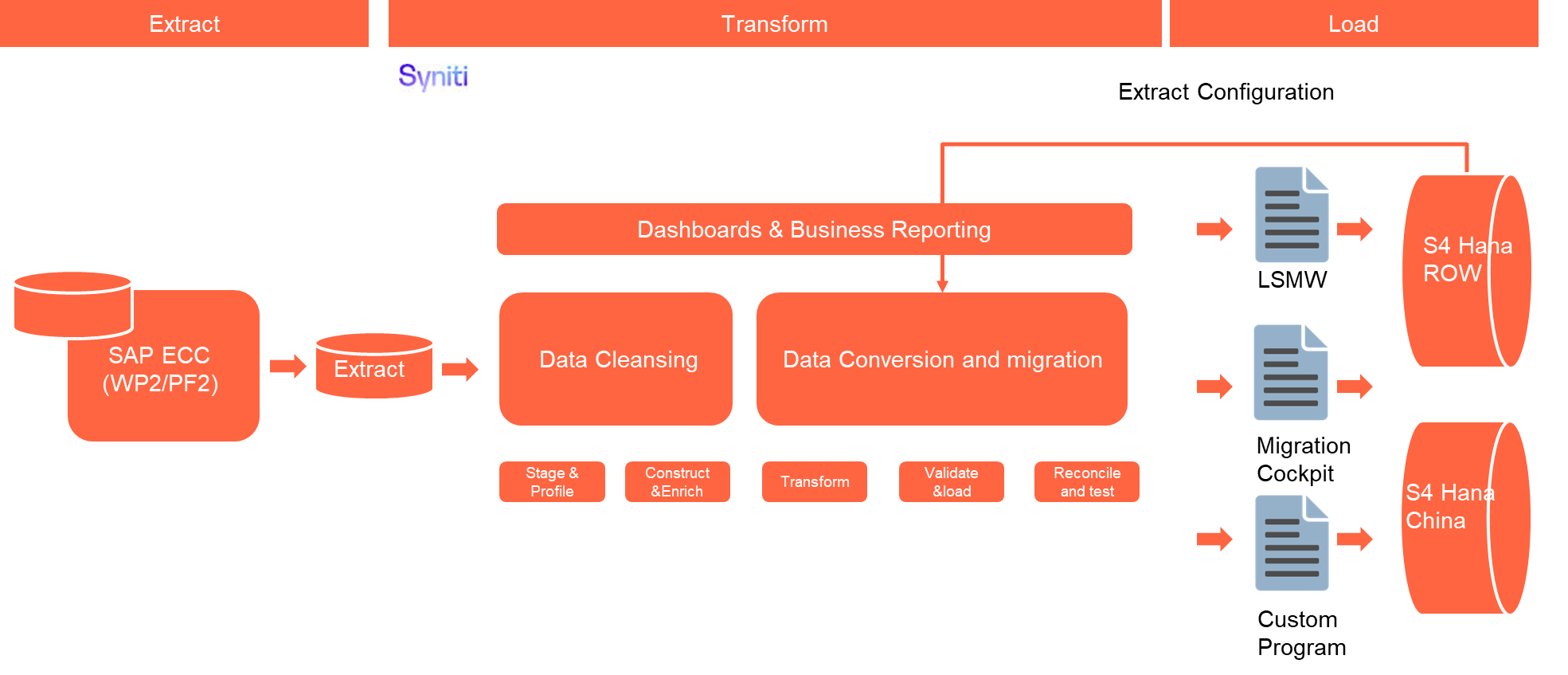
The high-level process is represented by the diagram below:
The ETL (Extract, Transform, Load) process is a structured approach to data migration and management, ensuring high-quality data is seamlessly transferred across systems. Here’s a breakdown of its key components:
1. Extraction
The process begins with extracting metadata and raw data from source systems, such as Syensqo ECC system (i.e., WP2/PF2) periodically. The extracted data is then staged for transformation.
2. Transformation
Once extracted, the data undergoes cleansing, consolidation, and governance. This step ensures data integrity, consistency, and compliance with business rules. The transformation process includes:
- Data validation to remove inconsistencies.
- Standardization to align formats across datasets.
- Business rule application to refine data for operational use.
3. Loading
The transformed data is then loaded into the target S4 Hana system.
Data Privacy and Sensitivity
Summarize Data Privacy and Sensitivity Requirements, if anyExtraction
Extract data from a source into Syniti Migrate. There are 2 possibilities:
- The data exists. Syniti Migrate connects to the source and loads the data into Syniti Migrate. There are 3 methods:
- Perform full data extraction from relevant tables in the source system(s).
- Perform extraction through the application layer.
- Only if Syniti Migrate; cannot connect to the source, data is loaded to the repository from the provided source system extract/report.
- The data does not exist (or cannot be converted from its current state). The data is manually collected by the business directly in Syniti Migrate. This is to be conducted using DCT (Data Collection Template) in Syniti Migrate
The agreed Relevancy criteria is applied to the extracted records to identify the records that are applicable for the Target loads
Extraction Run Sheet
| Req # | Requirement Description | Team Responsible |
|---|---|---|
Selection Screen
If applicable, this section will give the details on any selection screen parameters, including the parameter type, that are required to be entered to ensure consistent data extracts.| Selection Ref Screen | Parameter Name | Selection Type | Requirement | Value to be entered/set |
|---|---|---|---|---|
Data Collection Template (DCT)
Target Ready Data Collection Template will be created for Data Object data with exception of some fields which require transformation as mentioned in the transformation rule.<Object> DCT Rules
| Field Name | Field Description | Rule |
|---|---|---|
Extraction Dependencies
List the steps that need to occur before extraction can commence
| Item # | Step Description | Team Responsible |
|---|---|---|
Transformation
The Target fields are mapped to the applicable Legacy field that will be its source, this is a 3-way activity involving the Business, Functional team and Data team. This identifies the transformation activity required to allow Syniti Migrate to make the data Target ready:
- Perform value mapping and data transformation rules.
- Legacy values are mapped to the to-be values (this could include a default value)
- Values are transformed according to the rules defined in Syniti Migrate
- Prepare target-ready data in the structure and format that is required for loading via prescribed Load Tool. This step also produces the load data ready for business to perform Pre-load Data Validation
Transformation Run Sheet
| Item # | Step Description | Team Responsible |
|---|---|---|
Transformation Rules
| Rule # | Source system | Source Table | Source Field | Source Description | Target System | Target Table | Target Field | Target Description | Transformation Logic |
|---|---|---|---|---|---|---|---|---|---|
Transformation Mapping
Use the exact name and reference this section in the “Transformation rules” above| Mapping Table Name | Mapping Table Description |
|---|---|
| MAP_BU_GROUP | BP Grouping Mapping Table |
| MAP_REGION | Region Code Mapping Table |
| MAP_BPKIND | BP Type Mapping Table |
Transformation Dependencies
List the steps that need to occur before transformation can commence| Item # | Step Description | Team Responsible |
|---|---|---|
Pre-Load Validation
Project Team
The following pre-load validations will be performed by the Project Team.Completeness
| Task | Action |
|---|---|
| Validate the record count | Validate the loading file has the correct number of records |
| Validate the mandatory fields | Validate there is value for all the mandatory fields |
Accuracy
| Task | Action |
|---|---|
| Validate the transformation | Validate the fields which require transformation have the value after transformation instead of the original field value |
Business
The following pre-load validations will be performed by the business.Completeness
| Task | Action |
|---|---|
| title | specific details of what and how the task needs to be performed e.g. which reports are being used etc. |
Accuracy
| Task | Action |
|---|---|
| title | specific details of what and how the task needs to be performed e.g. which reports are being used etc. |
Load
The load process includes:
- Execute the automated data load into target system using load tool or product the load file if the load must be done manually
- Once the data is loaded to the target system, it will be extracted and prepared for Post Load Data Validation
Load Run Sheet
| Item # | Step Description | Team Responsible |
|---|---|---|
Load Phase and Dependencies
The Business Partner General will be loaded in the pre-cutover period.
Before loading, it will have dependency on the configuration. The configuration needs to be transported into the respective system first, including the manual configuration such as the number range set up.
Configuration
List the Configurations required before loading can commence
| Item # | Configuration Item |
|---|---|
| BP Grouping | |
| Customer/Vendor Account Group | |
| International Version | |
| Tax Category | |
| BP Type | |
| BP Number Range/Customer/Vendor Number range |
Conversion Objects
| Object # | Preceding Object Conversion Approach |
|---|---|
| 1083 | Bank Master |
Error Handling
The table below depicts some possible system errors for this data object during data load. All data load error is to be logged as defect and managed within the Defect Management
| Error Type | Error Description | Action Taken |
|---|---|---|
| The value XXX for field XXX doesn't exist |
| |
| There is mandatory field XXX missing |
| |
| The BP grouping is External or Internal Number range |
|
Post-Load Validation
Project Team
The following post-load validations will be performed by the Project Team.Completeness
| Task | Action |
|---|---|
| Validate Record count in the backend | Validate the main tables, such as BUT000 has the same records as the loading file |
| Display Records | Pick up few random BP numbers, and Run the BP Report to validate the BP general information can be displayed without any error |
Accuracy
| Task | Action |
|---|---|
| title | specific details of what and how the task needs to be performed e.g. which reports are being used etc. |
Business
The following post-load validations will be performed by the business.Completeness
| Task | Action |
|---|---|
| title | specific details of what and how the task needs to be performed e.g. which reports are being used etc. |
Accuracy
| Task | Action |
|---|---|
| title | specific details of what and how the task needs to be performed e.g. which reports are being used etc. |
Key Assumptions
- Master Data Standard is up to date as on the date of documenting this conversion approach and data load.
- BP General (Role 000000) is in scope based on data design and any exception requested by business.
Any additional key assumptions.