| Status | |
|---|---|
| Owner | |
| Stakeholders | The business stakeholders involved in making, reviewing, and endorsing this decision. Type @ to mention people by name |
Purpose
The purpose of this document is to define the conversion approach to create Packing Determination Data in S/4 HANA. following the DD-FUN-050 Master Data Stadard_1063-Packing Determination Master data design standard
We will taking on all the packing determination records from Legacy Systems for Materials in Scope as per Basic Data View,
An access sequence is assigned to the condition type. The key combinations contained in the access sequence are used for assigning the Packing instruction to characteristics combinations such as material/customer.
Conversion Scope
The data from legacy system includes:
- We will migrate all the packing determinations from Legacy Systems for Materials in Scope as per Basic Data View, Materials without a Deletion indicator
The data from legacy system excludes:
All Condition Types with an expired Valid to Date (DATBI)
The data from legacy system includes depending on Key Combination:
| Material |
| Material/Ship-to part |
| Material/Ship-to party/Use |
| Material/Plant |
| Material/Plant/Storage Location |
| Material/Vendor |
| Material/Ship.type |
| Ship.point/Transp.Group/Ship.Condition |
| Ship.point/Transp.Group/Ship.Condition/Ship-to party |
| Material/Ship.type/Ship-to pt |
| Plant/Material/Ship-to pt |
| Plant/Material/Country |
| Plant/Material/Export |
| Plant/Shipping conditiion/Material/Ship-to |
| Plant/Material/Pack.Unit |
| Source | Scope | Source Approx No. of Records | Target System | Target Approx No. of Records |
|---|---|---|---|---|
| PF2 | All active Packing Determination records with a valid date | Approx 38k records in WQ2 (used as baseline) | S4H | Depending on Consolidation of Plants/Materials |
Additional Information
Multi-language Requirement
N/A
Document Management
N/A
Legal Requirement
N/A
Special Requirements
N/A
Target Design
This MDS will be further updated once the actual Determination Types and Key Combinations to be used by the business are known. This will thus feed into the CNV.
The technical design of the target for this conversion approach.
| Table | Field | Data Element | Field Description | Data Type | Length | Requirement |
|---|---|---|---|---|---|---|
| KOTPxxx | KSCHL | KSCHL_PV | Application | CHAR | 4 | Required |
| KOTPxxx | MATNR | MATNR | Material Number | CHAR | 18 | Conditional |
| KOTPxxx | WERKS | WERKS_D | Plant for packing Instruction determination | CHAR | 4 | Conditional |
| KOTPxxx | LIFNR | LIFNR | Vendor for Packing Instruction | HAR | 10 | Conditional |
| KOTPxxx | KUNWE | PL_KUNWE | Ship-to Party or packing instruction determination | CHAR | 10 | Conditional |
| KOTPxxx | ABRVW | ABRVW | Usage Indicator | CHAR | 3 | Conditional |
| KOTPxxx | LGORT | LGORT_D | Storage Location | CHAR | 4 | Conditional |
| KOTPxxx | DATAB | KODATAB | Validity start date of the condition record | DATS | 8 | Required |
| KOTPxxx | DATBI | KODATBI | Validity end date of the condition record | DATS | 8 | Required |
| KONDP | PACKNR | PL_PACKNR_CONV | Packing Instruction | CHAR | 22 | Required |
| KONDP | PACKNR1 | PL_PACKNR_CONV | Packing instruction | CHAR | 22 | Conditional |
| KONDP | PACKNR2 | PL_PACKNR_CONV | Alternative Packing instruction 2 | CHAR | 22 | Conditional |
| KONDP | PACKNR3 | PL_PACKNR_CONV | Alternative Packing instruction 3 | CHAR | 22 | Conditional |
| KONDP | PACKNR4 | PL_PACKNR_CONV | Alternative Packing instruction 4 | CHAR | 22 | Conditional |
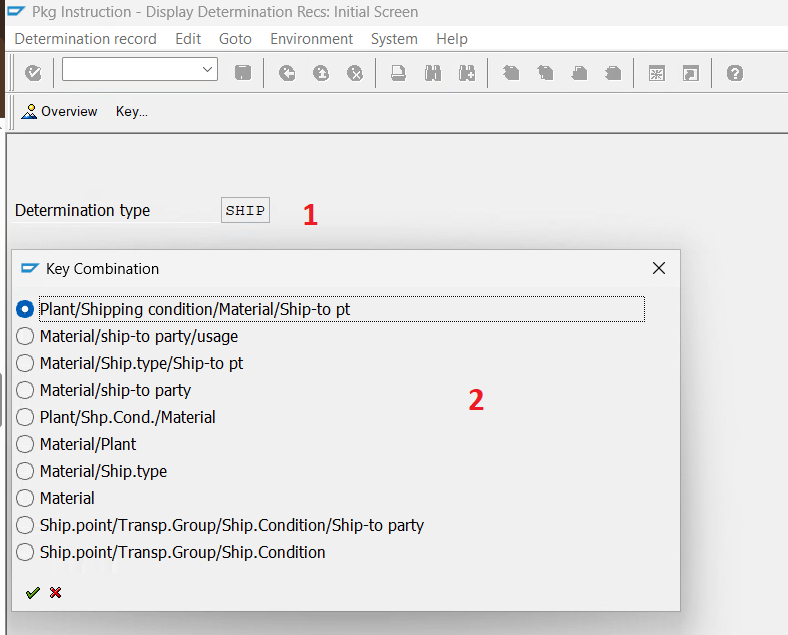
Depending On the Determination Type Various Tables and Columns Come into Scope. (See Figure1)
figure1
The following Matrix shows which fields are in scope per table:
x designates a copy Action
Note* KOTHP9xx series are as per Current "as is" Naming. As the tables are custom numbering dependant on Config the "To Be" numbering may be different. Can only confirm once setup in target
| FIELD | KAPPL | KSCHL | DATBI | DATAB | KNUMH | MATNR | KUNWE | ABRVW | WERKS | LGORT | LIFNR | VERSART | VSTEL | TRAGR | ZZVSBED | LAND1 | EXPKZ | ZZUNIT | ||
| Table Name | Key Combination) | Field Description → | Application | Condition type for packing object determination | Valid To | Valid From | Cond.record no. | Material | Ship-to party for packing instruction determination | Usage Indicator | Plant | Storage Location | Vendor | Shipping Type | Shipping Point/Receiving Point | Transportation Group | Shipping Conditions | Country Key | Export Indicator | Packing Unit |
| KOTP001 | Material | x | x | x | x | x | x | |||||||||||||
| KOTP100 | Material/Ship-to part | x | x | x | x | x | x | x | ||||||||||||
| KOTP110 | Material/Ship-to party/Use | x | x | x | x | x | x | x | x | |||||||||||
| KOTP200 | Material/Plant | x | x | x | x | x | x | x | ||||||||||||
| KOTP210 | Material/Plant/Storage Location | x | x | x | x | x | x | x | x | |||||||||||
| KOTP400 | Material/Vendor | x | x | x | x | x | x | x | ||||||||||||
| x | x | x | x | x | x | x | ||||||||||||||
| x | x | x | x | x | x | x | x | |||||||||||||
| x | x | x | x | x | x | x | x | x | ||||||||||||
| x | x | x | x | x | x | x | x | |||||||||||||
| x | x | x | x | x | x | x | x | |||||||||||||
| x | x | x | x | x | x | x | x | |||||||||||||
| x | x | x | x | x | x | x | x | |||||||||||||
| x | x | x | x | x | x | x | x | x | ||||||||||||
| x | x | x | x | x | x | x | x |
Data Cleansing
All data cleansing should take place in the data source system as defined in this document, unless system limitations prevent it.
If data cleansing is managed outside of the source system (e.g. Syniti Migrate, 3rd Party Vendor, DCT), the necessary documentation must be produced and appended to this deliverable for sign-off.
| ID | Criticality | Error Message/Report Description | Rule | Output | Source System |
|---|---|---|---|---|---|
| 1 | n/A | Currently no cleansing requirement identified | N/A | N/A | N/A |
Conversion Process
The high-level process is represented by the diagram below:

Data Privacy and Sensitivity
Summarize Data Privacy and Sensitivity Requirements, if anyExtraction
Extract data from a source into Syniti Migrate. There are 2 possibilities:
- The data exists. Syniti Migrate connects to the source and loads the data into Syniti Migrate. There are 3 methods:
- Perform full data extraction from relevant tables in the source system(s).
- Perform extraction through the application layer.
- Only if Syniti Migrate; cannot connect to the source, data is loaded to the repository from the provided source system extract/report.
- The data does not exist (or cannot be converted from its current state). The data is manually collected by the business directly in Syniti Migrate. This is to be conducted using DCT (Data Collection Template) in Syniti Migrate
The agreed Relevancy criteria is applied to the extracted records to identify the records that are applicable for the Target loads
Extraction Run Sheet
| Req # | Requirement Description | Team Responsible |
|---|---|---|
| 1 | Extract from Legacy all Determination Records for all the KOTP Tables utilised, Extract all the KONDP (Conditions for Packing objects Data Section) | Synity |
| 2 | Apply The relevancy Rules for Active records | Synity |
| 3 | Generate data and share with team | Synity |
Selection Screen
If applicable, this section will give the details on any selection screen parameters, including the parameter type, that are required to be entered to ensure consistent data extracts.| Selection Ref Screen | Parameter Name | Selection Type | Requirement | Value to be entered/set |
|---|---|---|---|---|
POF3 | Determination Type | Dependant on Key (See figure1) | Mandatory | example ('SHIP') |
Data Collection Template (DCT)
Target Ready Data Collection Template will be created for Data Object data with exception of some fields which require transformation as mentioned in the transformation rule.<Object> DCT Rules
| Field Name | Field Description | Rule |
|---|---|---|
| Not Applicable | ||
Extraction Dependencies
List the steps that need to occur before extraction can commence
| Item # | Step Description | Team Responsible |
|---|---|---|
| Org Structure needs to be finalised | Plants, Shipping Points, Storage Locations, Vendors, Ship to | Functionals |
Transformation
The Target fields are mapped to the applicable Legacy field that will be its source, this is a 3-way activity involving the Business, Functional team and Data team. This identifies the transformation activity required to allow Syniti Migrate to make the data Target ready:
- Perform value mapping and data transformation rules.
- Legacy values are mapped to the to-be values (this could include a default value)
- Values are transformed according to the rules defined in Syniti Migrate
- Prepare target-ready data in the structure and format that is required for loading via prescribed Load Tool. This step also produces the load data ready for business to perform Pre-load Data Validation
Transformation Run Sheet
| Item # | Step Description | Team Responsible |
|---|---|---|
| 1 | Obtain Relevancy signoff from Business | SyWay P2F Data Team |
| 2 | Execute Transform | SyWay P2F Data Team |
| 3 | Review & Validate Error Reports and Preload Reports | SyWay P2F Data Team |
| 4 | Generate Load files | SyWay P2F Data Team |
Transformation Rules
| Rule # | Source system | Source Table | Source Field | Source Description | Target System | Target Table | Target Field | Target Description | Transformation Logic |
|---|---|---|---|---|---|---|---|---|---|
| 1 | PF2/WP2 | KOTPxxx | KSCHL | Condition type for packing object determination | S4/HANA | KOTPxxx | KSCHL | Condition type for packing object determination | Copy |
| 2 | PF2/WP2 | KOTPxxx | MATNR | Material Number for packing Instruction determination | S4/HANA | KOTPxxx | MATNR | Material Number for packing Instruction determination | Value Mapping/xref |
| 3 | PF2/WP2 | KOTPxxx | WERKS | Plant for packing Instruction determination | S4/HANA | KOTPxxx | WERKS | Plant for packing Instruction determination | Value Mapping/xref |
| 4 | PF2/WP2 | KOTPxxx | LIFNR | Vendor for packing Instruction determination | S4/HANA | KOTPxxx | LIFNR | Vendor for packing Instruction determination | Value Mapping/xref |
| 5 | PF2/WP2 | KOTPxxx | KUNWE | Ship-to party for packing instruction determination | S4/HANA | KOTPxxx | KUNWE | Ship-to party for packing instruction determination | Value Mapping/xref |
| 6 | PF2/WP2 | KOTPxxx | ABRVW | The usage defines the conditions under which a material is sold | S4/HANA | KOTPxxx | ABRVW | The usage defines the conditions under which a material is sold | Copy(If Exists Key Combination) |
| 7 | PF2/WP2 | KOTPxxx | LGORT | Storage location for packing instruction determination | S4/HANA | KOTPxxx | LGORT | Storage location for packing instruction determination | Value Mapping/xref |
| 8 | PF2/WP2 | KOTPxxx | PACKNR | Packing Instruction Number to be used for packing | S4/HANA | KOTPxxx | PACKNR | Packing Instruction Number to be used for packing | Copy |
| 9 | PF2/WP2 | KOTPxxx | DATAB | Validity start date | S4/HANA | KOTPxxx | DATAB | Validity start date | Copy |
| 10 | PF2/WP2 | KOTPxxx | DATBI | Validity end date | S4/HANA | KOTPxxx | DATBI | Validity end date | Copy |
| 11 | PF2/WP2 | KONDP | PACKNR | Packing instruction number to be used for packing | S4/HANA | KONDP | PACKNR | Packing instruction number to be used for packing | Copy |
| 12 | PF2/WP2 | KONDP | PACKNR1 | Alternative packing instruction to be used for packing. | S4/HANA | KONDP | PACKNR1 | Alternative packing instruction to be used for packing. | Copy(If Exists ) |
| 13 | PF2/WP2 | KONDP | PACKNR2 | Alternative packing instruction to be used for packing. | S4/HANA | KONDP | PACKNR2 | Alternative packing instruction to be used for packing. | Copy(If Exists ) |
| 14 | PF2/WP2 | KONDP | PACKNR3 | Alternative packing instruction to be used for packing. | S4/HANA | KONDP | PACKNR3 | Alternative packing instruction to be used for packing. | Copy(If Exists ) |
| 15 | PF2/WP2 | KONDP | PACKNR4 | Alternative packing instruction to be used for packing. | S4/HANA | KONDP | PACKNR4 | Alternative packing instruction to be used for packing. | Copy(If Exists ) |
Transformation Mapping
Use the exact name and reference this section in the “Transformation rules” above| Mapping Table Name | Mapping Table Description | |
|---|---|---|
| 1 | Ensure all Transformation mappings are up to date | Synity/Data Team |
| 2 | Check Tables for fields are up to date & complete | Synity/Data Team |
| 3 |
| Synity/Data Team |
Transformation Dependencies
List the steps that need to occur before transformation can commence| Item # | Step Description | Team Responsible |
|---|---|---|
| 1 | In case Cleansing is applied in future , this needs to be applied, finalised & validated | Syway Data Team/Synity |
Pre-Load Validation
Project Team
The following pre-load validations will be performed by the Project Team.Completeness
| Task | Action |
|---|---|
| Verify Record Counts | SyWay P2F Data team need to verify that the total number of records in PREP (Relevancy) ties back to the number of records in the Load file. Any errors need to be assessed and either remediated or cleansed |
Accuracy
| Task | Action |
|---|---|
| Conversion Accuracy | Syway P2F Data Team to verify that all fields below meet the checks:
|
| Review Error Reports | Review and correct the errors. Raise defects for data remediated and requiring a correction in the source data |
Business
The following pre-load validations will be performed by the business.Completeness
| Task | Action |
|---|---|
| To check Data Accuracy checking count of records to load and loaded | Business Data Owner/s to verify that the total number of relevant records from the the Load file is equal to the total number of records in the Preload and PREP count. |
Accuracy
| Task | Action |
|---|---|
| Data owners to grant that the records in the load files are okay and according with the rules and mappings | To check and validate the load files with all the transformation and mapping rules. Ensure that all Signoffs are received. |
Load
The load process includes:
- Execute the automated data load into target system using load tool or product the load file if the load must be done manually
- Once the data is loaded to the target system, it will be extracted and prepared for Post Load Data Validation
Load Run Sheet
| Item # | Step Description | Team Responsible |
|---|---|---|
| 1 | Go to Load file & Pick a few records to load manually without any tool. See if any errors are encountered. | Synity Team |
| 2 | Exclude the records used to manually load from the load file in order not to attempt to create duplicates. | Synity Team |
| 3 | Proceed with full load if above steps are successful. | Synity Team |
| 4 | Validate A few records manually & check in SAP Directly | Synity Team |
| 5 | Generate Post-load Reports & Statistics Reports (Take note of Duration of load so that this can be used for planning for FDR) | Synity Team |
Load Phase and Dependencies
Master Data needs to exist
Materials exist
Customers/Plants/Shipping points exist
Packing Instructions loaded
Customizing (procedure/condition type/access sequence) is active
Packing Instructions need to exist
Field catalogue updated (For Z-fields)
Configuration
List the Configurations required before loading can commence
| Item # | Configuration Item |
|---|---|
| 1 | KOTP tables need to be setup and Naming known |
Conversion Objects
| Object # | Preceding Object Conversion Approach |
|---|---|
| 1059 | IM Packing Instructions |
Error Handling
This will be iterative and will be updated as the errors become known.
The table below depicts some possible system errors for this data object during data load. All data load error is to be logged as defect and managed within the Defect Management
| Error Type | Error Description | Action Taken |
|---|---|---|
| 1 | xxxx Not available in target | Inform Data Team to determine if it is missing config or if it is preceding object that did not manage to load the data but it is considered relevant. |
Post-Load Validation
Project Team
The following post-load validations will be performed by the Project Team.Completeness
| Task | Action |
|---|---|
| alidate Row counts | Check whether row counts in SAP tie back to load File & Preload Report. |
Accuracy
| Task | Action |
|---|---|
| Verify Accuracy | Perform fields by field Comparison to ensure that records sent in landed correctly (leading zero's & Decimal places etc) |
Business
The following post-load validations will be performed by the business.Completeness
| Task | Action |
|---|---|
| Raise any defects for errors | For each mock the relevant Checks need to be performed & incidents need to be raised to ensure that we learn from our mistakes & Pro-Active reports can be built to eliminate future errors |
Accuracy
| Task | Action |
|---|---|
| Sign off | Performa a few checks in the system based on business process & Sign off where applicable. |
Key Assumptions
- Master Data Standard is up to date as on the date of documenting this conversion approach and data load.
- DD-FUN-050 Master Data Standard_1063-Packing Determination is in scope based on data design and any exception requested by business.
- Caveat** This is an Evolving Document, expect some changes as more information becomes known
Any additional key assumptions.
See also
Insert links and references to other documents which are relevant when trying to understand this decision and its implications. Other decisions are often impacted, so it's good to list them here with links. Attachments are also possible but dangerous as they are static documents and not updated by their authors.