| Status | |
| Owner | Soumen Laru |
| Stakeholders | The business stakeholders involved in making, reviewing, and endorsing this decision. Type @ to mention people by name |
Purpose
The purpose of this document is to define the conversion approach of Profit Centre Group (Alt, Std Hierarchy)s into S/4 HANA.
The document details out the field list, extraction criteria, scoping, mapping of cost centre object
Cost Centres will be extracted from Source and based on the list of cost centres from the cost centre mapping sheet, target cost centre data file will be
Conversion Scope
Profit Centre Group (Alt, Std Hierarchy)s which will be listed as part of scope list with new numbering will be in scope of migration.
| Source | Scope | Source Approx No. of Records | Target System | Target Approx No. of Records |
|---|---|---|---|---|
| PF2 | Profit Centre Group (Alt, Std Hierarchy) | 6,423 | S4HANA | |
| WP2 | Profit Centre Group (Alt, Std Hierarchy) | 5,768 | S4HANA |
Additional Information
Multi-language Requirement
In the Syensqo Profit Centre Group (Alt, Std Hierarchy)s, the following four language keys must be maintained:
- English (EN)
- French (FR)
- Italian (IT)
- Chinese (ZN)
Note: For certain countries it may be required to also maintain account descriptions for certain Profit Centre Group (Alt, Std Hierarchy)s in local language as per regulatory requirement (e.g. Japanese) in the respective country. Such requests must be backed by supporting evidence of the underlying regulatory requirement.
Such data will be collected as part of DCT for the translation texts for Profit Centre Group (Alt, Std Hierarchy)s.
Document Management
Summarize Document Management requirement, if any
Legal Requirement
Summarize Legal Requirement/s, if any
Special Requirements
Specify any special requirements or considerations that may impact the data conversion process based on specific locations, regulatory compliance or system limitations. Clearly outline any regional or localization requirements such as country-specific data formats, legal reporting obligations or industry standards that must be adhered to (e.g., localization rules for countries like China).
If the data conversion involves third-party systems or external data sources, such as Icertis, describe any additional requirements related to data mapping, transformation logic, validation rules or security measures that must be followed.
Target Design
With Functional input, document the technical design of the target fields that are in the scope of this document.
The technical design of the target for this conversion approach.
| Table | Field | Data Element | Field Label | Data Type | Length | Requirement | Syensqo Requirement R = Required : Mandatory field. O = Optional: Not mandatory. If a value is entered it doesn't impact Business Process. C = Conditional: Not mandatory. If a value is entered it impacts Business Process or Reporting. S = System: System generates the value. NU = Not Used |
| CEPC | PRCTR | PRCTR | Profit Center | CHAR | 10 | Organizational unit in controlling used for internal reporting and responsibility accounting. The Profit center represents in syensqo context either a Plant or a GBS 'non Plant'. The Syensqo PC codification must follow the naming convention. "1 + 4 "" Digit #1 = GBU Indicator S=SPEC. POLYMERS or C=COMPOSITE MATERIALS or N=NOVECARE or T=TECHNOLOGY SOLUTIONS or B=CBS From digit 2 to 5 : 4 char. Company Code OR Plant Code. Illustration : S1001 | R |
Data Cleansing
All data cleansing should take place in the data source system as defined in this document, unless system limitations prevent it.
If data cleansing is managed outside of the source system (e.g. Syniti Migrate, 3rd Party Vendor, DCT), the necessary documentation must be produced and appended to this deliverable for sign-off.
ID | Criticality | Error Message/Report Description | Rule | Output | Source System |
1. | Can load, but business process will fail | Lock any Profit Centre Group (Alt, Std Hierarchy) not being used for last 5 years | TBD | Report | PF2 / WP2 |
Note: Cleansing mau not be necessary as the ex
Conversion Process
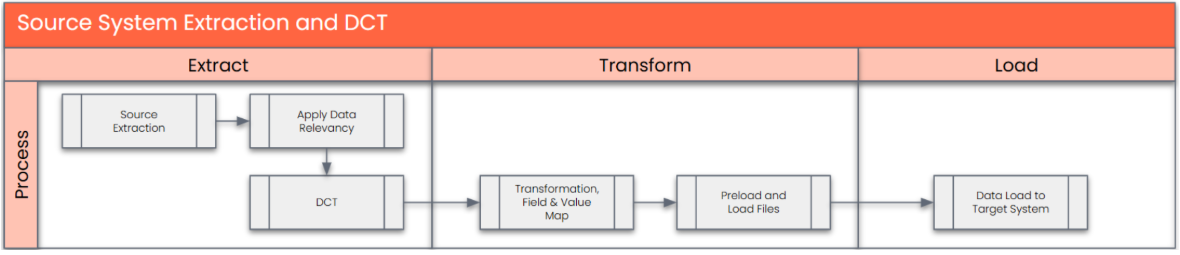
The high-level process is represented by the diagram below:
Summarize High-Level Process. Include diagrams, where applicable. Include information supporting details of Extract, Transform and Load specific to the Data Object
Data Privacy and Sensitivity
Summarize Data Privacy and Sensitivity Requirements, if anyExtraction
Extract data from a source into Syniti Migrate. There are 2 possibilities:
- The data exists. Syniti Migrate connects to the source and loads the data into Syniti Migrate. There are 3 methods:
- Perform full data extraction from relevant tables in the source system(s).
- Perform extraction through the application layer.
- Only if Syniti Migrate; cannot connect to the source, data is loaded to the repository from the provided source system extract/report.
- The data does not exist (or cannot be converted from its current state). The data is manually collected by the business directly in Syniti Migrate. This is to be conducted using DCT (Data Collection Template) in Syniti Migrate
The agreed Relevancy criteria is applied to the extracted records to identify the records that are applicable for the Target loads
Extraction Run Sheet
Req # | Requirement description | Team responsible |
1. | Ensure source tables CEPC and CEPCT are extracted in tool according to the agreed cut-off date in the project plan Ensure DCT is collected for the Profit Centre Group (Alt, Std Hierarchy)s based on the collection template | Data team |
2. | Perform preliminary completeness check documented in section 5.2.8.1.1 | Data team |
3. | Raise issues as defects if Req # 1 to 2 are not met | Data team |
4. | Repeat Req # 1 to 3 if required | Data team |
5. | Report extraction result to person in charge of APOI conversion | Data team |
Selection Screen
If applicable, this section will give the details on any selection screen parameters, including the parameter type, that are required to be entered to ensure consistent data extracts.| Selection Ref Screen | Parameter Name | Selection Type | Requirement | Value to be entered/set |
|---|---|---|---|---|
Data Collection Template (DCT)
Target Ready Data Collection Template will be created for Data Object data with exception of some fields which require transformation as mentioned in the transformation rule.<Object> DCT Rules
Field Name | Field description | Rule |
CEPC-PRCTR | Profit Centre Group (Alt, Std Hierarchy) | Business to enter content as per data type and length permitted |
Suggestion to add:
Decimal validation - Check table TCURX for the document currency key and if Decimals (TCURX-CURRDEC) is ‘0’, validate that no decimal value is populated.
Extraction Dependencies
List the steps that need to occur before extraction can commence
Item # | Step description | Team responsible |
1. | Any period / year end close activities have been fully completed | Business |
2. | Reconciliation for intercompany payables have been completed, and adjustment made in legacy SAP system | Business |
3. | Reconciliation of migrated Purchase Order is completed before the extraction of Accounts Payable Open Items | Business and Data |
Transformation
The Target fields are mapped to the applicable Legacy field that will be its source, this is a 3-way activity involving the Business, Functional team and Data team. This identifies the transformation activity required to allow Syniti Migrate to make the data Target ready:
- Perform value mapping and data transformation rules.
- Legacy values are mapped to the to-be values (this could include a default value)
- Values are transformed according to the rules defined in Syniti Migrate
- Prepare target-ready data in the structure and format that is required for loading via prescribed Load Tool. This step also produces the load data ready for business to perform Pre-load Data Validation
Transformation Run Sheet
Item # | Step description | Team responsible |
1. | Ensure all the fields that require value mapping, as stipulated Mapping tables, have the latest signed-off mapping files imported into toolMigrate. | Data team |
2. | In tool, select the Trial Balance object PY. | Data team |
3. | Go to Process Area Launch and Process the Object - Trial Balance object - R4 Trial Balance PY. | Data team |
4. | Launch the Objects to execute transformation. | Data team |
5. | Monitor the transformation progress and ensure performance and completion is within allowed timeframe | Data team |
6. | Generate Pre-Load reports . | Data team |
7. | Generate data load count. | Data team |
8. | Log errors as defects, if any and address resolutions. Close defects. | Data team |
9. | Re-transform and re-validate the Pre-load reports if necessary. | Data team |
10. | Validate the transformed file as part of pre-load validation, raise data defects or provide the pre-load sign-off. | Business |
11. | Analyse and resolve any pre-load defects logged by business. | Data team |
12. | Repeat steps 6 to 11 if necessary | Data team |
13. | Proceed to pre-load validations | Data team |
Transformation Rules
| Rule # | Source system | Source Table | Source Field | Source description | Target system | Target Table | Target Field | Target description | Transformation logic |
| 1 | DCT/ECC | CEPC | PRCTR | Profit Center | S/4HANA | CEPC | PRCTR | Profit Center | Copy From DCT as-is |
| 2 | DCT/ECC | CEPC | DATBI | Valid To Date | S/4HANA | CEPC | DATBI | Valid To Date | Copy From DCT as-is |
Transformation Mapping
Use the exact name and reference this section in the “Transformation rules” aboveMapping Table Name | Mapping Table Description |
Profit Centre Group (Alt, Std Hierarchy) | Mapping of legacy Profit Center to target system value |
Person Responsible | Mapping of legacy Person Responsible to New Person Responsible |
User ID | Mapping of legacy User ID |
Hierarchy Group | Mapping of Legacy Hierarchy Group to Hierarchy Group |
Transformation Dependencies
List the steps that need to occur before transformation can commence| Item # | Step Description | Team Responsible |
|---|---|---|
| 1 | Ensure all the fields that require value mapping, as stipulated. Mapping tables, have the correct values mapped and imported into tool. | Data Team |
| 2 | Ensure Profit Centre Group (Alt, Std Hierarchy) hierarchies are loaded into target S/4HANA | Data Team |
Pre-Load Validation
Project Team
The following pre-load validations will be performed by the Project Team.Completeness
Task | Action |
Generation of | Mandatory field check.
|
Record Count | Record Count
|
Accuracy
Task | Action |
Mandatory field mapping and transformation | Obtain a list of the fields to be populated with values from mapping files and ensure all these fields contain S/4HANA values. |
Business
The following pre-load validations will be performed by the business.Completeness
| Task | Action |
|---|---|
| Verify record count in Pre-load reports by region | Confirm the Preload File contains all the records in scope of migration based on the DCT (Data Construction Template) |
Accuracy
| Task | Action |
|---|---|
| Conversion accuracy | Verify Profit Centre Group (Alt, Std Hierarchy)s are transformed accurately as per endorsed transformation/mapping rules. Review error reports in tool for any mismatch or missing transformed values. In legacy system, execute ECC tcode SE16N to display table CEPC to confirm copied fields are accurately copied. ( If applicable) |
Load
The load process includes:
- Execute the automated data load into target system using load tool or produce the load file if the loading of records to be done using LTMC cockpit object of Profit Centre Group (Alt, Std Hierarchy).
- Once the data is loaded to the target system, it will be extracted and prepared for Post Load Data Validation with side by side check of each fields in scope of the objects with fields to be displayed as XXXX_ECC, XXXX_S4HANA, XXXX_MATCH ( As TRUE or FALSE) with an additional column denoting fields not matching and status of loading in S/4HANA as LOADED_IN_S4HANA ( As TRUE or FALSE)
Load Run Sheet
Item | Step description | Team responsible |
1 | Ensure the load tools are transported into the correct tool instance. | Data team |
2 | Ensure DCTs and all required mappings are submitted and complete | Data team |
3 | Ensure Pre-load sign-offs are obtained. | Data team |
4 | Execute upload of Profit Centre Group (Alt, Std Hierarchy) Object using Migration Cockpit Object for Profit Centre Group (Alt, Std Hierarchy) Upload | Data team |
5 | Generate the post load reports in tool. | Data team |
6 | Log errors as defects, if any and address resolutions. Close defects. | Data team |
7 | Resolve defects by reupload and re-generate post load reports if necessary. | Data team |
8 | Business to validate the post load files as part of post-load validation, raise data defects or provide the post-load sign-off. | Business |
9 | Repeat steps 5 to 7 if necessary. | Data team |
Load Phase and Dependencies
Identify the phase as to “when” the load for this object will occur. <Pre-Cutover, Cutover, Post Cutover> and list the steps that need to occur before the load can commence
Configuration
List the Configurations required before loading can commence
Item # | Configuration item |
1. | Controlling Area |
Conversion Objects
| Object # | Preceding Object Conversion Approach |
|---|---|
| N/A |
Error Handling
The table below depicts some possible system errors for this data object during data load. All data load error is to be logged as defect and managed within the Defect Management
Error type | Error description | Action taken |
Post-Load Validation
Project Team
The following post-load validations will be performed by the Project Team.Completeness
| Task | Action |
|---|---|
| Reconciliation of Record Count | Check Record count between DCT, Preload file and target extracted data from tables SETHEADER, SETNODE, SETLEAF. A Summary report to be added in the post-load report |
Accuracy
| Task | Action |
|---|---|
| Check values in key fields for accuracy | Refer to the post-load file and Manual check of the Loaded data using KCH3 and SE16N |
Business
The following post-load validations will be performed by the business.Completeness
| Task | Action |
|---|---|
| Record Count Check | Business to check Post-Load File and Summary report in post-load |
Accuracy
| Task | Action |
|---|---|
| Spot check | Spot check some sample records from the post-load report to be picked for checking in SAP transaction code KCH3 to verify accuracy of the data. |
Key Assumptions
- Master Data Standard is up to date as on the date of documenting this conversion approach and data load.
- Data Object is in scope based on data design and any exception requested by business.
Any additional key assumptions.