| Status | |
|---|---|
| Owner | |
| Stakeholders | The business stakeholders involved in making, reviewing, and endorsing this decision. Type @ to mention people by name |
Purpose
The purpose of this document is to define the conversion approach for migrating Purchasing Info Records into S/4HANA from multiple SAP ECC source systems. The migration of Purchasing Requisitions (PRs) aims to ensure business continuity by transferring relevant and open requisition data from one or more legacy systems into the SAP S/4HANA environment. This process is essential for preserving in-flight procurement processes, avoiding disruption in material and service availability, and maintaining traceability of internal purchasing demands.
Summarise how the data is currently utilized and set up in the legacy system/s and how object is intended to be represented in S/4, and any other relevant information
---CHECKLIST---
- Logical Source and Target Systems are identified.
- Processing Type is specified (i.e. Direct Input, BAPI, IDoc, Web Service, OData API, etc.)
- Standard or custom load program name/BAPI/IDoc is specified to support this functionality.
- Data Mapping is provided for mappings which are not obvious to a suitably-skilled and experienced developer
- All translation requirements are clearly defined (including data validation rules, data derivation/calculation and default values, if applicable)Input and/or Output file layouts are provided for all record types possible
- Transaction volume is specified Execution frequency is specifiedRestart/Recovery requirements have been defined
- Error handling requirements are specified, including alerting requirement and expected action on failure.
- Application log requirement if applicable to be specified.
- Additional topics to check (ABUOS)
- Rules for Data Merging (all systems)
- Conversion Scope
- Data Loading Details
Conversion Scope
This document outlines the approach for migrating active Purchasing Requisitions from Syensqo's legacy SAP ECC systems (PF2 and WP2) into SAP S/4HANA, in alignment with the Procurement Master Data Design Standard.
Purchasing Requisitions will be migrated to support operational procurement, sourcing strategies, and Ariba integration. All requisitions will be validated, cleansed, and centrally loaded using standardized templates and mapped fields, ensuring consistency with the target S/4HANA data model.
Due to the decentralized nature of the current system landscape—where requisition data is stored across PF2 and WP2—discrepancies in materials, vendors, and organizational data may exist. As a result, data harmonization, cleansing, and mapping are critical to ensure accurate and reliable information in the target system. These efforts will also ensure that load templates are properly formatted and aligned with the S/4HANA requirements.
The data from legacy system includes:
- Requisitions from multiple source systems referring to the same Vendor and Material
- Valid combinations of Material (MATNR), Plant, and Purchasing Group
- Requisitions with active Purchasing Organization and account assignment details
- Open requisitions or those converted into Purchase Orders in the last 2 years
- Requisitions with key control data (e.g., Delivery Date, Quantity, Account Assignment)
- Requisitions relevant for open sourcing processes or planned purchases
The data from legacy system excludes:
- Requisitions flagged for deletion or already fully processed (PO/Item received or deleted)
- Requisitions with blocked or deleted materials or vendors
- Requisitions referencing Plants, Vendors, or Materials that are Out of Scope (OOS)
- Draft or incomplete requisitions missing essential data (e.g., Material, Quantity)
- Requisitions created solely for test or training purposes
| Source | Scope | Source Approx No. of Records | Target System | Target Approx No. of Records |
|---|---|---|---|---|
| WP2 | The Purchasing Requisitions will be extracted/collected via DCT. An initial extract of the relevant data will be provided in Google Sheet format to support business decisions regarding the inclusion of any relevant requisitions from Source Systems. Any additional requisition data required to support the new design may be added directly into the DCT. A data review and standardization process will be performed across all Purchasing Requisitions in the DCT. | 3.885 | S4/Hana | 2.100 |
| PF2 | 2.245 | S4/Hana | 1.200 |
*The figures described above, are restricted to one 1W Period.
**The objective is to reduce the data volume to be migrated by 80%, retaining only manually created Purchase Requisitions.
Additional Information
Multi-language Requirement
Long Texts must be migrated in all languages relevant to global purchasing defined in the Source System (when availableon source system/PurchReq)
Data Deduplication
For this data object, deduplication rules are not applicable. This is due to the fact that the object represents a transactional entity exclusively created and maintained within the target system. As such, there is no risk of duplicate records originating from external sources or legacy systems. The object’s lifecycle is fully controlled within the system, ensuring uniqueness by design.
Therefore, no deduplication logic or validation needs to be implemented for this object in the data migration or integration processes.
Document Management
N/A
Legal Requirement
N/A
Special Requirements
N/A
Target Design
With Functional input, document the technical design of the target fields that are in the scope of this document.
The technical design of the target for this conversion approach.
| Table | Field | Data Element | Field Description | Data Type | Length | Requirement |
|---|---|---|---|---|---|---|
| EBAN | BANFN | BANFN | Purchase Requisition Number | CHAR | 10 | Required |
| EBAN | BNFPO | BNFPO | Item Number of Purchase Requisition | NUMC | 5 | Required |
| EBAN | BSART | BSART | Document Type | CHAR | 4 | Required |
| EBAN | MATNR | MATNR | Material Number | CHAR | 18 | Optional |
| EBAN | WERKS | WERKS_D | Plant | CHAR | 4 | Required |
| EBAN | MENGE | MENGE | Quantity | QUAN | 13 | Required |
| EBAN | MEINS | MEINS | Base Unit of Measure | UNIT | 3 | Required |
| EBAN | LFDAT | LFDAT | Delivery Date | DATS | 8 | Optional |
| EBAN | LIFNR | LIFNR | Vendor | CHAR | 10 | Optional |
| EBNA | BANFN | BANFN | Purchase Requisition Number | CHAR | 10 | Required |
| EBNA | BNFPO | BNFPO | Item Number of Purchase Requisition | NUMC | 5 | Required |
| EBNA | KNTTP | KNTTP | Account Assignment Category | CHAR | 1 | Required |
| EBNA | KOSTL | KOSTL | Cost Center | CHAR | 10 | Optional |
| EBKN | BANFN | BANFN | Purchase Requisition Number | CHAR | 10 | Required |
| EBKN | BNFPO | BNFPO | Item Number of Purchase Requisition | NUMC | 5 | Required |
| EBKN | KNTTP | KNTTP | Account Assignment Category | CHAR | 1 | Required |
| EBKN | KOSTL | KOSTL | Cost Center | CHAR | 10 | Optional |
| EBKN | AUFNR | AUFNR | Order Number | CHAR | 12 | Optional |
| EBUB | BANFN | BANFN | Purchase Requisition Number | CHAR | 10 | Required |
| EBUB | BNFPO | BNFPO | Item Number of Purchase Requisition | NUMC | 5 | Required |
| EBUB | FRGGR | FRGGR | Release Group | CHAR | 2 | Required |
| EBUB | FRGSX | FRGSX | Release Strategy | CHAR | 2 | Required |
| EBUB | FRGZU | FRGZU | Release Indicator | CHAR | 1 | Required |
Data Merging Strategy
Purchasing Requisitions (PRs) typically do not require data merging like master data does for the reason they are related to transactional and historical records. However this topic can be considered as Not Applicable (N/A).
ID | Scenario | Action |
|---|---|---|
Data Cleansing
All data cleansing should take place in the data source system as defined in this document, unless system limitations prevent it.
If data cleansing is managed outside of the source system (e.g. Syniti Migrate, 3rd Party Vendor, DCT), the necessary documentation must be produced and appended to this deliverable for sign-off.
| ID | Criticality | Error Message/Report Description | Rule | Output | Source System |
|---|---|---|---|---|---|
Conversion Process
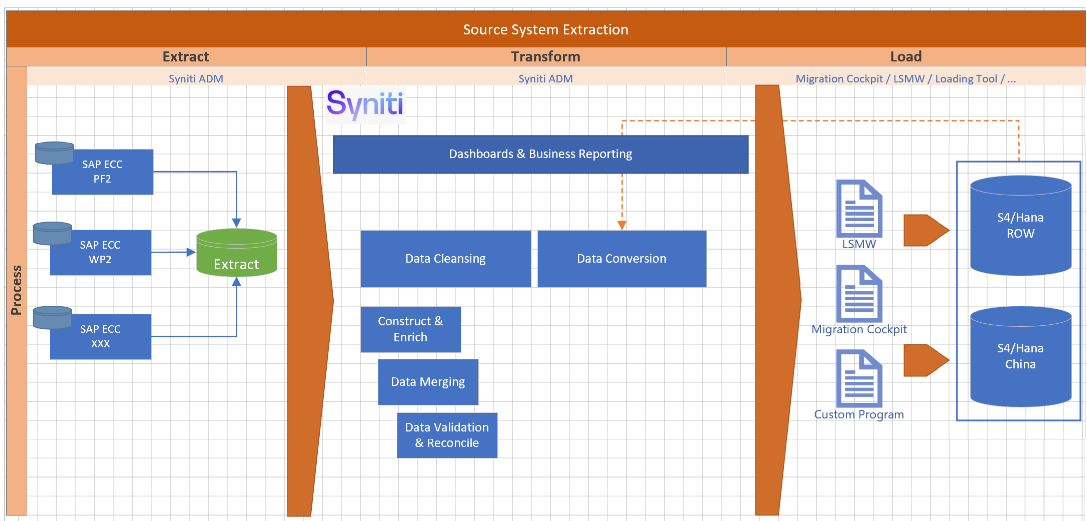
The high-level process is represented by the diagram below:

Data Privacy and Sensitivity
Summarize Data Privacy and Sensitivity Requirements, if anyExtraction
Extract data from a source into Syniti Migrate. There are 2 possibilities:
- The data exists. Syniti Migrate connects to the source and loads the data into Syniti Migrate. There are 3 methods:
- Perform full data extraction from relevant tables in the source system(s).
- Perform extraction through the application layer.
- Only if Syniti Migrate; cannot connect to the source, data is loaded to the repository from the provided source system extract/report.
- The data does not exist (or cannot be converted from its current state). The data is manually collected by the business directly in Syniti Migrate. This is to be conducted using DCT (Data Collection Template) in Syniti Migrate
The agreed Relevancy criteria is applied to the extracted records to identify the records that are applicable for the Target loads
Extraction Run Sheet
| Req # | Requirement Description | Team Responsible |
|---|---|---|
| 001 | Only select records with the following criteria EBAN-BSTYP = 'B' (Document cat.) EBAN-LOEKZ = '' (Deletion ind.) EBAN-ESTKZ <> 'B' (Creation ind.) EBAN-MARNR <> '' (Materials in scope) EBAN-BADAT>= 01.01.2023 (Creation Date) EBAN-STATU = ' ' or 'M' or 'F' or 'R' EBAN-EKORG = SCOPE ONLY (Purchasing Organization) EBAN-WERKS = SCOPE ONLY (Plant) or '' (empty) EBAN-LGORT = SCOPE ONLY (Storage Location) or '' (empty) EBAN-EBAKZ = '' | Syniti Team |
| 002 | EBAN-MATNR=Extract Only Materials that are present in scope | Syniti Team |
| 003 | EBAN-LIFNR =Extract Only Vendors that are present in scope OR vendor is empty | Syniti Team |
| 004 | EBAN-WERKS =Extract Only Plants that are present in scope OR plant is empty | Syniti Team |
| 005 | EBAN-LGORT = Extract Only Storage Locations that are present in scope OR plant is empty |
Selection Screen
If applicable, this section will give the details on any selection screen parameters, including the parameter type, that are required to be entered to ensure consistent data extracts.| Selection Ref Screen | Parameter Name | Selection Type | Requirement | Value to be entered/set |
|---|---|---|---|---|
Data Collection Template (DCT)
Target Ready Data Collection Template will be created for Data Object data with exception of some fields which require transformation as mentioned in the transformation rule.<Object> DCT Rules
| Field Name | Field Description | Rule |
|---|---|---|
| EBAN-BSART | Document Type | Select the document types that are in scope |
| EBAN-MATNR | Material Number | Select the materials that are in scope |
| EBAN-WERKS | Plant | Select the plants that are in scope |
| EBAN-MENGE | Quantity | Select entries that are bigger (>) than zero |
| EBAN-LFDAT | Delivery Date | Select entries that are bigger (>) or equal (=) than today |
| EBAN-LIFNR | Vendor | Select the vendors that are in scope |
Extraction Dependencies
List the steps that need to occur before extraction can commence
| Item # | Step Description | Team Responsible |
|---|---|---|
001 | Vendor - The Info Record is created for a specific vendor, therefore the vendor must exist and be active | S2P |
002 | Material - The Info Record is for a specific material, therefore the material must exist and be active | S2P |
003 | Purchasing Organization - Mandatory organizational level (configuration). Must be valid for both the vendor and material | S2P |
004 | Plant (optional) - The plant must be valid (included on scope) and maintained | FICO |
005 | Storage Location (optional) - The Storage Location must be valid (included on scope) and maintained for the Material / Plant | S2P |
005 | Currency & UoM - Must align with vendor master and material master data | S2P |
006 | Vendor Master Settings - The vendor must have the purchasing organization maintained in purchasing view | S2P |
Transformation
The Target fields are mapped to the applicable Legacy field that will be its source, this is a 3-way activity involving the Business, Functional team and Data team. This identifies the transformation activity required to allow Syniti Migrate to make the data Target ready:
- Perform value mapping and data transformation rules.
- Legacy values are mapped to the to-be values (this could include a default value)
- Values are transformed according to the rules defined in Syniti Migrate
- Prepare target-ready data in the structure and format that is required for loading via prescribed Load Tool. This step also produces the load data ready for business to perform Pre-load Data Validation
Transformation Run Sheet
| Item # | Step Description | Team Responsible |
|---|---|---|
| 001 | Identify target S/4HANA fields and determine applicable legacy source fields from both ECC systems WP2, PF2 | Functional Team (S2P)+ Data Team (S2P) |
| 002 | Map legacy field values to S/4HANA target values (including field-level mapping and technical names) | Data Team (S2P), Data Team (Syniti) |
| 003 | Define value mapping rules for fields requiring standardization or harmonization across the two source systems WP2, PF2. | Functional Team (S2P)+ Data Team (S2P) |
| 004 | Identify and agree on default values where legacy data is incomplete or inconsistent | Business Team + Functional Team (S2P) |
| 005 | Configure transformation rules in Syniti Migrate (including calculated fields, formatting rules, etc.) | Data Team (Syniti), Data Team (S2P) |
| 006 | Review transformation logic and mappings with Business for confirmation | Business Team + Functional Team (S2P) |
| 007 | Perform initial transformation run and generate draft target-ready dataset | Data Team (Syniti), |
| 008 | Review draft target-ready data for structure and completeness | Data Team (S2P), Functional Team (S2P) |
| 009 | Share transformed data with Business for Pre-load Validation | Business Team |
| 010 | Incorporate feedback from Business and refine mappings or transformation logic as needed | Data Team (S2P) |
| 011 | Finalize and approve transformed data as Target Ready Load File | Business + Functional (S2P) + Data Team (S2P) |
| 012 | Handover final file to Load Team or trigger the load via Syniti Load Workbench | Data Team (Syniti), Data Load Team |
Transformation Rules
| Rule # | Source system | Source Table | Source Field | Source Description | Target System | Target Table | Target Field | Target Description | Transformation Logic |
|---|---|---|---|---|---|---|---|---|---|
9044-001 | Legacy | EBAN | MATNR | Material | S/4HANA | EBAN | MATNR | Material | Select the new Material Code from the mapping table and update the corresponding target structure accordingly. |
9044-002 | Legacy | EBAN | MATKL | Material Group | MATKL | Material Group | MATKL | Material Group | Select the new Material Group from the mapping table and update the corresponding target structure accordingly. |
9044-003 | Legacy | EBAN | LIFNR | Vendor | S/4HANA | EBAN | LIFNR | Vendor | Select the new Vendor Code from the mapping table and update the corresponding target structure accordingly. |
9044-004 | Legacy | EBAN | MEINS | Order Unit | S/4HANA | EBAN | MEINS | Order Unit | Select the new Order Unit Code from the mapping table and update the corresponding target structure accordingly. |
9044-005 | Legacy | EBAN | WERKS | Plant | S/4HANA | EBAN | WERKS | Plant | Select the new Plant Code from the mapping table and update the corresponding target structure accordingly. |
9044-006 | Legacy | EBAN | WAERS | Currency | S/4HANA | EBAN | WAERS | Currency | Select the new Currency Code from the mapping table and update the corresponding target structure accordingly. |
Transformation Mapping
Tables are not yet available to be mentioned here.
Use the exact name and reference this section in the “Transformation rules” above| Mapping Table Name | Mapping Table Description |
|---|---|
Transformation Dependencies
List the steps that need to occur before transformation can commence| Item # | Step Description | Team Responsible |
|---|---|---|
| 001 | Value Mapping Tables are complete | Functional Team (S2P) + Data Team (S2P) |
| 002 | Configurations for Purchasing Requisitions are complete | Functional Team (S2P) + Data Team (S2P) |
| 003 | Org structure configuration is complete | Functional Team (S2P) + Data Team (S2P) |
| 004 | Dependent Master Data records for Customer and Material are loaded | Functional Team (S2P) + Data Team (S2P) |
| 005 | Configuration – Purchasing Organization | Functional Team (S2P) |
| 006 | Configuration – Plant | Functional Team (S2P) |
| 007 | Configuration – Product Group | Functional Team (S2P) |
| 008 | Configuration – Vendor | Functional Team (S2P) |
| 009 | Configuration – Material | Functional Team (S2P) |
| 010 | Configuration – Material Group | Functional Team (S2P) |
| 011 | Configuration – Unit of Measure | Functional Team (S2P) |
| 012 | Configuration – Purchasing Organization | Functional Team (S2P) |
| 013 | Configuration – Purchasing Group | Functional Team (S2P) |
Pre-Load Validation
Project Team
The following pre-load validations will be performed by the Project Team.Completeness
| Task | Action |
|---|---|
| Configuration | Ensure necessary configurations are in place in target system and field mapping is aligned with access sequence, condition types |
| Review Mapping Table | Ensure all the source organization units are mapped with target values |
| Check Values | Validate the pre-load data confirming the values are aligned with target system format and |
| Validate template structure and required field population | Ensure mandatory fields are filled |
Total number of records | SyWay S2P Data Team to verify that the total number of relevant records from the DCT is equal to the total number of records in the Preload and Load Sheets. |
Vendor Validation | Check if the vendor exists in the target system and is active for the purchasing organization. This object has to be loaded before Info Records and Price Conditions. |
Material Validation | Check if the material exists in the target system and is active for the purchasing organization. This object has to be loaded before Info Records and Price Conditions. |
Mandatory Field Check | Verify whether all mandatory Fields are properly updated: EINA-LIFNR |
Info Record Category | Check if the Info Record Category (EINE-ESOKZ) has been properly migrated and in case of conversion check the final result. |
Accuracy
| Task | Action |
|---|---|
| title | specific details of what and how the task needs to be performed e.g. which reports are being used etc. |
Business
The following pre-load validations will be performed by the business.Completeness
| Task | Action |
|---|---|
| title | specific details of what and how the task needs to be performed e.g. which reports are being used etc. |
Accuracy
| Task | Action |
|---|---|
| title | specific details of what and how the task needs to be performed e.g. which reports are being used etc. |
Load
The load process includes:
- Execute the automated data load into target system using load tool or product the load file if the load must be done manually
- Once the data is loaded to the target system, it will be extracted and prepared for Post Load Data Validation
Processing Details:

Load Method: We are using LSMW (Legacy System Migration Workbench) to perform the data migration for this object.
Tool: LSMW (Legacy System Migration Workbench)
Technical Approach: Utilization of BAPI BAPI_REQUISITION_CREATE (or BAPI_PR_CREATE) to create Purchasing Requisitions.
Load Run Sheet
| Item # | Step Description | Team Responsible |
|---|---|---|
Load Phase and Dependencies
Identify the phase as to “when” the load for this object will occur. <Pre-Cutover, Cutover, Post Cutover> and list the steps that need to occur before the load can commence
Configuration
List the Configurations required before loading can commence
| Item # | Configuration Item |
|---|---|
Conversion Objects
| Object # | Preceding Object Conversion Approach |
|---|---|
| list the exact title of the conversion object of only the immediate predecessor – this will then confirm the DDD (Data Dependency Diagram) | |
Error Handling
The table below depicts some possible system errors for this data object during data load. All data load error is to be logged as defect and managed within the Defect Management
| Error Type | Error Description | Action Taken |
|---|---|---|
Post-Load Validation
Project Team
The following post-load validations will be performed by the Project Team.Completeness
| Task | Action |
|---|---|
| title | specific details of what and how the task needs to be performed e.g. which reports are being used etc. |
Accuracy
| Task | Action |
|---|---|
| title | specific details of what and how the task needs to be performed e.g. which reports are being used etc. |
Business
The following post-load validations will be performed by the business.Completeness
| Task | Action |
|---|---|
| title | specific details of what and how the task needs to be performed e.g. which reports are being used etc. |
Accuracy
| Task | Action |
|---|---|
| title | specific details of what and how the task needs to be performed e.g. which reports are being used etc. |
Key Assumptions
- Master Data Standard is up to date as on the date of documenting this conversion approach and data load.
- Data Object is in scope based on data design and any exception requested by business.
Any additional key assumptions.
See also
Insert links and references to other documents which are relevant when trying to understand this decision and its implications. Other decisions are often impacted, so it's good to list them here with links. Attachments are also possible but dangerous as they are static documents and not updated by their authors.