| Status | |
|---|---|
| Owner | |
| Stakeholders |
Purpose
The purpose of this document is to define the conversion approach to create 1044 Quality Info Record in S/4 HANA.
Quality Info Records are used in SAP Quality Management (QM) to control the procurement and usage of materials from vendors or for customers. A QIR documents whether a supplier is approved to deliver a particular material, under what conditions, and with what quality agreements in place. It also supports restrictions such as blocking or requiring source inspections before delivery. This feature helps ensure supplier quality compliance and strengthens the linkage between procurement and quality processes.
In SAP S/4HANA, the structure and usage of Quality Info Records remain consistent with SAP ECC, generally defined by key combinations such as Material / Vendor / Plant or Material / Customer / Plant. QIRs can include attributes such as release status, validity dates, procurement blocks, source inspection requirements, and quality agreement indicators.
In SAP ECC, aside from the standard structures, Quality Info Records may also exist with extended combinations or enhancements, for example:
Material / Vendor without plant reference,
Material / Customer for sales-side QIRs,
Additional custom fields capturing supplier quality ratings,
Legacy blocks or obsolete release indicators that are no longer in use.
Such cases must be reviewed carefully (pending MDS) to determine whether they remain relevant for migration.
This conversion aims to migrate active and relevant Quality Info Records from existing ECC systems into S/4HANA by applying the required transformation logic using Syniti as the data migration and transformation platform. The converted records will be loaded into the target S/4HANA system using standard SAP mechanisms such as BAPIs (e.g., BAPI_QM_QUALINFORECORD_CREATE), IDOCs, or direct table loads where applicable, ensuring compliance with procurement and quality integration processes.
Conversion Scope
The scope of this document covers the approach for converting active Quality Info Record from Legacy Source Systems into S/4HANA following the Quality Info Record - Master Data Design Standard.
The data from legacy system includes:
Active QIRs used within the last three (3) years in procurement or sales processes.
QIRs without deletion flag.
Plant-specific QIRs that will be migrated to the To-Be Plant Mapping (taking into consideration the To-Be definition of Plants).
QIRs referenced in active material-vendor (procurement) or material-customer (sales) combinations.
The data from legacy system excludes:
Inactive QIRs not used in more than three (3) years.
QIRs marked for deletion.
QIRs belonging to deleted plants (per To-Be Plant mapping).
Obsolete or duplicate QIRs that are no longer relevant (e.g., replaced by harmonized corporate standards).
| Source | Scope | Source Approx No. of Records | Target System | Target Approx No. of Records |
|---|---|---|---|---|
| PF2 and WP2 | Quality Info Record will be extracted from PF2 and WP2 client | PF2 = 33642 records WP2 = 8889 records | S/4 HANA | 13655 records |
| DCT | Quality Info Records for Material / Vendor / Customer / Plant combinations which do not have data existing from PF2 and WP2 | TBD | S/4 HANA | TBD |
Additional Information
Multi-language Requirement
Not applicable
Document Management
Not applicable
Legal Requirement
Not applicable
Special Requirements
Not applicable
Target Design
The technical design of the target for this conversion approach.
| Table | Field | Data Element | Field Description | Data Type | Length | Requirement |
|---|---|---|---|---|---|---|
| QINF | MATNR | MATNR | Material Number | CHAR | 18 | Mandatory – Material subject to QIR |
| QINF | LIFNR | LIFNR | Vendor Number | CHAR | 10 | Mandatory (for procurement-side QIR) |
| QINF | KUNNR | KUNNR | Customer Number | CHAR | 10 | Mandatory (for customer-side QIR) |
| QINF | WERKS | WERKS_D | Plant | CHAR | 4 | Mandatory – Plant where QIR applies |
| QINF | QINFART | QINFART | QIR Category (Procurement, Sales) | CHAR | 1 | Mandatory |
| QINF | GUELTIGAB | DATUV | Valid-From Date | DATS | 8 | Mandatory |
| QINF | GUELTIGBIS | DATUB | Valid-To Date | DATS | 8 | Optional (blank = indefinite) |
| QINF | SPERRE | QSPERR | Procurement Block Indicator | CHAR | 1 | Optional (X = Blocked) |
| QINF | FREIGABE | QFREIG | Release Indicator | CHAR | 1 | Mandatory – Status of approval (Released/Not Released) |
| QINF | QVERWEIS | QVERW | Quality Agreement Reference (custom use) | CHAR | 10 | Optional |
| QINF | PRUEFLOSERF | QPRLOS | Source Inspection Required (Yes/No) | CHAR | 1 | Optional |
| QINF | KZLOEKZ | LOEKZ | Deletion Flag | CHAR | 1 | Optional (exclude if flagged) |
| QINF | ERNAM | ERNAM | Created By | CHAR | 12 | Optional (audit) |
| QINF | ERDAT | ERDAT | Created On | DATS | 8 | Optional (audit) |
| QINF | AENAM | AENAM | Last Changed By | CHAR | 12 | Optional |
| QINF | AEDAT | AEDAT | Last Changed On | DATS | 8 | Optional |
| QIHT | MATNR | MATNR | Material Number | CHAR | 18 | Mandatory (link key) |
| QIHT | LIFNR / KUNNR | LIFNR / KUNNR | Vendor/Customer | CHAR | 10 | Mandatory (link key) |
| QIHT | WERKS | WERKS_D | Plant | CHAR | 4 | Mandatory (link key) |
| QIHT | SPRAS | SPRAS | Language Key | LANG | 1 | Mandatory |
| QIHT | KURZTEXT | KURZTEXT | Short Text / Description of QIR | CHAR | 40 | Mandatory (per language) |
| QIHT | LTEXTKZ | LTEXTKZ | Long Text Exists Indicator | CHAR | 1 | Optional (if long text maintained) |
Data Cleansing
| ID | Criticality | Error Message/Report Description | Rule | Output | Source System |
|---|---|---|---|---|---|
| 2020-001 | C1 | Invalid or inactive Material in QIR | QIR references a material that does not exist in MARA/MARC or is flagged for deletion/blocked at plant. | Material | PF2/WP2 |
| 1139-001 3018-001 3021-001 3024-001 3025-001 3028-001 3031-001 | C1 | Invalid or inactive Vendor in QIR (procurement side) | QIR (MATNR/LIFNR/WERKS) references vendor not in LFA1/LFM1 (or blocked for purchasing). | Vendor | PF2/WP2 |
| 1139-001 3018-001 3021-001 3024-001 3025-001 3028-001 3031-001 | C1 | Invalid or inactive Customer in QIR (sales side) | QIR (MATNR/KUNNR/WERKS) references customer not in KNA1/KNVV (or blocked). | Customer | PF2/WP2 |
| 2010-001 3027-001 | C1 | Invalid Plant | QIR plant (WERKS) does not exist or is obsolete. | Plant | PF2/WP2 |
| 1044-001 | C1 | Duplicate QIR key | Duplicate active QIRs with same combination (Material + Vendor/Customer + Plant) and overlapping validity. | QIR | PF2/WP2 |
| 1044-001 | C1 | Validity overlap within same key | Multiple QIR records for same key have overlapping GUELTIGAB/GUELTIGBIS dates. | QIR | PF2/WP2 |
| 1044-001 | C1 | QIR not released/approved | Release indicator/status not set to “Released/Approved” as per business rule. | QIR | PF2/WP2 |
| 1044-001 | C1 | QIR blocked | Procurement block indicator set (e.g., SPERRE = X) while record flagged as active for migration. | QIR | PF2/WP2 |
| 1044-001 | C1 | Expired QIR | Valid-to date is before cutover date; exclude unless explicitly required. | QIR | PF2/WP2 |
| 1044-001 | C1 | Future-dated QIR outside go-live horizon | Valid-from date is after the go-live window (e.g., > N days after cutover) and no business justification provided. | QIR | PF2/WP2 |
| 2020-001 1139-001 3018-001 3021-001 3024-001 3025-001 3028-001 3031-001 | C1 | Source Inspection required but no enabling setup | QIR requires source inspection (e.g., indicator set) but vendor/material lacks inspection type & control in S/4 target design. | Material/Vendor Setup | PF2/WP2 |
| 1044-001 | C1 | Missing text/description for key languages | Language-dependent short text missing in required languages for the QIR. | QIR Text | PF2/WP2 |
| 1044-001 | C1 | Conflicting status flags | Record simultaneously marked for deletion and released (inconsistent). | QIR | PF2/WP2 |
| 1139-001 3018-001 3021-001 3024-001 3025-001 3028-001 3031-001 | C1 | Vendor Subrange / Purchasing Org mismatch | QIR expects vendor subrange or purchasing org-specific data that doesn’t exist/align. | Vendor Master | PF2/WP2 |
| 2009-001 | C1 | Material quality view missing | Material lacks required QM view/settings where policy mandates QM integration with QIR. | Material | PF2/WP2 |
| C1 | Customer-side QIR without usage | Customer QIR exists but material/plant not configured to use it (sales-side QM not in scope). | Scope Decision | PF2/WP2 | |
| C1 | Obsolete custom fields populated | Legacy custom fields used in ECC with no S/4 mapping; values must be cleared/mapped. | Mapping Issue | PF2/WP2 | |
| 1044-001 | C1 | Audit fields inconsistent | Created/changed by/on are missing or malformed (optional clean-up for traceability). | QIR | PF2/WP2 |
Conversion Process
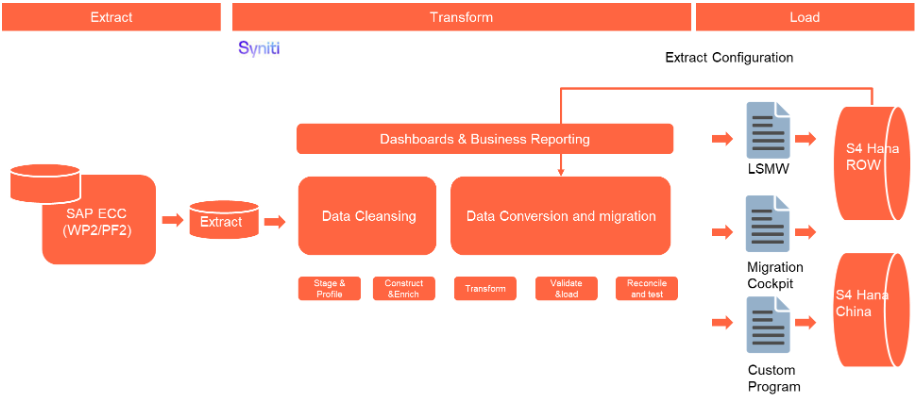
The high-level process is represented by the diagram below:
The ETL (Extract, Transform, Load) process is a structured approach to data migration and management, ensuring high-quality data is seamlessly transferred across systems. Here’s a breakdown of its key components:
1. Extraction
The process begins with extracting metadata and raw data from source systems, such as Syensqo ECC system (i.e. WP2/PF2) periodically. The extracted data is then staged for transformation.
2. Transformation
Once extracted, the data undergoes cleansing, consolidation, and governance. This step ensures data integrity, consistency, and compliance with business rules. The transformation process includes:
- Data validation to remove inconsistencies.
- Standardization to align formats across datasets.
- Business rule application to refine data for operational use.
3. Loading
The transformed data is then loaded into the target S/4HANA system.
Data Privacy and Sensitivity
Not applicableExtraction
Extract data from a source into Syniti Migrate. There are 2 possibilities:
- The data exists. Syniti Migrate connects to the source and loads the data into Syniti Migrate. There are 3 methods:
- Perform full data extraction from relevant tables in the source system(s).
- Perform extraction through the application layer.
- Only if Syniti Migrate; cannot connect to the source, data is loaded to the repository from the provided source system extract/report.
- The data does not exist (or cannot be converted from its current state). The data is manually collected by the business directly in Syniti Migrate. This is to be conducted using DCT (Data Collection Template) in Syniti Migrate
The agreed Relevancy criteria is applied to the extracted records to identify the records that are applicable for the Target loads
Extraction Run Sheet
| Req # | Requirement Description | Team Responsible |
|---|---|---|
| Extraction Scope Definition | - Identify the source systems and databases involved. - Define the data objects (tables, fields, records) to be extracted. - Establish business rules for data selection. | Syniti / LTC Data team |
| Extraction Methodology | - Specify the extraction approach (full, incremental, or delta extraction). - Determine the tools and technologies used. - Define data filtering criteria to exclude irrelevant records. | Syniti |
| Extraction Execution Plan | - Establish execution timelines and batch processing schedules. - Assign responsibilities for extraction monitoring. - Document dependencies on other migration tasks. | Syniti |
| Data Quality and Validation | - Define error handling mechanisms for extraction failures. | Syniti |
Selection Screen
| Selection Ref Screen | Parameter Name | Selection Type | Requirement | Value to be entered/set |
|---|---|---|---|---|
Data Collection Template (DCT)
Target Ready Data Collection Template will be created for Quality Info Record data with exception of some fields which require transformation as mentioned in the transformation rule.Quality Info Record DCT Rules
| Field Name | Field Description | Rule |
|---|---|---|
| Pending MDS and number of data in source system | ||
Extraction Dependencies
| Item # | Step Description | Team Responsible |
|---|---|---|
| 1 | Source System Availability
| Syensqo IT |
| 2 | Data Structure
| Syniti |
| 3 | Referential Integrity
| Syniti |
| 4 | Extraction Methodology
| Syniti |
| 5 | Performance and Scalability Considerations
| Syniti |
| 6 | Security and Compliance
| Syniti |
Transformation
The Target fields are mapped to the applicable Legacy field that will be its source, this is a 3-way activity involving the Business, Functional team and Data team. This identifies the transformation activity required to allow Syniti Migrate to make the data Target ready:
- Perform value mapping and data transformation rules.
- Legacy values are mapped to the to-be values (this could include a default value)
- Values are transformed according to the rules defined in Syniti Migrate
- Prepare target-ready data in the structure and format that is required for loading via prescribed Load Tool. This step also produces the load data ready for business to perform Pre-load Data Validation
Transformation Run Sheet
| Item # | Step Description | Team Responsible |
|---|---|---|
Transformation Rules
| Rule # | Source system | Source Table | Source Field | Source Description | Target System | Target Table | Target Field | Target Description | Transformation Logic |
|---|---|---|---|---|---|---|---|---|---|
Transformation Mapping
Use the exact name and reference this section in the “Transformation rules” above| Mapping Table Name | Mapping Table Description |
|---|---|
Transformation Dependencies
List the steps that need to occur before transformation can commence| Item # | Step Description | Team Responsible |
|---|---|---|
Pre-Load Validation
Project Team
The following pre-load validations will be performed by the Project Team.Completeness
| Task | Action |
|---|---|
| title | specific details of what and how the task needs to be performed e.g. which reports are being used etc. |
Accuracy
| Task | Action |
|---|---|
| title | specific details of what and how the task needs to be performed e.g. which reports are being used etc. |
Business
The following pre-load validations will be performed by the business.Completeness
| Task | Action |
|---|---|
| title | specific details of what and how the task needs to be performed e.g. which reports are being used etc. |
Accuracy
| Task | Action |
|---|---|
| title | specific details of what and how the task needs to be performed e.g. which reports are being used etc. |
Load
The load process includes:
- Execute the automated data load into target system using load tool or product the load file if the load must be done manually
- Once the data is loaded to the target system, it will be extracted and prepared for Post Load Data Validation
Load Run Sheet
| Item # | Step Description | Team Responsible |
|---|---|---|
Load Phase and Dependencies
Identify the phase as to “when” the load for this object will occur. <Pre-Cutover, Cutover, Post Cutover> and list the steps that need to occur before the load can commence
Configuration
List the Configurations required before loading can commence
| Item # | Configuration Item |
|---|---|
Conversion Objects
| Object # | Preceding Object Conversion Approach |
|---|---|
| list the exact title of the conversion object of only the immediate predecessor – this will then confirm the DDD (Data Dependency Diagram) | |
Error Handling
The table below depicts some possible system errors for this data object during data load. All data load error is to be logged as defect and managed within the Defect Management
| Error Type | Error Description | Action Taken |
|---|---|---|
Post-Load Validation
Project Team
The following post-load validations will be performed by the Project Team.Completeness
| Task | Action |
|---|---|
| title | specific details of what and how the task needs to be performed e.g. which reports are being used etc. |
Accuracy
| Task | Action |
|---|---|
| title | specific details of what and how the task needs to be performed e.g. which reports are being used etc. |
Business
The following post-load validations will be performed by the business.Completeness
| Task | Action |
|---|---|
| title | specific details of what and how the task needs to be performed e.g. which reports are being used etc. |
Accuracy
| Task | Action |
|---|---|
| title | specific details of what and how the task needs to be performed e.g. which reports are being used etc. |
Key Assumptions
- Master Data Standard is up to date as on the date of documenting this conversion approach and data load.
- Data Object is in scope based on data design and any exception requested by business.
Any additional key assumptions.
See also
Insert links and references to other documents which are relevant when trying to understand this decision and its implications. Other decisions are often impacted, so it's good to list them here with links. Attachments are also possible but dangerous as they are static documents and not updated by their authors.