| Status | |
|---|---|
| Owner | |
| Stakeholders |
Purpose
The purpose of this document outlines the conversion process for Right of Use (ROU) assets Master and Transactional data in SyWay S/4 HANA. The ROU Assets migration will move both the master and transactional data in a single step and there will be only one SAP standard template that will be utilized for both Master and Transactional data migrations. Syniti ADMM tool organises the execution of data extraction, transformation & mapping, loading and data quality (ETL).
ROU Asset master primarily contains of the following information:
- General information: Asset description, asset class, account determination, capitalization date etc.
- Time Dependent data: Cost Center, Plant, Location etc.,
- Depreciation terms data: Depreciation keys, Useful life and Depreciation areas
Note: This conversion specification will only include to ROU assets that were created from underlying RE-FX contracts from object 1076. All other fixed assets (non ROU) will be managed using objects 1070, 9022 and 9028.
Conversion Scope
The scope of this document is to define a data upload approach for active ROU Assets from legacy systems into S/4HANA.
Relevancy rule:
The data from legacy system includes:
- Company code is in scope
- All active ROU Assets
The data from legacy system excludes:
- All non-ROU assets
Relevancy rule for Extraction: The following relevancy criteria to be considered for extracting active ROU Assets from both WP2 and PF2. Note: PI2 does not have ROU Assets
- Step-1: Go to table ANLA and filter based on company code (BUKRS) that are in scope and asset class (ANLKL) that are relevant to ROU. Ensure that that deactivation date (DEAKT) is blank.
- Step-2: Based on the result from step-1, go to table ANLZ (Time dependent terms). Filter the details based on company code (BUKRS), asset number (ANLN1) and asset sub-number (ANLN2). If there are more than 1 line for the same asset number/co code, retrieve the latest validity date.
- Step-3: Based on the result from step-1, go to table ANLB (Depreciation area terms). Filter the details based on company code (BUKRS), asset number (ANLN1) and asset sub-number (ANLN2). Note: One asset will consist of more than one line item depending on the number of depreciation areas that is set up in the legacy system
- Step-4: Based on the result from step 1 and 3, go to table ANLC (Asset values). Filter based on company code (BUKRS), asset number (ANLN1), asset sub-number (ANLN2), fiscal year (GJAHR) and Depreciation areas (AFABE). For filtering on Fiscal year (GJAHR), this will depend on whether it is year end or mid-year migration.
- Year end migration: This will depend on the data transfer date. Ex: If the data transfer date is 31.12.2027, then fiscal year (GJAHR) will be 2027
- Mid year migration: This will depend on the data transfer date. Ex: If the data transfer date is 30.06.2028, then fiscal year (GJAHR) will be 2028
After this, retrieve the asset cumulative values.
i) ROU asset cumulative values KANSW
ii) ROU asset accumulated depreciation KNAFA. Note: For year end migration, the accumulated migration will equals to KNAFA + NAFAG as the accumulated depreciation
iii) ROU asset cumulative Unplanned depreciation KAAFA
iv) ROU asset ordinary depreciation posted in the current migration year NAFAG
v) ROU asset posted unplanned depreciation in the current migration year AAFAG
- Step-5: Go to table ANEP (Asset line item postings), filter based on company code (BUKRS), ROU asset number (ANLN1), ROU asset sub number (ANLN2), fiscal year (GJAHR) and accounting document number (BELNR). Then, retrieve the following:
i) Sequence number of asset line items in the current fiscal year LNRAN
ii) Asset value date BZDAT
iii) Asset transaction type BWASL
iv) Proportional values posted automatically XANTW
Step-6: Go to table ANLV (Insurance data), filter based on company code (BUKRS), ROU asset number (ANLN1) and ROU asset sub number (ANLN2). Then, retrieve the data for ROU asset insurance information.
Step-7: Go to table ANLU (Asset master: user fields), filter based on company code (BUKRS), ROU asset number (ANLN1) and ROU asset sub number (ANLN2). Then, retrieve the user fields data for ROU assets
There are 2 group go-live as below:
- Group 1 go-live is planned for 1 July 2028
- Group 2 go-live is planned for 1 Jan 2029
Note: There is a possibility to shift into 1 go live date, this option is currently still being considered.
If the currency of the depreciation area in the target S4 system is the same as the currency of the mapped depreciation area in the source system, the ROU asset balances will be copied from the mapped depreciation area of the source system. Otherwise, the asset balances will be converted from the asset balances of the depreciation area of the source system as per the mapping table by using the exchange rates for conversion as below:
- For Group 1 Go live: B/S spot rate as of 30 June 2028 will be used for Group Depreciation Areas
- For Group 2 Go live: B/S spot rate as of 31 Dec 2028 will be used for Group Depreciation Areas
Note: If company codes (where local currency is not EUR) have depreciation area in EUR, this EUR depreciation area is currently not used anymore. (In the past, these EUR depreciation areas were used when BFC was not the consolidation tool).
ROU Assets will be migrated to respective group go live as described in Enterprise Structure Catalog - Google Sheets (worksheet 10. Company code).
| Source | Scope | Source Approx No. of Records | Target System | Target Approx No. of Records |
|---|---|---|---|---|
| PF2 | ROU Assets | 1,675 | S/4 HANA | Will be same as Source, unless any new Assets and/or deactivation of assets before Go-live |
| WP2 | ROU Assets | 1,772 | S/4 HANA | Will be same as Source, unless any new Assets and/or deactivation of assets before Go-live |
Additional Information
Multi-language Requirement
It was decided to apply approach below:
- Field “Description Line1” (ANLA-TXT50) = Migrate as it is from legacy system to S/4HANA. The description could be any languages (not only the 4 core languages but also any other non-core languages.
- Field “Description Line2” (ANLA-TXA50) = Migrate as it is from legacy system to S/4HANA. The description line 2 is used to add information on the description of the asset when the line 1 length is not enough.
- Field "Asset main no.text" (ANLH-ANLHTXT) must be in English
Document Management
N/A
Legal Requirement
There are no legal requirements relevant to data migration of ROU Assets
Special Requirements
N/A
Target Design
The technical design of the target for this conversion approach.
| Load Sheet Name | Table | Field | Data Element | Field Description | Data Type | Length | Requirement |
|---|---|---|---|---|---|---|---|
| Master details | ANLA | BUKRS | BUKRS | Company Code | CHAR | 4 | Required |
| Master details | ANLA / ACDOCA | ANLN1 | ANLN1 | External/Legacy ROU Asset Number | CHAR | 12 | Required |
| Master details | ANLA / ACDOCA | ANLN2 | ANLN2 | ROU Asset Sub number | CHAR | 4 | Required, System auto generated |
| Master details | ANLA / ACDOCA | ANLKL | ANLKL | ROU Asset Class | CHAR | 8 | Required |
| Master details | ANLA | TXT50 | TXA50_ANLT | ROU Asset Description | CHAR | 50 | Required |
| Master details | ANLA | TXA50 | TXA50_MORE | ROU Asset Description 2 | CHAR | 50 | Optional |
| Master details | ANLA | SERNR | AM_SERNR | Serial Number | CHAR | 18 | Optional |
| Master details | ANLA | INVNR | INVNR_ANLA | Inventory Number | CHAR | 25 | Optional |
| Master details | ANLA / ACDOCA | MENGE | AM_MENGE | Quantity | QUAN | 13 with Decimal 3 | Optional |
| Master details | ANLA / ACDOCA | MEINS | MEINS | Base Unit of Measure | UNIT | 3 | Optional |
| Master details | ANLA | ANEQK | ANEQK | Asset is managed historically | NUMC | 1 | Not Used |
| Master details | ANLH | ANLHTXT | ANLHTXT | Asset Main Number Text | CHAR | 50 | Required |
| Master details | ANLU | ZZHEADING | Z1A_HEADING | Headings | CHAR | 10 | Not Used |
| Inventory | ANLA | IVDAT | IVDAT_ANLA | Last inventory date | DATS | 8 | Not Used |
| Inventory | ANLA | INKEN | INKEN | Inventory indicator | CHAR | 1 | Not Used |
| Posting Information | ANLA | AKTIV | AKTIVD | Asset Capitalization Date | DATS | 8 | Required |
| Time Dependent Data | ANLZ / ACDOCA | GSBER | GSBER | Business Area | CHAR | 4 | Not Used |
| Time Dependent Data | ANLZ / ACDOCA | KOSTL | KOSTL | Cost Center | CHAR | 10 | Required |
| Time Dependent Data | ANLZ / ACDOCA | WERKS | WERKS_D | Plant | CHAR | 4 | Not Used |
| Time Dependent Data | ANLZ | STORT | STORT | Asset Location | CHAR | 10 | Not Used |
| Time Dependent Data | ANLZ | FKBER | FKBER | Functional Area | CHAR | 16 | Not Used |
| Time Dependent Data | ANLZ / ACDOCA | PRCTR | PRCTR | Profit Center | CHAR | 10 | System Generated |
| Allocations | ANLA | ORD41 | ORD41 | Evaluation Group 1 | CHAR | 4 | Optional |
| Allocations | ANLA | ORD42 | ORD42 | Evaluation Group 2 | CHAR | 4 | Optional |
| Allocations | ANLA | ORD43 | ORD43 | Evaluation Group 3 | CHAR | 4 | Optional |
| Allocations | ANLA | ORD44 | ORD44 | Evaluation Group 4 | CHAR | 4 | Optional |
| Allocations | ANLA | GDLGRP | GDLGRP | Evaluation Group 5 | CHAR | 8 | Optional |
| Origin | ANLA | LIFNR | AM_LIFNR | Account Number of Supplier | CHAR | 10 | Optional |
| Origin | ANLA | HERST | HERST | Manufacturer of Asset | CHAR | 30 | Optional |
| Origin | ANLA | VBUND | RASSC | Company ID of Trading Partner | CHAR | 6 | Optional |
| Net Worth Valuation | ANLA | VMGLI | VMGLI | Property Classification Key | CHAR | 4 | Optional |
| Net Worth Valuation | ANLA | EIGKZ | EIGKZ | Property Indicator | CHAR | 1 | Not Used |
| Depreciation Areas | ANLB / ACDOCA | AFABE | AFABE_D | Depreciation Area | NUMC | 2 | Required |
| Depreciation Areas | ANLB | AFASL | AFASL | Depreciation Key | CHAR | 4 | Required |
| Depreciation Areas | ANLB | NDJAR | NDJAR | Useful Life (in Years) | NUMC | 3 | Required |
| Depreciation Areas | ANLB | NDPER | NDPER | Useful Life (in Periods) | NUMC | 3 | Optional |
| Cumulative Values | ANLC | AFABE | AFABE_D | Depreciation Area | NUMC | 2 | Required |
| Cumulative Values | ANLC / ACDOCA | GJAHR | GJAHR | Current Fiscal Year | NUMC | 4 | Required |
| Cumulative Values | ANLC | KANSW | KANSW | Cumulated Acquisition Value | CURR | 23 with Decimal 2 | Required |
| Cumulative Values | ANLC | KNAFA | KNAFA | Accumulated Ordinary Depreciation | CURR | 23 with Decimal 2 | Required |
| Cumulative Values | ANLC | KSAFA | KSAFA | Cumulative Special Depreciation | CURR | 23 with Decimal 2 | Not Used |
| Cumulative Values | ANLC | KAAFA | KAAFA | Cumulative Unplanned Depreciation | CURR | 23 with Decimal 2 | Optional |
| Cumulative Values | T093B | WAERS | WAERS | Currency Key | CUKY | 5 | Required |
| Posted Values | ANLC | AFABE | AFABE_D | Depreciation Area | NUMC | 2 | Required |
| Posted Values | ANLC / ACDOCA | GJAHR | GJAHR | Current Fiscal Year | NUMC | 4 | Required |
| Posted Values | ANLC | NAFAG | NAFAG | Posted Ordinary Deprec. for the Year | CURR | 23 with Decimal 2 | Required |
| Posted Values | ANLC | SAFAG | SAFAG | Posted Special Depreciation for the Year | CURR | 23 with Decimal 2 | Not Used |
| Posted Values | ANLC | AAFAG | AAFAG | Posted Unplanned Deprec. for the Year | CURR | 23 with Decimal 2 | Optional |
| Posted Values | T093B | WAERS | WAERS | Currency Key | CUKY | 5 | Required |
| Posted Values | ANLC | PSTEND | PSTEND | Depr. Posted Until (Including Period) | NUMC | 3 | Required |
| Transactions (Tranf.Dur.FY) | ANLC | AFABE | AFABE_D | Depreciation Area | NUMC | 2 | Conditional |
| Transactions (Tranf.Dur.FY) | ANEP | BWASL | BWASL | Asset Transaction Type | CHAR | 3 | Conditional |
| Transactions (Tranf.Dur.FY) | ANEP | GJAHR | GJAHR | Current Fiscal Year | NUMC | 4 | Conditional |
| Transactions (Tranf.Dur.FY) | ANEP | LNRAN | LNRAN | Sequence No. of Asset Line Items in FY | NUMC | 5 | Conditional |
| Transactions (Tranf.Dur.FY) | ANEP | BZDAT | BZDAT | Reference Date | DATS | 8 | Conditional |
| Transactions (Tranf.Dur.FY) | ANEP | ANBTR | ANBTR | Amount Posted | CURR | 23 with Decimal 2 | Conditional |
| Transactions (Tranf.Dur.FY) | T093B | WAERS | WAERS | Currency Key | CUKY | 5 | Conditional |
Data Cleansing
| ID | Criticality | Error Message/Report Description | Rule | Output | Source System |
|---|---|---|---|---|---|
| 1 | Low | If ROU asset is active but underlying RE-FX contract is concluded then the ROU asset will be cleansed through deactivation. | 1. Get contract numbers from VICNCN-BUKRS where BUKRS represents company codes in scope. 2. From step-1, get RE-FX contract numbers and verify VICERULE-VALIDTO is equal to Blank (or converted value ‘99991231') and Probable end date VICERULE-PROBABLEEND is less than or equal to 'Cutover date' or 'Blank (or converted value 99991231/ 00000000)' and VICERULE-CESLTYPE is 'A'. After this, pass VICNCN-INTERNO and check VICNCN-RECNENDABS is less than or equal to 'Cutover date' or 'Blank (or converted value 99991231). 3. From step-1 and 2, identify associated ROU assets and see if ROU asset is deactivated ANLA-DEAKT. If not deactivated, cleansing to be performed | After cleansing, those ROU assets will become deactivate | PF2 and WP2 |
Conversion Process
The high-level process is represented by the diagram below. Note: DCT is not required for this object 9108. DCT is shown in table below for reference only, just in case in the future data migration, DCT may be required.
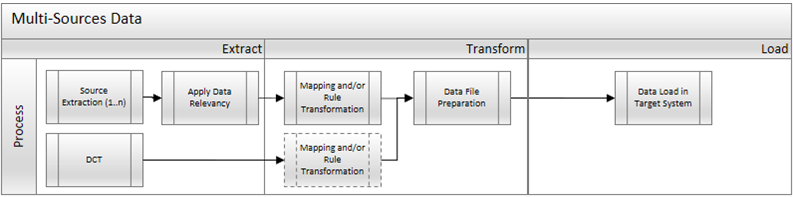
The conversion process will be largely automated using Syniti ADMM as the conversion tool:
Process | Activity |
Extract | Extract involves collecting data from the source. The source is a SAP system, Extract means to pull the required data from source systems into repository using Syniti ADMM. There are 2 steps for this method:
|
Transform | There are 2 steps of Transform activities that can happen in ADMM:
|
Load | This process includes:
|
Data Privacy and Sensitivity
N/AExtraction
The ROU Assets shall be extracted from SAP ECC and migrated using the Syniti Migrate. There are 2 possibilities:
- The data exists. Syniti Migrate connects to the source and loads the data into Syniti Migrate. There are 3 methods:
- Perform full data extraction from relevant tables in the source system(s).
- Perform extraction through the application layer.
- Only if cannot connect to the source, data is loaded to the repository from the provided source system extract/report.
- The data does not exist (or cannot be converted from its current state). The data is manually collected by the business directly in Syniti Migrate. This is to be conducted using DCT (Data Collection Template) in Syniti Migrate. Note: DCT is not applicable for this object 9108
The agreed Relevancy criteria is applied to the extracted records to identify the records that are applicable for the Target loads
Note: Co code 7735 operates outside SAP ERP and does not have any leased contracts / ROU assets under the scope of IFRS 16.
Extraction Run Sheet
| Req # | Requirement Description | Team Responsible |
|---|---|---|
1. | Extract ROU assets from ANLA table in PF2 and WP2 | Syniti team |
2. | Apply Asset Relevancy criteria on the extracted records. | Syniti team |
3. | Extract Time Dependent Data of ROU asset master records from ANLZ table in PF2 and WP2. | Syniti team |
4. | Extract Depreciation Terms Data of the ROU asset master from ANLB table in PF2 and WP2. | Syniti team |
5. | Extract ROU Asset master text from ANLH table in PF2 and WP2. | Syniti team |
| 6. | Extract Insurance Data of ROU asset master records from ANLV table in PF2 and WP2. | Syniti team |
Selection Screen
| Selection Ref Screen | Parameter Name | Selection Type | Requirement | Value to be entered/set |
|---|---|---|---|---|
| N/A |
Data Collection Template (DCT)
| Field Name | Field Description | Rule |
|---|---|---|
| N/A |
Extraction Dependencies
| Item # | Step Description | Team Responsible |
|---|---|---|
| 1. | Data cleansing of legacy ROU assets where associated RE-FX contracts are no longer available for valuation. | Business |
| 2. | Data cleansing of legacy ROU assets where ROU assets are still exist but underlying RE-FX contracts are expired, in this instance, ROU assets will be required to deactivate. | Business |
| 3 | Insurance Values: Final insurance values will be updated in respective ROU assets (mostly equipment related) before extraction begins. | Business |
| 4 | Complete Balance carry forward process, if any | Business |
Transformation
The Target fields are mapped to the applicable Legacy field that will be its source, this is a 3-way activity involving the Business, Functional team and Data team. This identifies the transformation activity required to allow Syniti Migrate to make the data Target ready:
- Perform value mapping and data transformation rules.
- Legacy values are mapped to the to-be values (this could include a default value)
- Values are transformed according to the rules defined in Syniti Migrate
- Prepare target-ready data in the structure and format that is required for loading via prescribed Load Tool. This step also produces the load data ready for business to perform Pre-load Data Validation
Transformation Run Sheet
| Item # | Step Description | Team Responsible |
|---|---|---|
1. | Ensure that all of the fields that require value mapping have the latest signed-off and imported into Syniti Migrate. | Data team |
2. | Go to Process Area Launch and Process the Object – ROU Asset | Data team |
3. | Launch the Objects to execute transformation. | Data team |
4. | Perform transformation ROU Assets extracted from PF2 and WP2 where target values will be derived from mapping tables. | Data team |
5. | Generate Pre-Load reports in Syniti Migrate. | Data team |
6. | Generate data load count in Syniti Migrate. | Data team |
7. | Log errors as defects, if any and address resolutions. Close defects. | Data team |
8. | Re-transform and re-validate the Pre-load reports if necessary. | Data team |
9. | Validate the transformed file as part of pre-load validation, raise data defects or provide the pre-load sign-off. | Business |
10. | Analyze and resolve any pre-load defects logged by business. | Data team |
Transformation Rules
The ROU asset takeover values will be based on the currency of the target depreciation area as depreciation areas are defaulted from the chart of depreciation assigned to the company code in the target system. Thus, depreciation area/chart of depreciation in the target system will be mapped to the depreciation area/chart of depreciation in the legacy system if the currency is the same.
- If the target depreciation area is found in the mapping table, the takeover values will be copied from the source depreciation area.
- Otherwise, will be translated from the gross values found in the Book Depreciation area, refer to section "Depreciation area in Foreign Currency".
Depreciation area in Foreign Currency:
Asset Balances in Group Currency depreciation area will not be migrated as per values Group depreciation areas in the legacy system. If the target depreciation area/chart of depreciation is not found in the mapping table, the corresponding balances for the depreciation area will be derived from the Book Depreciation area i.e. 01-Leading.
For conversion, the exchange rate would be as below:
- For Group 1 Go live: B/S spot rate as of 30 June 2028 will be used for Group Depreciation Areas
- For Group 2 Go live: B/S spot rate as of 31 Dec 2028 will be used for Group Depreciation Areas
The translation will be done in ADMM and align to the Trial Balance Conversion.
Translation logic to determine the balance:
In SAP, currencies (data type CURR) are stored with 2 decimal number but can be configured to display with different number of decimals (Table TCURX)
The logic to determine the balance (this logic should apply to all currencies):
- Check table T093B in legacy system to retrieve the currency for the company code and depreciation area.
- Check table TCURX in legacy system to find the number of decimal places for the currency. If '0', multiply the amounts by 100, else (including no entry found in TCURX), no action
Currency Adjustment During Migration (TCURX Consideration):
In SAP, the TCURX table defines the number of decimal places used for each currency. This impacts how amounts are stored internally in database tables versus how they are displayed externally in user interfaces or reports.
Currencies such as JPY (Japanese Yen), KRW (Korean Won), or VND (Vietnamese Dong) are typically configured with no decimal places (TCURX-CURRDEC = 0).
Understanding and correctly applying the TCURX rules is essential during data migration to ensure financial consistency between ECC and S/4HANA. Internal vs External Currency Representation example:
Internal Vs External Currency Amount Representation:
The amount value as displayed to users in SAP screens and reports is 96015 JPY (external), whereas, the amount value stored in database tables for computation is 960.15 JPY (internal).
During data migration, these internal (technical) amounts must be converted to external amounts to ensure accuracy and consistency in the target S/4HANA system through multiplied by factor = 10² if target has 2 decimals
Conversion Formula: External Amount = Internal Amount * 10 to the power (2 - Number of decimal for the currency in TCURX table)
Insurance value for ROU Assets conversion:
Before S/4HANA, there were two ways to map insurable values in the system.
- Option 1: Defining specific information for insurance in the asset master record (SAP ECC)
- Option 2: Managing insurance values in a dedicated depreciation area (SAP S/4HANA)
In SAP S/4HANA only the second option is supported. The customizing activities for the first option are no longer available.
The insurance value in the new depreciation (Area 04) in Syway S4HANA equals the net book value at the conclusion of the fiscal year. Because depreciation is not often calculated for new insurance value in the depreciation area, the net insurance value is derived from the legacy environment.
It has been agreed and confirmed with the business that the final insurance replacement values would be cleansed and updated through insurance depreciation area to reflect final insurance values as at cut-off date. Following that, the ETL process begins by extracting insurance value from table ANLC based on company code (BUKRS), ROU asset number (ANLN1), ROU asset sub number (ANLN2), Fiscal year (GJAHR) and Depreciation area (AFABE), which are then migrate to a dedicated depreciation area in Syway S4HANA as below.
| Table and Field name | Field description | Rule |
| ANLA-BUKRS | Company Code | Value mapping: Must be valid company code in company code configuration table |
| ANLA-ANLN1 | Asset number | Legacy ROU asset number which has insurance value |
| ANLA-ANLN2 | Asset sub-number | Defaulted to '0000' |
| ANLA-TXT50 | Description 1 | Legacy ROU asset description with up to 50 char. |
| ANLC-AFABE | Depreciation area | Defaulted to '04 - IFRS Insurance' |
| T093B-WAERS | Depreciation area currency | Get currency based on the combination of company code and depreciation area |
| ANLC- ANSWL | Total Acquisition Value – Current Year | Get the remaining insurance value as of cut-off date |
Evaluation Groups:
The following approach will be adopted to update the target EG values in Syway S/4HANA
- Download ROU assets in scope (from PF2 and WP2) for countries that require Evaluation Group (in S/4) into excel file.
- Send this file to Business to fill in the new target values of Evaluation Groups.
- Syniti team will get this value mapping during the ETL process
- Load to S/4 based on legacy ROU asset number and new values of Evaluation Group
| Load Template_Tab | Rule # | Source system | Source Table | Source Field | Source Description | Target System | Target Table | Target Field | Target Description | Transformation Logic |
|---|---|---|---|---|---|---|---|---|---|---|
| Master details | 1 | PF2 and WP2 | ANLA | BUKRS | Company Code | SAP S/4HANA | ANLA | BUKRS | Company Code | Value Mapping: Map from source to target by using company code mapping table. Must be a valid company code in company code configuration (table T001) |
| Master details | 2 | PF2 and WP2 | ANLA | ANLN1 | External/Legacy ROU Asset Number | SAP S/4HANA | ANLA / ACDOCA | ANLN1 | External/Legacy ROU Asset Number | Populate this field with the legacy ROU asset number from PF2 and WP2 |
| Master details | 3 | PF2 and WP2 | ANLA | ANLN2 | ROU Asset Sub number | SAP S/4HANA | ANLA / ACDOCA | ANLN2 | ROU Asset Sub number | According to Syway design in S/4HANA, no sub-assets will be created. Note: Only 1 ROU sub-asset (with sub number 1) is exist in WP2 and this will be migrated as main asset with sub number 0 |
| Master details | 4 | PF2 and WP2 | ANLA | ANLKL | ROU Asset Class | SAP S/4HANA | ANLA / ACDOCA | ANLKL | ROU Asset Class | Value Mapping: Map from source to target through ROU Asset Class mapping table. Note: ROU asset classes are only valid for this object. |
| Master details | 5 | PF2 and WP2 | ANLA | TXT50 | ROU Asset Description | SAP S/4HANA | ANLA | TXT50 | ROU Asset Description | Copy as-is from legacy |
| Master details | 6 | PF2 and WP2 | ANLA | TXA50 | ROU Asset Description 2 | SAP S/4HANA | ANLA | TXA50 | ROU Asset Description 2 | Copy as-is from legacy. Note: This field is only required if ANLA-TXT50 goes beyond 50 chars due to field length constraints. |
| Master details | 7 | PF2 and WP2 | ANLA | SERNR | Serial Number | SAP S/4HANA | ANLA | SERNR | Serial Number | Copy as-is from legacy |
| Master details | 8 | PF2 and WP2 | ANLA | INVNR | Inventory Number | SAP S/4HANA | ANLA | INVNR | Inventory Number | Copy as-is from legacy |
| Master details | 9 | PF2 and WP2 | ANLA | MENGE | Quantity | SAP S/4HANA | ANLA / ACDOCA | MENGE | Quantity | Copy as-is from legacy |
| Master details | 10 | PF2 and WP2 | ANLA | MEINS | Base Unit of Measure | SAP S/4HANA | ANLA / ACDOCA | MEINS | Base Unit of Measure | Copy as-is from legacy Note: Must be populated if Quantity ANLA-MENGE is populated, else, blank |
| Master details | 11 | PF2 and WP2 | ANLA | ANEQK | Asset is managed historically | SAP S/4HANA | ANLA | ANEQK | Asset is managed historically | Not used in Syway S4. Left with blank |
| Master details | 12 | PF2 and WP2 | ANLH | ANLHTXT | Asset Main Number Text | SAP S/4HANA | ANLH | ANLHTXT | Asset Main Number Text | Copy from legacy For migrated ROU assets, this field shall be used to capture the English translation of the asset description ANLA-TXT50 |
| Master details | 13 | PF2 | ANLU | ZZHEADING | Heading | SAP S/4HANA | Not used | Not used in Syway S4. Left with blank | ||
| Inventory | 14 | PF2 and WP2 | ANLA | IVDAT | Last inventory date | SAP S/4HANA | ANLA | IVDAT | Last inventory date | Not used in Syway S4. Left with blank |
| Inventory | 15 | PF2 and WP2 | ANLA | INKEN | Inventory indicator | SAP S/4HANA | ANLA | INKEN | Inventory indicator | Not used in Syway S4. Left with blank |
| Posting Information | 16 | PF2 and WP2 | ANLA | AKTIV | Asset Capitalization Date | SAP S/4HANA | ANLA | AKTIV | Asset Capitalization Date | Copy as-is from legacy Capitalization date will be less than or equal to mock cut-off date. |
| Time Dependent Data | 17 | PF2 and WP2 | ANLZ | GSBER | Business Area | SAP S/4HANA | ANLZ / ACDOCA | GSBER | Business Area | As per Syway design, this is not going to be used. So, left with blank |
| Time Dependent Data | 18 | PF2 and WP2 | ANLZ | KOSTL | Cost Center | SAP S/4HANA | ANLZ / ACDOCA | KOSTL | Cost Center | Value mapping Validation rule: ROU Asset's Cost center must be the same as underlying RE FX Cost center. Step-1: Get ROU asset number from ANLA-BUKRS where BUKRS is a valid company code from the mapping table and ANLA-ANLN1 where ANLN1 is relevant ROU asset number and ANLA-ANLN2='0'. Step-2: After, go to table VICERULE-ASSETOBJNR where ASSETOBJNR is ROU asset number from step 1 (ex: find with *XXXX123456789* where XXXX is a co code) and will get VICERULE-INTERNO from the output. Step-3: Go to table VICNCN and pass INTERNO (from step-2) to get VICNCN-INTERNO and VICNCN-OBJNR Step-4: Go to table VICERULE and pass INTERNO (from step-2) and CERULE is equal to 'IFRS16'. From the output, if valid to is 'Blank or converted value is 31.12.9999', then get VICERULE-ACCTOBJNR. ACCTOBJNR is a combination of 1. account assignment 2. controlling area and 3. Cost center. Ex: KSZ0268701-1101. If VICERULE-ACCTOBJNR is blank then move to Step-5 Step-5: Go to table VIBDOBJASS and pass OBJNR (that get from step-3) onto VIBDOBJASS-OBJNRSRC. From the output, get VIBDOBJASS-OBJNRTRG. Step-6: Go to table VIBDCNSUBJECT and pass OBJNR (from step 5) and get account assignment object (aka cost center) from VIBDCNSUBJECT-ACCTOBJNR. Identify cost center from position 7 in the string, Ex: KSZ0064019-5461 where cost center is '4019-5461'. |
| Time Dependent Data | 19 | PF2 and WP2 | ANLZ | WERKS | Plant | SAP S/4HANA | ANLZ / ACDOCA | WERKS | Plant | Not Used in S4
|
| Time Dependent Data | 20 | PF2 and WP2 | ANLZ | STORT | Asset Location | SAP S/4HANA | ANLZ | STORT | Asset Location | Not Used in S4
|
| Time Dependent Data | 21 | PF2 and WP2 | ANLZ | FKBER | Functional Area | SAP S/4HANA | ANLZ | FKBER | Functional Area | Not used. Left with blank |
| Time Dependent Data | 22 | PF2 and WP2 | ANLZ | PRCTR | Profit Center | SAP S/4HANA | ANLZ / ACDOCA | PRCTR | Profit Center | System generated. Profit center is auto derived from the cost center maintained in the ROU asset master record. In legacy systems, Profit center is not populated in ROU asset master. |
| Allocations | 23 | PF2 and WP2 | ANLA | ORD41 | Evaluation Group 1 | SAP S/4HANA | ANLA | ORD41 | Evaluation Group 1 | Value mapping This is dependent on S4 design, and will get target EG 1 values by legacy ROU asset as part of value mapping. |
| Allocations | 24 | PF2 and WP2 | ANLA | ORD42 | Evaluation Group 2 | SAP S/4HANA | ANLA | ORD42 | Evaluation Group 2 | Value mapping This is dependent on S4 design, and will get target EG 2 values by legacy ROU asset as part of value mapping. |
| Allocations | 25 | PF2 and WP2 | ANLA | ORD43 | Evaluation Group 3 | SAP S/4HANA | ANLA | ORD43 | Evaluation Group 3 | Value mapping This is dependent on S4 design, and will get target EG 3 values by legacy ROU asset as part of value mapping. |
| Allocations | 26 | PF2 and WP2 | ANLA | ORD44 | Evaluation Group 4 | SAP S/4HANA | ANLA | ORD44 | Evaluation Group 4 | Value mapping This is dependent on S4 design, and will get target EG 3 values by legacy ROU asset as part of value mapping. |
| Allocations | 27 | PF2 and WP2 | ANLA | GDLGRP | Evaluation Group 5 | SAP S/4HANA | ANLA | GDLGRP | Evaluation Group 5 | Value mapping This is dependent on S4 design, and will get target EG 5 values by legacy ROU asset as part of value mapping. |
| Origin | 28 | PF2 and WP2 | ANLA | LIFNR | Account Number of Supplier | SAP S/4HANA | ANLA | LIFNR | Account Number of Supplier | Value mapping. It will be migrated based on a mapping table of Vendor, provided that the vendor is relevant for BP master creation in S/4HANA. |
| Origin | 29 | PF2 and WP2 | ANLA | HERST | Manufacturer of Asset | SAP S/4HANA | ANLA | HERST | Manufacturer of Asset | Copy as-is from legacy |
| Origin | 30 | PF2 and WP2 | ANLA | VBUND | Company ID of Trading Partner | SAP S/4HANA | ANLA | VBUND | Company ID of Trading Partner | Value mapping - If the entity exists as a trading partner in S/4, it will be migrated based on a mapping table of Trading Partner. - if the entity doesn't exist as a trading partner in S/4, this field ANLA-VBUND will be blank |
| Net Worth Valuation | 31 | PF2 and WP2 | ANLA | VMGLI | Property Classification Key | SAP S/4HANA | ANLA | VMGLI | Property Classification Key | Value mapping |
| Net Worth Valuation | 32 | PF2 and WP2 | ANLA | EIGKZ | Property Indicator | SAP S/4HANA | ANLA | EIGKZ | Property Indicator | Copy as-is from legacy |
| Depreciation Areas | 33 | PF2 and WP2 | ANLB | AFABE | Depreciation Area | SAP S/4HANA | ANLB / ACDOCA | AFABE | Depreciation Area | Value mapping Map from source to target via Depreciation area mapping table |
| Depreciation Areas | 34 | PF2 and WP2 | ANLB | AFASL | Depreciation Key | SAP S/4HANA | ANLB | AFASL | Depreciation Key | Value mapping Map from source to target via Depreciation Key mapping table |
| Depreciation Areas | 35 | PF2 and WP2 | ANLB | NDJAR | Useful Life (in Years) | SAP S/4HANA | ANLB | NDJAR | Useful Life (in Years) | Copy as-is from legacy |
| Depreciation Areas | 36 | PF2 and WP2 | ANLB | NDPER | Useful Life (in Periods) | SAP S/4HANA | ANLB | NDPER | Useful Life (in Periods) | Copy as-is from legacy |
| Cumulative Values | 37 | PF2 and WP2 | ANLC | AFABE | Depreciation Area | SAP S/4HANA | ANLC | AFABE | Depreciation Area | Value mapping. Map from source to target via Depreciation area mapping table |
| Cumulative Values | 38 | PF2 and WP2 | ANLC | GJAHR | Current Fiscal Year | SAP S/4HANA | ANLC / ACDOCA | GJAHR | Current Fiscal Year | Fiscal year should be updated as per the mock cycle. Ex: If mock cycle 1 is 30.06.2027 then this field will be updated as 2027 and so on |
| Cumulative Values | 39 | PF2 and WP2 | ANLC | KANSW | Cumulated Acquisition Value | SAP S/4HANA | ANLC | KANSW | Cumulated Acquisition Value | Get APC cost from legacy |
| Cumulative Values | 40 | PF2 and WP2 | ANLC | KNAFA | Accumulated Ordinary Depreciation | SAP S/4HANA | ANLC | KNAFA | Accumulated Ordinary Depreciation | Get Accumulated depreciation from legacy - For year end migration, the accumulated depreciation will equals to KNAFA+NAFAG as the total accumulated dep. - For mid-year migration, the accumulated depreciation is only KNAFA as of previous year |
| Cumulative Values | 41 | PF2 and WP2 | ANLC | KSAFA | Cumulative Special Depreciation | SAP S/4HANA | ANLC | KSAFA | Cumulative Special Depreciation | No special depreciation for ROU assets in legacy, hence, leave it blank |
| Cumulative Values | 42 | PF2 and WP2 | ANLC | KAAFA | Cumulative Unplanned Depreciation | SAP S/4HANA | ANLC | KAAFA | Cumulative Unplanned Depreciation | Technically, there wont be unplanned depreciation for ROU assets for migration. - PF2 has no unplanned depreciation for ROU assets - WP2 has unplanned depiction for two ROU assets due to impairment that was already included in underlying RE-FX contracts via conditions. |
| Cumulative Values | 43 | PF2 and WP2 | T093B | WAERS | Currency Key | SAP S/4HANA | T093B | WAERS | Currency Key | Get depreciation area and go to table T093B and pass T093B-BUKRS and T093B-AFABE where AFABE is depreciation area. From the output, get currency key T093B-WAERS. |
| Posted Values | 44 | PF2 and WP2 | ANLC | AFABE | Depreciation Area | SAP S/4HANA | ANLC | AFABE | Depreciation Area | Value mapping. Map from source to target via Depreciation area mapping table |
| Posted Values | 45 | PF2 and WP2 | ANLC | GJAHR | Current Fiscal Year | SAP S/4HANA | ANLC / ACDOCA | GJAHR | Current Fiscal Year | Fiscal year should be updated as per the mock cycle. Ex: If mock cycle 1 is 30.06.2027 then this field will be updated as 2027 and so on |
| Posted Values | 46 | PF2 and WP2 | ANLC | NAFAG | Posted Ordinary Deprec. for the Year | SAP S/4HANA | ANLC | NAFAG | Posted Ordinary Deprec. for the Year | Get ordinary depreciation from legacy - For year end migration, the accumulated depreciation will equals to KNAFA+NAFAG as the total accumulated dep. - For mid-year migration, the ordinary depreciation is only NAFAG from currency year postings. |
| Posted Values | 47 | PF2 and WP2 | ANLC | SAFAG | Posted Special Depreciation for the Year | SAP S/4HANA | ANLC | SAFAG | Posted Special Depreciation for the Year | No special depreciation for ROU assets in legacy, hence, leave it blank |
| Posted Values | 48 | PF2 and WP2 | ANLC | AAFAG | Posted Unplanned Deprec. for the Year | SAP S/4HANA | ANLC | AAFAG | Posted Unplanned Deprec. for the Year | Technically, there wont be unplanned depreciation for ROU assets for migration. - PF2 has no unplanned depreciation for ROU assets - WP2 has unplanned depreciation for two ROU assets due to impairment that was already included in underlying RE-FX contracts via conditions. |
| Posted Values | 49 | PF2 and WP2 | T093B | WAERS | Currency Key | SAP S/4HANA | T093B | WAERS | Currency Key | Get depreciation area and go to table T093B and pass T093B-BUKRS and T093B-AFABE where AFABE is depreciation area. From the output, get currency key T093B-WAERS. |
| Posted Values | 50 | PF2 and WP2 | ANLC | PSTEND | Depr. Posted Until (Including Period) | SAP S/4HANA | ANLC | PSTEND | Depr. Posted Until (Including Period) | Obtain the last posted depreciation from legacy. Ex: If mock cycle cut off date is 30.06.2027, then depreciation posted up to in legacy is June and this field will be updated to '06'. |
| Transactions (Tranf.Dur.FY) | 51 | PF2 and WP2 | ANLC | AFABE | Depreciation Area | SAP S/4HANA | ANLC | AFABE | Depreciation Area | Value mapping. Conditional and only relevant to mid-year transactions Map from source to target via Depreciation area mapping table |
| Transactions (Tranf.Dur.FY) | 52 | PF2 and WP2 | ANEP | BWASL | Asset Transaction Type | SAP S/4HANA | ANEP | BWASL | Asset Transaction Type | Value mappings. Conditional and only relevant to mid-year transactions Rule: |
| Transactions (Tranf.Dur.FY) | 53 | PF2 and WP2 | ANEP | GJAHR | Current Fiscal Year | SAP S/4HANA | ANEP | GJAHR | Current Fiscal Year | Conditional and only relevant to mid-year transactions Fiscal year should be updated as per the mock cycle. Ex: If mock cycle 1 is 30.06.2027 then this field will be updated as 2027 and so on |
| Transactions (Tranf.Dur.FY) | 54 | PF2 and WP2 | ANEP | LNRAN | Sequence No. of Asset Line Items in FY | SAP S/4HANA | ANEP | LNRAN | Sequence No. of Asset Line Items in FY | Conditional and only relevant to mid-year transactions Rule: Sequence number must be based on the combination of Co Code + ROU asset + transaction + depreciation area for the current year. |
| Transactions (Tranf.Dur.FY) | 55 | PF2 and WP2 | ANEP | BZDAT | Reference Date | SAP S/4HANA | ANEP | BZDAT | Reference Date | Conditional and only relevant to mid-year transactions Copy as-is from legacy |
| Transactions (Tranf.Dur.FY) | 56 | PF2 and WP2 | ANEP | ANBTR | Amount Posted | SAP S/4HANA | ANEP | ANBTR | Amount Posted | Conditional and only relevant to mid-year transactions Copy values by depreciation area from legacy |
| Transactions (Tranf.Dur.FY) | 57 | PF2 and WP2 | T093B | WAERS | Currency Key | SAP S/4HANA | T093B | WAERS | Currency Key | Conditional and only relevant to mid-year transactions Get depreciation area and go to table T093B and pass T093B-BUKRS and T093B-AFABE where AFABE is depreciation area. From the output, get currency key T093B-WAERS. |
List of Custom Target Reports for this object is maintained here: Conversion Specification - Validation Reports
Transformation Mapping
The following legacy values have to be transformed to target SyWay values.
| Mapping Table Name | Mapping Table Description |
|---|---|
Company code | Mapping of legacy Company code to SyWay Company code |
Asset Class | Mapping of legacy ROU Asset Class to SyWay ROU Asset class |
Cost center | Mapping of legacy Cost centre to SyWay Cost centre |
Account number of Supplier | Mapping of legacy Supplier to SyWay Supplier |
Trading Partner | Mapping of legacy Trading Partner to SyWay Trading Partner |
Classification Key | Mapping of legacy Classification Key to SyWay Classification Key |
Depreciation area | Mapping of legacy Depreciation areas to SyWay Depreciation areas |
Depreciation key | Mapping of legacy Depreciation key to SyWay Depreciation key |
Asset Transaction Types | Mapping of legacy transaction types to SyWay Transaction types |
Evaluation Group 1 | Mapping for target EG 1 will be provided by legacy ROU asset number |
Evaluation Group 2 | Mapping for target EG 2 will be provided by legacy ROU asset number |
Evaluation Group 3 | Mapping for target EG 3 will be provided by legacy ROU asset number |
Evaluation Group 4 | Mapping for target EG 4 will be provided by legacy ROU asset number |
Evaluation Group 5 | Mapping for target EG 5 will be provided by legacy ROU asset number |
Transformation Dependencies
List the steps that need to occur before transformation can commence| Item # | Step Description | Team Responsible |
|---|---|---|
| 1 | Ensure that all of the fields that require value mapping, as specified in section "Mapping tables", have the appropriate values mapped and imported into ADMM. | Data team |
Pre-Load Validation
Project Team
Completeness
| Task | Action |
|---|---|
| Pre-load reports | Check that the number of ROU Assets in the upload file are the same as the number of contracts in the ETL file |
| Pre-load reports | Reconciliation of record count: Total number of ROU Assets in the extraction is compared against the total number of ROU Assets in the legacy system. |
Accuracy
| Task | Action |
|---|---|
| Conversion Accuracy | R2R Data Team to ensure that all fields listed below pass the checks:
|
| Review Error Reports | Review and correct the errors. Achieve a zero-error record count as much as possible. Raise defects for data remediated and requiring a correction in the ETL. |
Business
Completeness
| Task | Action |
|---|---|
| Verify record count | Business Data Owner/s to verify that the total number of relevant records from the source is equal to the total number of records in the Preload and Load Sheets. |
Accuracy
| Task | Action |
|---|---|
| Conversion accuracy | Business Data Owner/s to verify that all ROU assets are transformed accurately as per the ETL rules. Review List of Error reports in ADMM for any mismatch or missing transformed values. |
Load
ROU Assets will be migrated using the SAP tool 'Migration Cockpit' and 'Object: Fixed asset (incl. balances and transactions)'. Migration template is attached as a reference.
The load process includes:
- Execute the automated data load into target system using load tool or product the load file if the load must be done manually
- Once the data is loaded to the target system, it will be extracted and prepared for Post Load Data Validation
Load Run Sheet
| Item # | Step Description | Team Responsible |
|---|---|---|
1 | Ensure Pre-load sign-offs are obtained | R2R Data team |
2 | Ensure the load tools are transported into the correct tool instance | R2R Data team |
3 | Go to <Load tool> | R2R Data team |
4 | Load 1 or 2 records for "ROU Assets" to validate if data is loaded successfully without errors. If errors, log defects and obtain resolution | R2R Data team |
5 | Proceed with full load if step 4 is successful and validated | R2R Data team |
6 | Validate few records loaded by accessing standard transactions or tables from S/4HANA E.g. AS03, AW01N, AR01 etc., | R2R Data team |
7 | Generate post load report if step 6 is validated | R2R Data team |
Load Phase and Dependencies
The load phase for this object is Pre Cutover and this object will be loaded before RE-FX Contracts (object 9108) is loaded.
Configuration
The table below shows a key configuration elements
| Item # | Configuration Item |
|---|---|
1. | Company Code |
2 | Chart of Depreciation |
3 | Asset Class |
4 | Depreciation Areas |
5 | Depreciation Key |
6 | GL Account determination |
7 | i) Soft Config - ROU Asset number ranges ii) Soft Config - Asset Data Transfer Configuration · Transfer date – Last day of the month prior to go-live · Legacy Data Transfer Status = In Preparation · Document type 9A |
Conversion Objects
| Object # | Preceding Object Conversion Approach |
|---|---|
| CNV-1073 | Profit Centre |
| CNV-1074 | Cost Centre |
| CNV-3018 | Business Partners - FI Vendor |
Error Handling
The table below shows some possible system errors for this data object during data load. All data load error is to be logged as defect and managed within the Defect Management
| Error Type | Error Description | Action Taken |
|---|---|---|
Invalid Data | Relevant cost center is not valid in the validity of time dependent data in the ROU Asset master to be loaded. | Check whether the validity of time dependent data in cost center needs to be changed. |
Post-Load Validation
Project Team
The following post load validations will be performed by the project team.
Completeness
| Task | Action |
|---|---|
| Reconciliation of Total Record Count | Total number of records loaded for ROU Assets and Depreciation terms will be generated in the Post-load reports in ADMM. ROU Assets in the Post Load report is compared against total number of ROU assets in the pre-load reports by company code, Asset class, cost center, depreciation key etc., |
| Mandatory fields check | Review the post load file and note the records that failed the mandatory fields check and fix the errors |
| Post-load activity | Recalculate ROU Asset values using t.code AFAR. This is a one time activity that is only required after the RE-FX Lease contract migration and post first month end contract valuation following go live |
Accuracy
| Task | Action |
|---|---|
| Check values in key fields for accuracy | Post-load reports will have the same structure as the load file and some additional columns as required to facilitate the post load validation. Leverage the Syniti ADMM tool to create a Post load report that reports S/4 HANA loaded records along with the legacy values side-by-side to allow for 100% check of all these fields in the shortest possible time. If any mismatch, they will report under 'Error' for corrective action. |
Business
The following post load validations will be performed by the business.
Completeness
| Task | Action |
|---|---|
| Record Count Check | Review the record count report from the Data Team and ensure it is correct by cross-checking with the record count confirmed during Pre-load Business Validations. |
Accuracy
| Task | Action |
|---|---|
| Spot checks | Business should choose some ROU Assets and perform comprehensive checks of the fields in S/4 HANA. Recommended to verify sample data per company code and Asset class combination. |
| Conversion Accuracy | Verify that the ROU Assets in target S/4 HANA are loaded correctly via load program and validate post load reports using standard t.code AR01 from S/4 HANA. |
Key Assumptions
- Master Data Standard is up to date as on the date of documenting this conversion approach and data load.
- ROU Assets are in scope based on data design and any exception requested by business.
- ROU asset master cleansing is completed.
- All ROU assets (associated with RE-FX contracts) must be deactivated (i.e. populate the deactivation date field) if underlying lease contract is no longer available
See also
Insert links and references to other documents which are relevant when trying to understand this decision and its implications. Other decisions are often impacted, so it's good to list them here with links. Attachments are also possible but dangerous as they are static documents and not updated by their authors.