| APPLICATIONS |
|---|
THEORY, KNOWLEDGE, & MODELS |
|---|
| CAPABILITIES |
|---|
Drop tests on smart devices ... |
|
|---|---|
Impact tests on Battery enclosures / protection boxes | |
Bike components |
e-bike wheels and frame in Xencor PARA LGF-1050 (Stajvelo/Domteknika) |
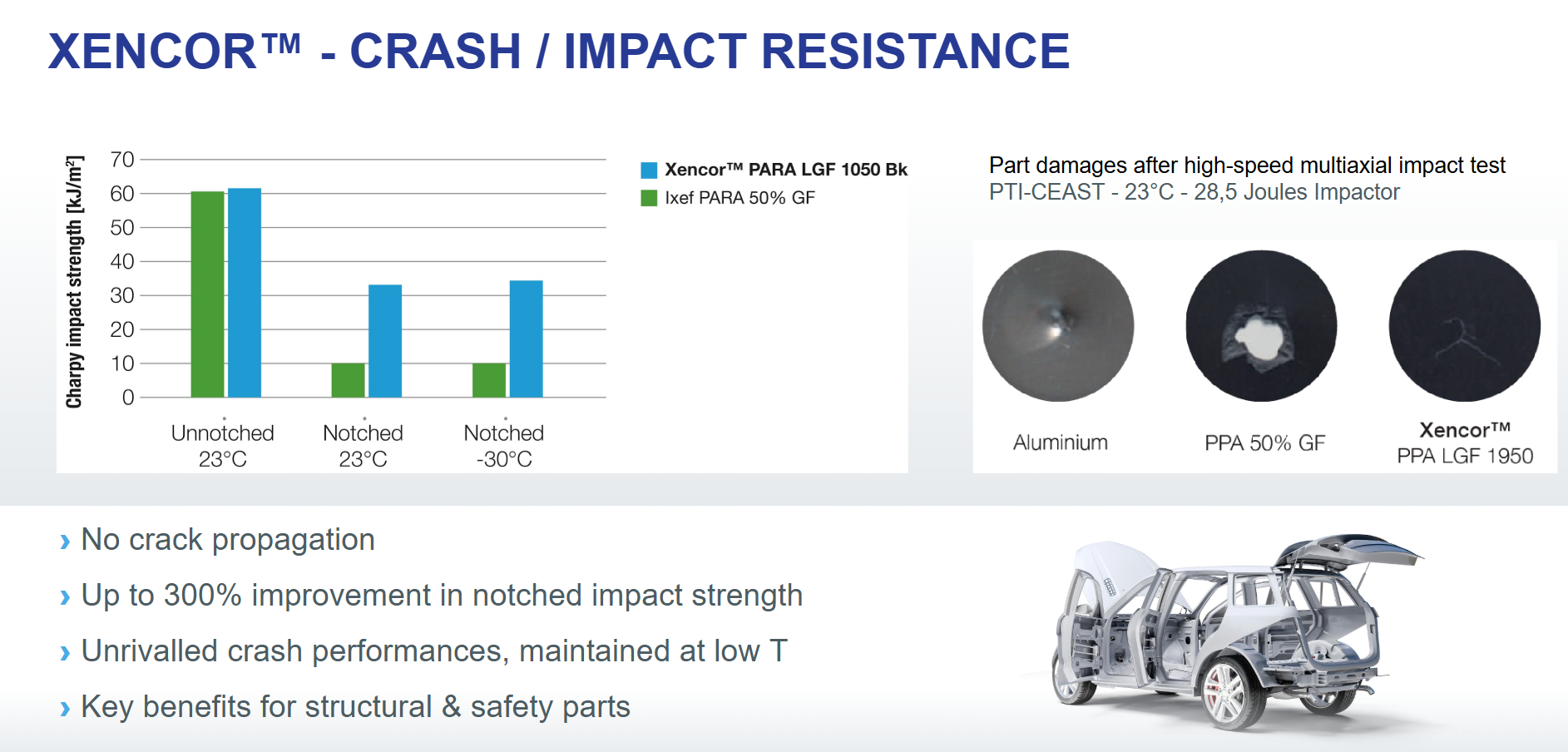
Promotion of Xencor product family for better impact performance |
The long fiber reinforced grades (Xencor) offer a higher resistance to failure propagation once the crack/notch is initiated. |
|


Characterization of a strain rate dependent DIGIMAT model for fiber reinforced polymers |
|
How to differentiate long fiber reinforced grades (Xencor) from short fiber reinforced ones in an impact simulation |
|

Standard impact tests such as Charpy/Izod tests or dart (multi-axial) impact tests are mainly part of the Syensqo Core Labs capabilities. The description of the related equipment can be found in the below links (core labs wikipages):
| Core Labs | Available equipment and link to description |
|---|---|
| AMC-Bollate |
|
| PCL-Alpharetta |
|
| PCL-Shanghai |
|
The Brussels analytical Lab (Explorer Center, Haren) is also equipped with impact test capabilities. On top of pendulum impact tests and dart impact tests, this Lab has the capability to characterize the behavior of our polymers at high strain rates using a Very High Speed (VHS) tensile test machine.
| Brussels Labs equipment | Description |
|---|---|
Very High Speed (VHS) tensile test machine
|
Picture
The VHS machine is particularly relevant for the calibration of advanced material models to run structural simulations taking into account the effect of the strain rate as well as the fiber orientation for filled materials (see "Theory and Model" section for more details). |
Dart Drop Tower
|
|
| Charpy/Izod/Tensile impact test |
|


Some impact related test capabilities are also available in our AD Labs:
| AD Labs | Available equipment and description |
|---|---|
| Bollate |
|
| Alpharetta |
|
| Shanghai |
|
| Fuji |
|
Finally, some "exotic" capabilities exist on the market to measure stress-strain curves at extremely high strain rates (at 1000/s for instance). An example is the so-called "Split Hopkinson Tensile Bar" where:
- The specimen is fixed between two different long bars (an incident bar and a transmission bar);
- a stress wave is generated, typically by a gas gun or a striker that impacts the incident bar, and transmitted through the specimen to the transmission bar;
- the strain in the sample is calculated by analyzing the differences between the incident, the reflected and the transmitted strain waves measured with strain gauges.
However, if the principle looks attractive on the paper, our practical experience based on different trials with external labs is less positive. Indeed, in many cases, we obtained measured stress-strain curves with a high level of noise making the post-processing and the calibration of material cards complex (and even inaccurate...).