| Status | |
|---|---|
| Owner | The person responsible for driving this decision and documenting it. Type @ to mention people by name |
| Stakeholders | The business stakeholders involved in making, reviewing, and endorsing this decision. Type @ to mention people by name |
| Jira Request ID | |
| Jira Development ID |
High- Level Specification
| Implementing System | S/4 Hana |
|---|---|
| Invoked by/Invokes | |
| Business Process Reference | 03.04.05.02. Manage Service Entry Sheets |
Functional Overview
Service Entry Sheet entered against CW Service POs in ERP system is send to the Business Network after its approval.
Service Entry Sheet from ERP is triggered upon the create or change event over the business object. As opposite to other Business Network flows, message is send as a regular Web Service Message and is translated to the CXML message in the CIG.
Service Entry Sheet is received in Business Network Buyers account and is routed to the Business Network Suppliers account, where the supplier is notified based on his preference. Assumption is that the supplier already has a trading relationship established,
due to the fact the Service Entry Sheet follows previously created Purchase Order.
Scope and Objectives
This document describes S/4 Hana outbound interface for sending ERP Initiated Service Entry Sheets into Business Network and the basic configuration needed in all the components in order for this interface to be operational.
Process Flow Diagram
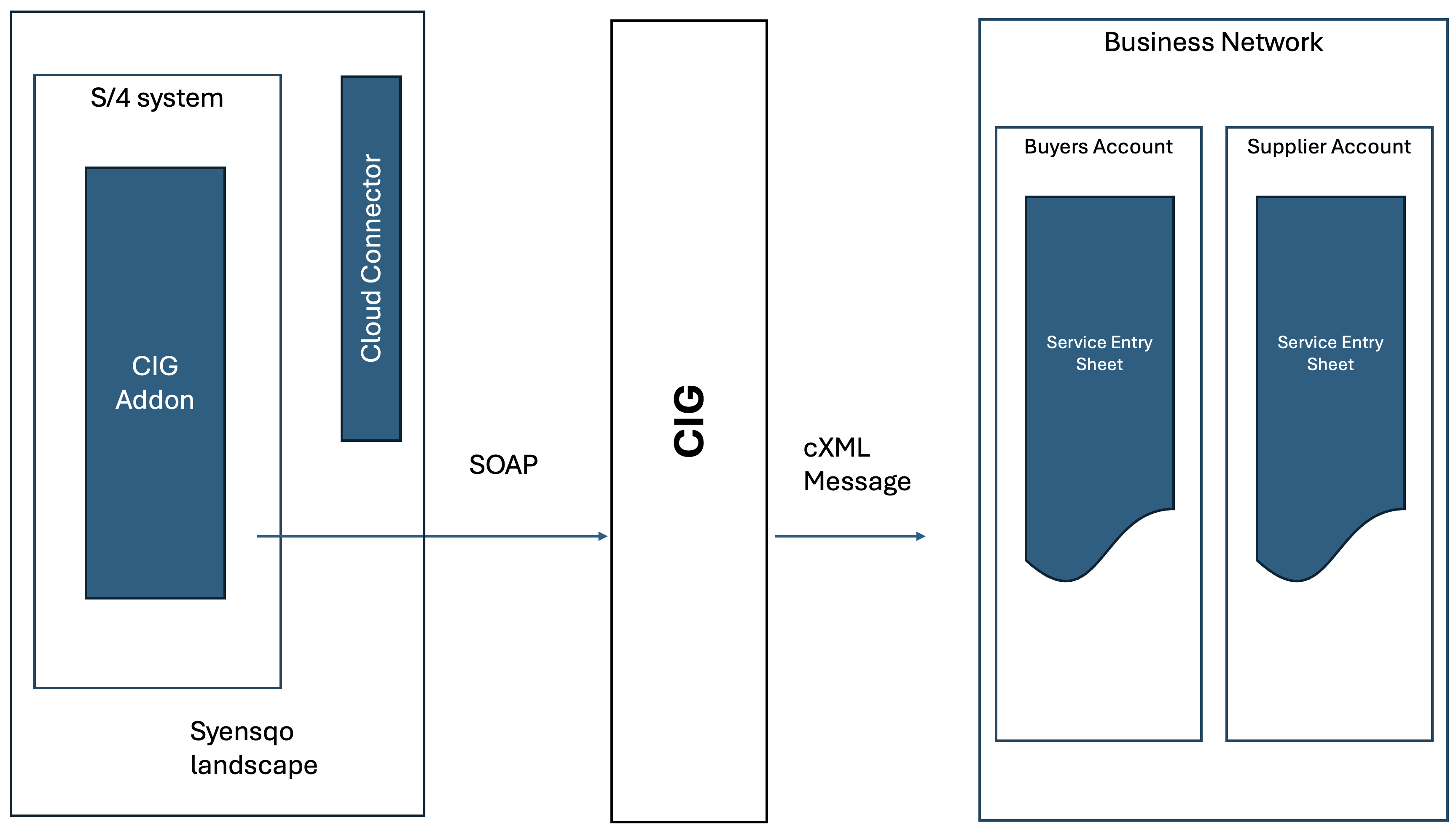
| Step | Description | Comment |
|---|---|---|
| 1. | Requester enters Service Entry sheet against a CW PO in Fiory | |
| 2. | Approved Service Entry sheet triggers create / change event over predefined Business Object | |
| 3. | CIG provided BAPI is executed | |
| 4. | Web Service Call is placed to the CIG | |
| 5. | CIG translates message into cXML format | |
| 6. | cXML is sent to the Business Network, received in the Buyers Account | |
| 7. | Service Entry Sheet is translated into Suppliers account and is matched against the Purchase Order |
Assumptions
- In SWEC transaction, document type ENTRYSHEET is assigned to the business object BUS2091 for On Create and On Change event
- Ariba source object and S/4HANA System target field mappings, including custom fields, will be updated based on mapping requirements in S/4HANA System
Dependencies
- CIG Addon installed in S/4 Hana
- Cloud Connector installed in Syensqo landscape
- Initial setup of CIG Addon is done already as described in ERP-92, section Configuration Requirements.CIG Configuration.
- Connectivity from CIG Addon to CIG is established, as described in ERP-92
Security, Integrity and Controls
The following are the Security and Authorization considerations for this interface:
- Message exchange between S/4 and CIG is encrypted over https.
- Access to interface parameters in CIG Addon is only available to the person with access to the SPRO authorization.
- Access to the CIG is restricted to the integration administrators within Ariba Guided Buying or Ariba Business Network
Configuration Requirements
CIG Configuration
Project setup is required in CIG to cover product type Ariba Network. One project is required per system ID of the backend S/4 system - Global, US and China. There are no additional setting for the Document Type ServiceEntrySheet
CIG Routing
Each Soap message sent from S/4 Hana contains System ID reference. No additional routing is needed in the CIG Addon - any subsequential message related to the Purchase Order sent from the S/4 Hana will use the System ID of the Purchase Order or the system id of the follow up document from S/4 Hana
Special Requirements
Specify any special requirements or considerations that may impact the interface based on specific locations, regulatory compliance or system limitations. Clearly outline requirements e.g. localization rules for countries like China
If the interface interacts with third-party systems such as Icertis, describe any additional integration, security or authentication considerations that must be taken into account.
Design Rationale
This template section may be used to specify the custom API design. The requirement can be for an API provider which means the API will be designed in the system or can be for an API consumer which means that an API will be consumed in the system.
API Use
Populate the type of the API use in this section. Will the API be Consumed or Provided.
Data Structure
The following fields will be used to provide the required data structure of the interface:
| Parent | Field | Description | Mandatory (Y/N) | Data Type |
|---|---|---|---|---|
Calculation and Validation
Populate the table below to list the calculation and validation rules per field. Can be deleted if not needed.
| Parent | Field | Rule Type | Rule Instruction |
|---|---|---|---|
eDocument mapping
Populate the table below to list the mapping for edocument implementations. Can be deleted if not needed.
| General | Syensqo XML (Target) | SAP eDoc Standard Mapping (Source) | Custom Mapping (Source) | ||||||
|---|---|---|---|---|---|---|---|---|---|
| S-NR | Flow (SD/FI/MM/ALL) | Field Details | Condition | Syensqo XML Node | Syensqo XML Field | SAP eDoc Standard Node | SAP eDoc Standard Field | Fixed Value | Custom Logic |
| Conditional / Mandatory | Header / Header Tax / Header Value / Header Extension / Sender / Sender Extension / Receiver / Receiver Extension / Item / Item Tax / Item Value / Item Extension | ||||||||
Processing Logic
Describe the processing requirement in the System
Delta or Full Load Requirements
Please describe change tracking requirements, i.e. transferring only delta, or always full load
Interface Alert & Monitoring
Please describe any alert & monitoring requirement for business users and support organization, i.e. AIF
Language Requirements
Specify multi language requirements
User Interface Requirements
Capture the requirements for the user interface (UI) associated with the interface. It should provide a clear description of how users will interact with the interface and how information will be presented to ensure usability and accuracy.
Sequencing
Please describe delivery requirements driven by message sequencing, i.e. specific order, impact of disruption of sequence, are duplicates allowed, etc.
Volumetrics
Provide volumetrics details: Initial load volumes, Number of Records, Expected Frequency, Expected Long term Growth)
Performance Consideration
Specify if there are any specific performance factors that need to be taken into consideration during development i.e. interface must be able to handle 100 posting per-hour, etc.
Error Handling
Detail how errors will be handled: Notification, Restart/ Recovery and Re-Processing Procedures
Testing
How to Test
Please provide some guidance and/or test data to help the developer unit test the interface. Please include both positive and negative testing (to validate error situations handling)
The developer will need to test repeatedly, so where appropriate provide instructions to reverse the actions performed so the test may be run again, or explain how to create new input data to the test. In particular, the developer will need logons for test users representing the various roles within the approval process.
Test Conditions and Expected Results
| ID | Condition | Expected Results |
|---|---|---|
Test Considerations/Dependencies
List any considerations essential for application test planning (e.g., test this before ABC along with DEF separate from GHI). If the development encompasses a user interface, explain how to test it. List any insights as to how this component could be tested the most efficiently.
Other Information
Development Details
Package
| Package Name | Parent Package |
|---|---|
Other Development Objects
| Object Type | Object Name | Purpose/High Level Logic | Design Rationale Reference |
|---|---|---|---|
Appendix
See also
Insert links and references to other documents which are relevant when trying to understand this decision and its implications. Other decisions are often impacted, so it's good to list them here with links. Attachments are also possible but dangerous as they are static documents and not updated by their authors.