| Status | |
|---|---|
| Owner | VAN AARDE-ext, Tonya |
| Stakeholders | |
| Jira Request ID | |
| Jira Development ID |
High- Level Specification
| Parameter | Value |
|---|---|
| Application System | Application System (Source)S/4Hana ROW, S/4Hana China |
| Business Process Reference | 02.04.02.01. Manage Standard Sales Order |
Functional Overview
1. Business Requirement
To ensure robust and stable integration between Sales & Distribution (SD) and Transportation Management (TM), the business requires control over changes to the Shipping Condition once Transportation planning has commenced.
When a Freight Unit (FU) has already been planned and assigned to a Freight Order or Freight Booking, changing the Shipping Condition—specifically from Ocean to Air—creates a mismatch between the sales document and the transportation execution. This can result in automatic de-assignment of the Freight Unit, leading to disruption of downstream logistics processes, replanning efforts, and potential delivery delays.
This WRICEF introduces controlled validation logic to prevent Shipping Condition changes from Ocean to Air when the related Freight Unit is already planned, while still allowing flexibility for other mode changes where operationally valid.
The solution supports:
Protection of TM planning integrity
Prevention of Freight Unit de-assignment
Consistent SD–TM integration behavior
Controlled flexibility based on Freight Unit planning status
Scope and Objectives
This WRICEF covers a targeted enhancement applicable to:
Sales Orders (Document Category C)
Change processing only
The enhancement applies at sales order header level, evaluated against item-level Freight Unit planning status, and is enforced during Save in the SAP Fiori application.
Applications in Scope
SAP Fiori
Manage Sales Orders – Version 2
Change Sales Orders
Why Standard SAP Is Not Sufficient
SAP standard does not include a validation mechanism to:
Check Freight Unit planning status in TM when a Shipping Condition is changed in Sales Orders
Prevent mode-of-transport mismatches once a Freight Unit is Planned or Partially Planned
Distinguish between allowed and disallowed Shipping Condition changes based on TM execution status
Without such validation:
Users can change the Shipping Condition from Ocean to Air after TM planning has occurred
Freight Units may be automatically de-assigned due to transport mode inconsistencies
Freight Orders or Freight Bookings can be disrupted or invalidated
Downstream logistics processes require manual correction and replanning
Limited Control in SAP Fiori Sales Order Processing
In the Manage Sales Orders – Version 2 Fiori app:
Shipping Condition changes are allowed without awareness of TM planning status
No standard error handling exists to block incompatible changes at Save
Users receive no immediate feedback on the impact of changes to TM execution
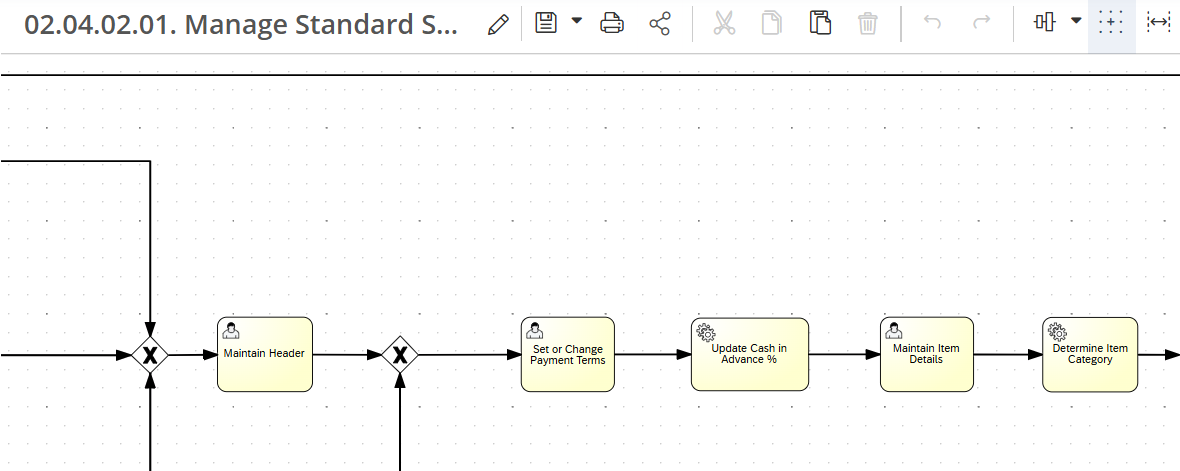
The scope of this enhancement is depicted in process step Maintain item details below. For the full Signavio, please go to 02.04.02.01. Manage Standard Sales Order
Insert the flowchart and fill in the steps
Step | Description | Comment |
|---|---|---|
Assumptions
Describe any assumptions that have been made in the process of completing this design. What functionality is expected of configuration or other developments that pass information to this development and/ or retrieve the information processed by it (performance, triggers, exceptions, etc.)
Dependencies
Indicate any dependencies or constraints that may impact this development, in terms of requirements from internal or external applications, other work streams, time constraints, data or system access restrictions. Also, please specify scheduling or process dependencies, e.g. interface/batch job that must run beforehand or process steps that need to be completed prior to executing this development.
Security, Integrity and Controls
To detail the security requirements for processing this enhancement, any data integrity issues associated with the object and the teams that will be responsible for processing the object, i.e. authorization/roles required to who can execute the enhancements, etc.
- Custom Tables, enhancement, transaction codes, programs, Web Dynpro Application, Code Data Services (CDS), Open Data Protocol (OData), BI reports, and Functional Modules need to have at least one authority check either standard or custom. (custom should be an exception)
- All custom tables will be maintained in a certain Authorization Group (example: ZFIN, etc.)
- In the case of transaction codes an additional check other than the object S_TCODE is required. You can use SU24 to find the related authorization objects to check.
All other WRICEFs
- If the authorization check is already performed in the calling Programs, this section can be filled as “Follow calling programs authorization check” (example : BADI to redirect DMS to OpenText, in which the calling Manage Purchase requisition Fiori App already performed authorization check)
- If the authorization check is not checked in any of the development, this section should be filled with the proposed authorization check. You can refer to SU24 to see the standard authorization objects. (example: full custom Fiori App to enable user to download/upload the project plan)
Configuration Requirements
Specify the configuration requirements for this object. Like in case of substitution/ routine specify the configuration needed
Language Requirements
Specify the language requirements for this object. Specify the required language and type of translation, like labels, data.
Special Requirements
Specify any special requirements or considerations that may impact the enhancement based on specific locations, regulatory compliance or system limitations. Clearly outline requirements e.g. localization rules for countries like China
If the enhancement interacts with third-party systems such as Icertis, describe any additional integration, security or authentication considerations that must be taken into account.
Design Rationale
Functional Requirements
Detail the functional requirements that are desired to be achieved by the Enhancement compared to current functionality
Proposed Technology to Use
Typically, an enhancement will be based on an existing SAP BADI / user exit. If this is the case, please provide the proposed details of the BADI / user exit.
Data Source Considerations
Include an overview of the source. Can be deleted if not needed.
| Table | Field Name | Comments/Calculation/Field Manipulation |
|---|---|---|
Data Validation Considerations
Include an overview of the data validation requirement. Can be deleted if not needed.
| Table | Field Name | Comments/Calculation/Field Manipulation |
|---|---|---|
Custom Tables
If any custom configuration tables are required, which will be read by the enhancement logic, then specify them here. Can be deleted if not needed.
Master Data
<Title Custom Table 1>
<Include an overview of the table and what it’s used for>
| Field | Description | Data Type/Length | Validation rule/ Value Help |
|---|---|---|---|
Configuration Table
Title Configuration Table 1
Include an overview of the table and what it’s used for
| Field | Description | Data Type/Length | Validation rule/ Value Help |
|---|---|---|---|
Selection Screen Enhancement
This section will give the details on the selection screen parameters, parameter type and whether it’s obligatory or not. This section can be used to define the Import Export parameters for Function Module or User Exit or Screens. Can be deleted if not needed.
| Field Name | Description | Select: Option or Parameter Check box or Radio button Import or Export | Data Type/Length | Default Value/ Validation rule/ Value Help | Selection Logic |
|---|---|---|---|---|---|
Processing Logic
This section defines the detailed step-by-step logic implemented within the BAdI/User Exit to process the data received from the standard SAP program and database retrieval. It explains the operations performed on the data, the expected outcomes in different scenarios and how the system should behave in response to specific conditions.
Volumetrics
Provide volumetrics details: Initial load volumes, Number of Records, Expected Frequency, Expected Long term Growth)
Performance Considerations
Specify if there are any specific performance factors that need to be taken into consideration during development i.e. enhancement must be able to be executed by 10 users at the same time, etc.
Error Handling
Detail how errors will be handled: Notification, Restart/ Recovery and Re-Processing Procedures
Testing
How to Test
Please provide some guidance and/or test data to help the developer unit test the enhancement. Please include both positive and negative testing (to validate error situations handling). The developer will need to test repeatedly, so where appropriate provide instructions to reverse the actions performed so the test may be run again or explain how to create new input data to the test. The developer will need logons for test users representing the various roles within the approval process.
Test Conditions and Expected Results
| ID | Condition | Expected Result |
|---|---|---|
Test Considerations/Dependencies
List any considerations essential for application test planning (e.g., test this before ABC along with DEF separate from GHI). If the development encompasses a user interface, explain how to test it. List any insights as to how this component could be tested the most efficiently.
Other Information
Development Details
Package
| Package Name | Parent Package |
|---|---|
Enhancement Implementation
| Enhancement Type | Standard Definition Name | Custom Implementation Name | Design Rationale Reference |
|---|---|---|---|
Other Development Objects
| Object Type | Object Name | Purpose/High Level Logic | Design Rationale Reference |
|---|---|---|---|
Appendix
Custom Authorization Group Naming Convention
This table is based on the Syensqo development standards document. It provides the naming conventions for authorization groups to associated with custom reports and tables to comply with security requirements.
ABAP | ZFI | ZMM | ZPS | ZCO | ZSD | ZBC | ZFI | ZCA |
|---|---|---|---|---|---|---|---|---|
| TABLES | ZFIT | ZMMT | ZPST | ZCOT | ZSDT | ZBCT | ZFIT | ZCAT |
See also
Insert links and references to other documents which are relevant when trying to understand this decision and its implications. Other decisions are often impacted, so it's good to list them here with links. Attachments are also possible but dangerous as they are static documents and not updated by their authors.