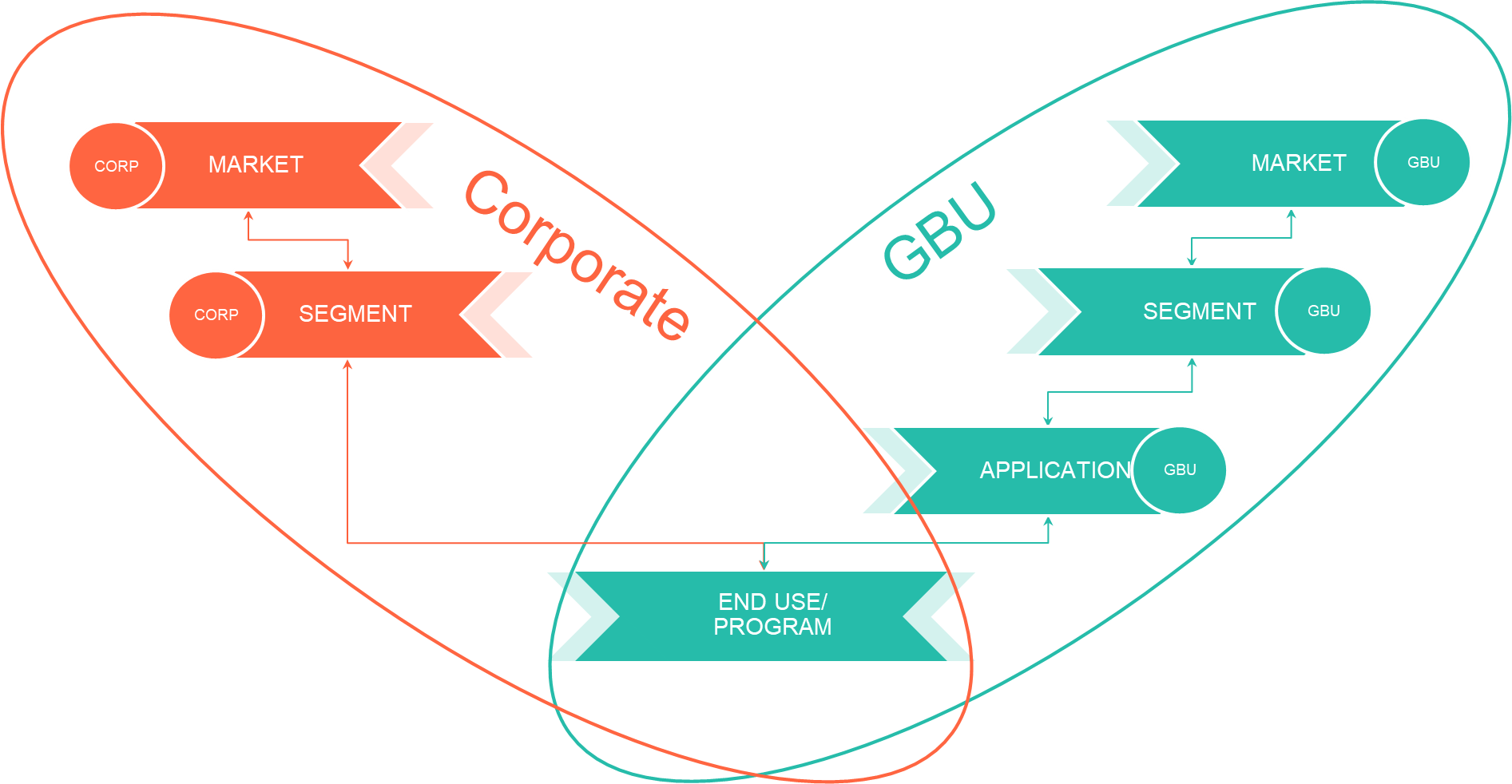
The purpose of this document is to establish a common, consistent, and governed definition of Market Hierarchies across Syensqo, covering both:
Corporate Market Hierarchy
GBU Market Hierarchy
The objective is to enable:
Standardized consumption of market dimensions across all SyWay in-scope systems
Definition and positioning of Corporate and GBU Market dimensions
Hierarchical relationship between Corporate and GBU market dimensions
Design principles for determination, derivation, and system usage
Governance model during SyWay and BAU
Today, market definitions exist across GBUs and Corporate functions with varying interpretations, granularity, and usage. This results in:
Inconsistent reporting across systems
Manual reconciliation for enterprise-level analysis
A unified Market Hierarchy approach is required to:
Support enterprise financial reporting and external disclosures
Enable GBU-specific commercial, sales, and demand planning processes
Ensure one global source of truth for market dimensions
The Syensqo Market Hierarchy will be composed of two complementary but distinct hierarchies:
Corporate Market
Corporate Segment
GBU Market
GBU Segment
GBU Application
End Use / Program
These hierarchies operate in parallel, with defined linkage rules, and are jointly consumed across SyWay applications.
Definition
Corporate Market groups customers based on their industry sector to define enterprise-level end-markets.
Key Characteristics
Corporate-led and enterprise-wide
Applies to customer–product combinations
Designed to support:
Financial reporting
Strategic portfolio management
External disclosures (shareholders / public communication)
5.2 Corporate Segment
Definition
A Corporate Segment is a sub-category within a Corporate Market, typically reflecting:
Key customer functionality needs, or
Logical groupings where functional segmentation is not applicable
Key Characteristics
Always linked to a single Corporate Market
Used consistently across internal and external reporting
Enables structured roll-ups at enterprise level
The GBU Market Hierarchy provides the commercial and operational view of markets, tailored to how products are sold and used by customers.
Key Characteristics
Highest level of the GBU hierarchy
Customer-centric
Assigned at the Business Partner (Sold-To / Ship-To) level
Used for commercial reporting and resource alignment
Key Characteristics
Linked below GBU Market
Represents the customer–product combination
Assigned at Ship-To + Material level
Key Characteristics
Linked below GBU Segment
Highlights how the product delivers value
Assigned at Ship-To + Material level
End Use specifies the technical or final use of the product as manufactured by the customer, describing how the product is ultimately applied in the customer’s process or finished output.
A Program represents a specific, identifiable customer initiative, platform, or long-term project under which Syensqo products are used, typically characterized by a defined scope, lifecycle, and application context.
Key Characteristics
Lowest level of the hierarchy
Most granular classification
Drives accurate demand planning and analytics
Common anchor point for Corporate and GBU derivations
Each lower level is fully dependent on its parent
No orphan values permitted
Changes at higher levels trigger downstream impact assessment
Corporate Market / Segment: Customer–Product combination
GBU Market: Customer (Business Partner)
GBU Segment / Application / End Use: Customer–Product combination
End Use serves as a key derivation anchor, enabling:
Derivation of Corporate Market & Segment
Derivation of GBU Market, Segment, and Application
Consistent reporting across hierarchies
The proposed solution separates governance, rule logic, and transactional execution to keep the design simple, scalable, and resilient to change. Corporate and GBU market hierarchies are centrally maintained as Global Hierarchies under governed ownership.
During transaction processing, End Use is automatically determined using predefined, rule-based logic based on customer, product, and relevant sales attributes. Once End Use is identified, all related Corporate and GBU market dimensions are system-derived and consistently propagated across Opportunities, Quotations, Contracts, Sales Orders, and Billing. This approach minimizes manual intervention, ensures consistent reporting, and allows future hierarchy changes without impacting transactional data.
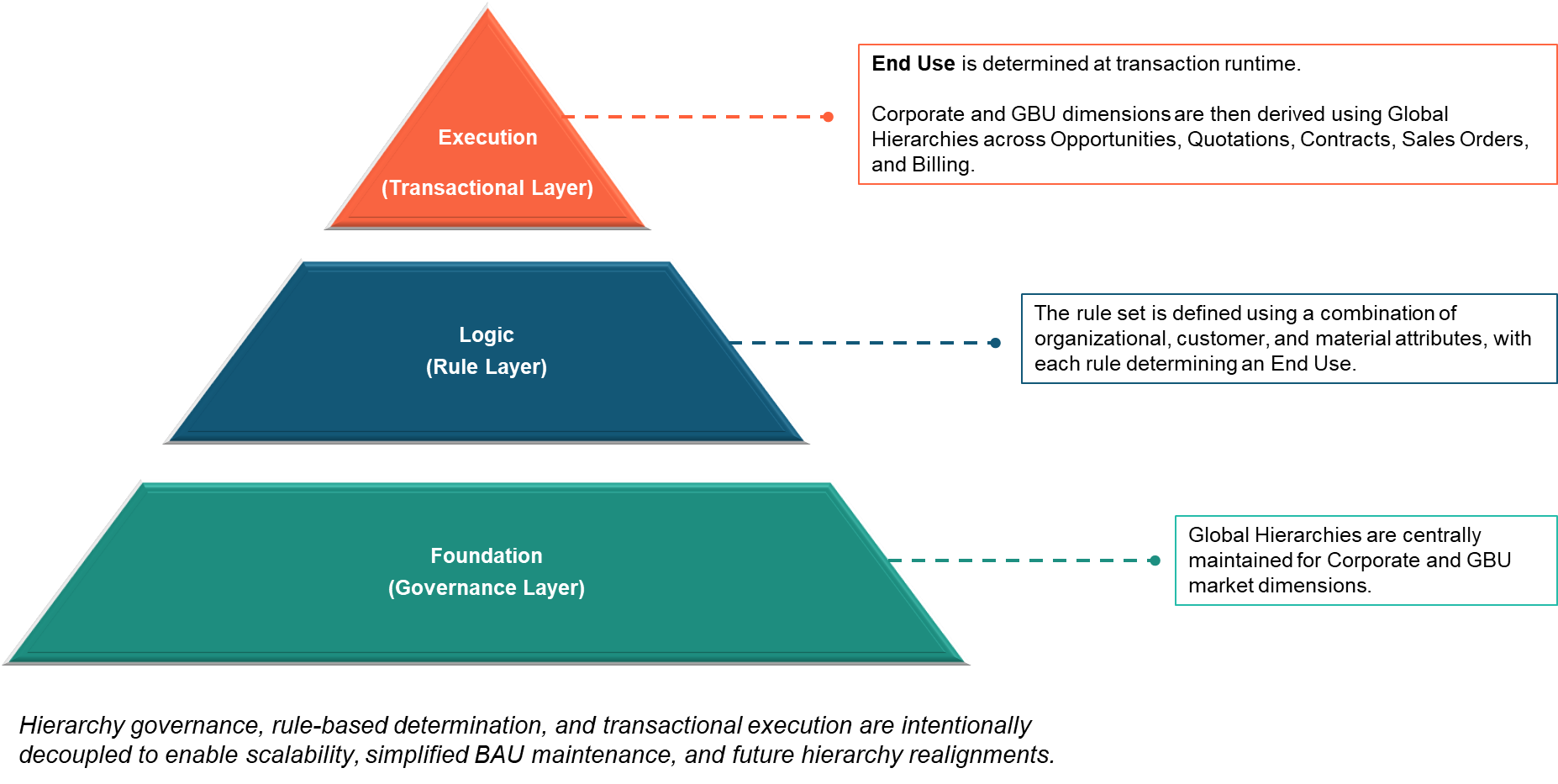
End Use is determined using a rule-based approach leveraging customer and product attributes, with GBU-specific variations reflecting business complexity and data availability.
| GBU | Determination Criteria |
|---|---|
| SpP (Specialty Polymers) | Customer (Sold-To / Ship-To) × Product (Commercial Product / Material Group) |
| TS (Technology Solutions) | Customer (Sold-To / Ship-To) × Product (Commercial Product / Material Group) |
| Novecare | Customer (Sold-To / Ship-To) × Product (Commercial Product / Material Group) |
| CM (Composites) | Customer (Sold-To / Ship-To) × Material × Specification |
Key principles
Ship-To is the primary customer reference where available, with Sold-To as fallback.
Product granularity is applied at Commercial Product / Material Group level unless material-specific differentiation is required.
Market dimensions are consumed across SyWay(In scope) systems, including:
All systems consume centrally governed global hierarchies, ensuring alignment across transactional and analytical use cases.

Corporate Hierarchy: Definitions and dimension values are governed and validated by Corporate Financial Planning & Analysis (FP&A).
GBU Hierarchy: Definitions and dimension values are governed and validated by GBU Marketing Directors.
Ensure all approved values are aligned between Corporate and GBUs and are ready for system configuration and consistent consumption across SyWay applications.
GBUs may propose changes to GBU-specific hierarchy levels (Market, Segment, Application, End Use / Program).
Each change proposal must:
Corporate Market realignments require a mandatory impact assessment to evaluate implications across all related GBU hierarchies and consuming systems.
The scope of this approach is limited to the Corporate and GBU Market Hierarchies; Customer Segmentation and Customer Hierarchy are out of scope.
End Use / Program is determined at transaction line-item level based on a predefined and governed rule set. All related Corporate and GBU market dimensions are system-derived from End Use and made available in transactions for reporting, planning, and analytics.
The Market Segments.xlsx, together with the aligned Corporate & GBU Market Hierarchy reference document, reflects the baseline set of values aligned with Corporate and GBU stakeholders and intended for system configuration, subject to formal governance.
Market hierarchies are modeled as two linked but distinct hierarchies, with strict parent–child dependencies and no orphan values.
Market dimensions are governed as Tier-1 Master Data, with Corporate MDM as the final owner and GBUs acting as contributors through a controlled change process.
All SyWay in-scope systems consume the same centrally governed global hierarchies, ensuring consistent and comparable market representation across transactions, planning, and reporting.
This approach defines a single, enterprise-wide Market Hierarchy framework for Syensqo, ensuring consistent market representation across SyWay systems through End-Use-based determination and centrally governed derivation, while allowing GBUs to contribute within a controlled and scalable governance model.
The Market Segments.xlsx contains the market hierarchy values and mappings that are planned to be configured, having been aligned with Corporate and GBU stakeholders. These values represent the agreed baseline for implementing the End-Use-based market determination approach, subject to formal governance and change control.
Aligned Corporate & GBU Market Hierarchy reference document (stakeholder-validated baseline for configuration).
Corporate and GBU Market Hierarchies will be governed through two standardized process flows — Manage Corporate Market Hierarchy and Manage GBU Market Hierarchy