Damien Avril
Damien AVRIL, Francois SANTY, Eric Triffaux, James Kyndt
| Status | |
| Owner | Damien Avril |
| Stakeholders | Damien AVRIL, Francois SANTY, Eric Triffaux, James Kyndt |
Decision: OPTION 4 Do not implement MultiGeo Decision made by: CISO Office Date: 15/04/2026 Online Meeting: |
Syensqo decided to have only one tenant for M365 platform in Europe region.
The Microsoft EU Data Boundary is a solution that stores and processes public sector and commercial customer data within the EU and European Free Trade Association (EFTA) regions. This includes data for Microsoft 365, Dynamics 365, Power Platform, and most Azure services.
Syensqo has to comply with complex regulations, like Export control and dual use. (Dual-use items are goods (including products, software, and technology) that can be used for both civilian and military use due to their technical specifications.)

The M365 environment is a standard platform to be used by any Syensqo users, which does not comply with specific complex regulations.
Deploy MultiGeo on specific scope where data residency matter, like Composite Material US and UK before the mass migration in order to avoid change management later on due to URL change.
MultiGeo will not solve data regulation like dual use, ITAR, CUI, but may benefit on data residency requirements.
M365 provides a capability covered by MultiGeo license to store data from Exchange, OneDrive, Sharepoint, Teams in a specific geographical region.
enabling MultiGeo prior to migrate the user or some SharePoint may help for data residency requirements.
Syensqo Owns 900+ Multi Geo licenses, and purview eDiscovery Premium from E5 and F5 capabilities which is required to cover multi region eDiscovery.
| Microsoft 365 Geography | PreferredDataLocation (PDL) Value |
|---|---|
South Korea, Japan, Singapore, Malaysia, Hong Kong Special Administrative Region | APC |
Australia | AUS |
Austria | AUT |
Brazil | BRA |
Canada | CAN |
Chile | CHL |
France, Netherlands, Ireland, Norway, Switzerland, Austria, Finland, Sweden, Germany | EUR |
France | FRA |
Germany | DEU |
India | IND |
Indonesia | IDN |
Israel | ISR |
Italy | ITA |
Japan | JPN |
Korea | KOR |
Malaysia | MYS |
Mexico | MEX |
New Zealand | NZL |
Norway | NOR |
Poland | POL |
Qatar | QAT |
South Africa | ZAF |
Spain | ESP |
Sweden | SWE |
Switzerland | CHE |
Taiwan | TWN |
United Arab Emirates | ARE |
United Kingdom | GBR |
United States | NAM |
Multi Geo Study
Question marks to be addressed
MultiGeo capabilities
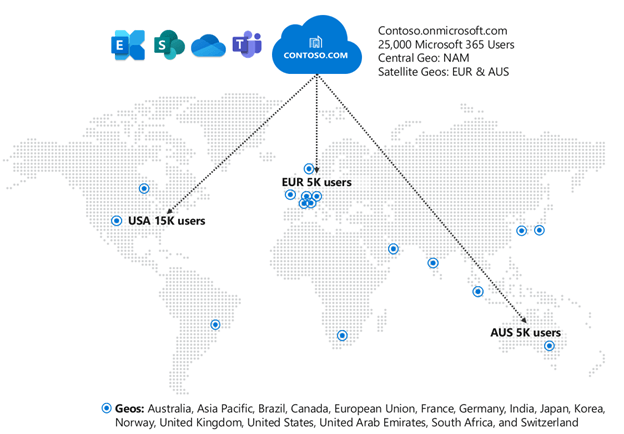
Multi-Geo allows to store data in multiple Geographies to satisfy data residency requirements, while retaining single-tenant administration and full-fidelity collaboration experiences between users as necessary.
Multi-Geo allows to manage and store in-scope data at a user level for Microsoft 365 Core Services including Exchange Online, SharePoint/OneDrive, Microsoft Teams, and Microsoft 365 Copilot and Copilot Chat. In addition, Multi-Geo can be used with shared resources including SharePoint sites, Microsoft 365 Groups, Shared Mailboxes, eDiscovery, or Microsoft Teams teams.
PDL stands for Prefered Data Location : by default stored in Europe.
MultiGeo capabilities:
Option 1: MultiGeo for CMMC (CUI data & ITAR)
Option 2: MultiGeo for Dual Use
Option 3: Deploy Multi Geo for performance
Option 4 : do not deploy MultiGeo
The following section describes relevant documentation:
Description | Repository | ||
| Service behavior a Multi-Geo enabled environment | Service Behavior in a Multi-Geo Enabled Environment - Microsoft 365 Enterprise | Microsoft Learn | ||
| Microsoft 365 Multi-Geo | Microsoft 365 Multi-Geo - Microsoft 365 Enterprise | Microsoft Learn | ||
M365 EU Boundary | What is the EU Data Boundary? - Microsoft Privacy | Microsoft Learn | ||