Purpose
The purpose of this document is to define the conversion approach to create 1040-Production Versions in S/4 HANA.
Production Version is used to define the product data structure. Meaning PV contains Master Recipe, BOM and Resources. According with lot size, Production version can be defined for each material to be processed in several production units. Usually, all Manufacturing plants need to use Production Versions for planning and scheduling processes. The aim is to migrate all the active Prod. Versions to S/4 HANA.
Conversion Scope
The scope of this document covers the approach for converting active <Data Object> from Legacy Source Systems into S/4HANA following the <Data Object> Master Data Design Standard.
Stand alone rules
The data from legacy system includes:
- The migration of Production Versions will be governed by the Material Relevancy Criteria, which serve as the foundational rule for identifying and including Production Versions that are valid, active, and business-relevant for conversion to S/4HANA.
- All active Production Versions W/o locked status
- All Active Production Versions W/O Deletion Flag
- All active Production Versions related to active material and Plant (Mapped in the To-Be Plant Mapping)
The data from legacy system excludes:
- All Production Versions older more than 4 years
- All production versions with Locked status (This needs to be checked to approve Production versions with Locked status in CM) Data Relevancy Criteria Meeting Review
- All Production Versions with deletion flag
- All Production Versions belonging to Materials flagged for deletion
- All Production Versions Belonging to Material-Plant combination not existing in the To-be Plant Mapping
Relevancy for Syniti
- Production version creation is only relevant when the following is live and active in a sequential order
- Material and Plant have a live status at Plant and at a Global level and contain 4 years of process order history
- BOM and all BOM components are live and active at plant level Based on the condition set that Materials contain 4 years of Process order History
- Master Recipe is live and an active BOM is available and live at Plant level, based on the condition set that Materials contain 4 years of Process order History
- Anything with BOM usage 6 are related to costings, and these are not in scope so they should not be migrated
Material/Plant active  BOM and all BOM components are live and active at Plant level Master Recipe is live and an active BOM is available at Plant level = Creation of Production Version
Plant Merging
Plants will be defined accordingly as some plants will be merged into one plant. Plants will be defined as NEW plant codes and be transformed via a transformation table, which will be contained in Syniti.
List of source systems and approximate number of records
| Source | Scope | Source Approx No. of Records | Target System | Target Approx No. of Records |
|---|---|---|---|---|
PF2, WP2 | Production Versions will be extracted from PF2 and WP2 | 105,000 | S/4 HANA | 105,000 |
Additional Information
Multi-language Requirement
N/A
Document Management
N/A
Legal Requirement
N/A
Special Requirements
N/A
If the data conversion involves third-party systems or external data sources, such as Icertis, describe any additional requirements related to data mapping, transformation logic, validation rules or security measures that must be followed.
Target Design
With Functional input, document the technical design of the target fields that are in the scope of this document.
The technical design of the target for this conversion approach.
| Table | Field | Data Element | Field Description | Data Type | Length | Requirement |
|---|---|---|---|---|---|---|
| MKAL | MKAL‑MANDT | MANDT | Client | CLNT | 3 | S |
| MKAL | MKAL‑WERKS | WERKS_D | Plant | CHAR | 4 | R |
| MKAL | MKAL‑MATNR | MATNR | Material Number | CHAR | 18 | R |
| MKAL | MKAL‑TEXT1 | VERS_TEXT | Version Short Description | CHAR | 40 | R - max. Of 40 characters. |
| MKAL | MKAL‑VERID | VERID | Production Version | CHAR | 4 | C - 4 digits |
| MKAL | MKAL-MKSP | MKSP | Production Version Lock | CHAR | 1 | R- "No locked" as default |
| MKAL | MKAL‑ADATU | ADATM | Valid‑From Date | DATS | 8 | R |
| MKAL | MKAL‑BDATU | BDATM | Valid‑To Date | DATS | 8 | R |
| MKAL | MKAL‑BSTMI | SA_LOSVN | Min Lot‑Size Interval Lower Limit | QUAN | 13 | R |
| MKAL | MKAL‑BSTMA | SA_LOSBS | Lot‑Size Interval Upper Limit | QUAN | 13 | R |
| MKAL | MKAL‑STLAL | STALT | Alternative BOM | CHAR | 2 | R |
| MKAL | MKAL‑STLAN | STLAN | BOM Usage | CHAR | 1 | R = BOM usage = "1" - Production |
| MKAL | MKAL‑PLNTY | PLNTY | Task List Type | CHAR | 1 | R |
| MKAL | MKAL‑PLNNR | PLNNR | Task List Group | CHAR | 8 | R |
| MKAL | MKAL‑ALNAL | PLNAL | Group Counter | CHAR | 2 | R |
| MKAL | MKAL‑PLTYG | PLTYG | Task List Type for Rate‑based Planning | CHAR | 2 | R |
| MKAL | MKAL‑SERKZ | SA_VERSI | Repetitive Mfg Allowed | CHAR | 1 | NU |
| MKAL | MKAL‑MDV01 | SA_LINE1 | Production Line | CHAR | 8 | NU |
| MKAL | MKAL‑MDV02 | MDV | Planning Identification | CHAR | 8 | C |
| MKAL | MKAL‑MATKO | MATKO | Other Material (BOM+Routing maintained) | CHAR | 40 | NU |
| MKAL | MKAL‑VERTO | SA_VERTO | Distribution Key | CHAR | 4 | NU |
| MKAL | MKAL‑ALORT | ALORT | Repetitive Mfg Storage Loc. | CHAR | 4 | NU |
| MKAL | MKAL‑EWM_LGNUM | LGNUM | Warehouse Number (EWM) | CHAR | 4 | NU |
| MKAL | MKAL‑EWM_LGPLA | LGPLA | Destination Storage Bin (EWM) | CHAR | 4 | NU |
| MKAL | MKAL‑PRVBE | SA_PRVBE | Target PSA | CHAR | 10 | NU |
| MKAL | MKAL‑ELPRO | SA_ELPRO | Proposed Issue Storage Location | CHAR | 4 | NU |
| MKAL | MKAL-TSA_PRVBE | TSA_PRVBE | Default Supply Area | CHAR | 10 | NU |
| MKAL | MKAL-UCMAT | VBOB_OB_RFMAT | OB reference material | CHAR | 40 | NU |
Data Cleansing
Business will perform data cleansing in the current ECC system. This means ECC will serve as the single source of truth for Manufacturing Data prior to the migration to S/4HANA.
All data cleansing should take place in the data source system as defined in this document, unless system limitations prevent it.
If data cleansing is managed outside of the source system (e.g. Syniti Migrate, 3rd Party Vendor, DCT), the necessary documentation must be produced and appended to this deliverable for sign-off.
| ID | Criticality | Error Message/Report Description | Rule | Output | Source System |
|---|---|---|---|---|---|
| 1040-001 | C1 | Invalid, Inactive or no Master Recipe for the Plant/ Material Combination | Master recipe needs to be created as pre-requisite to create Prod. Versions. | Master Recipe | PF2/WP2 |
1040-002 | C1 | Invalid, Inactive or no Bill of Material for the Plant/ Material Combination | Bill of Material needs to be created as pre-requisite to create Prod. Versions. | Bill of Materials | PF2/WP2 |
| 1040-004 | C1 | BOM Alternative Missing / incorrect. | BOM alternative is missing/ incorrect | BOM Alternative | PF2/WP2 |
| 1040-005 | C2 | Master Recipe Group Missing / Incorrect | Master Recipe Group Counter is needed. | Master Recipe Group Counter | PF2/WP2 |
| 1040-006 | C1 | BOM usage 1 / Routing type 2 / Master Recipe | Only BOM usage 1 and Routing type 2 or Master Recipe are valid for creating the Production Version | BOM Type 1 / Routing type 2 / Master Recipe category | PF2/WP2 |
| 1040-008 | C1 | Production Version has status locked | All Production Versions with status Locked, won't be migrated | PV Status Locked | PF2/WP2 |
| 1040-009 | C1 | Production Version NOT used the last 3 years | By rule, all Production Version with no Usage during the last 3 years won't be migrated | Active PV | PF2/WP2 |
| 1040-012 | C1 | PV with master recipe flagged for deletion | PV with a Master recipe flagged for deletion, won't be migrated | Master Recipe deletion Flag | PF2/WP2 |
| 1040-013 | C1 | PV With BOM flagged for deletion | PV with a BOM flagged for deletion, won't be migrated | BOM deletion flag | PF2/WP2 |
Conversion Process
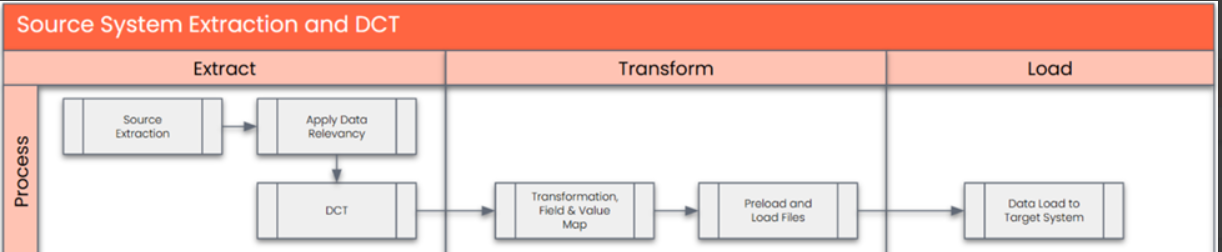
The high-level process is represented by the diagram below:
Data Privacy and Sensitivity
Summarize Data Privacy and Sensitivity Requirements, if anyExtraction
Extract data from a source into Syniti Migrate. There are 2 possibilities:
- The data exists. Syniti Migrate connects to the source and loads the data into Syniti Migrate. There are 3 methods:
- Perform full data extraction from relevant tables in the source system(s).
- Perform extraction through the application layer.
- Only if Syniti Migrate; cannot connect to the source, data is loaded to the repository from the provided source system extract/report.
- The data does not exist (or cannot be converted from its current state). The data is manually collected by the business directly in Syniti Migrate. This is to be conducted using DCT (Data Collection Template) in Syniti Migrate
The agreed Relevancy criteria is applied to the extracted records to identify the records that are applicable for the Target loads
Extraction Run Sheet
| Req # | Requirement Description | Team Responsible |
|---|---|---|
| 1 | Extract data from source system based on relevancy rule | Data Team |
| 2 | Google Sheet report pre-populated with PF2 and WP2 information to be generated based on relevancy criteria. | Data Team |
| 3 | Sinity Extraction in SQL / Excel to check the result | Sinity/ Data Team |
Selection Screen
If applicable, this section will give the details on any selection screen parameters, including the parameter type, that are required to be entered to ensure consistent data extracts.| Selection Ref Screen | Parameter Name | Selection Type | Requirement | Value to be entered/set |
|---|---|---|---|---|
Data Collection Template (DCT)
Target Ready Data Collection Template will be created for1040 - Production Version data with exception of some fields which require transformation as mentioned in the transformation rule.| Field Name | Field Description | Rule | Mappings |
|---|---|---|---|
MKAL‑WERKS | Plant | Plant of the material to be produced. Required Field | Map from Old Plants to New Plants |
Data Type: Character | |||
Length: 4 | |||
MKAL‑MATNR | Material Number | Material Number for which the PV is created. | Generate new Material number in Target System and maintain mapping in reference table |
Data Type: Character | |||
Length: 18 | |||
MKAL‑TEXT1 | Version Short Description | Free-text version description | Copy from System |
Data Type: Character | |||
Length: 40 | |||
MKAL‑VERID | Production Version | Version identifier | Conditions |
Data Type: Character | A001, A002, ...-Standard Production | ||
Length: 4 | B001, B002, ...-Blending | ||
C001, C002, ...-Rework | |||
D001, D002, ...-Special Activities (e.g., Relabel, Repacking, Sorting, Drying, etc.) | |||
E001, E002, ...-Engineering/Experimental | |||
MKAL‑ADATU | Valid‑From Date | Date from which the PV is valid. Required Field | Determines the effective period for BOM and master recipe. Date will be set on creation |
Data Type: Date Field | |||
Length: 8 | |||
MKAL‑BDATU | Valid‑To Date | Valid‑To Date ( Can be set, but is mostly set at (99991231) | Copy From System |
Data Type: Date Field | |||
Length: 8 | |||
MKAL‑STLAN | BOM Usage | BOM Usage always set to '1' | Defaulted to "1" |
Data Type: Character | |||
Length: 1 | |||
MKAL‑PLTYG | Task List Type for Rate‑based Planning | Task List Type for Rate‑based Planning Always set to '2' | Defaulted to "2" |
Data Type: Character | |||
Length: 2 | |||
MKAL‑PLNTY | Task List Type | Task List Type Always set to '2' | Defaulted to "2" |
Data Type: Character | |||
Length: 1 | |||
MKAL‑BSTMI | Min Lot‑Size Interval Lower Limit | Lower bound of lot‑size interval | Copy from system |
Data Type: Quantity | |||
Length: 13 | |||
MKAL‑BSTMA | Lot‑Size Interval Upper Limit | Upper bound of lot‑size interval | Copy from system |
Data Type: Quantity | |||
Length: 13 | |||
MKAL‑STLAL | Alternative BOM | Identifies one BOM in a BOM group. Note that the data format, leading zero is required for this field if it's a digital value. | Determined by the BOM master if the BOM exists. Auto generated when the BOM is created. |
Data Type: Character | |||
Length: 2 | |||
MKAL‑PLNNR | Task List Group | Key that uniquely identifies a recipe group. a data element in SAP used for storing Key for Task List GroupPLNNR is data in table fields Links the DCTS together Required Field | Derived from the creation of master recipe (internally generated when the Recipe is created) |
Data Type: Character | |||
Length: 8 | |||
MKAL‑ALNAL | Group Counter | Key that identifies a master recipe within a recipe group. Group Counter. PLNAL is a data element in SAP used for storing Group Counter data in table fields. You can have the same Group with different group counters, if there is to sources of Alternative BOMS Links the DCTS together | Sequential 1,2,3,4 etc when the master recipe is created (Internally generated when the Recipe is created) |
Data Type: Character | |||
Length: 2 | |||
MKAL‑MDV02 | Planning Identification | Planning Identification | |
Data Type: Character | |||
Length: 8 |
Extraction Dependencies
List the steps that need to occur before extraction can commence
| Item # | Step Description | Team Responsible |
|---|---|---|
| 1 | Source System Availability
| Syensqo IT |
| 2 | Data Structure
| Syniti |
| 3 | Referential Integrity
| Syniti |
| 4 | Extraction Methodology
| Syniti |
| 5 | Performance and Scalability Considerations
| Syniti |
| 6 | Security and Compliance
| Syniti |
| 7 | Data cleansing of legacy Production Version - If standardization within the DCT begins using relevant data from PF2 and WP2 before the cleansing is finalized, it is understood that the business will take due diligence to ensure any subsequent delta cleansing is verified and aligned within the DCT. | Business |
Transformation
The Target fields are mapped to the applicable Legacy field that will be its source, this is a 3-way activity involving the Business, Functional team and Data team. This identifies the transformation activity required to allow Syniti Migrate to make the data Target ready:
- Perform value mapping and data transformation rules.
- Legacy values are mapped to the to-be values (this could include a default value)
- Values are transformed according to the rules defined in Syniti Migrate
- Prepare target-ready data in the structure and format that is required for loading via prescribed Load Tool. This step also produces the load data ready for business to perform Pre-load Data Validation
Transformation Run Sheet
| Item # | Step Description | Team Responsible |
|---|---|---|
| 1 | Obtain DCT Sign-off from Business | SyWay Data Team |
| 2 | <Add steps from Syniti Migrate here> | SyWay Data Team |
| 3 | Review and Validate Error and Preload Reports | SyWay Data Team |
| 4 | Generate Load Files | SyWay Data Team |
Transformation Rules
| Rule # | Source system | Source Table | Source Field | Source Description | Target System | Target Table | Target Field | Target Description | Transformation Logic |
|---|---|---|---|---|---|---|---|---|---|
| 1 | PF2/WP2 | MKAL | WERKS | Plant | S4 HANA | MKAL | WERKS | Plant | Map from Old Plants to New Plants |
| 2 | PF2/WP2 | MKAL | MATNR | Material Number | S4 HANA | MKAL | MATNR | Material Number | Generate new Material number in Target System and maintain mapping in reference table |
| 3 | PF2/WP2 | MKAL | TEXT1 | Version Short Description | S4 HANA | MKAL | TEXT1 | Version Short Description | Value Direct from the current system |
| 4 | PF2/WP2 | MKAL | VERID | Production Version | S4 HANA | MKAL | VERID | Production Version | Value Direct from the current system - BASED on conditions |
| 5 | PF2/WP2 | MKAL | MKSP | Production Version Lock | S4 HANA | MKAL | MKSP | Production Version Lock | "Blank - Not locked" |
| 6 | PF2/WP2 | MKAL | ADATU | Valid‑From Date | S4 HANA | MKAL | ADATU | Valid‑From Date | Determines the effective period for BOM and master recipe. Date will be set on creation |
| 7 | PF2/WP2 | MKAL | BDATU | Valid‑To Date | S4 HANA | MKAL | BDATU | Valid‑To Date | Default 31129999 |
| 8 | PF2/WP2 | MKAL | BSTMI | Min Lot‑Size Interval Lower Limit | S4 HANA | MKAL | BSTMI | Min Lot‑Size Interval Lower Limit | Value Direct from the current system |
| 9 | PF2/WP2 | MKAL | BSTMA | Lot‑Size Interval Upper Limit | S4 HANA | MKAL | BSTMA | Lot‑Size Interval Upper Limit | Value Direct from the current system |
| 10 | PF2/WP2 | MKAL | STLAL | Alternative BOM | S4 HANA | MKAL | STLAL | Alternative BOM | Determined by the BOM master if the BOM exists. Auto generated when the BOM is created. |
| 11 | PF2/WP2 | MKAL | STLAN | BOM Usage | S4 HANA | MKAL | STLAN | BOM Usage | R = BOM usage = "1" - Production |
| 12 | PF2/WP2 | MKAL | PLNTY | Task List Type | S4 HANA | MKAL | PLNTY | Task List Type | Default to "2" |
| 13 | PF2/WP2 | MKAL | PLNNR | Task List Group | S4 HANA | MKAL | PLNNR | Task List Group | Derived from the creation of master recipe (internally generated when the Recipe is created) |
| 14 | PF2/WP2 | MKAL | ALNAL | Group Counter | S4 HANA | MKAL | ALNAL | Group Counter | Sequential 1,2,3,4 etc when the master recipe is created (Internally generated when the Recipe is created) |
| 15 | PF2/WP2 | MKAL | PLTYG | Task List Type for Rate‑based Planning | S4 HANA | MKAL | PLTYG | Task List Type for Rate‑based Planning | Task List Type = "2" |
| 16 | PF2/WP2 | MKAL | MDV02 | Planning Identification | S4 HANA | MKAL | MDV02 | Planning Identification | Can be blank. |
Transformation Mapping
Use the exact name and reference this section in the “Transformation rules” above| Mapping Table Name | Mapping Table Description |
|---|---|
| Plant | Mapping of legacy Plants to new Plants to target system value |
| Material | Mapping of legacy Materials to New Material number |
Transformation Dependencies
List the steps that need to occur before transformation can commence| Item # | Step Description | Team Responsible |
|---|---|---|
1 | Ensure DCT tables completeness | SyWay Data Team |
2 | Value Mappings are according to the latest design - <List of Value Mappings> | SyWay Data Team |
Pre-Load Validation
Project Team
The following pre-load validations will be performed by the Project Team.Completeness
| Task | Action |
|---|---|
Verify Record Count | Data team to verify that the total number of relevant records from the source systems is equal to the total number of records in the Preload and Load Sheets. |
Accuracy
| Task | Action |
|---|---|
Conversion Accuracy | Data team to verify that all fields below meet pass the checks: 1. Mandatory Fields 2. Field and Value Mapping Correctness 3. Null Checks 4. Text Length Checks |
Review error reports | Review and correct the errors. Achieve a zero-error record count as much as possible. Raise defects for data remediated and requiring a correction in the source data. |
Business
The following pre-load validations will be performed by the business.Completeness
| Task | Action |
|---|---|
Verify Record Count | Business team to verify that the total number of relevant records from the source systems is equal to the total number of records in the Preload and Load Sheets. |
Accuracy
| Task | Action |
|---|---|
Conversion Accuracy | Business to verify that all the data in the load table/file is accurate as per endorsed transformation/mapping rules (and signed-off data) |
Load
The load process includes:
- Execute the automated data load into target system using load tool or product the load file if the load must be done manually
- Once the data is loaded to the target system, it will be extracted and prepared for Post Load Data Validation
Load Run Sheet
| Item # | Step Description | Team Responsible |
|---|---|---|
| 1 | Go to <Load Tool> | SyWay Data Team |
| 2 | Load 3 records for < > to validate if data is loaded successfully without errors | SyWay Data Team |
| 3 | Proceed with full load if steps 2 and 3 are validated | SyWay Data Team |
| 4 | Validate few records loaded by accessing standard transactions from S/4HNA eg. MDO4 | SyWay Data Team |
| 5 | Generate post load report if step 5 is validated | SyWay Data Team |
Load Phase and Dependencies
Configuration
List the Configurations required before loading can commence
| Item # | Configuration Item |
|---|---|
| 1 | T001W - Plants/Branches |
| 2 | MARC/MARA - Material Number connected to a Plant |
| 3 | TCA01 - Task List Type |
Conversion Objects
| Object # | Preceding Object Conversion Approach |
|---|---|
| 2019 | Materials - Basic Data View and Plant view |
| 1038 | 1038 Material BOM |
| 1039 | 1039 Master Recipe |
Error Handling
The table below depicts some possible system errors for this data object during data load. All data load error is to be logged as defect and managed within the Defect Management
| Error Type | Error Description | Action Taken |
|---|---|---|
| 1 | Material has not been created in a Plant | Ensure the Material mapping is correct and or create the Material if it is valid |
| 2 | Material BOM has not been created in a Plant | Makes sure the BOM is available in the Plant, if not check to make sure it is required or Create the BOM for the PV Material |
| 3 | Master Recipe has not been created in a Plant | Makes sure the Master Recipe is available in the Plant, if not check to make sure it is required or Create the Master Recipe for the PV Material |
Post-Load Validation
Project Team
The following post-load validations will be performed by the Project Team.Completeness
| Task | Action |
|---|---|
Verify Count | Data team to verify the record count created in target S/4 HANA by accessing post load reports in Sinity Migrate or standard reports from S/4 HANA. |
Verify Logs | Check if there is data that failed to load and perform the necessary actions (e.g. register as post load issue, or attempt to load the record again, etc.). |
Validation Reports |
Accuracy
| Task | Action |
|---|---|
Conversion Accuracy | Data team to verify that the Measuring Point data in target S/4 HANA were loaded correctly via Sinity Migrate post load reports or standard reports from S/4 HANA. |
Business
The following post-load validations will be performed by the business.Completeness
| Task | Action |
|---|---|
Verify Count | Download Post Load Reports from Sinity Migrate and verify that the record count loaded in the target S/4 HANA is the same count as of the endorsed load file. |
Accuracy
| Task | Action |
|---|---|
Conversion Accuracy | Verify that the Measuring Point data in target S/4 HANA were loaded correctly via dspMigrate post load reports or standard reports from S/4 HANA. |
Key Assumptions
- Master Data Standard is up to date as on the date of documenting this conversion approach and data load.
- Data Object is in scope based on data design and any exception requested by business.
Any additional key assumptions.
See also
Insert links and references to other documents which are relevant when trying to understand this decision and its implications. Other decisions are often impacted, so it's good to list them here with links. Attachments are also possible but dangerous as they are static documents and not updated by their authors.