


| Status | Approved |
| Owner | |
| Stakeholders |
Issue
This document recommends the choice of primary mechanism for end users to access and interact with the user interfaces of the core enterprise systems in scope of the ERP Rebuild program, while taking into account usability, security and broad coverage to as many applications as possible. This document will focus on Desktop-based experiences as this is the primary access mechanism for most users, but will also consider its impact on general-purpose mobile use cases such as occasional use of some S/4HANA functionality and accessing workflow tasks. Other KDDs will cover more targeted mobile user experiences (e.g. for Maintenance and Logistics) as well as a general decision-making process for the use of mobile applications.
Recommendation
Use Build Work Zone Standard as the primary entry point for users of the enterprise systems in scope of ERP Rebuild. The Fiori Launchpad inside S/4HANA continues to be the primary UI for functionality provided by S/4HANA. It is used for both Fiori apps and traditional transactions accessed via GUI for HTML. Fiori Launchpad is dedicated to delivering the S/4HANA UI. Build Work Zone is required in addition to Fiori Launchpad due to the need for a solution that operates beyond S/4HANA alone. Build Work Zone will be used for launching applications and performing tasks spanning multiple enterprise systems (including S/4HANA).
Build Work Zone is SAP's future direction as the primary entry point for customers using multiple SAP systems including S/4HANA and SaaS applications, and is also designed to host cross-system applications such as SAP's consolidated workflow inbox "Task Center". The Advanced version of the product contains features not relevant for Syensqo, and thus the simpler and cheaper Standard offering is recommended. The SAP Mobile Start app for iOS and Android also requires the use of Build Work Zone.
The traditional SAP GUI is a legacy technology and will only be offered by exception to certain users who, based on the specific applications required for their job function, face technical limitations in the use of browser-based UIs.
Background & Context
The ERP Rebuild program is redesigning the core business processes of Syensqo which will be implemented on S/4HANA, as well as a number of SAP and non-SAP SaaS-based applications. The program aims to deliver end-to-end business processes that are simple and standardised; in many cases workflows will be used to implement standardisation and avoid both manual work and circumvention of controls. A single entry point to the various applications delivering these processes, and a single workflow inbox in which users can see the tasks pending with them, are seen as important in helping the ERP Rebuild program deliver on its charter values of Simplicity, Standardisation, and Future-Proofing.
Assumptions
- The browser-based Fiori/UI5 technology is the future user interface technology for SAP S/4HANA and other SAP applications; many functions newly introduced in S/4HANA no longer provide traditional SAP GUI transactions and can only be accessed using a browser. Combined with the sizeable footprint of SaaS applications, the use of a browser-based user interface is inevitable.
- Although the browser is the primary client, the use of certain Desktop client tools may be inevitable for specialised user personas. Where necessary, the ERP Rebuild program is able to deploy the required software and configuration into the Desktop computing environment of Syensqo.
- The Private Cloud Edition of S/4HANA will be used by Syensqo in the future; this is covered by KDD026 - SAP S/4HANA Deployment Model.
- Where traditional SAP GUI transactions must be used, rendering these using SAP GUI for HTML provides a good user experience. Prior experience of consultants on the ERP Rebuild program has shown this to be generally true.
- The core components of Syensqo’s enterprise landscape are not separated by GBU. Each instance of S/4HANA, Ariba, SuccessFactors, etc. will cover multiple GBUs.
- Separate instances may be required based on strategic or regulatory requirements. If this is required then:
- separation will occur along geopolitical lines (e.g. by country), and thus each instance would likely still contain data and processes for multiple GBUs.
- users will be aligned to one instance rather than multiple instances, and thus will have one primary entry point into the landscape.
- Although the ERP Rebuild scope encompasses applications besides S/4HANA, the vast majority of user-exposed transactions will be hosted by S/4HANA rather than the more focused SaaS products integrated to S/4HANA.
- The ability to deploy a common workflow task inbox is an important requirement for a modern, integrated solution spanning multiple enterprise systems. It helps to prevent users having to visit multiple different systems to check for workflow tasks being assigned to them, reduces reliance on email, and helps to deliver the ERP Rebuild program's vision of a future-proof implementation of systems delivering end to end business processes.
- SAP's future direction for a common workflow inbox is the Task Center hosted on BTP, for which SAP Mobile Start is the iOS/Android app.
- Build Work Zone could also be used the launching point for non-SAP applications, e.g. Salesforce, Kinaxis, etc. If these systems offer deep-linking directly to specific functions and screens, then apps and links can be exposed in a granular manner in Work Zone to support role-based access into the underlying non-SAP systems.
Constraints
- SAP Start is a relatively immature product early in its development lifecycle: integration to S/4HANA Private Cloud was only released with S/4HANA 2023 FPS01 (released in early 2024). Thus several restrictions exist in the integration of these products when compared with the relatively mature Fiori Launchpad available since 2016.
- Integration of SAP Build Work Zone Standard with S/4HANA Private Cloud has been available since the 1809 release of S/4HANA, when the product was called SAP Launchpad Service or SAP Fiori Cloud. SAP have transitioning the integration mechanism to the “exposure mode version 2” protocol which introduces new and different constraints over this original integration. These constraints do not appear to be critically limiting, but issues could be discovered during detailed design and implementation.
- Task Center hosted on BTP, which aggregates workflow tasks from S/4HANA, SuccessFactors, Ariba, Concur, etc. requires the use of Build Work Zone. If using only Fiori Launchpad as the primary access point, then use of Task Center is not possible.
- The only common workflow inbox in Fiori Launchpad is MyInbox, which SAP have positioned as being limited to S/4HANA rather than as a cross-system common inbox. It is technically possible to integrate other systems to My Inbox through custom development, though this may require the use of undocumented APIs.
Impacts
- The use of Build Work Zone as the central entry point places not only the Build Work Zone service but also the critical supporting service of BTP Identity Authentication Service on the critical path regarding user access to S/4HANA and other enterprise applications. This means that if any of these BTP services suffer an outage, or connectivity via Cloud Connector to the backend is disrupted, then users may be unable to access the S/4HANA system even if this remains technically available. The Availability SLA for both IAS and Build Work Zone is 99.95%, and thus will likely exceed the SLA of the underlying applications (e.g. SuccessFactors has an availability SLA of 99.7% for all modules apart from Employee Central, which offers 99.9%).
- Use of Build Work Zone enables the use of SAP's Mobile Start app for iOS and Android - which features access to the consolidated workflow inbox from Task Center, support for push notifications delivered to the phone, and for access to mobile-enabled Fiori UIs from S/4HANA and other systems.
- Build Work Zone (and SAP Start) impose a hard limit of 30,000 items per tenant. Items include roles, groups, catalogs, and apps. This should be sufficient for Syensqo in principle, but imposes a restrictions of the number of locales which can be enabled in the tenant. Each locale causes all content to be replicated, thus the enablement of multiple locales causes the total number of content items to multiply quickly. This could potentially limit the number of languages which can be supported by the system. Refer also to KDD055 - Multi-Language Support.
Business Rules
- Every system deployed by ERP Rebuild must have its user interfaces integrated into the common launchpad to provide a single entry point for end users.
- As far as technically possible, functions, applications, or reports must be accessed via deep-linking. The application’s main UI must only be linked directly from the launchpad if deep-linking is not technically possible.
- The browser is the primary UI client. Additional clients may be required for specialised use cases by exception only.
- SAP GUI is not considered to be a primary user interface and will not be generally available to end users.
Options considered
Desktop computers are considered the primary access mechanism for most of the users in most situations, and therefore must support all except highly specialised, role-specific functions. In modern SAP deployments there are four main starting points for a user’s interaction with SAP applications: the Fiori Launchpad embedded into S/4HANA, SAP Start, and SAP Build Work Zone, the latter being available in both Standard and Advanced versions. Of these, Fiori Launchpad is recommended by SAP to be embedded into S/4HANA while the other options are hosted on BTP.
“Build Work Zone” is a brand name applied to two different products that are both running on SAP BTP, but have quite different heritages: Work Zone Standard is a re-branding of BTP Fiori Launchpad Service, while Work Zone Advanced shares a name but little technology heritage with the Standard edition and thus offers different features and limitations.
Note: SAP SuccessFactors Work Zone is another product sharing the "Work Zone" brand name, but technically differs in some regards from the Build Work Zone products. SAP are in the process of transitioning this to the same stack as the Build Work Zone products.
SAP Portal was not considered as an option as the NetWeaver Java stack on which it runs is scheduled to go out of support in 2027.
Option A: SAP Fiori Launchpad in S/4HANA
Since the launch of Fiori-based user interfaces, the Fiori Launchpad has served as the common starting point for users of S/4HANA with a role-based menu structure, integration of Enterprise Search, a common workflow inbox, notification handling, and management of user preferences and defaults. Since the release of S/4HANA 1809, SAP have recommended an Embedded deployment running inside S/4HANA, rather than a separate stand-alone “hub and spoke” deployment using a dedicated Fiori Front-End Server.
A Fiori Launchpad based on Fiori 3 broadly offers the following capabilities:
- Role-based content including app launchers, tiles, pages, etc.
- Ability to integrate Web Dynpro and SAP GUI for HTML applications side-by-side with native UI5-based Fiori apps, including the use of semantic object navigation.
- Integration of Enterprise Search provided by the underlying business systems
- Integration of notifications and workflow tasks from connected business systems.
- Integration of Fiori-like interfaces provided by SAP SaaS applications such as SuccessFactors.
- Ability to publish tiles with arbitrary URL targets to support any other application, as well as static content hosted elsewhere.

Option B: SAP Start
SAP Start is a simple “launching point” designed as an “out of the box” solution for customers whose end users access more than one SAP cloud-based application (e.g. SuccessFactors and S/4HANA Public Cloud). It prioritises speedy implementation and simplicity over functional richness and thus offers only relatively simple features such as:
- Support for S/4HANA Cloud (both Public and Private editions), SuccessFactors, Fieldglass. Support for SAP Sales Cloud and SAP Service Cloud is on the roadmap for late 2024.
- Search for and launch apps and functions across the connected applications.
- Limited search integration for content inside the connected applications.
- Integration of workflow tasks from SAP Task Center, the BTP-hosted central workflow inbox.
- Integration with Joule, the SAP AI chatbot and co-pilot.
SAP Start is a relatively new product launched in late 2023. It is hosted on BTP and built using the same technology stack as Build Work Zone Standard. SAP offers an upgrade path from SAP Start to Build Work Zone Standard, although some technical migration work is required in addition to a licensing change.

Option C: SAP Build Work Zone Standard
SAP Build Work Zone Standard was formerly known as Launchpad Service - a BTP-hosted Fiori Launchpad able to surface Fiori apps from several underlying application providers such as S/4HANA, other ABAP-based systems, but also SuccessFactors, and selected other SaaS applications. It offers capabilities comparable to the Fiori Launchpad, such as:
- Role-based content including app launchers, tiles, pages, etc.
- Integration of Enterprise Search provided by the underlying business systems
- Support for Integration Cards which surface simple tasks from the underlying business systems into the Work Zone UI.
- Integration of notifications and workflow tasks from connected business systems.
It is built on the same technology stack as SAP Start, but not using the same stack as Build Work Zone Advanced. Migration from one to the other requires not only a licensing change, but also work to align the content models. SAP plans to deliver a migration tool, but this is not featured in the roadmap yet.
Several significant technical limitations remain, meaning Work Zone is not a full replacement for Fiori Launchpad, including restrictions on the use of Fiori 3 Spaces and Pages, merging of content from several underlying S/4HANA systems, and limitations on the use of SAP Analytics Cloud, CoPilot/Joule. Some of these limitations are resolved using “exposure mode version 2” which effectively causes S/4HANA applications to be launched in a separate browser tab; however this causes the Fiori Launchpad from the underlying S/4HANA system to then be loaded in that separate tab. SAP Note 3042853 contains further details on these limitations.

Option D: SAP Build Work Zone Advanced
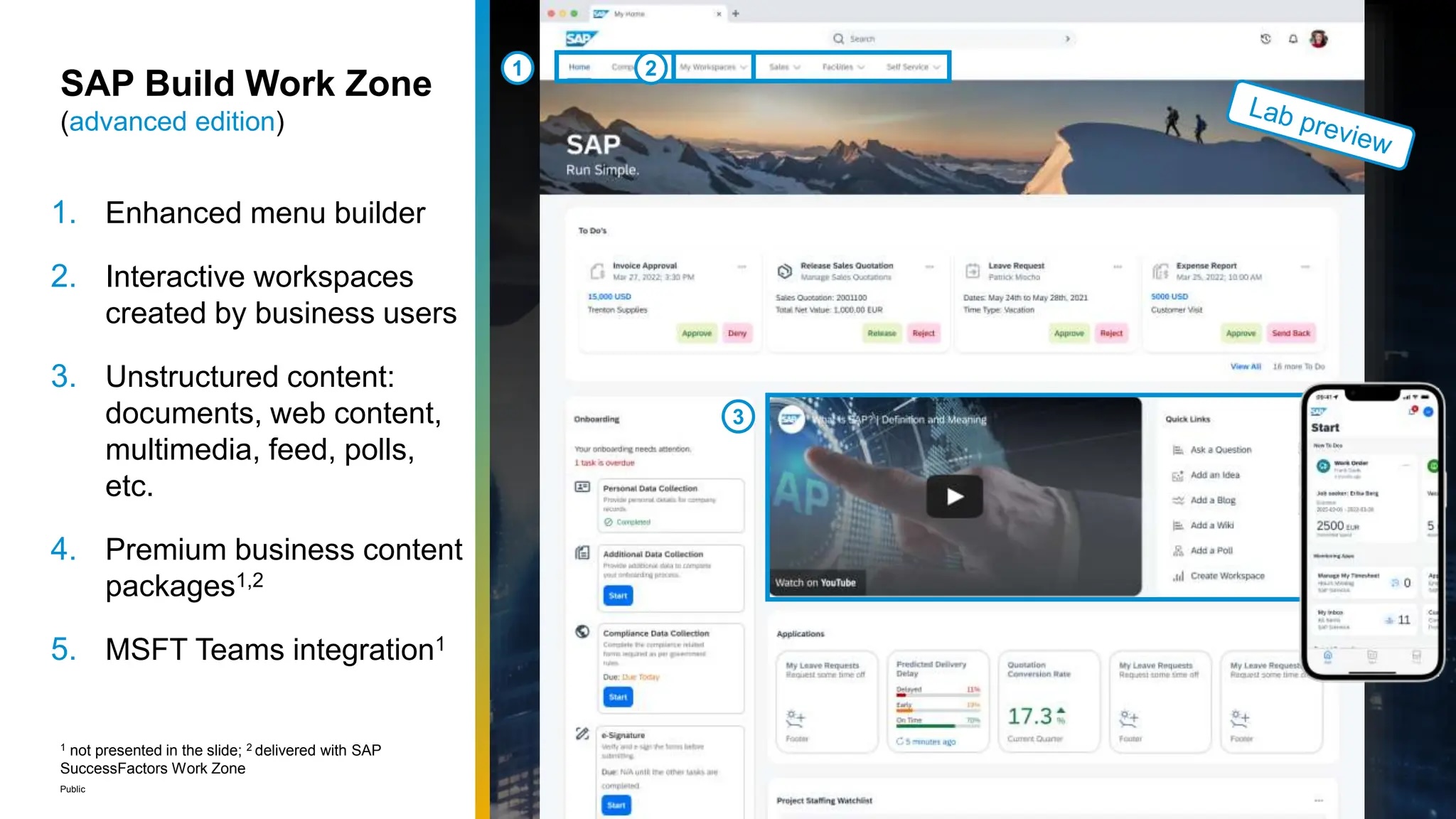
SAP Build Work Zone Advanced layers additional functionalities on top of Build Work Zone Standard, adding:
- “Citizen-developer” features that allow end users to build and share personalised, collaborative workspaces which can include external non-SAP content and collaboration features.
- Integrate intranet-like, unstructured content such as Forums, ToDo lists, Knowledge Base articles, documents from a document management system, or static content.
- Create task-oriented workspaces which can be shared with external collaborators or made public.
- Content packages delivered by SAP to integrate functionality from some SaaS applications. As of July 2024, this is only available for SuccessFactors.
- Integration with Microsoft Teams and low-code applications built using SAP Build tools
- APIs and webhooks published for other applications to consume.
As of July 2024, the underlying technology stack for the Standard and Advanced options of Build Work Zone are different. Migration from one to the other requires not only a licensing change, but also work to align the content models. SAP plans to deliver a migration tool, but this is not featured in the roadmap yet. Due to the differing technology stacks, some features of Standard are not available in Advanced; for example SAP Mobile Start is not yet supported for the Advanced version.
Evaluation
The evaluation below tries to focus only on significant differences between the various options. Where each option has the same Pros and Cons, these have been omitted to more clearly show the differences between them.
Weighting | Option A | Option B SAP Start | Option C SAP Build Work Zone Standard | Option D SAP Build Work Zone Advanced | |
|---|---|---|---|---|---|
| Alignment with SAP Roadmap | Low |
|
|
|
|
| Solution Maturity | High |
|  Very new product. SAP Start was launched in July 2023 for S/4HANA Public Cloud, and support for S/4HANA Private Cloud was added only in Q1 2024. Very new product. SAP Start was launched in July 2023 for S/4HANA Public Cloud, and support for S/4HANA Private Cloud was added only in Q1 2024. |
| |
| Functional Fit | Very High |
|
|
| |
| |||||
| Simplicity | High |
|
|
| |
| Security | High |
|
| ||
 Ability for Syensqo users to invite external collaborators into selected work spaces without those users needing to exist inside S/4HANA. Access is limited to functions provided by Build Work Zone itself (e.g. forums, collaboration content). Access to underlying business applications continues to require the user to hold an account. Ability for Syensqo users to invite external collaborators into selected work spaces without those users needing to exist inside S/4HANA. Access is limited to functions provided by Build Work Zone itself (e.g. forums, collaboration content). Access to underlying business applications continues to require the user to hold an account. | |||||
| Change management | Med |
|
|
|
|
| Cost | Med |
|
| Generate BTP consumption and requires an extra subscription license. |
|
See also
Related KDDs
KDD042 - Mobile Application Framework Selection
KDD016 - Mobility Solution Direction for Enterprise Asset Management
KDD025 - Mobility Solutions in Logistics and Warehouse Management Processes
KDD055 - Multi-Language Support
Material by SAP
SAP Learning Journey for Build Work Zone Advanced
Blog post by SAP Product Manager for Work Zone with more details and links
SAP Help pages listing the various restrictions of Build Work Zone Standard and Build Work Zone Advanced
SAP Roadmap Explorer for SAP Fiori, SAP Start, Build Work Zone Standard, Build Work Zone Advanced
SAP Business Technology Platform Service Description Guide, mentioning availability SLAs and other important aspects of the service.
SAP Fiori Deployment Options and System Landscape Recommendations
SAP Note 3345119 - Expose Fiori Launchpad content to BTP using Exposure Version 2
SAP Note 3429848 - Restrictions for the integration of SAP Start with S/4HANA Cloud Private Edition
SAP Note 3450958 - Launchpad Content Exposure with Exposure Version 2
Change log
Workflow history
| Title | Last Updated By | Updated | Status | |
|---|---|---|---|---|
| There are no pages at the moment. | ||||