


| Status | Lead Approval |
|---|---|
| Owner | |
| Stakeholders |
Purpose
The purpose of this document is to define the conversion approach for Quota Arrangements to be uploaded into SAP S/4HANA as part of the Procurement Data Migration. Quota Arrangements are used to determine the distribution of procurement quantities across multiple sources of supply, providing control over vendor sourcing allocations.
---CHECKLIST---
- Logical Source and Target Systems are identified.
- Processing Type is specified (i.e. Direct Input, BAPI, IDoc, Web Service, OData API, etc.)
- Standard or custom load program name/BAPI/IDoc is specified to support this functionality.
- Data Mapping is provided for mappings which are not obvious to a suitably-skilled and experienced developer
- All translation requirements are clearly defined (including data validation rules, data derivation/calculation and default values, if applicable)Input and/or Output file layouts are provided for all record types possible
- Transaction volume is specified Execution frequency is specified Restart/Recovery requirements have been defined
- Error handling requirements are specified, including alerting requirement and expected action on failure.
- Application log requirement if applicable to be specified.
--- Additional topics to check---
- Rules for Data Merging (all systems)
Conversion Scope
This conversion approach covers active and relevant Quota Arrangements maintained at the material, plant, and source (vendor or source list) level. Records from legacy ECC systems (e.g., PF2, WP2) will be extracted, validated, transformed, and loaded into the S/4HANA system.
Only quota entries linked to valid material and vendor combinations and with an active allocation percentage will be considered in scope. Obsolete, deleted, or inactive quota records will be excluded. The harmonization process will align multiple legacy records into a consistent target format.
The data from legacy system includes:
- Materials that are in scope for conversion
- Vendors that are valid and active in the target system
- Quota Arrangements with non-zero quota % and valid plant/material/vendor combinations
- Entries with recent procurement activity (last 3–5 years)
The data from legacy system excludes:
- Entries marked for deletion (QMAT-LOEKZ)
- Obsolete vendors or materials not migrated
- Quotas with zero allocation or expired validity period
| Source | Scope | Source Approx No. of Records | Target System | Target Approx No. of Records |
|---|---|---|---|---|
| PF2 | Only open/valid documents will be migrated | 8 | S4/Hana | 4 |
| WP2 | Only open/valid documents will be migrated | 205 | S4/Hana | 42 |
Additional Information
Multi-language Requirement
Descriptions are not applicable for Quota Arrangement, but Plant and Purchasing Organization descriptions may be presented in English and logon language if available.
Document Management
N/A
Legal Requirement
N/A
Special Requirements
Processing Type ETL:
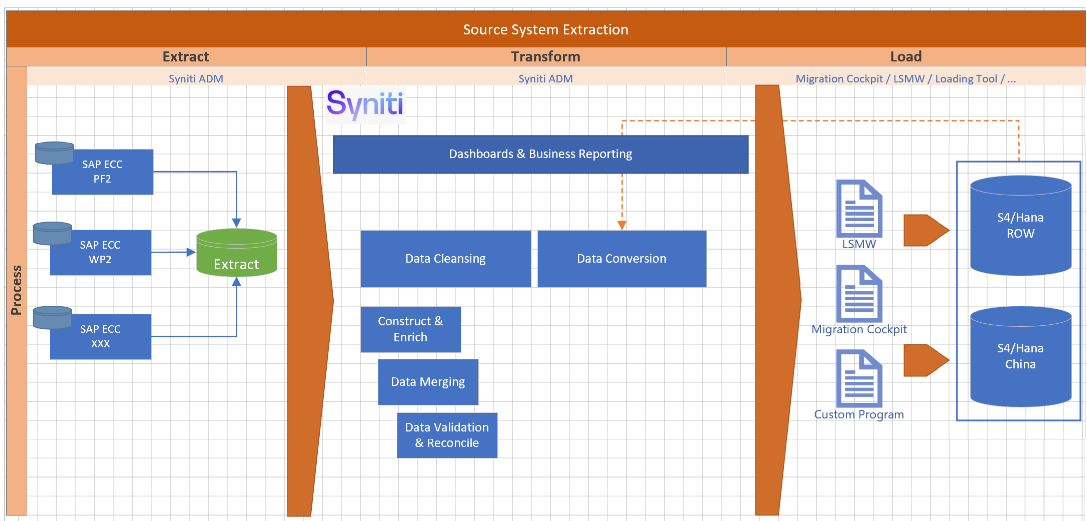
The extraction and transformation will be done by Syniti, while the loading will be executed by a Standard tool of SAP Migration Cockpit.
- E - Extraction: Data will be Extracted from at least two source systems. This process will be executed by Syniti
- T - Transform: Data will be Cleansed by Syensqo / Transformed, Merged, and generate a migration file (CSV - comma delimited) by Syniti
- L - Loading: Data will be Loaded using a custom Z-BAPI, custom function module, or BDC (Batch Data Communication) using MEQ1 that wraps this logic for reusability (no FM / BAPI / IDoc encountered)
Target Design
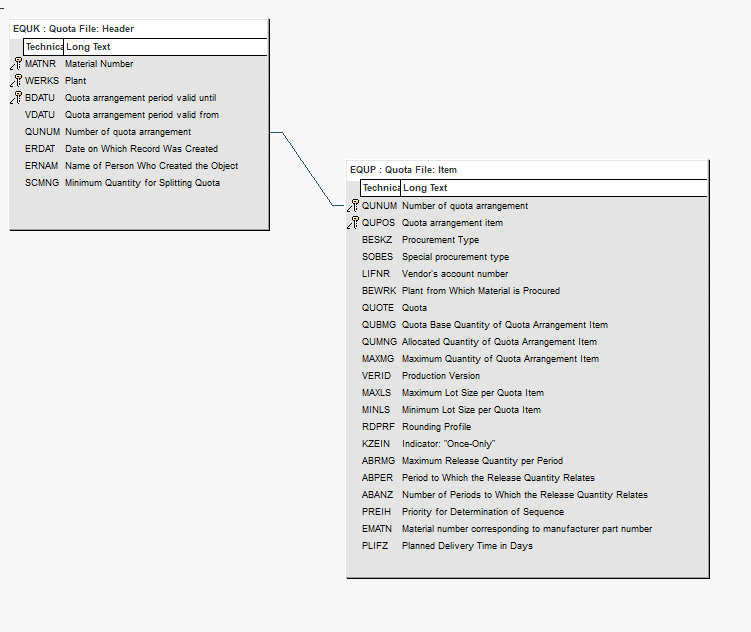
Quota Arrangement will be loaded into SAP S/4HANA using standard structures:
- Table: QMAT (Quota Arrangement by Material)
- Fields: MATNR, WERKS, LIFNR, KNTTP, KZUST, ANZQU, DATBI, DATAB, etc.
- The data must match the material master, vendor master, and source list configurations.
The technical design of the target for this conversion approach.
| Table | Field | Data Element | Field Description | Data Type | Length | Requirement |
|---|---|---|---|---|---|---|
| EQUK | MANDT | MANDT | Client | CLNT | 3 | Required Key Field - Automatically updated |
| EQUK | MATNR | MATNR | Material Number | CHAR | 18‑40* | Required Key Field - Automatically updated |
| EQUK | WERKS | WERKS_D | Plant | CHAR | 4 | Required Key Field - Automatically updated |
| EQUK | BDATU | QUOBI | Quota arrangement period valid until | DATS | 8 | Required Key Field - Automatically updated |
| EQUK | VDATU | QUOAB | Quota arrangement period valid from | DATS | 8 | Required |
| EQUK | QUNUM | QUNUM | Number of quota arrangement | CHAR | 10 | Automatic |
| EQUK | ERDAT | ERDAT | Date on which record was created | DATS | 8 | Automatic |
| EQUK | ERNAM | ERNAM | Name of person who created the object | CHAR | 12 | Automatic |
| EQUK | SCMNG | SCMNG | Minimum quantity for splitting quota | QUAN | 15.3 | Conditional. Syensqo user need to specify the minimum quantity that a lot must have in order to be apportioned among several sources of supply in the planning run.
|
| EQUK | CHANGEDON | TIMESTAMPL | UTC timestamp when record was changed | DEC | 21 | Opcional |
| EQUP | MANDT | MANDT | Client | CLNT | 3 | Required Key Field - Automatically updated |
| EQUP | QUNUM | QUNUM | Number of quota arrangement | CHAR | 10 | Required Key Field - Automatically updated |
| EQUP | QUPOS | QUPOS | Quota arrangement item number | NUMC | 3 | Required Key Field - Automatically updated |
| EQUP | BESKZ | QBESK | Procurement type | CHAR | 1 | Required. Allowed procurement type will be based on material master data set-up. So if material master is set-up as External procurement, then user can only choose External procurement during quota arrangement creation. |
| EQUP | SOBES | SOBES | Special procurement type | CHAR | 1 | Conditional. If any special procurement such as consignment or subcontracting exist for a supplier, then choose relevant type in this field. |
| EQUP | LIFNR | ELIFN | Vendor account number | CHAR | 10 | Required |
| EQUP | BEWRK | BEWRK | Plant from which material is procured | CHAR | 4 | Not Required. Syensqo will not need quota arrangement for materials provided within internal production plants |
| EQUP | QUOTE | QUOTE | Quota | DEC | 3 | Required in case of multiple suppliers exist for particular material. Quota will be used to identify portion of quantity to be procured from particular supplier. |
| EQUP | QUBMG | QUBAS | Base quantity of quota arrangement item | QUAN | 15.3 | Conditional. Set quota base quantity if to avoid changes in the quantity to be allocated in case new source is added. If quota base quantity is not specified, then system will automatically allocate quantity to supplier(s). |
| EQUP | QUMNG | QUMNG | Allocated quantity of quota arrangement item | QUAN | 15.3 | Opcional |
| EQUP | MAXMG | QUMAX | Maximum quantity of quota arrangement item | QUAN | 15.3 | Opcional |
| EQUP | VERID | VERID | Production version | CHAR | 4 | Opcional |
| EQUP | MAXLS | MAXLS | Maximum lot size per quota item | QUAN | 13.3 | Opcional |
| EQUP | MINLS | MINLS | Minimum lot size per quota item | QUAN | 13.3 | Opcional |
| EQUP | RDPRF | RDPRF | Rounding profile | CHAR | 4 | Opcional |
| EQUP | KZEIN | KZEIM | Once‑only indicator | CHAR | 1 | Opcional |
| EQUP | ABRMG | ABRMG | Maximum release quantity per period | QUAN | 13.3 | Opcional |
| EQUP | ABPER | ABPER | Period related to release quantity | CHAR | 1 | Opcional |
| EQUP | ABANZ | ABANZ | Number of periods for release quantity | NUMC | 2 | Opcional |
| EQUP | PREIH | PREIH | Priority for determination sequence | NUMC | 2 | Opcional |
| EQUP | EMATN | EMATN | Manufacturer part number's material number | CHAR | 18 | Opcional |
| EQUP | PLIFZ | PLIFZ | Planned delivery time in days | DEC | 3 | Opcional |
Data Cleansing
| ID | Criticality | Error Message/Report Description | Rule | Output | Source System |
|---|---|---|---|---|---|
| 001 | Medium | Ensure RFQ types (e.g., AN, ANQ) are valid and configured in S/4HANA | - Delete or correct RFQs using types that are not configured in S/4HANA - Map to valid types if migration logic allows | ||
| 002 | Medium | Consistent numbering scheme, no duplicates | -Identify duplicates via RFQ number (e.g., EBAN-BANFN or custom RFQ ID) - Keep only one version, preferably the most recent - Renumber only if permitted by target system config | ||
| 003 | Medium | RFQ dates (creation, validity from/to) must be consistent and within allowed range | - Correct invalid dates (e.g., validity end before start) - Delete expired RFQs if beyond retention cutoff (e.g., older than 5 years) - Flag records with future-dated creation or unrealistic validity ranges for review | ||
| 004 | Medium | Material (MATNR) not in the approved Material Master scope | Delete the line item from the RFQ | ||
| 005 | Medium | Material flagged for deletion (MARA–LVORM = X or MM03 deletion flag) | Exclude the RFQ line | ||
| 006 | Medium | Material belonging to an obsolete Material Group (MATKL) | Validate with business, likely delete | ||
| 007 | Medium | Non-stock/service items without master data in S/4HANA | Exclude or replace with valid alternatives |
Data Governance Rules
| These governance rules apply to the object overall. They relate to the creation, blocking or deletion, or duplicate checks that must be applied. | |||
| Rule # | Activity | Rule description | Validation Method |
| Sample | Change | Change information inhouse bank if necessary | Ongoing Manual |
| 1 | Create | 1) When Syensqo has multiple suppliers providing the same key supplies, Quota Arrangements should be utilized to automate the distribution of work, eliminating the need for manual intervention. This approach minimizes the risk of excessive dependence on a single vulnerable supplier. Quota arrangements are manually created within the S/4 Hana system. 2) A distinct quota arrangement must be established for each specific combination of material and plant. 3) The quota arrangement could be based on contract and / or purchase info records created with supplier. 4) When purchase requisitions are created manually or automatically for these materials, the system selects a supplier according to the predefined quota arrangement. This arrangement is valid for a specific time period and, once expired, will no longer be used to determine the source. | |
| 2 | Create | Quota arrangements are always created against material and plant combination | |
| 4 | Change | Quota arrangements can be changed via S/4 Hana system adopted at Syensqo. Scenarios at Syensqo which trigger updating of Quota arrangement master data: 1) New supplier is identified for the material which needs to be added in the Quota arrangement 2) Contract with the supplier against particular material is renewed for new validity period. Quota arrangement needs to be aligned with the new validity period. 3) Contract with the supplier against particular material is expired and/or new contract is created with separate supplier. Quota arrangement needs to be updated to add new supplier and period. 4) Purchase Info Record with the supplier against particular material is renewed for new validity period. Quota arrangement needs to be aligned with the new validity period. 5) Purchase Info Record with the supplier against particular material is expired and/or new Purchase info record is created with separate supplier. Quota arrangement needs to be updated to add new supplier and period. | |
| 5 | Deletion | If the quota arrangement is no longer required, the quota arrangement validity period can be reduced to past data and allocated quantity/quota can be reduced to zero via the S/4 HANA system adopted at Syensqo | |
| Validation Method | |||
| These validation method apply to the object overall. They relate to the creation, blocking or deletion, or duplicate checks that must be applied. | |||
| Method # | Validation Method | Definition | |
| 1 | Ongoing Manual | Manual checks only by MDO. | |
| 2 | Upfront Automated | SAP validates upon entry. | |
| 3 | Ongoing Automated | Automated method to check data against standards and report KPIs | |
| 4 | Hybrid | Combination of Automated activities and manual intervention in DSP | |
| 5 | Upfront manual/Default on the form | Manual check upon data entry | |
| Field Governance Rules | |||
| These governance rules apply to the individual fields within the data record. | |||
| Rule # | Field Label | Rule Description | Validation Method |
| Sample | Account ID | The first 3 characters are to represent the currency of bank account number. Please refer to currency codes as per ISO 4217. (https://www.iso.org/iso-4217-currency-codes.html) The fourth and fifth characters are to be sequential starting at 01 ending at 99. | Upfront Manual |
| 1 | Quota arrangement number | The Quota arrangemen record number is 15 characters and is automatically generated in S4 | Upfront Automated |
| 2 | Material | The material no is required to be specified by the user and is validated againest relevant Material masters available in S/4 HANA. | Upfront manual/Default on the form |
| 3 | Plant | The plant no is required to be specified by the user and is validated againest relevant plants available in S/4 HANA. | Upfront manual/Default on the form |
| 4 | Valid to | The date is updated as the date until the quota arrangement will be kept valid. This needs to be manually inputted. | Upfront manual/Default on the form |
| 5 | Valid from | The date is updated as the date on which the record was created. Its automatically updated in database basis the record creation date in S/4 HANA. | Upfront Automated |
| 6 | Min. Qty for Splitting Quota | Specifies for the splitting quota the minimum quantity that a lot must have in order to be apportioned among several sources of supply in the planning run | Upfront manual/Default on the form |
| 7 | Created On | This field specifies date on which the data is created in the system | Upfront Automated |
| 8 | Created By | This field specifies the user or system who created the data. | Upfront Automated |
| 9 | Time Stamp | This field specifies timestamp i.e. date & time of the data creation | Upfront Automated |
| 10 | Quota arrangemt.item | Uniquely identifies the quota arrangement item within a quota arrangement period. | Upfront manual/Default on the form |
| 11 | Procurement Type | Indicates the type of procurement (that is, in-house manufacture, i.e. "making in", or external procurement, i.e. "buying out") for the quota arrangement item. | Upfront manual/Default on the form |
| 12 | Special procurement | Indicates which special procurement type (for example, consignment) is to apply in the case of this source. | Upfront manual/Default on the form |
| 13 | Supplier | The Supplier is a business partner or organization that provides goods or services to your company. The information entered on the MDG form gets validated againest valid Business partner records in S/4 HANA. | Upfront manual/Default on the form |
| 14 | Procurement Plant | Key for the factory or branch of a company (that is, a company code), from which the material is to be procured. You can only enter one supplier number or one plant per quota arrangement item. In the case of process orders, this field should remain empty if the quota arrangement is being used to select a production version. | Upfront manual/Default on the form |
| 15 | Quota | Number specifying which portion of a requirement is to be procured from a given source of supply | Upfront manual/Default on the form |
| 16 | Quota Base Quantity | This control quantity for a quota arrangement. Can set the quota base quantity manually or have it determined by the system. Using the quota base quantity, you can regulate the quota arrangement without having to change the quota if, for example, a new source is to be included in the arrangement. | Upfront manual/Default on the form |
| 17 | Allocated Quantity | Total quantity procured to date from the quota arrangement item source. This value is updated in planned orders, purchase requisitions, purchase orders, and scheduling agreement delivery schedule lines. | Upfront Automated |
| 18 | Maximum quantity | Specify maximum quantity to be sourced from the supplier mentioned in the quota arrangement. A quota arrangement item is no longer suggested as the source if the quota-allocated quantity is equal to or exceeds the maximum quantity. | Upfront manual/Default on the form |
| 19 | Production Version | Key which determines the various production techniques according to which a material can be manufactured. The production version determines the following: 1)the BOM alternative for a BOM explosion 2)the task list type, the task list group and the task list group counter for allocation to task lists 3)lot-size restrictions for repetitive manufacturing | Upfront manual/Default on the form |
| 20 | Maximum Lot Size | Maximum PO quantity that may be allocated to a source of supply per order proposal in the planning run. If the shortage (undercoverage) quantity exceeds the maximum lot size, the quota system is re-applied to the remaining quantity. | Upfront manual/Default on the form |
| 21 | Minimum Lot Size | Minimum order quantity that may be allocated to a source of supply per order proposal in the planning run. If the shortage (undercoverage) quantity is less than the minimum lot size, the latter quantity will be allocated to the source instead of the former. | Upfront manual/Default on the form |
| 22 | Rounding Profile | Key that the system uses to adjust the order proposal quantity to deliverable units. | Upfront manual/Default on the form |
| 23 | Indicator: "Once-Only" | Specifies that a source may only be taken into account once in the apportionment of a lot. | Upfront manual/Default on the form |
| 24 | Max. Release Qty | The "maximum release quantity" defines the maximum quantity that a source of supply can make available/supply within a specified timeframe. The maximum release quantity is only taken into account in the planning run within MRP, not when purchase requisitions or planned orders are created manually. | Upfront manual/Default on the form |
| 25 | Period for Release Quantity | Period to Which the Release Quantity Relates | Upfront manual/Default on the form |
| 26 | Number of Periods | In this field, you determine the number of periods for which the maximum release quantity is valid. | Upfront manual/Default on the form |
| 27 | Priority | The priority determines the sequence in which the individual sources of supply are used. Items with priority are always taken into consideration first, before the items for which no priority has been entered. | |
| 28 | MPN: Material | ||
| 29 | Planned Deliv. Time | ||
| 30 | Number of Entries | Automatically determined on backend tables. Not available for user input. | Not Required |
Conversion Process
The high-level process is represented by the diagram below:
Data Privacy and Sensitivity
Extraction
Extract data from a source into . There are 2 possibilities:
- The data exists. connects to the source and loads the data into . There are 3 methods:
- Perform full data extraction from relevant tables in the source system(s).
- Perform extraction through the application layer.
- Only if ; cannot connect to the source, data is loaded to the repository from the provided source system extract/report.
- The data does not exist (or cannot be converted from its current state). The data is manually collected by the business directly in . This is to be conducted using DCT (Data Collection Template) in
The agreed Relevancy criteria is applied to the extracted records to identify the records that are applicable for the Target loads
Extraction Run Sheet
| Req # | Requirement Description | Team Responsible |
|---|---|---|
| 001 | The material exists and is in scope | Syniti Team |
| 002 | The plant exists and is in scope | Syniti Team |
| 003 | The vendor is active and valid | Syniti Team |
| 004 | The quota is > 0 | Syniti Team |
| 005 | The record is not marked for deletion | Syniti Team |
| 006 | The record has not expired (DATBI >= current date) | Syniti Team |
| 007 | Select records where EQUK-ERDAT >= 01.01.2023 | Syniti Team |
Selection Screen
| Selection Ref Screen | Parameter Name | Selection Type | Requirement | Value to be entered/set |
|---|---|---|---|---|
Data Collection Template (DCT)
Target Ready Data Collection Template will be created for data with exception of some fields which require transformation as mentioned in the transformation rule.DCT Rules
| Field Name | Field Description | Rule |
|---|---|---|
Extraction Dependencies
Quota Arrangements depend on the successful migration of the following objects:
| Item # | Step Description | Team Responsible |
|---|---|---|
| 001 | Material Master | |
| 002 | Vendor Master | |
| 003 | Source List (EORD) | |
| 004 | Purchasing Info Records |
These must be loaded prior to the execution of Quota Arrangement upload.
Transformation
The Target fields are mapped to the applicable Legacy field that will be its source, this is a 3-way activity involving the Business, Functional team and Data team. This identifies the transformation activity required to allow to make the data Target ready:
- Perform value mapping and data transformation rules.
- Legacy values are mapped to the to-be values (this could include a default value)
- Values are transformed according to the rules defined in
- Prepare target-ready data in the structure and format that is required for loading via prescribed Load Tool. This step also produces the load data ready for business to perform Pre-load Data Validation
Transformation will involve harmonizing supplier codes, plant IDs, and units of measure across systems. Where multiple legacy entries exist for the same material/plant, the most recent or business-prioritized record will be retained.
Quota percentage (ANZQU) will be recalculated if source values are inconsistent or incomplete. Date fields will be reformatted to YYYYMMDD and adjusted to cover valid procurement windows.
Transformation Run Sheet
| Item # | Step Description | Team Responsible |
|---|---|---|
Transformation Rules
| Rule # | Source system | Source Table | Source Field | Source Description | Target System | Target Table | Target Field | Target Description | Transformation Logic |
|---|---|---|---|---|---|---|---|---|---|
Transformation Mapping
| Mapping Table Name | Mapping Table Description |
|---|---|
Transformation Dependencies
List the steps that need to occur before transformation can commence| Item # | Step Description | Team Responsible |
|---|---|---|
Pre-Load Validation
Project Team
Completeness
| Task | Action |
|---|---|
Accuracy
| Task | Action |
|---|---|
Business
Completeness
| Task | Action |
|---|---|
Accuracy
| Task | Action |
|---|---|
Load
The load process includes:
- Once the data is loaded to the target system, it will be extracted and prepared for Post Load Data Validation;
- The data will be loaded using SAP LSMW leveraging BAPI_QUOTA_CREATE. No standard Migration Cockpit object exists for quota arrangements.
- The BAPI supports creation of records based on target-aligned templates. Staging Tables or Source Files will be handled by Syniti.
Load will occur in mock and production phases, with logs captured and reviewed for consistency, completeness, and errors.
As part of the Loading Strategy, the data will be loaded using SAP LSMW leveraging BAPI_QUOTA_CREATE. No standard Migration Cockpit object exists for quota arrangements. The BAPI supports creation of records based on target-aligned templates. Staging will be handled by Syniti.
Load will occur in mock and production phases, with logs captured and reviewed for consistency, completeness, and errors.
Load Run Sheet
| Item # | Step Description | Team Responsible |
|---|---|---|
Load Phase and Dependencies
Configuration
| Item # | Configuration Item |
|---|---|
Conversion Objects
| Object # | Preceding Object Conversion Approach |
|---|---|
| list the exact title of the conversion object of only the immediate predecessor – this will then confirm the DDD (Data Dependency Diagram) | |
Error Handling
| Error Type | Error Description | Action Taken |
|---|---|---|
Post-Load Validation
Project Team
Completeness
| Task | Action |
|---|---|
Accuracy
| Task | Action |
|---|---|
Business
Completeness
| Task | Action |
|---|---|
Accuracy
| Task | Action |
|---|---|
Key Assumptions
- Master Data Standard is up to date as on the date of documenting this conversion approach and data load.
- is in scope based on data design and any exception requested by business.
See also
Change log
Workflow history
| Title | Last Updated By | Updated | Status | |
|---|---|---|---|---|
| There are no pages at the moment. | ||||