

Table of contents
Scope

ERP


Frequency
Whenever needed
<< WW IFRS16 - Asset Retirement Obligation >>
1. Objective and Scope
1.1. Objective of this Operation
The purpose of this operation is to properly register Asset Retirement Obligation assets in the scope of IFRS16 whenever a contract with such condition is created.
An Asset Retirement Obligation is a clause in some contracts (mostly buildings) that require that the object of the lease contract is returned to its original condition at the end of the contract term, therefore it is the renter's obligation to perform any necessary maintenance and dismantling work to bring the object to the conditions it was in before the contract start.
Whenever a contract with Asset Retirement Obligation appears, please contact the CAM of the relevant company to ensure that they are aware of the provision that needs to be created.
1.2. Scope
This procedure is applied to all companies WW that follow the IFRS16 procedure.
2. Definitions
See Finance Glossary:
- ARO: Asset Retirement Obliation
- BFC: Business Financial Consolidation
- GAR: Group Accounting & Reporting
- RoU: Right of Use
- RE-FX: Real Estate Module in SAP
- CAM: Country Accounting Manager
- ACP: Accounting Platform team
3. Tasks description
3.1. I create the ARO asset master data
Whenever analyzing a contract where there is a clause for asset retirement obligation, it is necessary to create an asset as a subnumber of the original RoU asset generated by the contract in RE-FX.
3.1.1. I check the RoU asset master data
Open the contract related to the ARO in transaction RECN and find the asset number in the "Valuation Parameters" tab:

3.1.2. I Create a subnumber for this asset
Open transaction AS11 and insert the RoU asset number of the contract:

Adjust the master data of the ARO asset accordingly (name, cost center, plant, etc...). Please ensure that the useful life of the ARO asset (in tab "Deprec. Areas) is aligned with the duration of the contract, as the ARO asset should end its depreciation at the same time as the RoU asset generated by the contract. If any term changes are done to the RoU asset, the ARO useful life must be adjusted accordingly.
3.2. I perform the ARO values posting
3.2.1. I validate the posting scheme
According to GAR, the following posting scheme should be performed for ARO:
1 - New ARO is created:
| Movement | Heading | Flow |
|---|---|---|
| Debit | A23300 - Right of Use Buildings | F50 |
| Credit | L15900 - LT provisions for other contingencies and losses | F50 |
2 - Adjustment of significant amount compared to the original provision:
| Movement | Heading | Flow |
|---|---|---|
| Debit/Credit | A23300 - Right of Use Buildings | F50 |
| Credit/Debit | L15900 - LT provisions for other contingencies and losses | F50 |
3 - Adjustment of not significant amount compared to the original provision:
| Movement | Heading | Flow |
|---|---|---|
| Debit/Credit | P&L Provision heading to be defined by GAR | N/A |
| Credit/Debit | L15900 - LT provisions for other contingencies and losses | F25 if increase, F36 if decrease |
For postings that have no impact on the RoU asset, please contact ACP to proceed with the posting.
If any movement that is not represented above needs to be made in the ARO, please contact the GAR team to validate the posting scheme.
3.2.2. I perform the posting in SAP
To perform the posting in the RoU asset, go to transaction ABSO and use the following transaction types:
PF1:
ZOI - Debit
ZOJ - Credit
WP1:
Z44 - Debit
Z41 - Credit
The document date and posting date fields should be filled according to each request:

Inform the amount to be posted as well as the offsetting account (to be checked with ACP team):
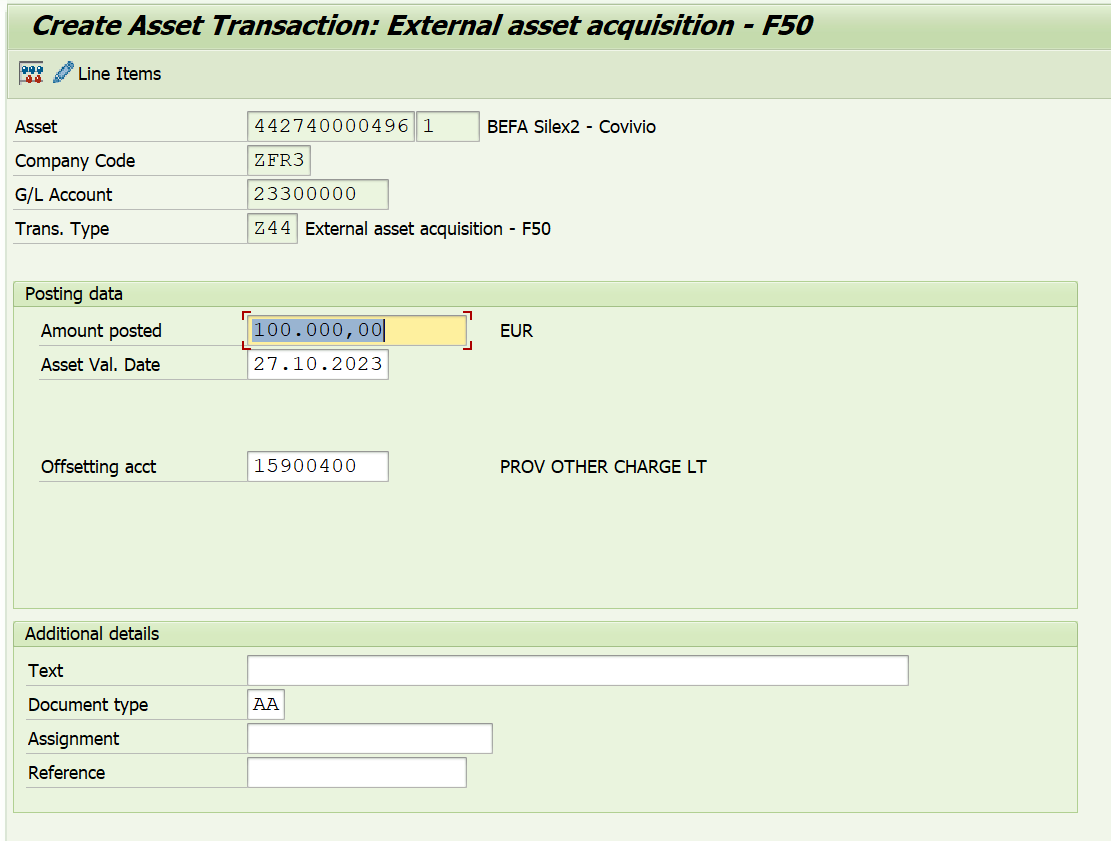
Important: Always check if the country follows IFRS16 at local GAAP before making the postings!
If the country does not follow IFRS16 at statutory/local GAAP, the ARO asset should have no values in the local depreciation areas (01 to 49 in PF1, 30 to 44 in WP1). If that's the case, select the option "Line Items" and delete the amount from the local areas. See example below for a country that doesn't follow IFRS16 at local GAAP in WP1:
