


| Status | Approved |
| Owner | |
| Stakeholders | Andrew Rimmer, Betty Tang, Frank Valendo, Jamie Howes, Joseph Beliotte, Suzanne Newbury, Wilson Larrarte, Brian Erwin, Clement Nachawati, Delphine Richard, Louise Mardling, Marie Pereira, Marielle Chaume, Moreno Peluso, Najaite Nidboufker, Yvonne Gu |
Issue
Syensqo has different types of plants i.e. Manufacturing, Distribution, Subcontracting, Consignment, Traded, Port plants, plants abroad etc. created in order to support different existing As-Is processes ex: Intercompany, Subcontracting etc. A lot of these plants are virtual plants i.e. do not have a physical location and are created to support a business process or legal/regulatory requirements. As part of ERP rebuild program the business processes are being standardised and therefore there is an opportunity to standardise and simplify the plant structure by getting rid of the virtual plants and those that are not needed for the future design. This simplification will improve supply chain transactions and increase opportunities for automation.
Recommendation
Based on the comprehensive analysis conducted, Option B: Simplify and Standardize the Plant Structure is recommended. This option involves a thorough evaluation of all existing plants using a decision tree outlined in the accompanying document, which will be applied during the detailed design phase. The goal is to streamline and standardize the number of plants, ensuring that they align with the future design requirements. By implementing this approach, Syensqo will not only reduce the complexity associated with managing multiple plant types but also enhance operational efficiency. Furthermore, this standardization will provide a valuable opportunity to optimize Syensqo's supply chain network, leading to improved overall performance and cost-effectiveness.
Background & Context
Syensqo operates a diverse range of plant types to support various business processes. These include Manufacturing, Distribution, Subcontracting, Consignment, Traded, Port plants, and Plants Abroad. Each plant type was established to fulfill specific operational needs and to manage processes such as Intercompany transactions and Subcontracting. Notably, many of these plants are virtual i.e. they do not have a physical location. These virtual plants were created primarily to address particular business processes or to comply with legal and regulatory requirements, allowing Syensqo to navigate complex operational landscapes without maintaining a physical presence for each plant.
The As-Is plant structure can be found in the Enterprise Structure Catalog.
Following is the Overview of As-Is plants (Only the active plants as of writing this document are considered in the table below)
| Type of Plant | As-Is Counts | Purpose of the plants |
|---|---|---|
| Manufacturing Plants | 67 |
|
| Distribution Centers | 208 |
|
| Subcontracting Plants | 196 |
|
| Trading Plants | 18 |
|
| Consignment Plants | 8 |
|
| Maintenance Planning Plants | 74 |
|
| Maintenance Plants | 74 |
|
As a part of the To-Be design, plant represents a physical location where materials are produced, procured, stored, maintained or distributed. Following are some of the key functionalities at plant level
- Materials are valuated at plant level
- Inventory management functions including inventory reporting are carried out at plant level
- Materials Requirement Planning (MRP) is carried out at plant level
- Production and production planning activities are executed at plant level
- Quality management is carried out at plant level
- Maintenance and maintenance planning activities are executed at plant level
- A plant is the location where the technical objects of a company are installed i.e. Workcenter, functional location etc.
- Many master data objects are maintained at plant level ex: Material master MRP, Purchasing, QM etc.
- Plant is a key element for application system security
Assumptions
- Advanced Intercompany will be implemented in Syensqo which will change the behaviour of Intercompany process and therefore traded plants are not required. (ref. KDD017 - Intercompany Processing in the new ERP Solution)
Constraints
Any modifications to the current understanding of tax treatments or regulatory requirements could necessitate changes to the plant design. If there are updates or new interpretations of tax regulations or compliance standards, the plant structure may need to be adjusted to ensure alignment with these legal and regulatory frameworks.
Impacts
Following are the impacts
Data Conversion and Migration: As part of the ERP rebuild program, it is essential to map data from the existing As-Is systems according to the new proposed Plant Structure. This process involves systematically aligning and converting the data from the current plant setups to the standardized plant model. Accurate data mapping ensures that all inventory records, asset details, and related information are properly integrated into the new system, reflecting the updated plant design and structure. This step is crucial for maintaining data integrity and supporting seamless operations post-migration.
Cutover: The approach to migrating inventory during the cutover phase must be carefully designed to align with the new plant structure. This involves planning and executing the transition of inventory data from the old system to the new one, ensuring that all inventory items are correctly assigned to their new plant locations according to the standardized model. The cutover strategy should include detailed procedures for data extraction, transformation, and loading, as well as comprehensive testing to validate that the migration has been successful and that inventory records are accurately reflected in the new system.
Downstream System: The changes in plant codes will affect all downstream systems that rely on this data. These systems, which may include supply chain management tools, financial systems, and reporting applications, will need to be updated to accommodate the new plant structure. A one-time remediation or mapping exercise will be required to adjust these systems and ensure that they continue to function correctly with the revised plant codes. This exercise involves updating interfaces, data mappings, and integration points to reflect the new plant design and prevent disruptions in downstream processes.
Business Rules
A location will be defined as a plant if atleast one the following conditions are met:
- Inventory is held and the ownership linked with this location
- Inventory is valued separately and material price varies
- Technical objects like functional locations etc., are reported and mapped to this location
- Location executes production and / or maintenance activities
- Has its own set of material master data values e.g. lead times, lot sizes etc.
- Location requires separate authorizations
Options considered
Following are the options proposed
Option A: Continue with the As-Is Plant Structure
Opting to maintain the current plant structure by copying all valid plants from the As-Is system will allow the business to continue operating with its existing setup. This approach ensures that there is no immediate disruption to current operations, as the familiar plant structure remains intact. However, this option will not fully leverage the advantages offered by the future design. By retaining the existing structure, Syensqo will miss out on the opportunity to streamline processes and take full advantage of automation possibilities that a more standardized plant design could provide. As a result, while this option ensures continuity, it limits the potential for enhanced efficiency and modernization that comes with adopting the proposed future design.
Option B: Simplify and standardise the Plant Structure
As part of this option, the proposed approach involves simplifying the plant structure using a decision tree methodology. Each plant within the current As-Is system will be evaluated against this decision tree during the detailed design phase. This process aims to determine which of the existing plants are still relevant and should be retained or recreated in the new To-Be structure. By systematically assessing each plant, the decision tree will help identify which plants align with the future design requirements and ensure that only valid and necessary plants are included in the streamlined plant structure. This approach will facilitate a more organized and efficient transition to the new system, while also supporting the goal of simplifying and optimizing the plant design.
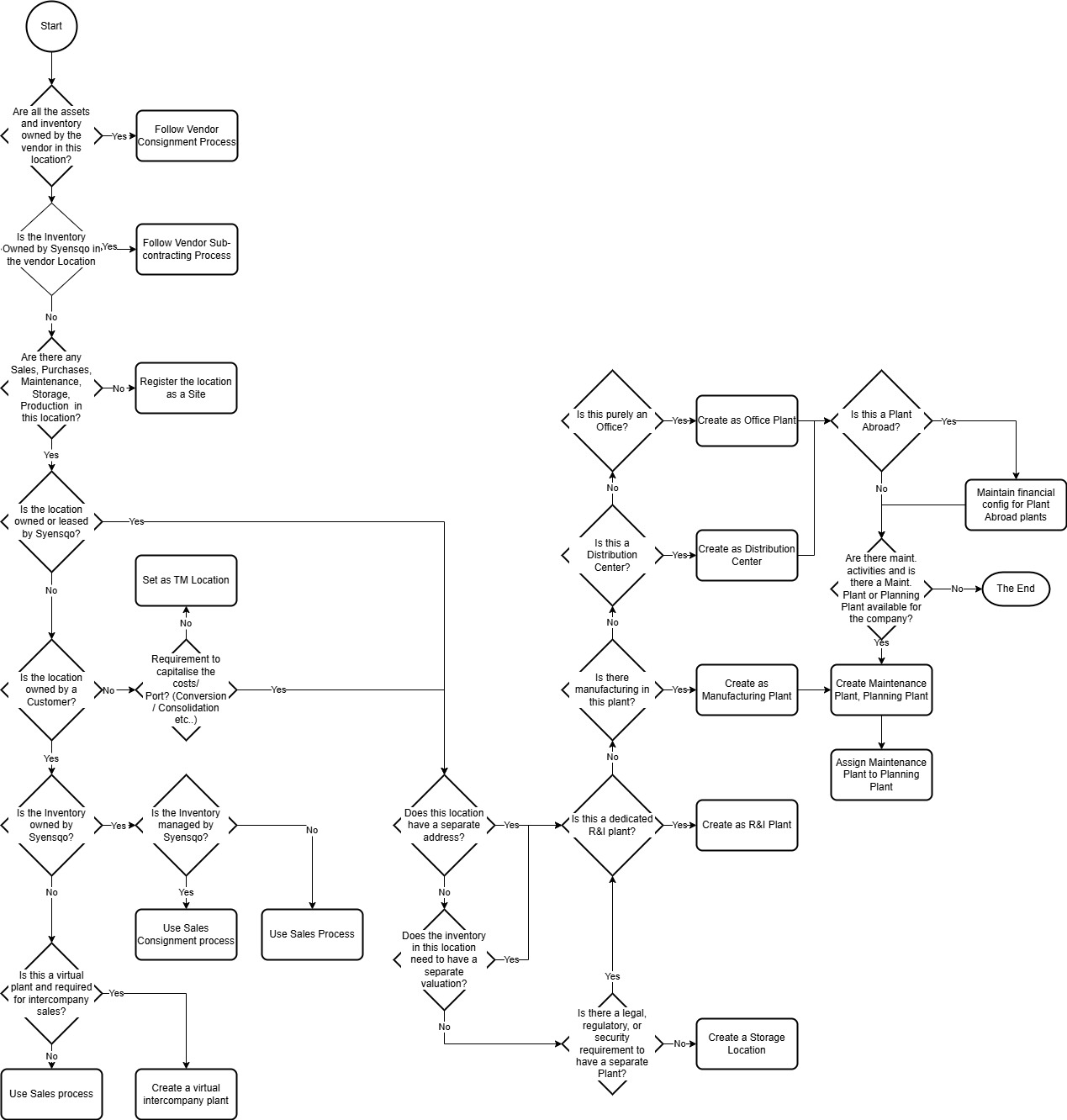
Following is the decision matrix used in the flow chart
| Decision Step | Rationale |
|---|---|
| Are all the assets and inventory owned by the vendor in this location? | If a location exclusively holds inventory or assets owned and managed by a vendor, it should be represented through the Business Partner – vendor. However, if a location contains inventory that is owned and managed by Syensqo, but also includes inventory provided by a vendor under a consignment arrangement, the existing plant can accommodate the vendor consignment process. In such cases, there is no need to create new plants. |
Are there any Sales/ Purchases/Maintenance/Storage/Production in this location? | If there are no sales or purchases of inventory occurring at a location or, if inventory is never stored in a location, there is no requirement to set up the location as a plant. |
| Is the location owned or leased by Syensqo? | If a location performs sales, purchases or holds inventory (as per question 2) and is owned, leased or managed by Syensqo, there is a requirement to represent this location as a plant in order to perform the relevant transactions. |
Is the location owned by a customer? | If a location is owned by a customer, and if the inventory is owned by Syensqo but not managed by Syensqo then a consignment sales process should be adopted in this location. If a location is owned by a customer, and if the inventory is not owned by Syensqo then a normal sales process should be adopted in this location. |
Requirement to capitalise the costs/Port? (Conversion / Consolidation etc.) | If a port is storing inventory for a period of time or if a port is changing the nature of the product (conversion, load consolidation/separation), then the port is playing the role of a distribution centre and should be treated as such. If a port is simply a location where goods transit to get to/from a destination, then a transportation location is sufficient to represent this location in the supply chain. Note that any transport specific costs such as duties, container charges, port charges, etc are all considered part of transport costs (as opposed to storage costs) and are handled through the normal transport management processes (and, therefore, do not require a plant or storage location). |
Inventory owned and managed by Syensqo and has a separate address to the existing plants | The location to be set-up as a separate plant |
Inventory owned and managed by Syensqo and doesn't have a separate address to the existing plants and needs to have separate valuation | There can be different material valuation requirement in case multiple GBU's exist in the same plant and can have different valuations due to having different supply chain network, Different external suppliers, different country of origin requirements, packing processes etc. If a material has to be valuated differently in two separate locations, there are 2 options, 1. to create a separate plant or 2. To enable split valuation. It is recommended at this point in time to create a separate plant. Further analysis will be conducted during the detailed design based on the analytical requirements if split valuation will be able to fulfil the requirements |
Inventory owned and managed by Syensqo and doesn't have a separate address to the existing plants and doesn't need to have separate valuation | The location will be set-up as storage location for an existing plant (If existing storage locations cannot be used) |
Is there a legal/regulatory / Security req to have a separate plant | There could be legal/regulatory/security requirements that will require the location to be set-up as a separate plant. The legal/regulatory requirement always takes precedence when we evaluate the location to be set-up as a plant. There will further evaluation done on case-by-case basis for the security requirements, if they can be fulfilled by any other attributes in the process / custom security objects that will take the precedence, however if the design becomes too complex creation of separate plant is advised |
Is the plant virtual and required for Intercompany Sales? | There is a technical requirement to have at least one plant assigned to the legal entity for Advanced Intercompany Sales process. In the case, where there are sales from the entities which doesn't have any plant, a virtual plant is created |
Evaluation
*The evaluation scoring system ranges from Low to Very High. In this system, a low score indicates a negative attribute, such as high costs.
Option A: Continue with the As-Is Plant Structure | Rating | Option B: Simplify and standardise the Plant Structure | Rating | |
|---|---|---|---|---|
| Operational Complexity |
Conducting stock takes becomes cumbersome and challenging because some stock is virtual and not physically present. This discrepancy can complicate inventory reconciliation and reporting. | Low |
A unified stock take process simplifies inventory management by clearly distinguishing between different types of stock—such as physical stock, consignment stock, subcontracting stock, and stock in transit (SIT). This clarity helps in maintaining accurate inventory records and streamlines the reconciliation process. | High |
System Complexity |
Multiple virtual plants can lead to performance issues, particularly in reporting. The fragmentation of data and the added complexity of virtual plant management can slow down reporting processes and impact overall system performance. | Low |
A simplified and standardized plant structure enhances system performance and reporting efficiency. With fewer plants to manage and less data fragmentation, the reporting processes become more streamlined and accurate. | High |
| Automation |  Automated processes may be more difficult to design and implement due to the need to account for various virtual plant scenarios. Automated processes may be more difficult to design and implement due to the need to account for various virtual plant scenarios. | Low |  Standardizing the plant structure facilitates the development and implementation of new automations as the plants are clearly classified which will define the processes that are implemented in those plants. Without the need to manage virtual plants or virtual postings, there are fewer scenarios to model, which simplifies the automation process and enables more efficient automation solutions. Standardizing the plant structure facilitates the development and implementation of new automations as the plants are clearly classified which will define the processes that are implemented in those plants. Without the need to manage virtual plants or virtual postings, there are fewer scenarios to model, which simplifies the automation process and enables more efficient automation solutions. | High |
| Data Management | Managing data becomes more complex due to the need for additional data that need to be created and maintained. For example, extra material plant views, transportation lanes, and routes must be maintained for each virtual plant. This can lead to fragmented data and inconsistent reporting, complicating data analysis and management. | Low | Standardizing the plant structure eliminates the need for additional data maintenance related to virtual plants. This results in a more streamlined data management process | High |
| Data Migration | Data migration is less complex when dealing with a larger number of virtual plants, as the data mappings required are minimal. However, there may still be challenges in aligning the data with the future design, which requires careful planning and execution. | Medium | The process of data migration is more complex with a standardized plant structure due to the need for extensive data mapping and de-duplication efforts. Despite these complexities, the migration is a one-time activity that ultimately aligns the data with the future design, resulting in a more coherent and efficient data structure | Medium |
See also
Change log
Workflow history
| Title | Last Updated By | Updated | State | Status | |
|---|---|---|---|---|---|
| KDD059 - Supply Chain Enterprise Structure | HE-ext, Cindy | Apr 21, 2026 17:10 | Edited following Approval |