

Purpose of the Document
This document provides an overview of the system landscape and third-party integrations within the Safety-to-Sustainability (S2S) domain.
The document focuses on:
The core SAP applications supporting Safety and Sustainability processes
The integration landscape with external systems
The role of each third-party application
The high-level integration structure between systems
The multi-instance architecture for SAP systems
The objective is to provide clarity on the S2S ecosystem and how systems interact across the landscape.
Third-Party Applications Overview
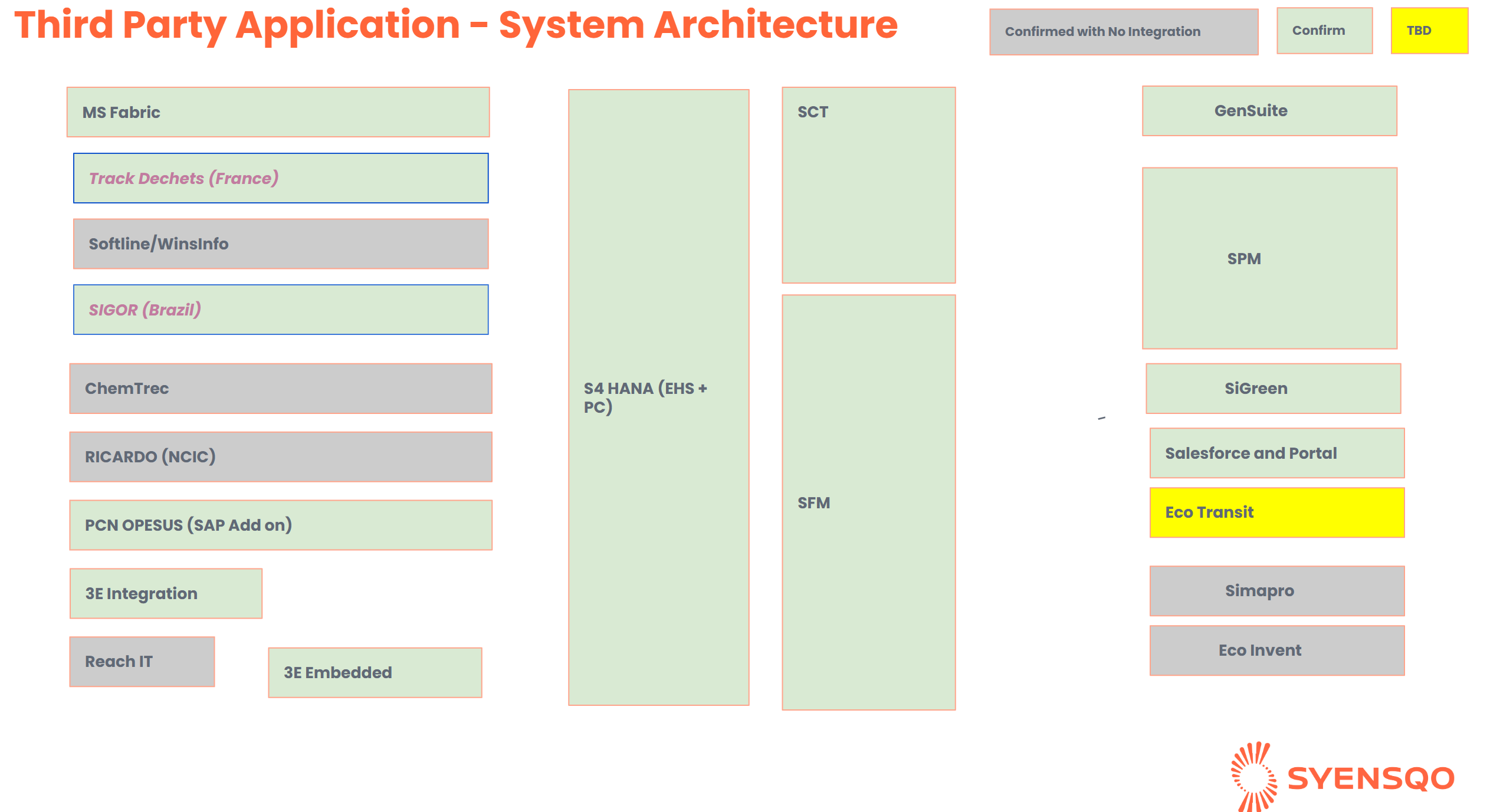
The Safety-to-Sustainability (S2S) landscape integrates with several external applications that support sustainability calculations, lifecycle assessment, chemical compliance, environmental reporting, and data processing.
The table below provides an overview of all third-party systems connected to the S2S domain.
| Third-Party Application | Category | Description | Purpose in S2S Landscape |
|---|---|---|---|
| Sustainability Portfolio Management (SPM) | Sustainability Management | Platform used to manage and monitor sustainability initiatives and programs. | Tracks sustainability projects, KPIs, and program performance. |
| SAP SiGreen | Supply Chain Sustainability | Platform enabling exchange of product carbon footprint data across supply chains. | Supports Scope 3 emissions data exchange with suppliers. |
| Benchmark Gensuite | ESG / EHS Management | Enterprise platform used for environmental, safety, and sustainability management. | Supports ESG monitoring and EHS management processes. |
| Sphera SimaPro | Lifecycle Assessment | Life Cycle Assessment (LCA) software used to analyze environmental impacts of products and processes. | Supports lifecycle impact modeling and sustainability analysis. |
| ecoinvent | Environmental Data Provider | Global provider of lifecycle inventory datasets used for environmental impact calculations. | Supplies emission factors and lifecycle datasets used in sustainability calculations. |
| ChemTrec | Chemical Emergency Response | Emergency response information service for hazardous materials transport and handling. | Provides chemical emergency response and safety data information. |
| Ricardo (NCIC) | Regulatory Compliance | Regulatory intelligence and compliance services provider for chemical and environmental regulations. | Supports regulatory compliance and chemical reporting. |
| Microsoft Fabric | Data & Analytics Platform | Enterprise data platform used for data ingestion, transformation, and analytics. | Supports sustainability data processing and analytics integration. |
| PCN OPESUS | Regulatory Compliance | SAP add-on used for Poison Centre Notification (PCN) dossier preparation and submission. | Supports EU poison center regulatory submissions. |
| Salesforce / Customer Portal | Customer & Partner Platform | Customer and partner portal platform used for product information and communication. | Provides external access to product and compliance information. |
| Softline/Winsinfo | Chemical Compliance | Platform supporting safety data sheet (SDS) authoring and regulatory compliance management. | Supports SDS management and regulatory documentation. |
| Microsoft Fabric | Data & Analytics Platform | Enterprise data platform used for data ingestion, transformation, and analytics. | Supports sustainability data processing and analytics integration. |
| Track Déchets | Waste Compliance | French regulatory platform used for hazardous waste tracking. | Supports digital waste shipment tracking and compliance reporting. |
| SIGOR | Environmental Compliance | Brazilian environmental reporting system. | Supports environmental compliance reporting and waste management. |
5. Detailed Third-Party Application Integrations
This section provides detailed information for each third-party application integrated with the S2S landscape.
5.1 Sustainability Portfolio Management (SPM)
5.2 SiGreen
SiGreen is a platform designed to enable secure exchange of Product Carbon Footprint (PCF) data across supply chains.
It allows companies to:
request PCF data from suppliers
receive PCF data from suppliers
publish PCF information to customers
Within the Safety-to-Sustainability (S2S) landscape, SiGreen integrates with SAP Sustainability Footprint Management to enable bi-directional PCF data exchange with supply chain partners.
2. Integration Capabilities
The integration between SFM and SiGreen supports two primary processes:
| Capability | Description |
|---|---|
| Supplier PCF Collection | Request and receive PCF data from suppliers |
| PCF Publication to Customers | Publish calculated PCFs to customers via SiGreen |
Integration Scenario 1 – Request Supplier PCF
This integration allows the organization to request product carbon footprint information from suppliers.
Process Flow
A PCF request is initiated in SFM
Request can be created manually
Requests can also be generated in bulk using file upload
The request is sent to suppliers via SiGreen.
Suppliers provide the Product Carbon Footprint (PCF) through SiGreen.
A scheduled integration job checks for new PCFs available in SiGreen.
The PCF data is retrieved using the SiGreen API.
The received PCF is reviewed and approved in SFM using the Manage Supplier Footprints application.
Once approved, a supplier product footprint is created in SFM.
Integration Scenario 2 – Publish PCF to Customers
This integration enables organizations to share product carbon footprint information with customers.
Process Flow
A Product Carbon Footprint is calculated and published in SFM.
Published PCFs are made available for integration.
A periodic integration process sends published PCFs to SiGreen.
PCFs are transferred to SiGreen using the SiGreen API.
The PCF data becomes available in SiGreen.
Customers may request PCF information.
The PCF is shared with customers through SiGreen.
In some cases, publication to customers may be triggered manually within SiGreen. or Via Salesforce
5.3 NCIC and Chemtrec
Source of SDS
The organization maintains all SDSs in a central, secure document repository (Sachem portal).
SDSs include all regulatory and safety information for Dangerous Goods.
Some sites store SDSs on an SAP FTP server as the primary storage location.
Documents may be pushed automatically from the SAP FTP server to the central repository or to authorized portals.
For China, SDSs are also uploaded to the NRCC database to comply with legal requirements.
Central Access (Sachem Portal)
The Sachem portal acts as the central access point for authorized emergency response providers.
SDSs can either be:
Directly uploaded from the SAP FTP server, or
Synced periodically to the portal for the latest version.
Portal access ensures secure, role-based retrieval, eliminating unauthorized copying or duplication
Access by Emergency Response Providers
Ricardo and Chemtrec have secure login access to the Sachem portal.
Access allows them to search for, view, and use the most current SDS in the event of an incident.
SDSs are not printed or stored offline by these providers, ensuring compliance with current version requirements and cybersecurity protocols.
Incident Response Flow
Incident occurs involving a Dangerous Good.
Caller contacts Ricardo or Chemtrec via the 24-hour emergency number.
Provider logs into the Sachem portal to access the relevant SDS.
Provider advises on cleanup, exposure, or incident management, ensuring guidance is based on the latest SDS information.