

Creating Safety is the new step by Syensqo in its safety journey, with the aim to ensure people’s safety and health: it relies on a safety leadership style where managers act as mentors and demonstrate genuine care for all.
This will contribute to strengthen our HSE culture, with more focus on how we do things right, without losing the fundamentals such as rules (SLSR) and systems.
Clicking on the image will open it in large format

is the way a person spontaneously think and feel about health, safety and environment. This personal safety mindset is at the basis of everyone’s way of doing, from the operators in the field to the managers in their leadership styles. Individual’s safety mindsets feed the organization’s safety culture , and vice-versa, moving everyone from a “have to” to a “want to” attitude.

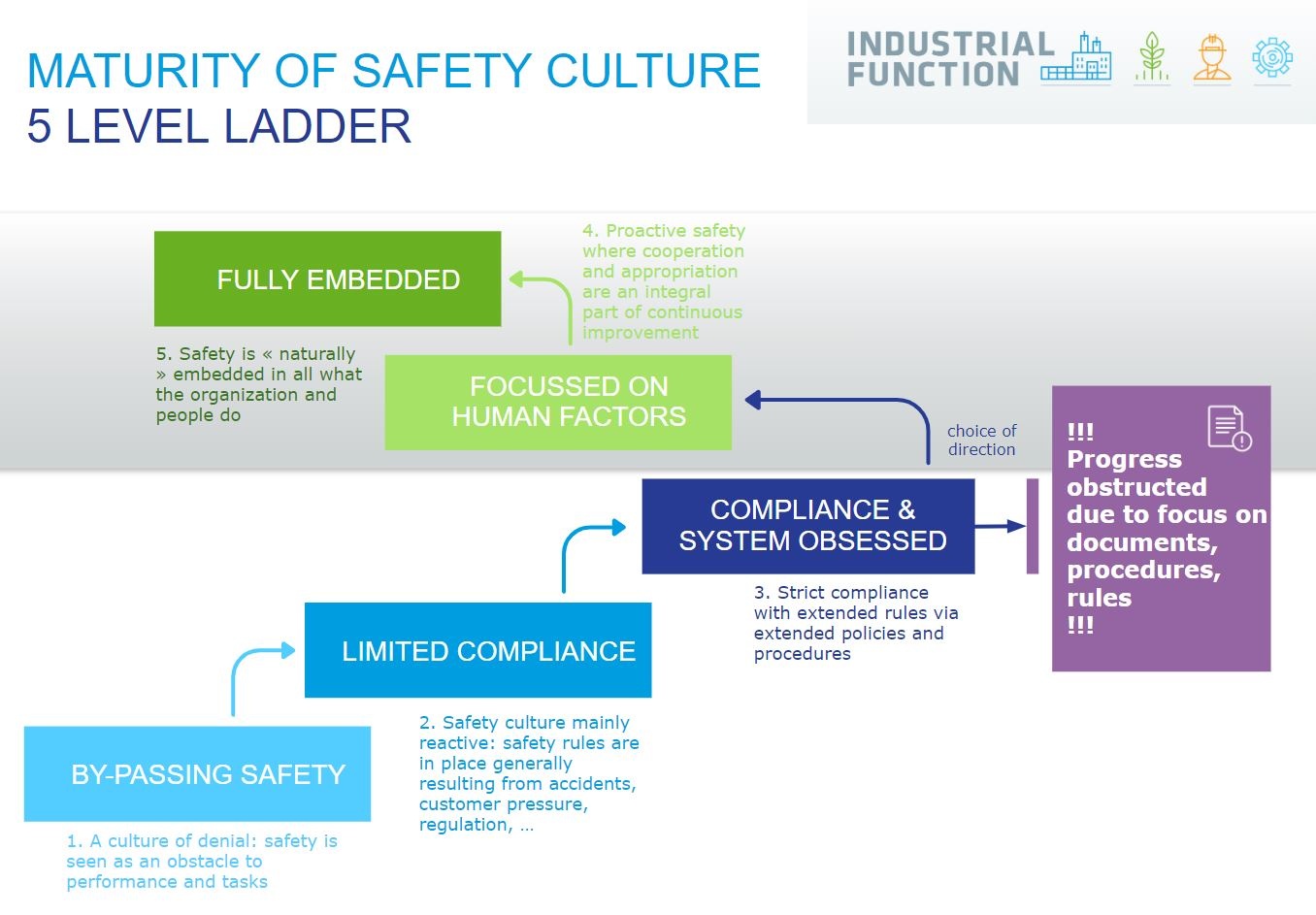
is “the way we do things around here”. It is the shared way we do, perceive and think about health, safety and environment. The maturity of an organization's safety culture can be represented on a 5 steps ladder: from low or pathological, to intermediate or reactive and high. Reinforcing the safety culture means moving beyond rule-based safety (HSE rules, procedures, systems) to make safety a spontaneous, genuine value. Safety climate assessment gives a snapshot of the organization’s safety culture.

can be illustrated on a 5 level ladder of safety culture advancement :
- Pathological (By-passing or avoidance of safety),
- Reactive (limited compliance),
- Calculative (compliance & system obsessed).
- Proactive (focussed on human factors)
- Generative (safety is fully embedded or integrated)
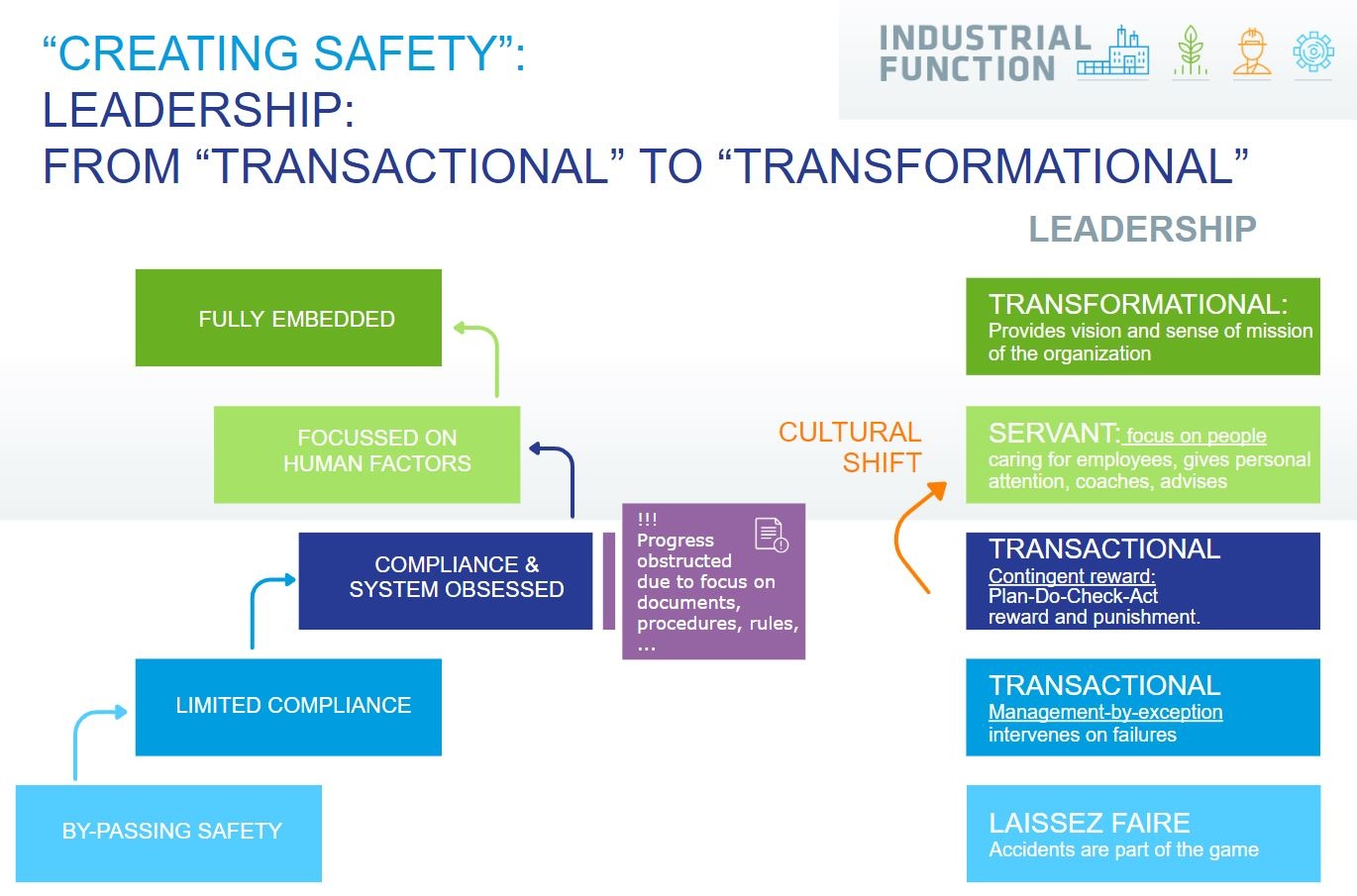
Each step or level can be shortly described with a number of aspects of safety and is strong related with the leadership style . The ultimate goal is to get the right mix of different leadership styles (see table)
5 levels - additional features | ||||
By-Passing Safety | Limited Compliance | Compliance & System obsessed | Focussed on human factors | Safety is fully embedded |
Pathological | Reactive | Calculative | Proactive | Generative |
Management is not interested in prevention | Accidents are just bad luck | Compliance with procedures | Dialogue is promoted | Broad view of interaction between system & people. |
Blame culture | No formal systems | Over reaction to accident | Management takes some responsibilities | Two way process |
Leadership styles | ||||
“Laissez-faire” leadership | “Transactional” leadership: management by exception | “Transactional leadership”: contingent reward | “Servant leadership” | “Transformational leadership” |
Avoids making decisions and taking actions | Waits for problems to arise before reacting | Uses rewards to obtain people's engagement. | Acts as a mentor or coach, focuses on individual needs and personal development. . | Inspires people with a clear vision of what success looks like for the organization Engages people to create safety. |
How we do it right : shifting from preventing accidents to “creating safety” means a reinforced focus on “how to make it right”, so making people central. Doing it right is the Safety leadership style expected from Managers in order to go further in creating safety.

is the ability of the Management to create a strong safety culture. This requires acts, visibility, safety dialogues , … and the promotion of positive attitudes and behavior in general and regarding HSE in particular. This leadership is necessary to move beyond a “have-to” safety culture: Reinforcing the safety culture relies on a safety leadership style where managers act as mentors and demonstrate genuine care for all.
must be interactive and create a feeling of trust, thanks to positive attitudes and behaviors : show interest by asking to explain the ongoing work, actively listen without interrupting, encourage dialogue through open questions, reinforce the person’s commitment by asking for potential improvement actions, …
Creating safety implies to shift from a “have to” to a “want to” mindset. In this culture, rules are not obeyed just to be compliant, but to be safe, to protect people, neighbours, the environment. This requires to move the organization beyond a rule-based safety . Attitudes and behaviors by the management and by all are key.

HSE management is usually focussed on avoiding “excursions” such as accidents, risk exposure, non compliance. Such management is often mainly rule-based and system based . “ Creating safety ” goes beyond prevention program, systems and tools, with a clear focus onpeople and the will of everyone to ensure the safety of all. Leading indicators that drive performance are privileged over accident monitoring to drive action.
Rules, procedures, systems (and continuously adding more) may in fact jeopardize safety: This is because people become “rule obsessed” at the price of alertness and understanding of the real risk they are exposed to. Safety is seen as a burden and an obligation. So people may become less engaged in safety: They also have the false confidence that just respecting rules ensures their safety and are less prepared to face unexpected situations ; “Creating safety ” is the way out. It triggers the ability to escape from the pitfall of the “ what to do” (procedures, equipment, rules, corrective actions, prevention…) to “how we do it right”. Rules should not be forgotten, on the contrary, but we must understand that rules by themselves are not enough.

accidents and deviations result from the failure to ensure a good safety management. Just managing “results” means managing failures contrary to managing the processes that ultimately bring the results. Creating safety thus relies on performance indicators that not just measure results (monitoring accidents, learning from failures and non-compliances, looking backwards) but more importantly monitor what “leads” safety (operators involved in improvement actions, training, dialogues, …), what is put in place to create safety (beyond merely managing risks ).
