

DATE : 2016-04-28
Could this industrial power be a big player in energy?
Energy storage has finally captured the imagination of the energy industry. It could be the industry's next growth segment and make a grid with more variable renewable energy operate efficiently.
GTM Research recently concluded that U.S. energy storage grew 243% in 2015 to 112 MW, more than doubling the amount of storage installed. By 2020, they predict the market will be 1.7 GW annually. And now there may be a new entrant into the market.
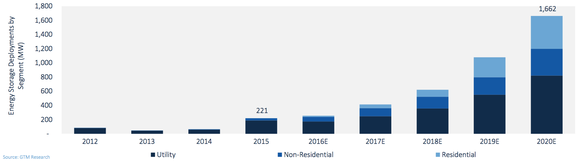
IMAGE SOURCE: GTM RESEARCH.
Today's battery systems aren't fully developed
Lockheed Martin has revealed that it is pursuing energy storage in a bold move into the electricity business. The opportunity is too big to ignore and with smaller companies, with weaker balance sheets, dominating the business today it could have a place in the future. The company's first idea is to build a lithium ion battery system that aims to lower balance of system costs.
A lot of companies have entered the market buying commodity batteries from suppliers in Asia and building the brains behind charging and utilizing the system. Lockheed Martin says it wants to work on the entire balance of system design (everything beyond the battery itself), making installation, integration, and operations more efficient. That's where, the company argues, the opportunity lies.

MOST ENERGY STORAGE SYSTEMS TODAY ARE BIG, BULKY BOXES, WHICH LOCKHEED MARTIN IS TRYING TO CHANGE. IMAGE SOURCE: SUNEDISON.
Right now, the company says it is launching a 250 KWh and 500 KWh system, which is larger than Tesla Motors' 100 kWH Powerpack. Now, Lockheed Martin just has to show that it can live up to its talk about lowering costs on the balance of systems.
The next level of energy storage
The bigger move may be in long duration energy storage, which could be the big market long-term. Long duration wouldn't be used for storage hour to hour, as a lithium battery is, but rather allow for operation all night or even storage of energy from sunny summer to winter months. And it's those applications that could prove to ultimately disrupt energy even more than the fast-charging lithium ion battery.
Lockheed Martin thinks it has technology that will make flow batteries economical enough to work in grid applications. Product manager Brad Fiebig called the product a "fundamentally new flow-battery chemistry" that uses more common materials and will have lower costs than competitors. With a flow battery energy "flows" through a cell stack from one storage tank to another, leading to almost limitless amounts of storage capacity (limited by the tanks). And if someone can make the concept economical it could be nothing short of transformative for the energy industry.
Again, time will tell if these claims become industry leading products. There's a place in the industry for both fast charging and long-duration energy storage, so if Lockheed can make a compelling product it could be a large untapped market.
Why this exciting for energy storage
I have no idea if Lockheed Martin is really serious about energy storage long-term or if this is a side project for the company. However, the fact that a company with billions in revenue in adjacent markets to energy is taking notice of energy storage is a big deal. It validates that this is an infant industry worth keeping an eye -- that's notable in and of itself. As more and more players begin taking an interest in energy storage, it becomes increasingly likely that a breakthrough is on the horizon.
A secret billion-dollar stock opportunity
The world's biggest tech company forgot to show you something, but a few Wall Street analysts and the Fool didn't miss a beat: There's a small company that's powering their brand-new gadgets and the coming revolution in technology. And we think its stock price has nearly unlimited room to run for early-in-the-know investors! To be one of them, just click here.
SOURCE The Motley Fool
DATE : 2016-04-22
Lockheed Martin has more than 100,000 employees worldwide, a market cap of $69.1 billion and was the recipient of nearly 10 percent of the funds paid out by the Pentagon in 2013.
Lockheed Martin's energy group is raising its profile in a bid to enter the energy storage market with an offering of lithium-ion battery systems, in addition to its new flow-battery chemistry. The energy storage market is tricky but growing. The big international conglomerates and equipment providers have taken notice of this shift in grid architectures -- and battle lines are being drawn. AES Energy Storage, Panasonic, LG Chem, Samsung, Saft, S&C Corporation, ABB and GE's Current are all in the mix, as well as loads of newcomers including Tesla, Stem, Alevo and Green Charge Networks.Lockheed Martin comes to the battle with more than 100,000 employees worldwide and a market cap of $69.1 billion, as well as the advantage of being the recipient of nearly 10 percent of funds paid out by the Pentagon in 2013 (here's a spreadsheet from the GSA).These firms are compelled by a dynamic, rapidly growing energy storage market across utility, commercial and industrial, and residential segments.
Figure: Annual U.S. Energy Storage Deployments (MW), 2012-2020E
The first is the integration of lithium-ion systems. Brody noted that while lithium-ion battery prices are falling, "We've seen precious little innovation and cost reduction in the balance of system."
He said that the typical approach taken by battery vendors is to house the system in a human-habitable shipping container with fire suppression and lighting. He added, "A battery for the grid should be like any industrial piece of equipment -- a purpose-built design that's built, integrated and backed by one company, just like every other power product designed for the grid."
"We designed a complete, integrated AC lithium-ion system," said Brody, adding, "Everything is in there: batteries, battery management, thermal management, and the AC interconnections – all engineered for single-side access."
The system is sized at 250 kilowatts/500 kilowatt-hours, but can be configured for smaller or larger deployments in C&I applications and small to medium-size utility projects.
"We only source from top-tier suppliers," said Brody, pointing out that some companies are in the integration business "to drag through sales of their own components. We have the freedom to select the best components."
The company pointed to the usual C&I applications: demand-charge reduction, peak shaving, solar-plus-storage and self-consumption -- but also suggested that those behind-the-meter assets can still provide services to the grid and stacked revenue streams to stakeholders.
"We think lithium-ion can address a significant portion of the applications on the grid" with known limitations in cycle life, depth of discharge and scalability, said Fiebig, "but for longer durations, we think flow batteries are the better solution."

Lockheed Martin's other energy storage effort is in commercializing a new flow-battery technology.
In 2014, the aerospace giant acquired "substantially all of the assets of Sun Catalytix Corporation" for an undisclosed amount. Approximately 25 employees were transferred to Lockheed Martin as part of the deal.
When we spoke with Sun Catalytix investor and board member Bob Metcalfe back in 2010, he told us that Sun Catalytix aimed to commercialize a new, affordable catalyst that splits water into oxygen and hydrogen. According to Metcalfe, MIT professor Daniel Nocera discovered a process that "mimicked photosynthesis with inorganic chemistry." The science underpinning Sun Catalytix was an amorphous cobalt-phosphate catalyst in solution at neutral pH at 1 atmosphere that can electrolyze water to hydrogen and oxygen. Metcalfe said the materials involved were nontoxic, "dirt-cheap," earth-abundant materials that "you could buy at Home Depot."
The Cambridge, Massachusetts-based startup later shifted its technology and business plan from the difficult-to-commercialize hydrolysis technology to the difficult-to-commercialize flow-battery energy storage technology.
And that's the same technology Lockheed Martin is looking to bring to market.
Fiebig said that incumbent flow battery vendors "depend on expensive materials," and that's "a fundamental limit for cost reduction" for those particular chemistries. Flow battery materials such as zinc-bromide or vanadium and their solutes are "caustic," and that makes siting "a big deal."
Additionally, materials which are that aggressive require expensive materials to transport and contain them. Electrodes also have to be replaced more often in harsh environments, according to Fiebig.
He said that most flow-battery materials systems are electrochemical couples or plating technology that depend on one or two elements of the periodic table, and that means "your room for innovation is limited."
Fiebig claims that the Sun Catalytix technology relies on "an engineered molecule" that is a platform for combinations of transition metal ions and ligands. Rather than the acids used in many flow batteries, Lockheed Martin uses an aqueous electrolyte with a "mild pH (like soapy water)" that allows the use of conventional materials in the balance-of-system components, such as PVC tubing, while still providing a "good energy density" that's "better than vanadium."
He called it a "fundamentally new flow-battery chemistry" that allows the use of low-cost materials, adding that competitors using traditional flow-battery chemistries "can't scrub cost from the system."
Flow batteries have made some recent progress in commercialization, but developing new energy storage technology remains a time- and capital-intensive effort. Perhaps Lockheed Martin has the wallet and patience to bring this science to market.
FIGURE: Flow Battery System Vendors

Source: GTM Squared flow industry survey