

The NVH (Noise Vibration Harshness) and efficiency requirements in e-mobility and appliances are driving the metal to plastic replacement. The development of plastic gears addresses the NVH challenge thanks to the higher compliance and lower mesh stiffness of plastic gears compared to metal gears. Also, the lightweight improves the efficiency. Other advantages like lower production cost of injection molding, design freedom, corrosion resistance or ability to operate with minimum or no external lubrication are contributing to the adoption of plastic gears.
Today, many plastic gears are based on polyacetal (POM) and PA 4,6. However, there are some limitations in their use : low operating temperature, limited load carrying capability, limited resistance to chemicals and lubricants and greater dimensional instabilities than metal, due to their larger coefficient of thermal expansion and moisture absorption.
Solvay has a broad portfolio of high performance polymers that puts us in a unique position to meet the requirements of the very stringent gear applications as well as the less demanding more cost-effective applications. The ultrapolymers (Torlon PAI and PEEK) as well as the semi-crystalline polymers (PPA, PPS) are particularly suitable for the gear applications.
Here are some examples of plastic gears applications:
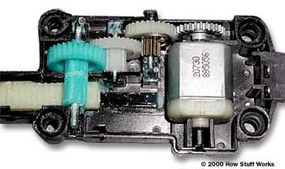
A small electric motor turns a series of spur gears that serve as a gear reduction. The last gear drives a rack-and-pinion gearset that is connected to the actuator rod. The rack converts the rotational motion of the motor into the linear motion needed to move the lock.
334px
Gear pumps
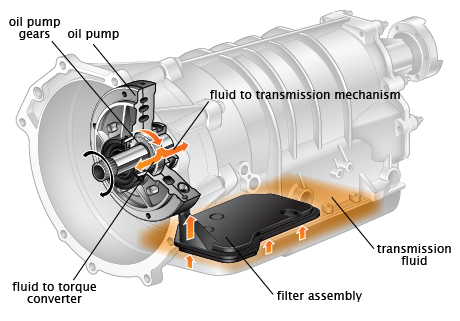
A gear pump uses the meshing of gears to pump fluid by displacement. They are one of the most common types of pumps for hydraulic fluid power applications. Here is the link to a case study aiming to replace metal transmission gear pump with Torlon material to reduce NVH.
Home appliances
The high speeds of kitchen robots require the use of reduction gears.

Gear Program
A dedicated transversal team, the SPIN team, is following the gear developments. Do not hesitate to contact the team if you have any specific questions !
Christine Hamon (ADL), Benoit Devaux (ADL, Virtual Eng.), Christopher Nelson (ADL, Virtual Eng.), Coleman Hellyer (CTD, transportation), Stefano Montani (CTD, transportation), Philippe Brasseur (CTD, HECC), Yasunobu Sato (MM, Transportation)
The new Friction and Wear laboratory in ADL EMEA is intended to support the gear program by implementing specific tests like tribological tests in roll-slip contact or single tooth bending test on gear prototypes. The collaboration with external labs and experts in the field are also important to support the developments. If you want to learn more about the current program on gears, please ask the access to this presentation.