Have you ever wanted to give your career a boost by learning new skills outside of your current role? From aSkills Based Organizationstandpoint, working on projects to develop skills means taking on short-term or temporary assignments to gain experience, learn new skills, and improve existing ones. This powerful approach allows employees to work on a variety of projects that would not be possible if they only rely on projects within the same job scope.
In this page:
Explorerscan consult information about projects they may apply for, which align with their interests, availability, and skills to improve.
Project Leaderscan publish their projects to all explorers.
ASkills-Based Organization (SBO)is a flexible and agile company that emphasizes developing and utilizing employee skills as the primary driver of success. Unlike traditional hierarchical organizations, SBOs prioritize the employees' expertise, continuous learning, and adaptability over rigid structures and siloed departments. Syensqo is in the first steps of this journey and the focus is to embed a skills-centric approach in the way weattract, develop, manage, and reward Talent.
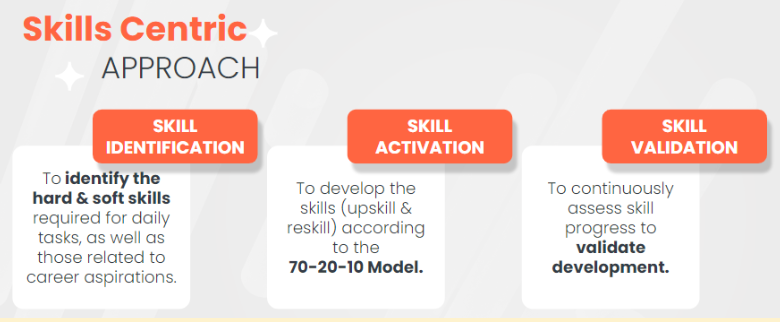
The methodology of our skills-centric approach is:
The Engineering Learning Journey have shared their insights on the Skills-Based Organization (SBO). Have a look!
What if we found ourselves building something that nobody wants?
At Syensqo, we embrace this journey by embedding the principle of experimentation. Our objective is simple: to pilot theSkills Centric Approachand empirically measure the progress. EXPLORE with us!
The process of identifying skills can vary based on the context or project. It might be a centralized effort, like through an Academy, or an individual effort by an employee or team.
The Development Phase focuses on the opportunities employees can explore to build their critical skills, supported by the 70-20-10 Model.
The primary emphasis in these experiments lies on the 70 (learning by experience) and the 20 (learning by others) aspects.
→SKILL VALIDATION (for more information, contactHelena Ferreira)
Skill validation ensures employees have the necessary skills to excel. The validation is an iterative cycle that measures the proficiency level of employees in comparison with the proficiency needed for the job.