| Content Column |
|---|
| | Content Block |
|---|
| | SP Horizontal nav group |
|---|
| | SP Horizontal nav item |
|---|
| anchor | 1258113742 |
|---|
| name | Employee |
|---|
| | SP Vertical nav group |
|---|
| | SP Vertical nav item |
|---|
| anchor | 1050131637 |
|---|
| name | I am a learner |
|---|
|
| SP Horizontal nav group |
|---|
| | SP Horizontal nav item |
|---|
| anchor | 1703914554 |
|---|
| name | Introduction |
|---|
| YOUGrow is the main learning platform at Syensqo and you need to comply with mandatory courses, you can also check which courses are available for your own development, or even how to take advantage of the tool, here you will find useful information. |
| SP Horizontal nav item |
|---|
| anchor | 434778222 |
|---|
| name | How many training hours have I already accumulated? |
|---|
| An easy step by step guide for you to follow in order to get your own report of your training hours for the current year. In some countries it is mandatory a certain amount of training hours per year. |
| SP Horizontal nav item |
|---|
| anchor | 58370419 |
|---|
| name | Drop off a class/course |
|---|
| In case you need to cancel your participation in one course or class or choose another class language Check how in this article. |
| SP Horizontal nav item |
|---|
| anchor | 41901693 |
|---|
| name | Code of Business Integrity |
|---|
| Get to know what is COBI and why it is so important to our company. |
|
|
| SP Vertical nav item |
|---|
| anchor | 2095656950 |
|---|
| name | Your learning expedition |
|---|
| | SP Horizontal nav group |
|---|
| | SP Horizontal nav item |
|---|
| anchor | 1703914554 |
|---|
| name | Introduction |
|---|
| As we come together as explorers at Syensqo, it’s an opportunity to reflect on where we are now and where we want to go in the future — including our personal development and career advancement. Continuous personal development is essential throughout your career, to stay competitive, adaptable, and fulfilled. Engaging in personal development allows explorers to acquire new skills, knowledge, and experiences that can enhance their performance in their current roles and prepare them for future opportunities. We encourage you to view learning and development as a journey filled with discovery and opportunities to navigate new challenges. | Embedded Google Drive File |
|---|
| url | https://docs.google.com/presentation/d/14i1VVyIUlva3vs4Cfltc9rdP0ZXtHTQ49YAXfo1At4c/edit#slide=id.g2cba609ae38_0_1168 |
|---|
| fullwidth | true |
|---|
| height | 600 |
|---|
|
If you are new to Syensqo's Wiki space, you may need to link your Google Drive in order to see embedded documents. Follow the instructions here. |
| SP Horizontal nav item |
|---|
| anchor | 432373974 |
|---|
| name | Our Development Philosophy |
|---|
| Our development philosophy is a set of guiding principles that shapes how we approach skill-building, performance culture, and accelerated development. Throughout the following wiki pages you'll discover an abundance of helpful development resources. For Explorers- I drive my development and career, with the strong support of my manager.
- I learn the most through my daily work and maintain a continuous learning mindset.
- I seek projects and roles to accelerate my development and build capabilities for the future.
- I encourage my team to spend time developing themselves and support time 'away' from day-to-day activities to create the habit of learning.
- I specifically support skill building during my recurring check-in discussions — occurring at least once per quarter.
- I am responsible for ensuring my team has development opportunities.
In addition, Syensqo Academies are designed to offer customized development solutions for target audiences. Our academies are aligned with business goals, leverage development plans focused on building critical skills, include diverse ways of learning and are committed to simplification. | Embedded Google Drive File |
|---|
| url | https://docs.google.com/presentation/d/1GQlNNekkhRI41xUomcyTESMsa6mEc2EzvHysrbxCoG4/edit?usp=drive_link |
|---|
| fullwidth | true |
|---|
| height | 600 |
|---|
|
|
| SP Horizontal nav item |
|---|
| anchor | 2100731109 |
|---|
| name | Our Learning Model |
|---|
| The research is clear about how we develop successfully: we benefit most from on-the-job training, then learning from others, and sometimes formal training. Your development plan is unique to you
| 70% through experience, challenges and assignments (on-the-job) | 20% through exposure to developmental relationships (mentoring and coaching) | |
|---|
- Applying what you’ve learned in a group setting.
- Putting new techniques or approaches into practice with your team.
- Stretch assignments inside or outside your current role.
- Problem-solving and innovation in challenging tasks.
| | - Functional Skills Training
- Books and articles
- Presentations
- Podcasts, TEDTalks
- Webinars
| Integration of Learning | Learning Momentum | Learning Event |
|
| SP Horizontal nav item |
|---|
| anchor | 1384999968 |
|---|
| name | How to Create a Meaningful Development Plan |
|---|
| | Embedded Google Drive File |
|---|
| url | https://drive.google.com/file/d/1aa9pbDT8MCI5-f8DKO5skDPvc1km6DiB/view?usp=drive_link |
|---|
| fullwidth | true |
|---|
| height | 600 |
|---|
|
|
| SP Horizontal nav item |
|---|
| anchor | 1379133949 |
|---|
| name | Leadership Skills |
|---|
| NEW TO THE ROLE / PEOPLE LEADERSHIP | READY TO GROW |
|---|
Learn About the Practical Aspects of My Role
| Assess My Leadership Skills | Develop & Engage My TeamI can access the Leadership Academy channel to learn how to lead difficult conversations and provide feedback, have meaningful discussions with my team, stretch high performers, and retain team members.
| Seek Support from a Mentor | Discover My Role in DEI | Develop My Leadership Skills |
Feedback? We're learning! Click here to share your thoughts about the Learner Led Development guide. |
| SP Horizontal nav item |
|---|
| anchor | 1084078427 |
|---|
| name | Technical Skills |
|---|
| Our focus is on the most sought-after technical skills in the chemical sector, backed by industry research including; technical skills relevant to individual scope, safety, health and wellbeing, business integrity, sustainability, language training and more. To bridge these skill gaps and unlock the competitive advantage we actively organize global and local targeted development campaigns.
On-the-job training is crucial for ensuring our explorers have the necessary skills and knowledge to perform their jobs safely and effectively. Consider these daily interactions with leaders, managers and peers at our industrial sites: Equipment Operation | Chemical Handling and Storage | Process Control |
|---|
Training on operating various types of machinery and equipment used in chemical processing, such as reactors, distillation columns, pumps, and valves. Employees learn how to start up, shut down, and troubleshoot equipment under the guidance of experienced operators. Chemical Handling and Storage: Instruction on the safe handling, storage, and disposal of chemicals according to regulatory standards. This includes proper labeling, containment, and spill response procedures. | Instruction on the safe handling, storage, and disposal of chemicals according to regulatory standards. This includes proper labeling, containment, and spill response procedures. | Training on monitoring and controlling chemical processes to ensure product quality and efficiency. This may involve learning how to use control systems, instrumentation, and process simulation software. | Quality Assurance | Maintenance and Repair | Regulatory Compliance | Education on quality control procedures, including sampling, testing, and analysis of raw materials and finished products. Employees learn how to identify and address quality issues to maintain product integrity. | Hands-on training in equipment maintenance and repair to minimize downtime and ensure operational reliability. This may include preventive maintenance tasks, troubleshooting common problems, and performing minor repairs. | Training on relevant laws, regulations, and industry standards governing the chemical industry. This ensures that employees understand their responsibilities regarding environmental protection, workplace safety, and product quality. | Teamwork and Communication |
|---|
| Ongoing development of interpersonal skills and teamwork abilities through collaborative projects and group activities. This helps employees effectively communicate with colleagues, supervisors, and other stakeholders in the workplace. |
These examples highlight the diverse range of on-the-job training opportunities available, all aimed at equipping explorers with the skills, mindsets, and behaviors needed to succeed in their roles while ensuring safety, quality, and regulatory compliance. It’s important for explorers to find a balance between developing their technical and behavioral skills while maintaining a continuous learning mindset. Keep in mind when building a development plan unique to you — if it doesn’t challenge you, it won’t change you. Remember - Managers specifically support skill building during the recurring check-in discussions — occurring at least once per quarter. The Manager and Explorer discuss openly how the Explorer delivers against the defined goals and where development actions could increase performance. |
|
|
| SP Vertical nav item |
|---|
| anchor | 1031385426 |
|---|
| name | Creating an Actionable Development Plan |
|---|
| | SP Horizontal nav group |
|---|
| | SP Horizontal nav item |
|---|
| Your development journey at Syensqo is an opportunity to reflect on where you are now and where you want to go in the future — including your personal development and career advancement. Development planning is not a one-time activity. You should treat your development plan as an ever-evolving document - one that you revisit and refine regularly as you gain new knowledge, experiences, and insights.
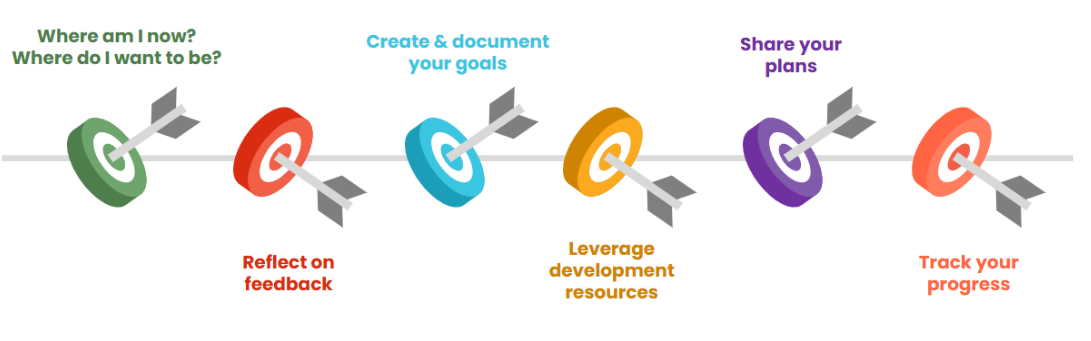
Unsure where to start? Try using SyGPT to support your development planning! 1. Start by reflecting on where you are now vs where you want to be in the future. Use the questions in this guide to reflect and open a conversation with your Manager
2. Review and reflect on the feedback from your Manager, peers, stakeholders, etc. Identify both strengths to build upon and areas for improvement.
3. Then, translate the feedback into specific, measurable goals and update your development plan in My HR Services (Goals & Development). Example: If your feedback highlights ‘presenting’ as an area for growth, set a goal to lead a team meeting or present at a group session in the next 6 weeks (vs. ‘increase communication skills’ which is too vague and not action-oriented). 4. Leverage the development resources available to you to support your plans to improve. Check out the Your Learning Expedition page for more! 5. Share your plans for development and ask others to hold you accountable for making improvements or continuing to build on your strengths. Make a habit of asking for feedback (“How did I do?”) - it gets easier to do each time! 6. Keep a log of your actions, progress, and feedback received to celebrate milestones and improvements. Example: If your feedback highlights ‘presenting’ as an area for growth, set a goal to lead a team meeting or present at a group session in the next 6 weeks (vs. ‘increase communication skills’ which is too vague and not action-oriented). Best Practice: Set a regular reminder to review and update your development plan in My HR Services.
|
|
|
| SP Vertical nav item |
|---|
| anchor | 420185907 |
|---|
| name | Coaching at Syensqo |
|---|
| | SP Horizontal nav group |
|---|
| | SP Horizontal nav item |
|---|
| anchor | 1703914554 |
|---|
| name | Introduction |
|---|
| Coaching is a development process for individuals, teams and organizations, that seeks to unlock people's potential for personal and professional growth and transformation in order to achieve a higher level of performance. Is Coaching the same as Mentoring? No. Coaching is led by an experienced coach who focuses on the future goals and actions of the coachee. Mentoring is typically provided by an expert in a specific topic. See the comparison below for further illustration. Mentoring is a relationship where a Mentor shares their knowledge, skills, and experience in some field with a Mentee in order to support their development. It is a good way of efficiently transferring valuable competencies from one person to another, and can motivate individuals and teams to learn and grow, expose them to learning opportunities, and provide support for their learning and growth. For more information on Mentoring, click here. Coaching | Mentoring | Short-term for a set duration | Long-term, no set duration | Conversation | Advises on what to do | Asks powerful questions | Shares, models, teaches | Partners | Teacher and student | Intuitive feedback | Explicit feedback | Participative | Directive |
|
| SP Horizontal nav item |
|---|
| anchor | 1225159802 |
|---|
| name | Coaching Options |
|---|
| Syensqo has assembled an Internal Coaching Community, made up of skilled Human Resources professionals trained to offer high quality coaching to employees. Syensqo has also engaged with EZRA-X as the provider to deliver Executive Coaching to employees S22 and above and with MooveOne-CoachHub as the provider to deliver Executive Coaching to employees S21 and below. |
| SP Horizontal nav item |
|---|
| anchor | 673462818 |
|---|
| name | What are peer coaching circles? |
|---|
| Peer Coaching Circles present one of the most effective and accelerated ways to learn through focused discussions with your colleagues on topics of common interest. Participants share their concrete experiences, challenges, and impressions in order to learn from and support each other. A key difference between Peer Coaching and Group Mentoring is that, unlike Group Mentoring, Peer Coaching does not require a mentor. Participants can elect a leader or rotate leadership responsibilities. Key elements of effective Peer Coaching include:- Common development target
- Openness to share your own challenges and learnings
- Willingness to actively listen to the experiences of your colleagues
- Confidentiality
- Flexibility to incorporate learnings into your specific situation
Click here to view practical guidance for starting a Peer Coaching Circle.
|
|
|
| SP Vertical nav item |
|---|
| anchor | 817173492 |
|---|
| name | Mentoring at Syensqo |
|---|
| | SP Horizontal nav group |
|---|
| | SP Horizontal nav item |
|---|
| anchor | 1703914554 |
|---|
| name | Introduction |
|---|
| The Talent Growth Platform manages formal mentoring relationships for specific talent pools including Future Top Leaders, Executive Key Account Managers, and more. Keep in mind inclusion in a formal, managed program is not required to harness the benefits of a mentoring partnership. You are encouraged to take ownership of your career, review the available guidance, best practices, digital learning, and discuss with your Manager how you can leverage a mentoring partnership. Mentoring is optional and is just one among many other ways of developing skills. Getting a Mentor is not a guarantee of superior performance. It is up to the Mentee to be in the driving seat and make the most of the opportunity. It is a relationship where a Mentor shares their knowledge, skills, and experience with a Mentee in order to support their development. It is a good way of efficiently transferring valuable competencies from one person to another, and can motivate individuals and teams to learn and grow, expose them to learning opportunities, and provide support for their learning and growth. Click to read about the two types of mentoring at Syensqo: | Expand |
|---|
| What is Group Mentoring?Group Mentoring pairs experienced leaders with individuals who wish to develop skills and grow in their careers. Syensqo may deploy a group mentoring approach in situations where there are many individuals who face similar challenges on the same topic and could benefit from peer-sharing discussions, led by a Mentor.
What are the benefits of Group Mentoring?Similar to one-on-one mentoring relationships, group mentoring can motivate Mentees to learn and grow, expose them to learning opportunities, and provide support for their career development and growth. Although group mentoring may not be as “intimate” as a one-on-one mentoring relationship, group mentoring can bring tremendous value through opportunities to network and connect with others outside of the individual’s job scope, and a dedicated space to share their career challenges and gain perspective. |
| Expand |
|---|
| What is Reverse Mentoring? Reverse mentoring encourages employees to form partnerships - regardless of seniority – in order to exchange skills, knowledge, and understanding. Traditionally, a Mentor is expected to be more senior and experienced than their Mentee, however, reverse mentoring recognizes that there are skills gaps on both sides, and that each person can address their weaknesses with the help of the other's strengths.
What are the benefits of Reverse Mentoring?Reverse mentoring can play an important role in crossing generational divides. It can also help to break down negative stereotypes about different age groups. People often think that the more experienced you are, the less you need to learn, however, newer, or more junior team members often have valuable skills, a fresh perspective, and expertise that can benefit their more established colleagues.
Reverse mentoring isn’t just about age. New joiners can provide fresh perspectives and ways of working, while long-serving team members likely possess a wealth of organizational knowledge.
Best practices for Reverse MentoringSet Clear Goals and Expectations - Discuss your expectations for the relationship with your mentoring partner. Make sure that you're both committed and that your goals are aligned. What do you want to get out of the relationship? What specific skills do you want to learn? What knowledge, skills, and experience can you provide? How often will you meet?
Work on Your Communication Skills - It can be challenging to communicate with someone with vastly different levels of experience or skills. For example, some people may feel more comfortable engaging with others by email or instant messaging, while others may prefer to speak on the telephone or meet in person. So, make sure that you're sensitive to the other person's communication preferences and needs.
Be Tactful, Patient, and Open-Minded - Both you and your reverse mentoring partner must be open to learning from one another. So, remain respectful, and listen actively without any preconceived ideas.
- Don't get frustrated if your partner doesn't understand the skills you're trying to share. Instead, communicate with tact, and give encouraging feedback that doesn’t belittle their knowledge. Use constructive feedback to help them understand your perspective.
Measure Your Progress - Check in regularly to ensure that you are both happy with the relationship and that you're getting the information you need. However, if you are not making your desired progress, schedule a brainstorming session and discuss new ways to achieve your goals.
|
|
| SP Horizontal nav item |
|---|
| anchor | 434778222 |
|---|
| name | Is Coaching the same as Mentoring? |
|---|
| No. Coaching is led by an experienced coach who focuses on the future goals and actions of the coachee. Mentoring is typically provided by an expert in a specific topic. See the comparison below for further illustration. Coaching | Mentoring | Short-term for a set duration | Long-term, no set duration | Conversation | Advises on what to do | Asks powerful questions | Shares, models, teaches | Partners | Teacher and student | Intuitive feedback | Explicit feedback | Participative | Directive |
Click here to learn about Peer Coaching Circles |
| SP Horizontal nav item |
|---|
| anchor | 58370419 |
|---|
| name | How can I identify a Mentor? |
|---|
| In the course of your regular performance check-ins with your manager, you may discover the need to improve upon one or more skills or behaviors in order to reach your development goals. Although Syensqo does not currently facilitate mentor / mentee matching on a broad scale, there are several ways that you can find a mentor to support your development. - Mentors can be senior to you in your company, executive leaders in the same or another GBU or function, customers, strategic partners, respected members in your industry, or people who are doing the job to which you aspire.
- Mentoring relationships can be formal or informal. They can also come from all parts of your life, not just your professional life.
- Be clear about what you are looking for in a Mentor and what support you need. Think about what you would like to get out of the relationship and your career goals.
- Ask your Manager to tap into their network.
- After identifying someone, the next step is to simply ask, “Would you be willing to be my mentor?” Explain why you asked this particular person and what you hope to get out of the relationship.
|
| SP Horizontal nav item |
|---|
| anchor | 702029939 |
|---|
| name | What does the typical Mentoring Journey look like? |
|---|
| - The Mentee identifies a match.
- The Mentor and Mentee meet to get acquainted with each other.
- Mentor and Mentee(s) clarify development needs and goals
- Mentee(s) defines a development plan and ask for a review by the Mentor
- Mentor encourages Mentee(s) to try new behaviors and serves as a role model.
- Mentee applies what they’ve learned and receives feedback from the Mentor
- Mentor and Mentee(s) evaluate the individual’s progress.
|
|
|
| SP Vertical nav item |
|---|
| anchor | 1121955872 |
|---|
| name | Skill Based Organization (SBO) |
|---|
| | SP Horizontal nav group |
|---|
| | SP Horizontal nav item |
|---|
| anchor | 1703914554 |
|---|
| name | Introduction |
|---|
| Have you ever wanted to give your career a boost by learning new skills outside of your current role? From a Skills Based Organization standpoint, working on projects to develop skills means taking on short-term or temporary assignments to gain experience, learn new skills, and improve existing ones. This powerful approach allows employees to work on a variety of projects that would not be possible if they only rely on projects within the same job scope. In this page: - Explorers can consult information about projects they may apply for, which align with their interests, availability, and skills to improve.
- Project Leaders can publish their projects to all explorers.
A Skills-Based Organization (SBO) is a flexible and agile company that emphasizes developing and utilizing employee skills as the primary driver of success. Unlike traditional hierarchical organizations, SBOs prioritize the employees' expertise, continuous learning, and adaptability over rigid structures and siloed departments. Syensqo is in the first steps of this journey and the focus is to embed a skills-centric approach in the way we attract, develop, manage, and reward Talent. The methodology of our skills-centric approach is:

The Engineering Learning Journey have shared their insights on the Skills-Based Organization (SBO). Have a look! | Embedded Google Drive File |
|---|
| url | https://drive.google.com/file/d/1FODZnQ5DHLDpqA92rG_DRefuGrnLW9Sp/view?usp=drive_link |
|---|
| fullwidth | true |
|---|
| height | 600 |
|---|
|
|
| SP Horizontal nav item |
|---|
| anchor | 702029939 |
|---|
| name | What if we found ourselves building something that nobody wants? |
|---|
| At Syensqo, we embrace this journey by embedding the principle of experimentation. Our objective is simple: to pilot the Skills Centric Approach and empirically measure the progress. EXPLORE with us! The process of identifying skills can vary based on the context or project. It might be a centralized effort, like through an Academy, or an individual effort by an employee or team. The Development Phase focuses on the opportunities employees can explore to build their critical skills, supported by the 70-20-10 Model. The primary emphasis in these experiments lies on the 70 (learning by experience) and the 20 (learning by others) aspects. Skill validation ensures employees have the necessary skills to excel. The validation is an iterative cycle that measures the proficiency level of employees in comparison with the proficiency needed for the job. |
|
|
| SP Vertical nav item |
|---|
| anchor | 78991613 |
|---|
| name | Syensqo's Learning and Development Tools |
|---|
| | SP Horizontal nav item |
|---|
| Subject Matter Experts who facilitate training can gain access to our internal content creation tools to create and publish digital courses on YOUGrow. Learn more about our content creation tools below; Our Global Learning Management System, YOUGrow, is the primary tool for training enrollment. Explorers and Managers can access YOUGrow from Syensqo’s HUB and browse our catalog, enroll in courses, request new classes and more. Managers have access to the Manager Dashboard to review and assign training to their teams. On the YOUGrow platform explorers will discover a collection of content from internal and external subject matter experts. At Syensqo individual experts have the opportunity to contribute knowledge and manage training. | Expand |
|---|
| title | Click here for more information on IsEazy |
|---|
| IsEazy, which is a Cloud-based authoring tool with which you can create interactive and professional e-learning courses. - Why should you use it?
- Create professional and interactive e-learning
- Dynamic trainings
- Create courses
- How do you install IsEazy?
- IsEazy is a cloud-based tool so there is no installation needed.
You can request a license through Syra in the Service request "Application Access Request (Generic)". To note that access requests and administrator subjects related to the tool, Digital Technology area should be contacted and they will provide support. |
| Expand |
|---|
| title | Click here for more information on Wevideo |
|---|
| Wevideo, which is a web-based video editing and recording application that allows you to easily create videos. This is a semi-professional tool, accessible to beginners. - Why should you use it?
- Promotion/communication on a project
- Team communication
- Tutorial
- How do I install Wevideo?
- Wevideo is a cloud-based tool so there is no installation needed.
You can request a license through the Syra application request. It is really important that you tell us how long your project will last. We have put in place a rolling system for the license to allow more people to create videos throughout the company. To note that access requests and administrator subjects related to the tool, Digital Technology area should be contacted and they will provide support. |
| Expand |
|---|
| title | Click here for more information on Vyond |
|---|
| Vyond, which is a Cloud-based authoring tool with which you can create interactive videos. - Why should you use it?
- Promotion/communication on a project
- Team communication
- Tutorial
- How do you install Vyond?
- Vyond is a cloud-based tool so there is no installation needed.
You can request a license through Syra in the Service request "Application Access Request (Generic)". To note that access requests and administrator subjects related to the tool, Digital Technology area should be contacted and they will provide support. |
| Embedded Google Drive File |
|---|
| url | https://docs.google.com/presentation/d/1zC_GIYqgaaKAd5hrPcX7PEiMdJTXjLNBl-0xb-0rs8c/edit?usp=drive_link |
|---|
| fullwidth | true |
|---|
| height | 600 |
|---|
|
If you are new to Syensqo's Wiki space, you may need to link your Google Drive in order to see embedded documents. Follow the instructions here. |
|
| SP Vertical nav item |
|---|
| anchor | 366324455 |
|---|
| name | Global Standards |
|---|
| | SP Horizontal nav item |
|---|
| anchor | 1632559982 |
|---|
| name | Global Standard Documents |
|---|
| Here you can find all the Global Standards related to Learning & Development. Please select from the following list of documents. |
|
| SP Vertical nav item |
|---|
| anchor | 388128047 |
|---|
| name | Updating my Talent Profile |
|---|
| | SP Horizontal nav group |
|---|
| | SP Horizontal nav item |
|---|
| anchor | 1703914554 |
|---|
| name | Talent Profiles: What, When and Why do we use them? |
|---|
| Syensqo's integrated people management system is used as a means to support our efforts to identify, deploy and retain Talent across our organisation. Our system is global to ensure we offer a consistent look, feel, and experience to all our employees. Your Talent Profile is like an internal cv and enables you to showcase your experiences and achievements. It will also be used in the Po2 resourcing activities to enable you to apply for positions and let potential hiring managers know what you can offer to a position. Frequently Asked Questions| Expand |
|---|
| title | Click to read more + |
|---|
| What is a Talent Profile? Your Talent Profile is a key element of your Career Development at Syensqo. It is a place where you can highlight your experience, accomplishments, skills, and ambitions. Responsibility for updating the Talent Profile rests entirely with the individual and should be revisited on a regular basis to ensure it accurately reflects your current situation.
What is the benefit of updating my Talent Profile?
Updating your profile is the quickest way to increase your visibility for new opportunities at Syensqo. When your profile is up to date, Hiring Managers and HR can more easily find you when searching for relevant experience and skills. You can also make quick applications to positions that you are interested in.
Is my Talent Profile public? Who can view my Talent Profile?
Sections of your Talent profile are Public. These sections are; About me, Education, Achievements, Work experiences and Languages. This means employees of Syensqo can see this information.
Do I have to use my Talent profile or can I just use my CV? Using the Talent profile enables us to more quickly identify the positions that might be a good match for you. We are able to search on keywords, skills and experiences which is not possible with cvs. Once you've updated your Talent profile you can make quick applications to the positions you are interested in.
What sections of the Talent profile are important? All sections of the profile are important as they are designed to ensure we capture the fullest insights on you, what you can offer a position and what a position could offer you. We sometimes find sections of the profile incomplete or with only one or two words which is unlikely the impression you would want to leave with a potential hiring manager.
How long will it take me to complete my Talent profile? Completing your profile does not have to take long but thinking about what you want to write and how best to articulate it is always good preparation.
Should I start updating my profile now?
Yes it’s always good to update your Talent profile when you are not in a hurry and can spend time reflecting on what you want to write. If your position may be suppressed as a result of Po2 we strongly recommend you start updating your profile so you can be best positioned to apply for opportunities in the resourcing rounds. |
|
| SP Horizontal nav item |
|---|
| anchor | 702029939 |
|---|
| name | Best practices for completing your profile |
|---|
| - Block time in your diary to complete your profile. We often find people prefer to do this at the beginning of the day before they look at emails or at the end of the day when they have finished their meetings for the day.
- You can copy and paste sections from your cv into the talent profile to help speed up your completion- ie many of us have a short summary and introduction to your cv. This can be used in the About me section of the profile.
- When completing the About Me and Career Ambitions sections of the profile take time to consider what you would want a potential hiring manager to know about you and your ambitions
- The Development section is an opportunity to show you are investing in your continuous learning and actively working towards your development needs. Following your next check-in, update this section with the actions and progress that you discuss with your manager.
- We also suggest that you type the headings on a Google doc and prepare your text so you can copy and paste it into the system when you are ready.
- Ask your Line Manager to read your profile and help make suggestions for improvement and refinement.
|
|
|
|
|
| SP Horizontal nav item |
|---|
| | SP Vertical nav group |
|---|
| | SP Vertical nav item |
|---|
| anchor | 778433746 |
|---|
| name | My Role in Employee Development |
|---|
| | SP Horizontal nav group |
|---|
| | SP Horizontal nav item |
|---|
| anchor | 1741110524 |
|---|
| name | Why this moment matters |
|---|
| The development of your team is one of the most important aspects of your role as a Leader. Although the employee is in the driver’s seat for their own development, you enable them to identify and seize the right opportunities for their development. Development of your team means better performance that leads to growth for both Syensqo and your team. |
| SP Horizontal nav item |
|---|
| anchor | 151363638 |
|---|
| name | What to do as a leader |
|---|
| - Take the time to develop a deep understanding of each member of your team including the areas in which they need to develop capabilities and skills;
- Understand their career aspirations looking 1, 3, and 5 years out. If they aren’t sure or clear on their career goals, engage in a coaching conversation. Not sure what questions to ask to stimulate this discussion? Consult this development discussion guide.
- Engage in regular conversations that are not just focused on their objectives, but also their development;
- Provide clear and actionable feedback on what they are doing well and what they need to do better;
- Identify challenging projects and work to accelerate their development;
- Leverage your network to make connections and find opportunities to expose them to other GBUs and Functions that match their career goals;
- Employee development is a critical part of every leader’s role. Guidance on coaching and providing professional development for your team members is available in the Leader’s Guide to Coaching & Professional Development.
|
| SP Horizontal nav item |
|---|
| anchor | 352582225 |
|---|
| name | Useful Links |
|---|
| |
|
|
| SP Vertical nav item |
|---|
| anchor | 890472152 |
|---|
| name | Coaching |
|---|
| | SP Horizontal nav group |
|---|
| | SP Horizontal nav item |
|---|
| anchor | 1703914554 |
|---|
| name | Introduction |
|---|
| Coaching is a development process for individuals, teams and organizations, that seeks to unlock people's potential for personal and professional growth and transformation in order to achieve a higher level of performance. Is Coaching the same as Mentoring? No. Coaching is led by an experienced coach who focuses on the future goals and actions of the coachee. Mentoring is typically provided by an expert in a specific topic. See the comparison below for further illustration. Mentoring is a relationship where a Mentor shares their knowledge, skills, and experience in some field with a Mentee in order to support their development. It is a good way of efficiently transferring valuable competencies from one person to another, and can motivate individuals and teams to learn and grow, expose them to learning opportunities, and provide support for their learning and growth. For more information on Mentoring, click here. Coaching | Mentoring | Short-term for a set duration | Long-term, no set duration | Conversation | Advises on what to do | Asks powerful questions | Shares, models, teaches | Partners | Teacher and student | Intuitive feedback | Explicit feedback | Participative | Directive |
|
| SP Horizontal nav item |
|---|
| anchor | 273953990 |
|---|
| name | How to know if Coaching is right for the employee? |
|---|
| To help you decide whether to invest in coaching, consider the following questions: - What other options besides coaching have been, or should be considered for their development? How will the coaching process change the current situation?
- Have I been giving regular feedback to this team member?
- Coaching encourages coachees to explore their mindsets and behaviours, but it is not a ‘quick fix’ for any potentially damaging mindsets or behaviours. Is the individual open to exploring new behaviours and ways of thinking about workplace challenges?
- Is there time to invest in coaching? Coaching is a long-term time investment including time spent with a coach and additional time to reflect on coaching sessions.
- Coaching promotes greater self-awareness. A goal is to shift any more negative underlying behaviours and improve accountability. Is the individual ready to be accountable for goals set? A coach will support them to find the answers, but the coachee is responsible for taking what they have learned and applying it within the workplace environment.
- Does the individual know what they want to get out of coaching? Organizations should know what they want to get out of coaching in terms of measurable business results, while coachees must align with their managers on what they need to get from coaching in terms of business impact and personal development.
If you can answer ‘yes’ to each question, coaching may be the right step for the individual. |
| SP Horizontal nav item |
|---|
| anchor | 2048973687 |
|---|
| name | What is the process to request a coach for one of my employees? |
|---|
| - The Manager initiates the process by contacting Syensqo's Coaching Coordinator.
- The Coaching Coordinator and the Manager meet for a briefing session to discuss the individual’s needs.
- The Manager completes an intake form to start the coaching process;
- In Executive Coaching, the coachee interviews potential coaches to select the right coach (“chemistry interviews”);
- The employee may complete a 360 assessment at this stage.
- The coaching process begins.
- In Executive Coaching, three separate meetings are held between the Coach, Coachee, and Leader over the course of the coaching process to : 1) Set objectives, 2) Validate the action plan, and 3) Conduct a final evaluation.
The total time commitment for a coaching relationship is a minimum of 12 hours to a maximum of 20 hours over a period of 6 months. |
| SP Horizontal nav item |
|---|
| anchor | 1225159802 |
|---|
| name | Coaching Options |
|---|
| Ezra is our global provider for external coaching. We support individual external coaching requests and also offer personalized external coaching as part of our comprehensive leadership development programs. External coaching is a significant investment and is offered as a strategic initiative to address specific business needs. Criteria for participation are always communicated in advance with Strategic HR Business Partners. |
|
|
| SP Vertical nav item |
|---|
| anchor | 2109306788 |
|---|
| name | Managing my Team in YouGrow |
|---|
|
|
| SP Vertical nav item |
|---|
| anchor | 811825939 |
|---|
| name | How to create content in YouGrow |
|---|
| | SP Horizontal nav group |
|---|
| | SP Horizontal nav item |
|---|
| When you need to create courses or any other kind of learning event in YouGrow, and you don’t have access as Admin to it, the first thing is to open a ticket to the People Services team and choose the option that better suits your request and it will leads you to fill in a Google Form regarding the type of action that you need to perform. |
| SP Horizontal nav item |
|---|
| name | Course, Classes, Certifications, Curricula |
|---|
| Certification: A certification is a credential that a person earns by demonstrating mastery in the credential's subject area. A credential is similar to a competency, but is more formal. The Certification requires several paths and have to re-certify every a certain time. For example, eSecurity certification for Syensqo users (re-certify every year)
Curriculum: A curriculum is a set of courses in a hierarchical structure of components. It differentiates from a Certification as it will have no expiration date, and therefore, once acquired, will not have to be renewed in the future. As per this, a Curriculum is to be used if there is the need to aggregate different courses in a Program but there is no need to renew any training in the future.
Course: A course is the highest level in the learning class hierarchy. It represents a learning subject that can be delivered in a variety of forms.
Class: A learning class is an instance of a course delivered in one of a variety of formats known as delivery types. Each class is an instance of a delivery type, where each class inherits the properties of its parent delivery type. - Instructor-led (scheduled) - A face-to-face training is a course Instructor-led (scheduled) where trainers and participants will meet "physically". Example: a fire extinguisher training with exercises
- Virtual classrooms (scheduled) - Virtual classes are delivered to learners through a Web browser (Google meeting, saba classroom or other browser).
- Web-based training (self-paced) - A web-based training / elearning is a course with only digital content. Example: a course with a power point, video, link.
- On-the-job training (self-paced) - An on job training is a training that takes place in field. This training can't be launched, it records only the training hours.
|
| SP Horizontal nav item |
|---|
| Use the Vendor Creation form to request the creation of a learning vendor.
A learning vendor is an external provider that :
- is a trainer: delivers the training
- is a digital content creator: an external company responsible for the creation of the digital content
The vendor is mandatory information for creating a learning event. In case your course will be provided by a Syensqo employee, then this information needs to be provided on the course creation form as "Internal Provider" |
| SP Horizontal nav item |
|---|
| name | Course & Class Creation |
|---|
| Use the Course & Class creation form when you need to create any type of course, whether it is face to face, web based or virtual classroom. Also, if you need to create a class within an existing course. - Face to face - for courses where trainers and participants will meet on site.
- Web-based/e-learning - for courses where you want to create a course with only digital content.
- Virtual Classroom - for when you need to create a course for people to be able to register themselves or be registered for Google meetings, or another meeting platforms.
|
| SP Horizontal nav item |
|---|
| name | Certification Creation |
|---|
| A certification is a credential that a person earns by demonstrating mastery in the credential's subject area. A credential is similar to acquiring a skill but in a formal. The Certification requires several paths and has to be re-certified from time to time.
For example, the eSecurity certification for Syensqo users (re-certify every year)
To submit the Certification Creation form, the course must be already created in YouGrow. |
| SP Horizontal nav item |
|---|
| name | Participant Management |
|---|
| Use the Participation Management form for: - Assign courses, Certifications, Curricula.
- Regist person in classes
- Create rules to assign courses automatically (or another learning event) regarding some criteria (for example: assign a course automatically for all newcomers from the Carnaxide Site)
- Upload a list of specific people you want to assign a course or another learning event.
You can always request help from any member of the People Services Team for any additional support, opening a request. |
|
|
| SP Vertical nav item |
|---|
| anchor | 1683576124 |
|---|
| name | Leadership Expedition |
|---|
| | SP Horizontal nav group |
|---|
| | SP Horizontal nav item |
|---|
| name | The Why behind the Leadership Expedition |
|---|
| Leadership at Syensqo is more than a role — it’s a Journey. Much like an Expedition into uncharted territory, being a leader requires preparation, adaptability, and continuous growth. It means equipping yourself with the tools, skills, and mindset to navigate challenges, inspire others, and achieve extraordinary results.
The Leadership Expedition is our commitment to supporting you on this journey. It’s designed to help you activate Syensqo’s behaviors, implement our business strategy, and lead your teams with confidence and impact.
We recognize that leadership is not a one-size-fits-all path. That’s why this expedition is flexible and evolving. As the needs of our leaders and our organization grow, so too will the Leadership Expedition. |
| SP Horizontal nav item |
|---|
| name | What does Leadership Expedition have to offer you? |
|---|
| Please click on the following buttons to learn more: | | | | The Manager Essentials Program equips managers with essential skills and tools to achieve results through teamwork. Tailored for first-time managers or those looking to enhance their management abilities, it offers practical guidance for effective and confident leadership. | Leadership Boosts offer flexible opportunities to enhance your skills and mindset throughout your leadership journey. Consider them as inspirational basecamps to refuel and prepare for upcoming challenges.
Choose from:
Live Sessions: Live, interactive
experiences with peers.
On-Demand Modules: Self-paced
learning.
Quick Inspiration: Bite-sized articles
and videos.
| The Impact Platform is your personalized learning platform designed to provide ongoing access to resources, tools, and insights for leadership growth. This is your compass for continuous development—guiding you to the right learning at the right time. |
|
| SP Horizontal nav item |
|---|
| name | How to access the Leadership Expedition? |
|---|
| Every great expedition starts with curiosity and exploration. If you're curious, start exploring the Leadership Expedition content today by clicking on the image below which will
direct you to YouGrow. Enjoy your expedition! 
|
| SP Horizontal nav item |
|---|
| name | Who has access to the Leadership Expedition? |
|---|
| - ALL managers, that have at least one direct report, looking to enhance their leadership skills.
- There is No additional cost for the business.
For any questions concerning the Program please raise a ticket in SyRa. |
|
|
|
|
| SP Horizontal nav item |
|---|
| | SP Vertical nav group |
|---|
| | SP Vertical nav item |
|---|
| anchor | 1513062564 |
|---|
| name | Supporting and Developing Top Talent |
|---|
| | SP Horizontal nav group |
|---|
| | SP Horizontal nav item |
|---|
| At Syensqo, Managers are expected to support their team members’ development, whatever their potential. HR supports Managers by challenging and advising them on talent-related topics. Additionally, HR has a responsibility to educate employees on Syensqo’s approach to development and support top talent in their scope. |
| SP Horizontal nav item |
|---|
| Strategic HR Business Partners (SBPs) and Site HR Partners have important and distinct roles to play in top talent identification and development. Where SBPs typically have greater visibility and are closer to those in the Future Top Leader / Future Functional Leader talent pools, Site HR Partners typically know and are closer to Emerging Leader talent. Therefore, the activities described below may be adjusted and carried out by SBPs or Site HR Partners in their respective scope. Check the Top Talent RACI to better understand your role. - Review and understand Syensqo’s approach to development, in order to help employees understand where they fit in.
- Review and understand the Top Talent criteria (Emerging Leader, Future Top Leader, Future Functional Leader) below to support and challenge Managers on an employee’s eligibility for these programs.
- Act as a conduit between employees and the Site, GBU, or Function leadership. Employees often feel more comfortable sharing their professional development and challenges with HR.
- Share your observations with leaders to support talent discussions where others may lack visibility.
- Ask questions, challenge, advise, and help leadership test their thinking when it comes to talent.
- For example: Why do you want to nominate this person? How did you make the decision? Have you and the individual discussed their aspirations? How have they demonstrated their commitment to development? What practical steps have they already taken toward their development?
- Share development planning resources with Managers and employees.
|
| SP Horizontal nav item |
|---|
| name | Syensqo's Approach to Development |
|---|
| No two employees are the same - depending on an individual's performance and aspirations, they may benefit from one of the following approaches. 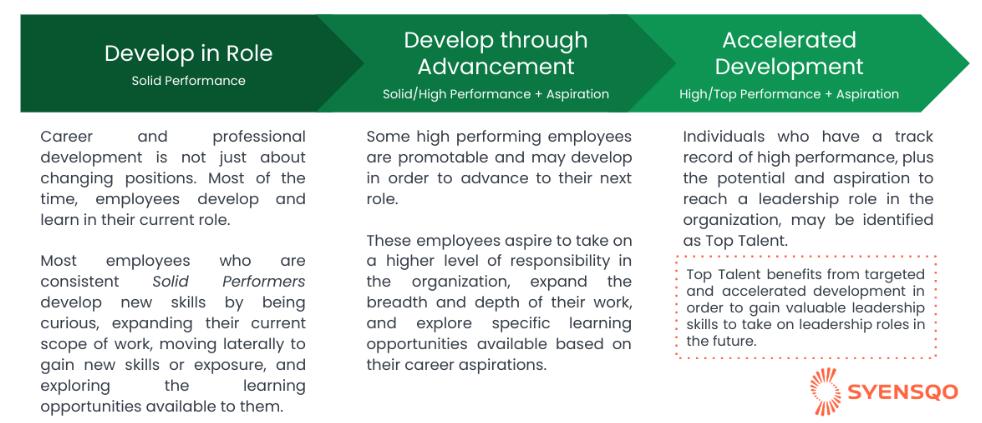
Regardless of the approach, all employees drive their own development and should have access to opportunities as well as a meaningful development plan in order to continue to learn and grow. |
| SP Horizontal nav item |
|---|
| Managers play a direct role in identifying top talent and accelerating the development of Syensqo's next generation of Leaders. As HR, you can support managers to identify individuals who meet the following criteria in order to be considered top talent and ensure the quality of the top talent pools.. Performance | Performance is the passport to opportunity. It is an indication of leadership potential. An individual should have a track record of sustained high performance prior to their nomination for a talent pool. Potential | Potential translates to the individual’s ability to perform across fundamentally different challenges (rather than in one role alone). This ability provides insight into an individual’s agility, resilience, and drive. Aspiration | Aspiration is a persistent drive to gain experience and develop professionally, (versus ambition displayed as a desire to achieve a specific grade or title). Commitment | Commitment reflects an individual’s ownership of their development and career journey and a willingness to take on new opportunities outside of their comfort zone. |
| SP Horizontal nav item |
|---|
| name | Future Top & Future Functional Leaders |
|---|
| A Future Top Leader (FTL) or Future Functional Leader (FFL) is a high-performing individual, typically grades S20 -S22 , who has the potential and aspiration to take on an Executive or Senior level leadership role in the future and who is committed to their development. The Future Top Leaders and Future Functional Leaders assessment and confirmation processes require a significant time and resource investment. As such, the employee’s Manager should first review the Future Top Leader / Future Functional Leader Journey guidelines and criteria and engage with their Strategic HR Business Partner to understand more about the process and program. |
| SP Horizontal nav item |
|---|
| An Emerging Leader is a high-performing individual between grades S15-S20 with a minimum of 2 years of career experience who has the potential and aspiration to take on a Regional or Global leadership role in the future, and who is committed to their development. Participation in the Emerging Leader experience is at the nomination of Managers, supported by their Site HR, with final validation at the discretion of Leadership and HR Strategic Business Partners. Read more about the Emerging Leader Journey guidelines and criteria. |
| SP Horizontal nav item |
|---|
| When an individual is confirmed for a Talent Pool, they can expect to receive differentiated access to programs that support their accelerated leadership evolution, skill-building practices, networking, and opportunities to connect with Senior Leadership. In return, Syensqo expects that individuals will commit to their development, maintain a growth mindset, actively participate in skill-building practices that enhance their experience and skill set, and take ownership of their career journey. Line Managers play a vital role in the development of talent and can benefit from support with resources and learning opportunities related to Coaching and Development from their HR teams. |
| SP Horizontal nav item |
|---|
| The following describes at a high level how an individual may exit the FTL and FFL Talent Pools. - An individual will “graduate” from the pool once they reach the level of a GBU or Function Leadership team.
- Upon reaching a GBU or Function Leadership Team, the Talent Growth Platform team, the employee, and their Manager will discuss at what point the individual will exit the pool. Typically the employee has a period of 12 months, following their appointment, to decide on timing. Following graduation, the employee becomes a talent pool “alumni.”
- Once an employee becomes a talent pool “alumni” they may be asked in the future to mentor a FTL/FFL or Emerging Leader, to present a topic at a future FTL/FFL/EL community event and/or engage other FTL/FFL’s or Emerging Leaders in any strategic projects they may encounter
- An FTL/FFL may exit the pool on their own, in mutual agreement with their manager, if their aspirations to become a Future Leader in the organization change, their performance declines, or if they no longer have the time to invest in the program.
- In this case, the individual and their Manager should engage with the Talent team to discuss leaving the pool.
|
|
|
|
|
|
|
|
|