

Table of contents
1. Objective and Scope
1.1 Objective of this Procedure
1.2 Scope
2 Reference Documents
3 Definitions
4 Main Part
4.1 General Roles and Responsibilities
4.2 Communication flow
4.3 Process Description
4.3.1 Record Assets Commissioning (final asset creation)
4.3.2 Record Other Asset Movements: Asset Disposal
4.3.3 Record Other Asset Movements: Asset Retirement
4.3.4 Record Other Asset Movements: Asset Transfer - Cost center
4.3.5 Record Other Asset Movements: Intercompany Asset Transfer
Objective and Scope
Objective of this Procedure
The purpose of this document is to describe the role of SBS in the process of Investment & Divestment transactions accounting management, notably related to the appropriate record of final fixed asset, asset disposal, retirement or transfer
Scope
This organizational procedure (P) applies to all companies within the Global Business Services scope of entities. It is important to highlight that this procedure concerns all types of projects: Industrial, Research & Development, and IT etc.
Reference Documents
Group IFRS Principle and Rules
Financial Reporting Guide
CAPEX
Management of investments and capex excellence progress
Definitions
ERP | Enterprise Resource Planning (SAP) |
GBS | Global Business Services |
SU MAC | Service Unit - Management accounting |
CAM | Companies Accounting Manager |
BFC | Business Financial Consolidation. Group's consolidation tool |
AUC | Asset Under Construction |
Main Part
General Roles and Responsibilities
SBS Actors:
- SU MAC I&D Expert: is responsible to ensure process efficiency and performance enhancement coordination / follow-up when needed.
- SU MAC Regional I&D contacts: SU MAC I&D Contacts are accountable of the appropriate registration in IFRS and local GAAP. The local GAAP to be applied are under the responsibility of the CAM. They are responsible to identify, maintain, update and communicate the list of individual eligible to send a request to SU MAC.
- Companies Accounting Managers: CAM can be consulted determining relevant accounting treatment for asset useful life or depreciation for example. They must ensure a legal and regulatory watch in order to up-to-date on fiscal and accounting treatment related to assets accounting on their respective country. They shall liaise with regional I&D contacts to ensure effective application of any change needed.
- SU MAC Projects & Analytics Team: Project & Analytics team is responsible to record in the appropriate way all the Assets accounting flows (IFRS, local GAAP) under the supervision of the Regional I&D Contact.
Non SBS Actors:
- Project Manager (Industrial Function / IT / GBU/ Regulatory Affairs/ Research & development): The role of these actors is to provide SBS actors and / or the technical controller with the necessary input (capitalization request) in order to carry out their responsibilities.
- Technical Controller: In Syensqo Legacy the technical controller is responsible of the asset register update / WBS. SU MAC is exclusively responsible of all posting transactions (WBS settlement on AUC / depreciation posting / periodic posting)
Communication flow
The communication flow should respect the following criteria:
- Any request must be sent to SU MAC via a ticketing tool in order to be registered
- The requester should be recognized as eligible
- SU MAC is in charge of following the traceability, performing the request and sending a feedback to the requester.
Process Description
The "I&D SAP Transaction Management" organizational procedure describes the roles and responsibilities of the different parties involved in registering the multiple operations in the systems:
- Asset Commissioning
- Asset Disposal
- Asset Retirement
- Asset Transfers (cost center – intercompany)
Record Assets Commissioning (final asset creation)
Key Principles
Commissioning/depreciation rules
IAS 16 PAR 55 Depreciation of an asset begins when it is available for use, ie when it is in the location and condition necessary for it to be capable of operating in the manner intended by management.
This rule define the commissioning date and is under responsibility of the project manager
The record asset commissioning process is described as follow: 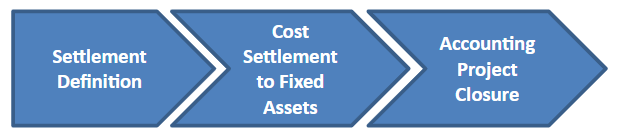
- Settlement Definition :
In order to carry out the settlement, the settlement rules need to be defined in PS.
- For Rhodia legacy, distribution rules and settlement parameters to final fixed asset are defined by the project manager at each cost of WBS elements. They must be entered in the system (at each cost line) in order to allow the allocation to the correct final asset.
- For Syensqo Legacy, a settlement rule is defined at each WBS level. For the 5 European countries (AAA – Germany – France – Italy – Spain - Belgium), settlement rules are predefined based on the WBS Material Code level II
- When different components of an asset have different useful life or it provide benefit economic following different pace, it's mandatory to allocate the asset between these different constitutes elements (components) and to book each element separately.
Asset components can be:
- Physicals (assets parts) ; or
- Major inspections or overhauls (repair or renovation planned in advance and carried out at upper rates in the year).
These costs are often called works of stop or planned maintenance. However, for this costs type, capitalization minimum threshold is 500 K€ (below this threshold, costs treated as maintenance expenses).
It should be noted that the class repartition between lands – constructions - equipment should be applied for all cases and all amounts.
2. Cost Settlement to Fixed Asset :
The effective cost settlement to fixed asset is performed via transaction CJ8G/CJ88 run by Project & Analytics team. Costs on WBS elements are settled on final fixed assets that have been previously defined. When investment costs are capitalized at the end of a project, the amount recorded on AUC is settled to Final Assets. This operation is done through an automatic cycle at the creation of the fixed assets.
3. Accounting project closure :
When a project has been put in service and all the related assets have been created, the project must be "closed". This operation prevents any new cost allocation of the project. This step can be performed later, within 6 months after the asset commissioning in order to avoid any re-opening for outstanding costs.
Before the accounting closure of the project, SU MAC has to check that:
- 100% of costs on AUC must be capitalized (settled to fixed asset). AUC balance must be equal to 0
- No outstanding reception (all invoice / reception discrepancies must be cleared. Transaction MR11)
- No outstanding orders. The last reception must be flagged as "last reception" in the system.
- Verify, by using BW tool, that the change status is performed. This will permit to detect the WBS that has to be closed.
4. Expenses/postings after Final Commissioning :
All complementary postings (positive or negative) in AUC related to an asset already in service must be balanced within 6 months of the commissioning date. By simplification, all amount < 50 Keur and < 10 % of the cost of the project must by posted in profit and loss account R38100 in the GBU activity related. Otherwise appropriate new commissioning or divestment has to be performed by the back office with the support of industrial function if needed.
Roles and Responsibilities
Syensqo Legacy
Roles and responsibilities | Project Managers | Technical Controller | SBS | Tools |
| X | Xls/Doc/mail | ||
| X | Xls/Doc/mail | ||
| X | Xls/Doc/mail / SAP | ||
| X | SAP-AA | ||
| X | Excel Format | ||
| X | SAP-PS | ||
| X | SAP | ||
| X | SAP-AA | ||
| X | SAP-AA |
Rhodia Legacy
Roles and responsibilities | Project Managers | SBS | Tools |
| X | Excel Format | |
| X | Excel Format | |
| X | Excel Format / SAP | |
| X | SAP-AA | |
| X | Excel Format | |
| X | SAP-PS | |
| X | SAP | |
| X | SAP-AA | |
| X | SAP-AA |
Flowchart
Syensqo Legacy 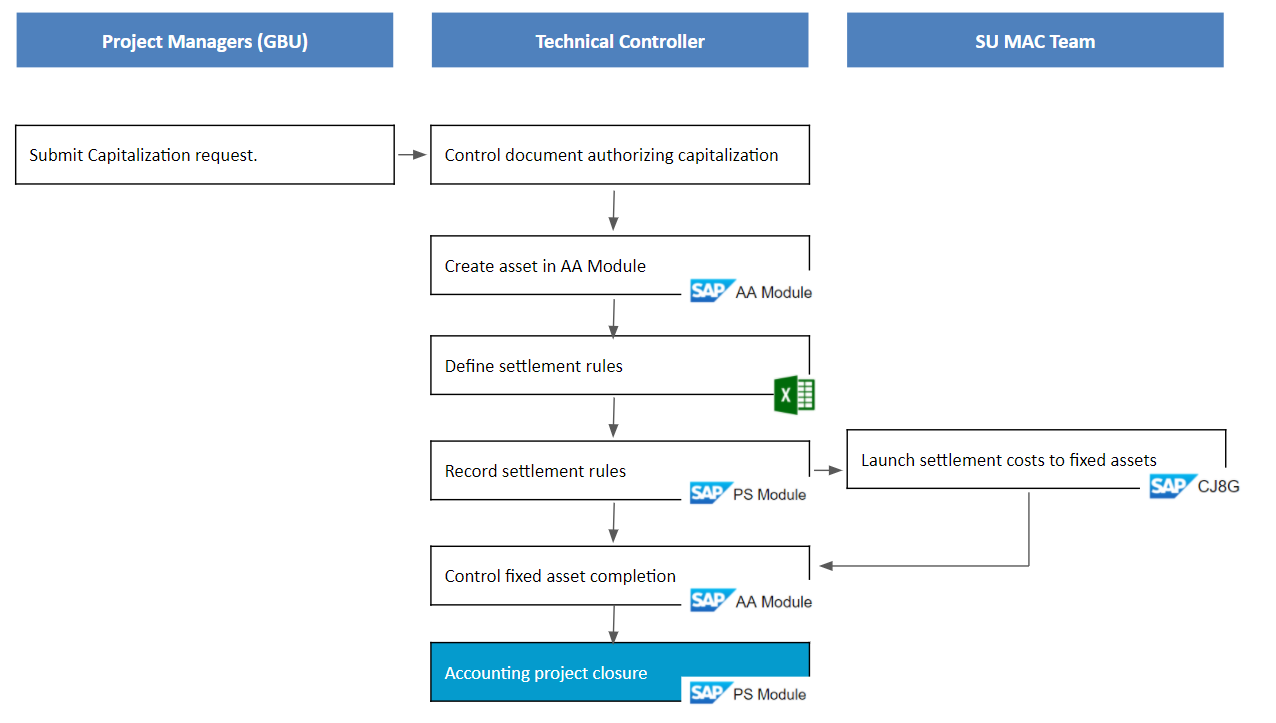
Rhodia Legacy 
Record Other Asset Movements: Asset Disposal
Key Principles
- All invoicing for the disposal of a fixed asset must be accompanied by the retirement of the corresponding asset during the same period.
- All disposals of fixed assets are contingent upon the exact identification of the materials to be disposed of in the fixed asset register.
Roles and Responsibilities
- The project managers, industrial facilities operators, intangible assets manager are in charge of:
- Identifying the fixed asset to be recorded as retired within the fixed asset register
- Issuing the fixed asset disposal form and submitting it to the Site management Controller / technical controller along with any sales certification documents
- The site controllers/GBU controller are in charge of:
- Creating the invoice order based on the documents submitted by the manager in charge of the operation.
- Submitting the disposal form, invoice order and certification documents to SBS.
- SU MAC is in charge of:
- Formally overseeing the fixed asset disposal form, invoice order form, and certification documents to ensure that they are all completed.
- Recording in the appropriate accounting way the retirement of fixed assets and issuing the invoice to the client.
- Checking the consistency and accuracy of the disposal records in the ERP and the BFC (consolidation tool)
Flowchart

Record Other Asset Movements: Asset Retirement
Key Principles
Facts generating assets retirement:
- Substitute investment: rehabilitation / replacement
- Demolition
- Physical Inventory
- Final shutdown
- Retiring a fixed asset on the register should be performed according to IFRS, as long as no future economic benefit is definitively expected from its use or as long as the asset is permanently discontinued.
- However, as long as the fixed assets remain physically present on the Group sites, they will be maintained on the fixed asset register and fully depreciated according to the asset value tests. (for detailed information, please refer to the reporting guide)
Therefore:
- Any retirement a fixed asset from the fixed asset register must be accompanied by the physical retirement of the corresponding assets.
- Any elimination of an asset requires it having been previously identified in the fixed asset register. However, should the exact identification not be possible, the retirement may proceed based on a reasonable assessment made by the industrial manager overseeing the operation, who must have adequate experience and knowledge of such assets.
- It is possible to perform a partial divestment
- In the event of a replacement investment for an existing facility or equipment, the in-service form request must be accompanied by the corresponding divestment form for the old facility or replaced equipment.
- In the event of multi-year stops, divestment must be accompanied with the amount resulting from the deactivation or a share of the asset in question if the initial classification had not identified the need for the capitalized multi-year deactivation. The amount to be divested should be close to the amount invested. This task is under the responsibility of the Project Managers. SU MAC have to verify the existence of this information and should send an alert if the information is missed.
Control to be performed - FXA.01.02: Divestment for each maintenance shutdown
- When the fixed asset is a spare part: the disinvestment operation will move forward as long as the part's service life has definitively ended – that's to say once the part has been scrapped.
- The movement of parts between the equipment to which they are dedicated and the store where they are stocked does not constitute a retirement of a fixed asset.
Repair or restoration costs are treated as non-capitalized costs, as long as the work does not significantly increase the initial service life of the item in question.
Roles and Responsibilities
- The project managers, industrial facilities operators, intangible assets manager are in charge of:
- Identifying the fixed asset to be recorded as retired within the fixed asset register. (It is possible to put a fixed asset partially out of service).
- Issuing the divestment request and submitting it to SU MAC
- SU MAC is in charge of:
- Overseeing the divestment request process (whether documents are completed, signed, and dated)
- Recording in the appropriate accounting way the retirement of fixed assets
- Checking the consistency and accuracy of the retirement l records in the ERP and the BFC (consolidation tool)
Flowchart

Record Other Asset Movements: Asset Transfer - Cost center
Key Principles
The asset transfer is performed in the case of:
- A reorganization of a BU
- A reclassification of a cost center
Roles and Responsibilities
- The BU / Site controller is in charge of:
- Sending the asset transfer request to SU MAC
- SU MAC is in charge of:
- Modifying the relevant cost center
- For Solvay Legacy, creating a new fixed asset in case of a change in the business area
Record Other Asset Movements: Intercompany Asset Transfer
Key Principles
- The intercompany asset transfer is done through a sale
- The depreciation of the added value related to the asset transfer should be isolated
Roles and Responsibilities
- The seller (GBU function) (or delegate) is in charge of:
- Formalizing and communicating the agreement to SU MAC team
- Identifying the appropriate fixed asset in question in the asset register
- Sending the information, including selling price to SBS (invoice order)
- The buyer (GBU function) is in charge of:
- Sending the creation order of the WBS-element and asset master data record.
- SBS is in charge of:
- Creating the invoice and sending it to the buyer (intercompany process)
- Creating a WBS-element and asset master data record
- Posting the asset sale
- Checking the balancing of the reconciliation account (intercompany process)
- Recording the operation in AA module
- Checking the appropriate accuracy of the posting
End of document