

Sales and Operations Planning (S&OP)
Why is SO&P important to the Group?
Sales and Operations Planning (S&OP) is a way of working to deliver the business and Solvay Group strategy. Without a formal structured S&OP driven by cross functional stakeholders, it is difficult to allocate, align and optimize company resources, focus on balanced actions to grow the top line while managing operating costs as well as improvements in cash, cost and customer experience.
This page helps to provide instructions on how to improve the maturity of a GBU's S&OP process. SO&P is a decision making process, to balance demand and supply, to align volume and mix, and to integrate sales, finance, operations and product lifecycle management.
1. Principles and definitions
Sales and Operations Planning (S&OP) is a well understood practice within the supply chain. S&OP represents a 3- to 18-month strategic horizon, in which organizations model out plans for entire product families based on demand forecasts. It is a way of working - aligning cross functional teams to deliver the business and Solvay Strategic End-to-End (E2E) objectives of cash, cost and customer experience.
Scope of S&OP:

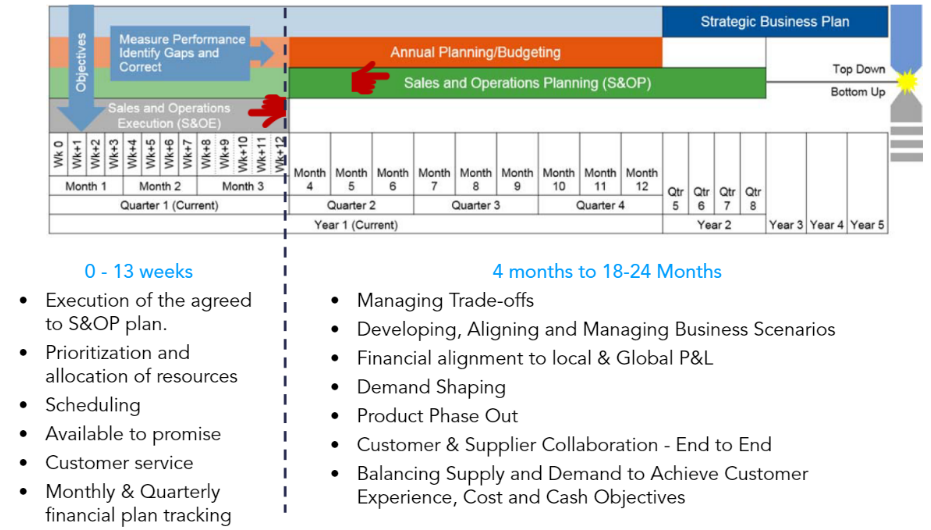
An important notion is identifying properly the interface between SO&P and Sales & Operations Execution (S&OE), which is about the short term execution of the planning (less than 12 weeks). This will be expanded upon further in this page.
S&OP is a month-long repeatable process, consisting of 4 integrated meetings to create a link between business planning cycle and tactical schedule over a 18+ month horizon. It generates a single, realistic, integrated plan (single set of numbers). Importantly, it provides a reconciliation of unconstrained demand with what can be supplied (bottom-up), and the overall financial goals of the business (top-down). The Solvay S&OP has a continuous improvement focus through KPI performance management and process evaluation.
The inputs and outputs of the S&OP process are the following:

By providing management with a Sales, Inventory and Production Plan, the S&OP process helps drive business decisions. These balanced and realistic plans also include Contingency Plans (identification, mitigation and management). The benefits of an effective S&OP process are the following:
- Proactive balancing of supply/demand
- Focused utilization of resources: machine, manpower, materials and cash
- Reduced churn; unplanned changes and actions
- Improvements in forecast and supply plan accuracy
- Reduced inventory / improved working capital management
- Improved ability to meet customer needs consistently
- Increased collaboration/teamwork across functions
- Improved financial performance (top, bottom line and working capital)
2. Bringing all Solvay GBUs to mature S&OP process
2.1. Conducting an S&OP Maturity Assessment
The maturity assessment is based on the Gartner's Five-Stage Maturity Model . This maturity model supports supply chain leaders’ efforts to build stronger analytics strategy competence. It presents a five-stage maturity model along seven dimensions: goal, data, talent, organizational model, use cases, analytics techniques and supporting technologies.

According to Gartner, a higher S&OP maturity delivers on average 2.5% improvements in working cap/SC Cost/Forecast accuracy/Gross Profit vs Intermediate maturity level.
Support for workshops and a questionnaire are available from the Transformation Center to give a grading to the operations (1-5). It is the goal of E2E to reach stage 3 by 2022 and stage 4 by 2024. This maturity assessment should be conducted annually.
2.2. Managing the S&OP process
The process for S&OP is month-long, starts with a demand management meeting and is finalized by an Executive S&OP meeting which approves the operational plan. This process covers four areas:
- In Week 1 to 2 - Demand : develop unconstrained consensus plan
- Week 2 to 3 - Supply : rough cut capacity plan - materials, manpower and machines. Identify constraints and options. Develop the supply plan (which may or may not be constrained)
- Week 3 to 4 - Pre-S&OP : add financials to the plan and prepare for the S&OP / Executive S&OP
- Week 4 - S&OP : culmination of the monthly process focused on decision making to align critical resources to achieve the business strategy.

Additional resources: The Monthly S&OP Process Steps “How To” Guide covers each step in more detail explaining the input, output and RACI (Roles & Responsibilities). There are also templates for each meeting step and a S&OP Meeting Effectiveness Checklists .
2.3. Managing the interactions between SO&P and SO&E
Sales & Operations Execution (S&OE) complements S&OP and is an emerging focus area for supply chain organizations.
S&OE has a much more granular 0-12 week tactical horizon, where supply chain teams need to adapt and make last minute changes to ensure specific products aren’t impacted when unplanned exceptions occur within lead time.
Think of Supply Planning, which looks over an 18 month horizon, as the roadmap, destination, targets and guardrails - whereas S&OE makes sure you are executing to plan. S&OE and Supply Planning are important parts of the S&OP process - complementing each other and key ingredients for success.
2.4. Managing S&OP Decisions: concept of stability zones
An important output of the demand review is an unconstrained consensus forecast . In the supply review, demand may be constrained due to a supply issue or the demand can be met (quantity and timing). Therefore, part of the execution process is to manage and prioritize demand. Decision points and stability zones are needed to establish guidelines for how change is managed.
There are typically four stability zones of time where cost of change can be differentiated.
- The first is the detailed schedule frozen zone (near term)
- Second is the firm zone (current month)
- Third is the trading zone (out to 4 months)
- And fourth is the free change zone (18+ months)
The point between the zones becomes a decision point for the demand organization to use when updating the demand plan with the PAM (Product and Asset Manager) and commercial teams.
An S&OP Stability Zones Guide Link exists within the Transformation Center to go into more detail in how these decision points should be set up and organized.
The below chart shows the different stability zones and the different impacts on operations:
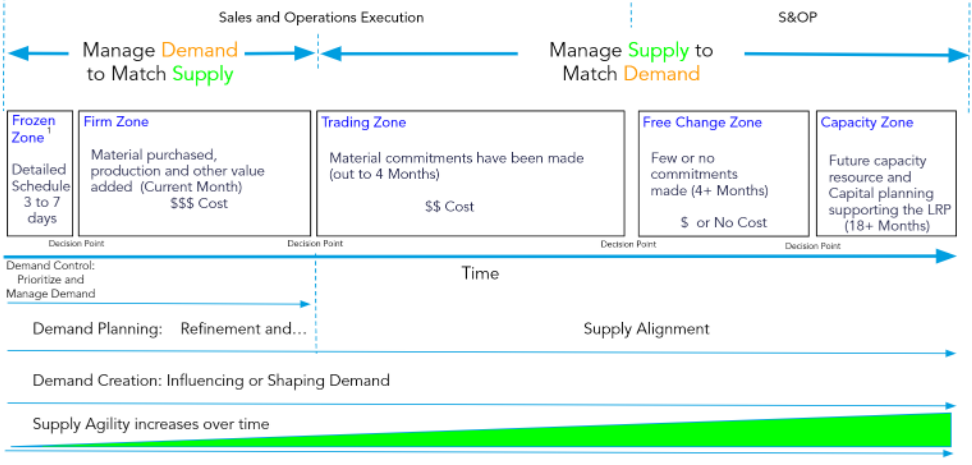
Note: these zones are not intended to prevent changes in supply and demand from occurring., but to establish guidelines for how change is managed.
3. KPIs and Metrics
There are no specific Group metrics that are directly linked to the S&OP process. The main key metrics are lagging KPIs and include:
- Forecast Accuracy (% M-2/3) : this compares what was forecasted with actual demand to be able to calibrate better down the line forecasts.
- Inventory Performance (DOS) : this is a major Group KPI as it is linked to Working Capital and cash delivery. It is measured in Days of Supply.
- SMOG represents Slow Moving Obsolete Goods, it is a representation of the raw material, intermediates and finished goods that are on inventory and that are at risk of becoming obsolete / scrapped (quality issues, expired, etc.). SMOG is included in Inventory Performance (DOS).
- Production Plan / Schedule Adherence: compares in hindsight the production plan vs. what was actually produced.
- Asset Availability and Utilization ( OEE ) : this measures the performance of our assets. In short, it is the realized output over the maximum output of the asset.
- Delivered OTIF (Customer Request and First Promise) is “One Time and In Full”. It defines our E2E Value Chain performance and gives an indication of customer satisfaction (did we deliver in time what we promised?).
- Logistics Cost to Serve: it is a measure of total logistics costs of servicing your customers at a customer and product level.
Key Documents:
- Sales and Operations Planning Playbook
- S&OP Maturity Assessment
- Toolkit to Support Stage 3 S&OP Maturity
Key Trainings:
Key contacts:
Linked pages::
This page has no comments.