


| Status | Approved |
| Owner | |
| Stakeholders |
Issue
Currently Syensqo has multiple SAP systems (WPX, WP1 and PF1) and a single material can be represented in different systems with a different Material Master number.
Recommendation
Syensqo's all materials (finished, semi-finished and raw materials) will be represented by a unique material master number which will be assigned from a new number range. For ease of search, the newly created material number will have the reference to the old material numbers.
Background & Context
Currently Syensqo has multiple SAP systems (WPX, WP1 and PF1) and a single material can be represented in different systems with a different Material Master number.
Assumptions
N/A
Constraints
N/A
Impacts
Legacy Data – Master data
All dependent master data ex: BOM's etc.. will be updated with the new material numbers.
Legacy Data – Transactions
Any historical data that is migrated to the new S/4 system will be updated with the new material numbers
Any catalogs (internal / 3rd party hosted on Ariba network) will be updated with the new material numbers
Legacy Data – Interfaces
Mappings to the customer / vendor material numbers will be updated with the new material numbers
Stock Valuation
There might be an impact on the stock valuation when there is de-duplication of materials with different valuations
Downstream systems
Any downstream system using the material master numbers will be updated with the new material numbers or by creating a mapping table with the old and new material numbers
Change Management
Training material will describe how the users can search and find the material using the old material number
Communication
Communication will be sent to customers / vendors / 3rd party system owners using material master number
Business Rules
Material master number will be internally assigned by the system with no intelligence
Options considered
Option 1 – Do not change the legacy material numbers
Materials from the legacy systems are copied into the new S/4 system without de-duplication.
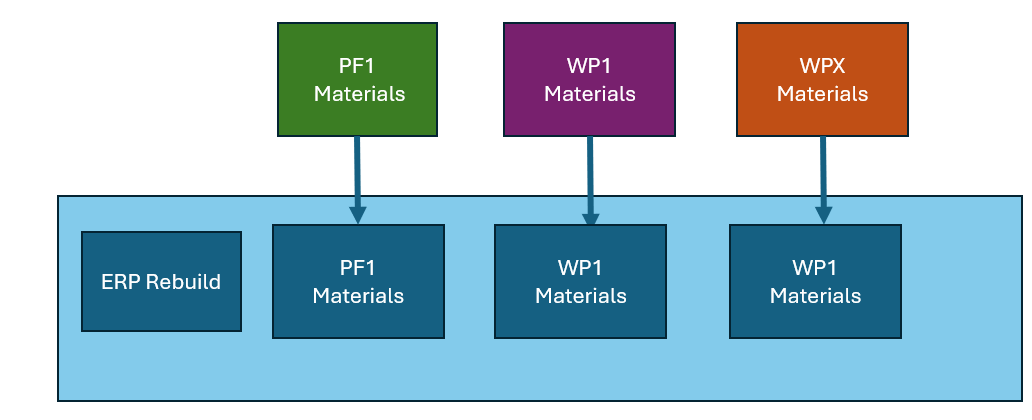
Advantages:
- No impact on legacy data
- No impact on vendors and customers as material numbers don’t change
Disadvantages:
- Significant duplication of material masters
- No global view of material data
- Sub optimal supply chain planning
- Incorrect inventory levels
- Incorrect reporting
Option 2 – Create all valid Material Masters with new number ranges
As a part of this option, the material masters are de-duplicated, and one material master is created per valid material. The material numbers are automatically assigned by the system and are sequential with no intelligence.

- Clean set of de-duplicated material masters
- Optimal supply chain planning
- Correct inventory level across the globe
- Correct reporting
Disadvantages:
- Additional one-time effort for de-duplication
- Additional one-time effort by the downstream system to adopt the new material master numbers or to incorporate a mapping table between old and new numbers
Evaluation
Based on the evaluation of the options, it is recommended that Syensqo should choose option 2 and align the material master numbering to a single standard in the new system and also align the master and transactional data brought across to the new standard to ensure accurate reporting and information in the new system. It should also work with customers and vendors to have them also use the new single material master numbers.
For simplicity the numbering scheme should be a sequential number range with no intelligence, potentially with differing number ranges split by material type.
| Factor | Option 1 - Do not change the legacy material numbers | Option 2 - Create all valid Material Masters with new number ranges |
|---|---|---|
| Alignment with project charter - Standardization and Simplification | ||
| Operational Efficiency | ||
| Reporting | ||
| Change Impact | ||
| Integration Impact | ||
| Unified global standard view and approach |  No standard No standard |  New and globally used standard New and globally used standard |
| Clear consistent approach and messaging |
|
|
| Effort to change Legacy master and transaction data |
| Significant effort to change to legacy data |
| Unified global standard view and approach | No standard | New and globally used standard |
| Removal of Duplicates | Duplicates copied over | Duplicates removed |
Next Steps
- Work with the business to identify true real-world materials with multiple numbers across the system
- Work with data team to determine the amount of effort required to realign any legacy master and transaction data to this new standard
The business benefits of aligning material numbers
Historically Syensqo has let plants maintain their own Material Master data across three different systems. This means that while Syensqo may use the same real-world physical materials across the world, a single materials may have been created under different material master numbers in each system which has made it hard to get a global view of the usage and availability of the same material.
The need to align as part of the new ERP Rebuild system
Implementing S4 HANA as a single entity means that the same real-world materials which had different numbers in the old systems now have to be aligned to the same number in the new system.
See also
Change log
Workflow history
| Title | Last Updated By | Updated | Status | |
|---|---|---|---|---|
| There are no pages at the moment. | ||||