


| Status | Pending Stakeholder Review |
| Owner | |
| Stakeholders |
Purpose
This document outlines the Syensqo-wide approach to data migration and readiness to move to SAP S/4HANA. It establishes a strategic and operational framework to ensure data is clean, reliable, structured and available at go-live.
The objectives are:
To plan, govern and control data migration activities from legacy systems to the SAP S/4HANA platform.
To define scope, dependencies, roles, risks and timelines aligned with cutover planning.
To ensure business engagement and ownership in all data quality and validation activities.
To meet global regulatory, operational and integration requirements with third-party systems.
To institutionalize data quality and governance practices that extend beyond go-live.
Background
The migration to SAP S/4HANA is a core enabler of business transformation and digital integration across Syensqo operations. Accurate and high-quality data is critical for the success of this initiative as it directly impacts core business processes, user adoption, reporting accuracy and legal compliance.
This data approach takes into consideration the need to:
Harmonize disparate legacy system data models into a unified global standard.
Ensure operational continuity during cutover by preloading critical data and validating business readiness.
Enable phased go-lives while managing cross-system data dependencies.
Use repeatable and scalable tools and methods that support global harmonization efforts.
Key steps include:
Inventory and classification of all data objects
Definition of transformation rules and mappings
Execution of data profiling, cleansing and enrichment
Mock load cycles for reconciliation and process testing
Final cutover execution with validation and audit trails
Data Migration Scope
The scope of data migration for this global ERP transformation encompasses all essential master data, open transactional data and selected historical records required to ensure business continuity, legal compliance and readiness at the point of cutover. Data will be migrated from multiple SAP ECC source systems, legacy third-party applications and local tools into a harmonized SAP S/4HANA environment.
Data Sources
Data Targets
Data Dependencies
The data dependencies diagram will be used to ensure Syensqo's data migration timeline remains achievable, dependent object loads may begin once the corresponding predecessor objects have been technically loaded with 100% success and have passed initial data verification. This approach supports timely execution across all load waves and has been designed to balance efficiency with data integrity.
Link - Data Dependencies Diagram
Data Migration Process
The data migration process follows a structured and repeatable approach to extract, transform and load data into the SAP S/4HANA system. The process is primarily driven by Syniti Migrate, with the SAP S/4HANA Migration Cockpit used as a supporting tool when required.
Data is extracted from legacy systems, transformed to match the S/4HANA target structure using automated mapping rules and loaded following a controlled sequence. Each data object is guided by a Conversion Specification and aligned with the Data Dependency Diagram to ensure correct load order and integration.
The "Load Early, Load Often" approach emphasizes repeatability, early and frequent mock loads with cross-functional validation at each stage to support business readiness and cutover precision. This end-to-end process enables a clean, auditable migration into the S/4HANA environment, supporting Syensqo’s global deployment strategy and long-term data governance objectives.
Data Extraction
Data extraction from Syensqo legacy systems is performed using Syniti Migrate, a tool designed specifically to streamline and automate the end-to-end data extraction process. This tool has been selected to align with Syensqo’s objective of reducing manual effort, increasing traceability, and accelerating migration readiness.
The adoption of Syniti Migrate offers the following advantages:
Minimizes dependency on legacy system owners by automating data pulls, reducing manual handovers and time-intensive coordination.
Enables both full and delta extractions, supporting iterative load cycles and ensuring data accuracy across multiple mock migrations.
Supports scheduled or on-demand extraction, allowing flexibility to align with validation cycles, mock cutovers and business availability.
Requires minimal to no custom development within the legacy systems, preserving system stability and reducing the risk of disruptions during the extraction phase.
This tool-driven approach has been integral in maintaining data integrity, auditability and repeatability across Syensqo’s global migration waves.
Data Transformation
Data transformation is centrally managed through the Syniti Migrate platform, using its integrated tools to Map and Transform to ensure data from legacy systems is accurately and consistently prepared for the SAP S/4HANA environment.
All transformation logic is fully automated within the Syniti Migrate platform, in accordance with the defined conversion approach and documented within the respective conversion functional specifications. Transformation execution is sequenced immediately prior to pre-load validations to ensure consistency with the latest configuration and to maintain data integrity throughout the load cycle.
Data prepared using Data Collection Templates (DCTs) generally does not require structural transformation as the templates are purpose-built to match the target S/4HANA design. However, when reference values such as material numbers, asset IDs or cost centers differ between legacy systems and the target configuration, cross-reference tables are applied to ensure accurate translation and alignment of these identifiers within the S/4HANA environment.
Data Load
The data load phase marks the final step of the migration lifecycle, where validated, transformed and approved data is transferred into the SAP S/4HANA environment. Data loads are executed and controlled through the Syniti Migrate platform, with the SAP S/4HANA Migration Cockpit. Together, these tools enable the end-to-end load process, including execution, monitoring and error handling to ensure accuracy, traceability and control.
Load Execution
The data loading process is designed to be streamlined and controlled with minimal transformation applied at this stage. The load execution strictly adheres to predefined sequencing, validation and approvals to ensure a clean and auditable migration into the SAP S/4HANA environments.
The standard load process follows these core steps for each data object and business unit:
Pre-load validation checks are run by the data team to confirm data completeness and structural readiness.
Pre-load validation files are generated and distributed per object, per business unit.
Approval requests are sent to designated business data owners
Load files are generated and formally released.
Data is loaded into S/4HANA using Migration Cockpit.
Load logs are reviewed to assess technical completion and identify any immediate issues.
Post-load validation checks are executed to confirm accuracy, completeness and integrity in the target system.
Final approval requests are triggered with validation responsibilities assigned to the appropriate data owners and governance teams.
Load Execution Constraints and Exceptions
While the preferred approach is to load each object in a single run, exceptions may be approved under specific conditions:
High data volumes requiring split loads or parallel processing to meet technical runtime windows
Cutover sequencing that requires objects to be loaded in multiple phases or site-specific batches
Load Dependencies and Sequencing
The Conversion Specification for every data object outlines its upstream dependencies, reflecting both functional logic and technical requirements to ensure proper sequencing during the load process. These inter-object relationships are illustrated in the Data Dependency Diagram to support accurate execution and end-to-end traceability.
Delta Load Strategy
As a general principle, delta loads are avoided unless warranted by high volumes of business-critical changes between mock load cycles and final cutover. In standard scenarios, once a data object has been loaded and signed off, any subsequent changes in legacy systems must be manually replicated.
Manual Load Exceptions
Manual loading is only permitted in strictly defined, low-impact scenarios where automation is not feasible or cost-effective:
Retrofit activities where mass changes can be executed via standard SAP transactions
Business-as-usual (BAU) data entry where volume is minimal and aligned with operational timelines
Very low-volume loads requiring less than 30 minutes of effort and not justifying custom tooling
Any manual load scenario must be documented, reviewed and approved as part of the cutover plan to ensure traceability and alignment with data governance standards.
Error Handling and Defect Management
If errors occur at any point in the process, a defect must be logged in ???. Defects must be investigated, resolved and formally closed before proceeding to the next load step. Error handling is determined by the nature of the object, the load tool in use and the dependencies between records.
SAP S4/HANA Migration Cockpit Loads:
When loading via the Migration Cockpit, any failed records are automatically flagged during the simulation or execution phase. These records must be corrected either at source or within the transformation logic and reloaded through a new load cycle using the same tool.
Load File-Based Errors:
For interdependent records (e.g. transactional data referencing master data), the load will halt upon encountering an error. A new file must be generated containing all impacted records and reloaded once corrected.
For independent records, the load can proceed and a follow-up file containing only the failed records will be created and processed separately.
In all scenarios, data corrections must be made at the source either within legacy systems or within Syniti Migrate. Manual editing of load files is strictly prohibited unless formally requested through a defect and approved by the business.
Data Migration Load Cycles
The “Load Early, Load Often” approach will be a core principle of the SAP S/4HANA data migration strategy. Mock Migrations are not simply technical exercises, they are critical validation cycles that enable teams to test, refine and build confidence in the end-to-end migration process. Powered by the automation and control offered through the Syniti Migrate platform, each mock cycle helps ensure that data is ready, processes are sound and business operations remain uninterrupted at go-live.
Accelerated Load Cycles and Cutover Readiness
By executing mock migrations early and frequently, Syensqo significantly reduces migration cycle times. Repeatable, proven processes minimize rework and allow for effective scheduling of activities, resources and system availability. With each mock migration, critical dependencies are tested, load durations are refined and system performance under realistic data volumes is evaluated. This enables precise cutover planning, better load leveling and minimized disruption during go-live.
Risk Reduction Through Controlled Rehearsals
Mock migrations allow Syensqo to rehearse the complete load process, from transformation and validation to post-load checks and business sign-off. Practicing the full sequence exposes process gaps, integration issues and resource constraints early in the timeline. As a result, risks can be mitigated well in advance of production cutover, reducing uncertainty and improving confidence in delivery.
Continuous Improvement in Data Quality
Each mock cycle contributes to measurable improvements in data quality. As data is progressively cleansed, transformed and validated through mock migrations, stakeholders gain better visibility into the completeness, accuracy and usability of migrated content. Issues can be addressed, priorities adjusted and functional alignment strengthened with every cycle. This ensures that when Syensqo enters User Acceptance Testing (UAT) and System Integration Testing (SIT), high-quality, business-representative data is available to validate both the system and its processes.
In summary, "Load Early, Load Often" supported by structured Mock Migrations is key to de-risking Syensqo’s S/4HANA cutover and delivering trusted, high-quality data that is fully aligned with business needs from day one.
Migration Schedule
As part of Syensqo’s structured SAP S/4HANA migration approach, a series of Mock Migrations are planned to validate the end-to-end data conversion process, test system readiness, and support iterative improvement of data quality and load performance.
| Mock Migration Stage | Environment | Duration |
|---|---|---|
| Mock Load 1 – Build Support | S/4HANA Development (DEV) | TBD |
| Mock Load 2 – Unit Testing Prep | S/4HANA Development (DEV) | TBD |
| Mock Load 3 – SIT | S/4HANA Quality (QAS) | TBD |
| Mock Load 4 – UAT | S/4HANA Quality (QAS) | TBD |
| Mock Load 5 – Cutover Rehearsal | S/4HANA Pre-Production | TBD |
Additional Load Requirements
Beyond the core mock migration cycles, additional targeted loads will be executed to:
Support parallel payroll testing in designated test clients
Data cleansing loads will be executed to support Master Data Scenario's within dedicated data client, ensuring that end-user enablement and simulation activities are performed with clean, relevant and business-ready data. This approach is critical to building user confidence and validating real-world usability of the SAP S/4HANA system prior to go-live.
Special Requirements
Separate instance for China and US
Team and Deliverables
Functional Team
Deliverables
The Functional Team is responsible for ensuring that business process requirements are accurately reflected in the target data model. They define master data standards, validate mapping logic and ensure that transformation rules align with functional design.
Key Deliverables:
Master Data Standards
Target Data Models
Mapping Review and Approval
Functional Validation of Transformation Logic
Roles
Data Team
Deliverables
The Data Team is responsible for coordinating all data-related activities across the business, functional and technical workstreams. This includes overseeing data cleansing efforts to ensure legacy data meets the quality standards required for migration and driving data construction activities where new or restructured data sets must be created to align with the SAP S/4HANA target design. The team ensures that master data standards are applied consistently. Conversion specifications are accurately developed and validation activities are planned and executed.
Key Deliverables:
Data Conversion Specifications for each object
Data Cleansing Oversight and Weekly Quality Reporting
Data Conversion Build Plan (in collaboration with Syniti)
Review and approval of Mock Load Results
Data Validation Frameworks and Execution Support
Exception Tracking and Resolution Coordination
Roles
Business Team
Deliverables
The Business Team is accountable for ensuring the data is accurate, complete and fit-for-purpose. They own the source data, validate mappings and confirm readiness at each load cycle. Their active participation in cleansing and approval activities is essential to achieving business readiness at go-live.
Key Deliverables:
Data Cleansing and Enrichment
Source-to-Target Mapping Review
Data Validation (Pre and Post Load)
Formal Approvals for Load Cycles
Roles
Third Party Vendor
Deliverables
The data migration partner Syniti, is responsible for delivering the full Extract, Transform, Load (ETL) capability across the SAP S/4HANA migration lifecycle. Leveraging the Syniti Migrate platform, they will lead the technical execution of all data conversion activities, ensure tool configuration and rule implementation and support the governance and traceability of data movement from source to target systems.
Key Deliverables:
End-to-end ETL design and execution via Syniti Migrate
Detailed Data Conversion Build Plan
Baseline Extracted Data Sets from Legacy Systems
Transformation Logic and Cross-Reference Tables
Reconciliation and Error Reporting Dashboards
Build and Deployment of Load Programs
Execution and Monitoring of Data Loads into SAP S/4HANA
Roles
Assumptions
Data Migration Risks & Issues
| Risk/Issue | Mitigation Action |
|---|---|
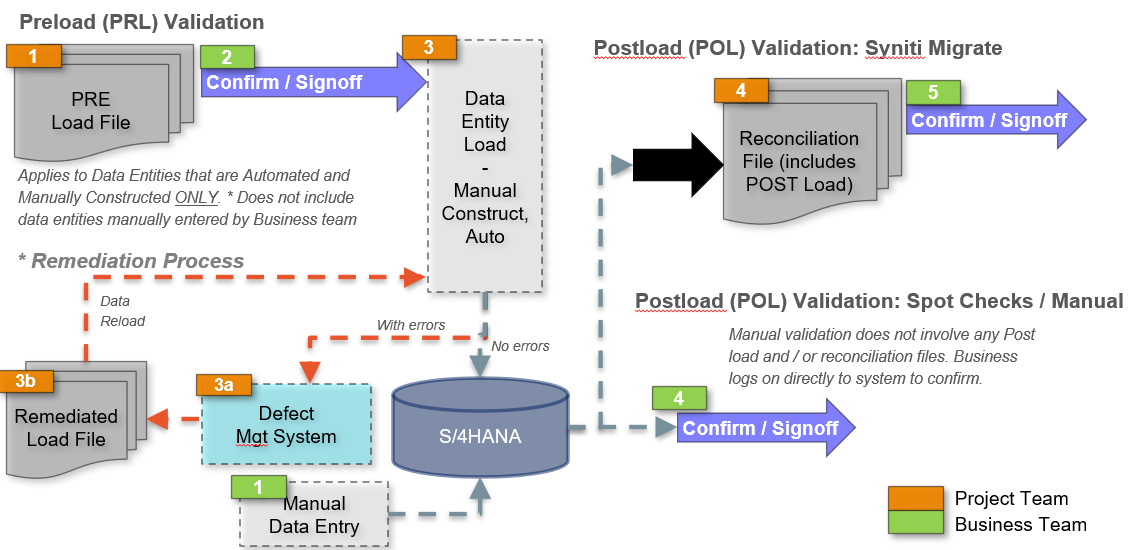
Data Validation Process
Data validation will be a structured, tool-enabled process designed to confirm that all migrated data is accurate, complete and aligned with the SAP S/4HANA target design. Leveraging the Syniti Migrate platform, validation is executed across multiple checkpoints and supported by detailed, system-generated validation reports.
The validation process includes both technical and business-facing activities to ensure full traceability and accountability. These activities are coordinated across the data, functional and business teams and occur during both mock cycles and production cutover.
Pre-Load Validation
Post-Load Validation
Data Privacy
Change log
Workflow history
| Title | Last Updated By | Updated | Status | |
|---|---|---|---|---|
| There are no pages at the moment. | ||||