


| Status | In Progress |
|---|---|
| Owner | |
| Stakeholders |
Purpose
This document outlines the conversion strategy for migrating Source List data from SAP ECC systems to SAP S/4HANA.
In the legacy systems, Source List entries may be duplicated, outdated, or inconsistently maintained across plants and purchasing organizations. Some entries reference inactive vendors or materials and contain obsolete validity dates. As per SyWay standards, Source List data will be rationalized and aligned to the new S/4HANA data model.
Conversion Scope
The objective is to convert active and relevant Source List entries from legacy systems (PF2, WP2) into S/4HANA in accordance with the Source List Master Data Design.
The Source List in SAP defines the approved supply source(s) for a specific material over a given timeframe and plant. It plays a critical role in the Source-to-Pay process, particularly in automatic sourcing and purchase requisition conversion.
The legacy systems already use Source List functionality, but the structure, completeness, and business relevance vary. A cleansing and standardization process will be undertaken to ensure only valid, non-redundant records are transitioned.
The data from legacy system includes:
Valid Source List entries with active Vendor and Material
Entries with current or future Validity Period
Plant (when applicable) and Purchasing Organization combinations relevant to the business scope
Fixed vendor flags and quota arrangements, if maintained
The data from legacy system excludes:
Entries with deletion indicators
Expired entries with no future relevance
Entries referring to blocked materials or vendors
| Source | Scope | Source Approx No. of Records | Target System | Target Approx No. of Records |
|---|---|---|---|---|
| PF2 | S4H | |||
| WP2 | S4H |
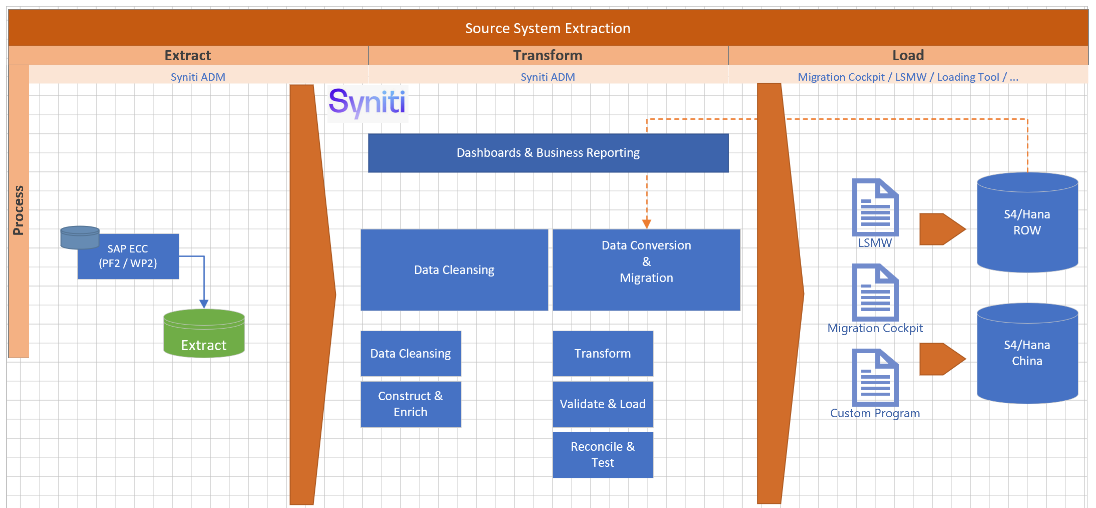
Data will be extracted via Syniti Migrate and formatted into DCTs (Data Collection Templates). Business users will validate and confirm the relevance of each entry.
Additional Information
Multi-language Requirement
Descriptions are not applicable for Source List records, but Plant and Purchasing Organization descriptions may be presented in English and logon language if available.
Document Management
N/A
Legal Requirement
N/A
Special Requirements
N/A
Target Design
Source List data will be loaded into SAP S/4HANA tables EORD and EINE (if applicable for quota and vendor assignment) according to the standard structure:
The technical design of the target for this conversion approach.
| Table | Field | Data Element | Field Description | Data Type | Length | Requirement |
|---|---|---|---|---|---|---|
EORD | MATNR | MATNR | Material Number | CHAR | 18 | |
| EORD | WERKS | EWERK | Plant | CHAR | 4 | |
| EORD | ZEORD | DZEORD | Number of Source List Record | NUMC | 5 | Mandatory |
| EORD | ERDAT | ERDAT | Record Created On | DATS | 8 | |
| EORD | ERNAM | ERNAM | Name of Person Responsible for Creating the Object | CHAR | 12 | |
| EORD | VDATU | ORDAB | Source List Record Valid From | DATS | 8 | |
| EORD | BDATU | ORDBI | Source List Record Valid To | DATS | 8 | |
| EORD | LIFNR | ELIFN | Supplier's Account Number | CHAR | 10 | |
| EORD | FLIFN | FLIFN | Indicator: Fixed Supplier | CHAR | 1 | |
| EORD | EBELN | EVRTN | Agreement Number | CHAR | 10 | |
| EORD | EBELP | EVRTP | Agreement Item | NUMC | 5 | |
| EORD | FEBEL | FEBEL | Fixed Outline Purchase Agreement Item | CHAR | 1 | |
| EORD | RESWK | BEWRK | Plant from Which Material is Procured | CHAR | 4 | |
| EORD | FRESW | FRESW | Fixed issuing plant in case of stock transport order | CHAR | 1 | |
| EORD | EMATN | EMATN | Material Number Corresponding to Manufacturer Part Number | CHAR | 40 | |
| EORD | NOTKZ | ORDSP | Blocked Source of Supply | CHAR | 1 | |
| EORD | EKORG | EKORG | Purchasing Organization | CHAR | 4 | |
| EORD | VRTYP | BSTYP | Purchasing Document Category | CHAR | 1 | |
| EORD | EORTP | EORTP | Category of Source List Record | CHAR | 1 | |
| EORD | AUTET | AUTET | Source List Usage in Materials Planning | CHAR | 1 | |
| EORD | MEINS | BSTME | Purchase Order Unit of Measure | UNIT | 3 | |
| EORD | LOGSY | LOGSYSTEM | Logical System | CHAR | 10 |
Data Cleansing
Standardization activities include:
| ID | Criticality | Error Message/Report Description | Rule | Output | Source System |
|---|---|---|---|---|---|
| 1097-001 | C1 | Removal of duplicates | Since we may have multiple source systems, is possible to | ||
| 1097-002 | C1 | Elimination of expired entries | Remove expired dates before upload the date | ||
| 1097-003 | C1 | Alignment with valid vendor-material combinations | Identify whether the info record exists | ||
| 1097-004 | C1 | Standardizing date formats and flags | Check whether the date format is correct according to the users language |
Conversion Process
The conversion process begins with the extraction of Source List records from ECC systems based on relevancy criteria. These records are pre-validated to ensure referenced materials and vendors are active and valid. The validated data is then loaded into the DCT where cleansing, standardization, and transformation activities are performed. Once complete, the business reviews the entries and confirms readiness. Following this, load files are prepared and test loads are executed for validation. If successful, a full data load is carried out into S/4HANA, followed by a post-load validation to confirm completeness and accuracy.
Data Privacy and Sensitivity
N/AExtraction
Extract data from a source into . There are 2 possibilities:
- The data exists. connects to the source and loads the data into . There are 3 methods:
- Perform full data extraction from relevant tables in the source system(s).
- Perform extraction through the application layer.
- Only if ; cannot connect to the source, data is loaded to the repository from the provided source system extract/report.
- The data does not exist (or cannot be converted from its current state). The data is manually collected by the business directly in . This is to be conducted using DCT (Data Collection Template) in
The agreed Relevancy criteria is applied to the extracted records to identify the records that are applicable for the Target loads
Extraction Run Sheet
| Req # | Requirement Description | Team Responsible |
|---|---|---|
001 | Extract data from source system based on relevancy rule | SyWay Data Team |
002 | Google Sheet report pre-populated with PF2 and WP2 information to be generated based on relevancy criteria. | SyWay Data Team |
003 | Only extract data that is NOT marked for deletion Where: EINA-LOEKZ = ”” | SyWay Data Team |
004 | Only extract records that are still valid Where: EINA-LIFBI >= Today’s date | SyWay Data Team |
005 | Extract Info Records for Vendors that are NOT marked for deletion and are part of an Info Record | SyWay Data Team |
006 | Extract Info Records for Vendors that are in scope | SyWay Data Team |
007 | Extract Info Records for Materials that are NOT marked for deletion and are part of the respective Info Record | SyWay Data Team |
008 | Extract Info Records for Materials that are in scope | SyWay Data Team |
009 | Extract Info Records for Plants that are in scope. Do this check when EINE-WERKS is different than initial | SyWay Data Team |
Selection Screen
| Selection Ref Screen | Parameter Name | Selection Type | Requirement | Value to be entered/set |
|---|---|---|---|---|
Data Collection Template (DCT)
Target Ready Data Collection Template will be created for data with exception of some fields which require transformation as mentioned in the transformation rule.DCT Rules
| Field Name | Field Description | Rule |
|---|---|---|
Extraction Dependencies
| Item # | Step Description | Team Responsible |
|---|---|---|
001 | Vendor - The Info Record is created for a specific vendor, therefore the vendor must exist and be active | S2P |
002 | Material - The Info Record is for a specific material, therefore the material must exist and be active | S2P |
003 | Purchasing Organization - Mandatory organizational level (configuration). Must be valid for both the vendor and material | S2P |
004 | Plant (optional) - If a plant-specific Info Record is used, the plant must be valid (included on scope) and maintained | FICO |
005 | Currency & UoM - Must align with vendor master and material master data | S2P |
006 | Tax Code - Should exist in system and be consistent with vendor's country and plant region | S2P |
007 | Conditions - Purchasing conditions (price, discounts, scales) are typically stored in condition records. Linked to Info Records via condition tables | S2P |
008 | Vendor Master Settings - The vendor must have the purchasing organization maintained in purchasing view | S2P |
Transformation
The Target fields are mapped to the applicable Legacy field that will be its source, this is a 3-way activity involving the Business, Functional team and Data team. This identifies the transformation activity required to allow to make the data Target ready:
- Perform value mapping and data transformation rules.
- Legacy values are mapped to the to-be values (this could include a default value)
- Values are transformed according to the rules defined in
- Prepare target-ready data in the structure and format that is required for loading via prescribed Load Tool. This step also produces the load data ready for business to perform Pre-load Data Validation
Transformation Run Sheet
| Item # | Step Description | Team Responsible |
|---|---|---|
Transformation Rules
| Rule # | Source system | Source Table | Source Field | Source Description | Target System | Target Table | Target Field | Target Description | Transformation Logic |
|---|---|---|---|---|---|---|---|---|---|
Transformation Mapping
| Mapping Table Name | Mapping Table Description |
|---|---|
Transformation Dependencies
List the steps that need to occur before transformation can commence| Item # | Step Description | Team Responsible |
|---|---|---|
Pre-Load Validation
Project Team
Completeness
| Task | Action |
|---|---|
Accuracy
| Task | Action |
|---|---|
Business
Completeness
| Task | Action |
|---|---|
Accuracy
| Task | Action |
|---|---|
Load
The load process includes:
- Execute the automated data load into target system using load tool or product the load file if the load must be done manually
- Once the data is loaded to the target system, it will be extracted and prepared for Post Load Data Validation
Load Run Sheet
| Item # | Step Description | Team Responsible |
|---|---|---|
Load Phase and Dependencies
Configuration
| Item # | Configuration Item |
|---|---|
Conversion Objects
| Object # | Preceding Object Conversion Approach |
|---|---|
| list the exact title of the conversion object of only the immediate predecessor – this will then confirm the DDD (Data Dependency Diagram) | |
Error Handling
| Error Type | Error Description | Action Taken |
|---|---|---|
Post-Load Validation
Project Team
Completeness
| Task | Action |
|---|---|
Accuracy
| Task | Action |
|---|---|
Business
Completeness
| Task | Action |
|---|---|
Accuracy
| Task | Action |
|---|---|
Key Assumptions
- Master Data Standard is up to date as on the date of documenting this conversion approach and data load.
- is in scope based on data design and any exception requested by business.
See also
Change log
Workflow history
| Title | Last Updated By | Updated | Status | |
|---|---|---|---|---|
| There are no pages at the moment. | ||||