


| Status | Approved |
|---|---|
| Owner | |
| Stakeholders |
Purpose
The purpose of this document is to define the conversion approach to create Cross Selling in S/4 HANA.
Cross selling is a sales technique where a customer is offered related or complementary products to what they have already purchased or are purchasing. The system can automatically suggest these items during sales order creation, potentially increasing sales volume and customer satisfaction.
Conversion Scope
The scope of this document covers the approach for converting active Cross Selling from Legacy Source Systems into S/4HANA following the Cross Selling Master Data Design Standard.
From the current system landscape, Cross Selling data exists separately in the legacy systems (PF2 and WP2), with potential discrepancies in both systems. Harmonization and validation are required to ensure accurate and consolidated data in S/4HANA. While PF2 and WP2 serve as source systems, extensive mapping and transformation logic will be necessary to produce properly formatted load templates in line with the target design.
The data from legacy system includes: Final relevancy rule pending MDS
- All active Cross Selling, where "valid from date up to 1 year after S/4HANA Go-Live date" AND "valid to date is after valid from date AND beyond S/4HANA Go-Live date" AND each of the below as per table combination:
- Sales organization in scope of S/4HANA
- Customer sales view migrated as per CNV-3003 Business Partners - Customer (Sales and Service) - FLCU01 (pending MDS as there are no data maintained in table 904)
- Material sales view migrated as per CNV-2003 Materials - Sales view with sales long text.
The data from legacy system excludes:
Invalid Cross Selling; none of the above
| Source | Scope | Source Approx No. of Records | Target System | Target Approx No. of Records |
|---|---|---|---|---|
| WP2 | Cross Selling table: KOTD906 | 150 | S/4HANA ROW | 150 |
| PF2 | Cross Selling | N/A | S/4HANA ROW | N/A |
| WP2 | Cross Selling table: KOTD906 | 150 | S/4HANA China | 150 |
| PF2 | Cross Selling | N/A | S/4HANA China | N/A |
| WP2 | Cross Selling table: KOTD906 | 50 | S/4HANA CUI | 50 |
| PF2 | Cross Selling | N/A | S/4HANA CUI | N/A |
Additional Information
Multi-language Requirement
N/A
Document Management
N/A
Legal Requirement
As per US Department of Defence (DOD) a Cybersecurity Maturity Model Certification/ CMMC 2.0 is a mandatory certification for all contractors handling Controlled Unclassified Information (CUI) and Federal Contract Information (FCI). CUI includes sensitive technical data (e.g., design specs, system info) related to U.S. military and space applications. The Composites Business handles CUI and is therefore within CMMC scope. Without certification, the business risks disqualification from existing and future DoD programs.
It is mandatory to implement CMMC-compliant systems and processes to for all the organizations that are dealing with CUI.
Therefore, there will be one SAP instance specifically for CUI related entities. The migration for CUI related entities will be covered by US based data consultant using separate tools.
Special Requirements
Cross Selling
A. Different SAP Instance Migration Approach
Due to compliance requirement, there will be one SAP instance for Rest of the World (ROW), one for China and one for CUI.
- For entities in China, the data will be loaded into SAP China instance while the entire migration process will remain the same as rest of the world.
- For entities which will reside in CUI, the migration will be handled by US based data consultant.
Please refer to the link for the entity mapping for each instance. In case the data object is applicable for multiples instances, what business rule to follow?
- To identify the record is for SAP ROW Instance, it will use below logic.
- The Cross Selling has sales organization data in below entities.
Source | ||
|---|---|---|
| PF2 | 3383 | SOLVAY SPOL KR |
| PF2 | 5686 | SOLVAY QUIMICA (AR) |
| PF2 | 5782 | SOLVAY SPOL US |
| PF2 | 5835 | SOLVAY SPOL IT |
| PF2 | 5846 | SOLVAY SPOL JP |
| PF2 | 5955 | SOLVAY SPECIALIT IN |
| PF2 | 5978 | SOLVAY SPOL BE |
| PF2 | 6080 | SOLVAY FRANCE FR |
| PF2 | 6327 | SLV SP CHEM ASIA PAC |
| WP2 | AE01 | AE Composite Matls |
| WP2 | AU01 | Technology Solutions |
| WP2 | AU02 | AU Novecare |
| WP2 | BR42 | Quimicos BR Novecare |
| WP2 | BR44 | Quimicos BR SpecPoly |
| WP2 | BR47 | Quimicos BR Tech Sol |
| WP2 | CA12 | Technology Solutions |
| WP2 | CA15 | Cytec CA Novecare |
| WP2 | CL01 | Cytec Chile Tech Sol |
| WP2 | FRAZ | SPOP Novecare |
| WP2 | GB34 | Solvay Solutions UK |
| WP2 | ID01 | CYID Tech Solutions |
| WP2 | IN04 | SSIPL IN Novecare |
| WP2 | IT07 | Novecare Italie |
| WP2 | JP02 | Solvay Japan, Ltd |
| WP2 | JP03 | Solvay Nicca, Ltd |
| WP2 | JP10 | Technology Solutions |
| WP2 | KR11 | CY KR Novecare |
| WP2 | KR12 | CY KR Tech Solutions |
| WP2 | MX01 | MX Tech Solutions |
| WP2 | MX02 | MX Novecare |
| WP2 | MX08 | MX Spec Polymers |
| WP2 | NL01 | Cytec Ind BV TS |
| WP2 | NL05 | Solvay Sol NL Noveca |
| WP2 | NZ01 | Solvay New Zealand |
| WP2 | PE01 | Technology Solutions |
| WP2 | SG03 | Solvay Sp Chem SG |
| WP2 | SG08 | SSCAP SG Tech Sol |
| WP2 | TH01 | Technology Solutions |
| WP2 | TH03 | Solvay (Bangpoo) SC |
| WP2 | US05 | Solvay US Novecare |
| WP2 | US23 | Technology Solutions |
| WP2 | US50 | Composite Mat (7008) |
- To identify the record is for SAP China Instance, it will use below logic.
- The Cross Selling has sales organization data in below entities.
| System | Sales Organization Code | Sales Organization Description |
|---|---|---|
| PF2 | 5876 | SOLVAY SHANGHAI LTD |
| PF2 | 5991 | SOLVAY SPEC POLYMERS |
| WP2 | CN15 | Solvay ZJ Novecare |
| WP2 | CN18 | Zhuhai SLV Novecare |
| WP2 | CN19 | Solvay ZJG Novecare |
| WP2 | CN27 | Solvay ZJ Tech Sol |
| WP2 | CN28 | CYIS Tech Solutions |
| WP2 | CN36 | CYIS Composites Matl |
| WP2 | CN41 | CEM (SH) Compos Mats |
- To identify the record is for SAP CUI Instance, it will use below logic.
- The Cross Selling has sales organization data in below entities.
| System | Sales Organization Code | Sales Organization Description |
|---|---|---|
| WP2 | DE13 | Composites Materials |
| WP2 | GB40 | Composites Materials |
| WP2 | US32 | Composite Materials |
| WP2 | US33 | CEM Defense Material |
Target Design
The technical design of the target for this conversion approach.
| Table | Field | Data Element | Field Description | Data Type | Length | Requirement |
|---|---|---|---|---|---|---|
Data Cleansing
All data cleansing should take place in the data source system as defined in this document, unless system limitations prevent it.
| ID | Criticality | Error Message/Report Description | Rule | Output | Source System |
|---|---|---|---|---|---|
| 1037-001 | Change the 'Validity Period - TO' to before SyWay go live date. | For main material, if it is in-active/ obsolete. | PF2/ WP2 | ||
| 1037-002 | Delete the alternative material. | For alternative materials, if it is in-active/ obsolete. | PF2/ WP2 | ||
Conversion Process
The high-level process is represented by the diagram below:
The ETL (Extract, Transform, Load) process is a structured approach to data migration and management, ensuring high-quality data is seamlessly transferred across systems. Here’s a breakdown of its key components:
1. Extraction
The process begins with extracting metadata and raw data from source systems, such as Syensqo ECC system (i.e., WP2/PF2) periodically. The extracted data is then staged for transformation.
2. Transformation
Once extracted, the data undergoes cleansing, consolidation, and governance. This step ensures data integrity, consistency, and compliance with business rules. The transformation process includes:
- Data validation to remove inconsistencies.
- Standardization to align formats across datasets.
- Business rule application to refine data for operational use.
3. Loading
The transformed data is then loaded into the target S4 Hana system.
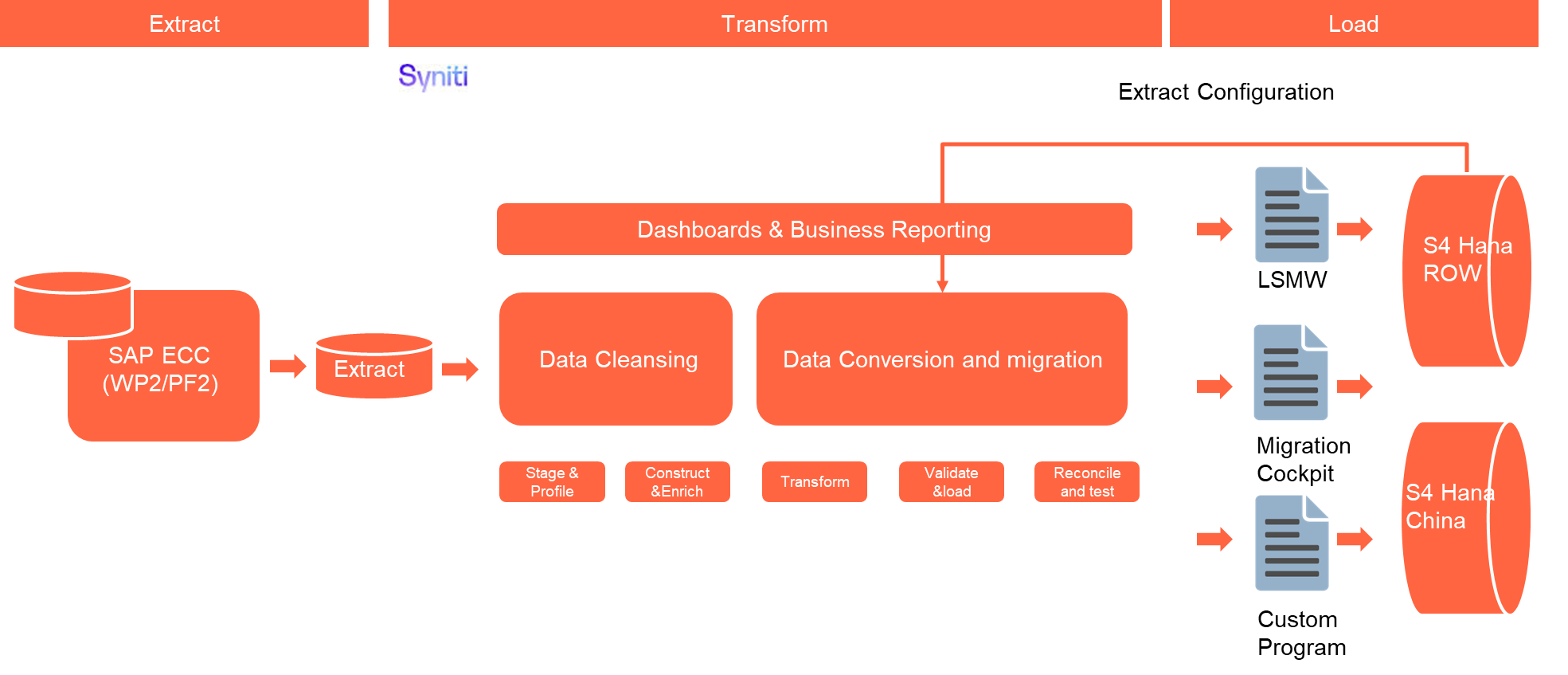
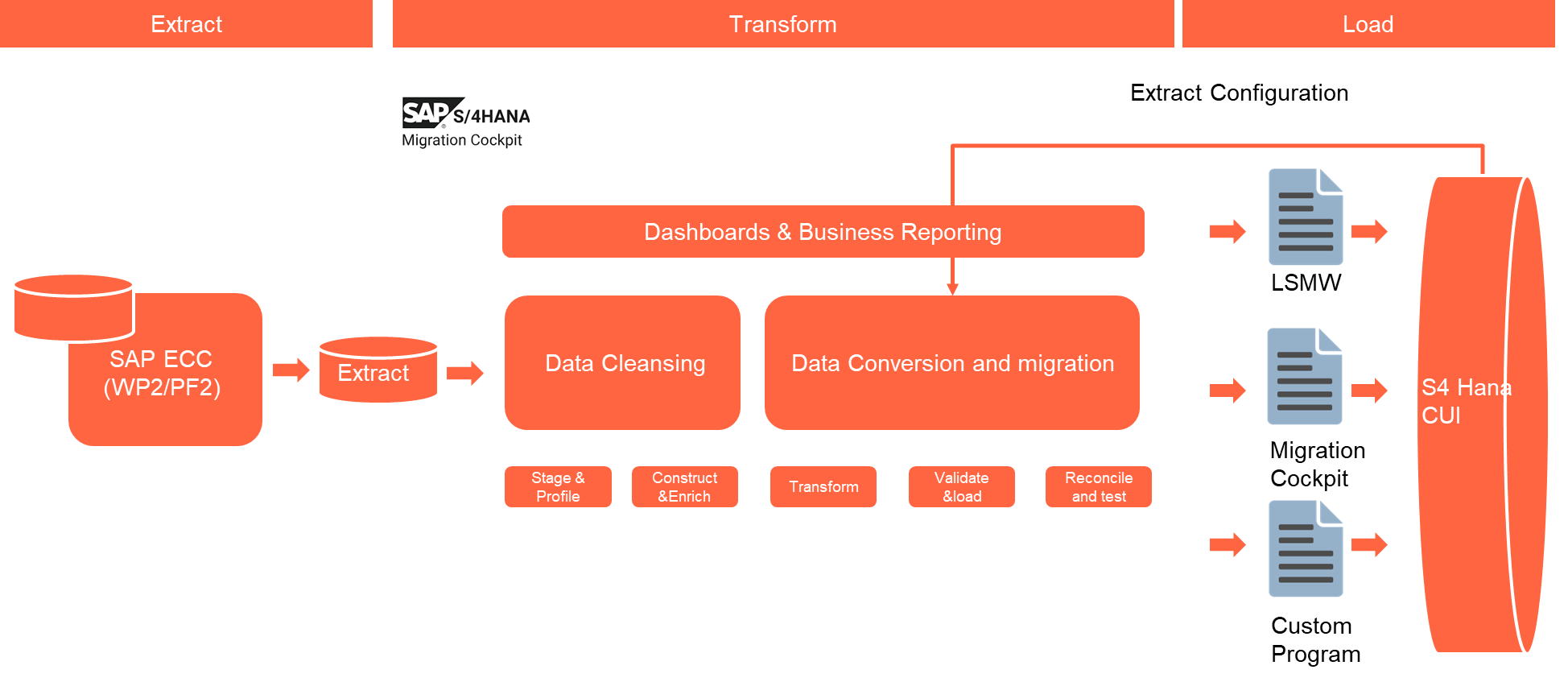
For CUI instance, the ETL process will be similar, but it will not use Syniti tool.
Data Privacy and Sensitivity
For SAP CUI instances, the data will be processed by US Based consultants.Extraction
Extract data from a source into Syniti Migrate for S/4HANA ROW and S/4HANA China relevant entities. There are 2 possibilities:
- The data exists. Syniti Migrate connects to the source and loads the data into Syniti Migrate. There are 3 methods:
- Perform full data extraction from relevant tables in the source system(s).
- Perform extraction through the application layer.
- Only if Syniti Migrate cannot connect to the source, data is loaded to the repository from the provided source system extract/ report.
- The data does not exist (or cannot be converted from its current state). The data is manually collected by the business directly in Syniti Migrate. This is to be conducted using DCT (Data Collection Template) in Syniti Migrate.
The agreed Relevancy criteria is applied to the extracted records to identify the records that are applicable for the Target loads
For SAP CUI related entities, it will be alternative extraction process and the data will be stored in approved tools.
Extraction Run Sheet
| Req # | Requirement Description | Team Responsible |
|---|---|---|
| Extraction Scope Definition | - Identify the source systems and databases involved. - Define the data objects (tables, fields, records) to be extracted. - Establish business rules for data selection. | Syniti / US Based Consultant for SAP CUI instance Syniti / LTC Data team |
| Extraction Methodology | - Specify the extraction approach (full, incremental, or delta extraction). - Determine the tools and technologies used. - Define data filtering criteria to exclude irrelevant records. | Syniti / US Based Consultant for SAP CUI instance |
| Extraction Execution Plan | - Establish execution timelines and batch processing schedules. - Assign responsibilities for extraction monitoring. - Document dependencies on other migration tasks. | Syniti / US Based Consultant for SAP CUI instance |
| Data Quality and Validation | - Define error handling mechanisms for extraction failures. | Syniti / US Based Consultant for SAP CUI instance |
Selection Screen
| Selection Ref Screen | Parameter Name | Selection Type | Requirement | Value to be entered/set |
|---|---|---|---|---|
| N/A | ||||
Data Collection Template (DCT)
Target Ready Data Collection Template will be created for Cross Selling data with exception of some fields which require transformation as mentioned in the transformation rule.DCT Rules
| Field Name | Field Description | Rule |
|---|---|---|
Extraction Dependencies
| Item # | Step Description | Team Responsible |
|---|---|---|
| 1 | Source System Availability
| Syensqo IT |
| 2 | Data Structure
| Syniti / US Based Consultant for SAP CUI instance |
| 3 | Referential Integrity
| Syniti / US Based Consultant for SAP CUI instance |
| 4 | Extraction Methodology
| Syniti / US Based Consultant for SAP CUI instance |
| 5 | Performance and Scalability Considerations
| Syniti / US Based Consultant for SAP CUI instance |
| 6 | Security and Compliance
| Syniti / US Based Consultant for SAP CUI instance |
| 7 | Data cleansing of legacy Cross Selling data must be completed. If standardization within the DCT begins using relevant data from PF2 and WP2 before the cleansing is finalized, it is understood that the business will take due diligence to ensure any subsequent delta cleansing is verified and aligned within the DCT. | Business |
Transformation
The Target fields are mapped to the applicable Legacy field that will be its source, this is a 3-way activity involving the Business, Functional team and Data team. This identifies the transformation activity required to allow Syniti Migrate to make the data Target ready:
- Perform value mapping and data transformation rules.
- Legacy values are mapped to the to-be values (this could include a default value)
- Values are transformed according to the rules defined in Syniti Migrate
- Prepare target-ready data in the structure and format that is required for loading via prescribed Load Tool. This step also produces the load data ready for business to perform Pre-load Data Validation
Transformation Run Sheet
| Item # | Step Description | Team Responsible |
|---|---|---|
| 1 | Transformation Scope Definition - Identify the source and target data structures. - Define business rules for data standardization. - Establish data cleansing requirements to remove inconsistencies. | Data Team |
| 2 | Data Mapping and Standardization - Align source fields with target fields. - Ensure unit consistency (e.g., currency, measurement units) | Data Team |
| 3 | Business Rule Application - Implement data enrichment/collection if applicable - Apply conditional transformations based on predefined logic/business rules | Data Team |
| 4 | Transformation Execution Plan - Define batch processing schedules. - Assign responsibilities for monitoring execution. - Establish error-handling mechanisms | Syniti / US Based Consultant for SAP CUI instance |
Transformation Rules
| Rule # | Source system | Source Table | Source Field | Source Description | Target System | Target Table | Target Field | Target Description | Transformation Logic |
|---|---|---|---|---|---|---|---|---|---|
Transformation Mapping
| Mapping Table Name | Mapping Table Description |
|---|---|
| MAP_VKORG | Sales Organization Mapping Table |
MAP_VTWEG | Distribution Channel Mapping Table SyWay - Sales Area.pptx --> All the actual distribution channels and divisions won't exist in the to-be solution Check current Dist.Ch. and discuss with Functional team and how to do the mapping |
MAP_KUNNR | Customer Mapping Table |
MAP_MATNR | Material Mapping Table |
Transformation Dependencies
List the steps that need to occur before transformation can commence| Item # | Step Description | Team Responsible |
|---|---|---|
| 1 | Source Data Integrity - Ensure extracted data is complete, accurate, and consistent. - Validate that data types and formats align with transformation requirements. | Syniti / US Based Consultant for SAP CUI instance |
| 2 | Referential Integrity - Ensure dependent records are transformed together or in advance | Syniti / US Based Consultant for SAP CUI instance |
| 3 | Transformation Logic and Mapping - Define data mapping rules between source and target schemas. | Data Team |
| 4 | Performance and Scalability Considerations - Optimize transformation processes for large datasets. - Ensure system resources can handle transformation workloads | Syniti / US Based Consultant for SAP CUI instance |
| 5 | Logging and Error Handling - Maintain detailed logs of transformation activities. - Define error-handling procedures for failed transformations | Syniti / US Based Consultant for SAP CUI instance |
Pre-Load Validation
Project Team
The following pre-load validations will be performed by the Project Team.Completeness
| Task | Action |
|---|---|
| Compare Data Counts |
|
| Validate the mandatory fields | Validate there is value for all the mandatory fields |
| Validate Primary Keys and Unique Constraints |
|
| Test Referential Integrity | Confirm dependent records exist in related tables |
Accuracy
| Task | Action |
|---|---|
| Validate the transformation | Validate the fields which require transformation have the value after transformation instead of the original field value |
| Check Data Consistency |
|
Business
The following pre-load validations will be performed by the business.Completeness
| Task | Action |
|---|---|
| Compare Data Counts |
|
| Review populated templates for missing or incorrect values | Use checklists to verify completeness and correctness before submission |
Accuracy
| Task | Action |
|---|---|
Conversion Accuracy | Business Data Owner/s to verify that all the data in the load table/file is accurate as per endorsed transformation/ mapping rules (and signed-off DCT data). |
Load
The load process includes:
- Execute the automated data load into target system using load tool or product the load file if the load must be done manually
- Once the data is loaded to the target system, it will be extracted and prepared for Post Load Data Validation
Load Run Sheet
| Item # | Step Description | Team Responsible |
|---|---|---|
| 1 | Load Scope Definition - Identify the target system and database structure. - Define data objects (tables, fields, records) to be loaded. - Establish business rules for data validation. | Data team |
| 2 | Load Methodology - Specify the loading tools and technologies (Migration Cockpit, LSMW, custom loading program). | Syniti / US Based Consultant for SAP CUI instance |
| 3 | Data Quality and Validation - Ensure data integrity checks (null values, duplicates, format validation). - Perform pre-load validations to verify completeness. - Define error handling mechanisms for load failures | Syniti / US Based Consultant for SAP CUI instance |
| 4 | Load Execution Plan - Establish execution timelines and batch processing schedules. - Assign responsibilities for monitoring execution. - Document dependencies on other migration tasks | Syniti / US Based Consultant for SAP CUI instance |
| 5 | Logging and Reporting - Maintain detailed logs of loading activities. - Generate summary reports on loaded data volume and quality. - Define escalation procedures for errors | Syniti / US Based Consultant for SAP CUI instance |
Load Phase and Dependencies
The Cross Selling will be loaded in the pre-cutover period.
Before loading, it will have dependency on the configuration and data objects in the S/4HANA. The configuration needs to be transported into the respective system first.
Configuration
| Item # | Configuration Item |
|---|---|
| 1 | Sales Organization |
| 2 | Distribution Channel |
| 3 | Cross Selling Condition Table |
| 4 | Cross Selling Access Sequence |
| 5 | Cross Selling Condition Type |
| 6 | Cross Selling Procedure |
| 7 | Maintain Customer/ Document Procedures for Cross Selling |
| 8 | Define Cross Selling Profile |
| 9 | Assign Cross Selling Profile |
Conversion Objects
| Object # | Preceding Object Conversion Approach |
|---|---|
3003 | Business Partners - Customer (Sales and Service) - FLCU01 |
2003 | Materials - Sales view with sales long text |
Error Handling
| Error Type | Error Description | Action Taken |
|---|---|---|
Configuration / Data Transformation | The value XXX for field XXX doesn't exist |
|
Configuration | There is mandatory field XXX missing |
|
Post-Load Validation
Project Team
The following post-load validations will be performed by the Project Team.Completeness
| Task | Action |
|---|---|
Validate Record count in the backend | Validate all tables has the same records as the loading file |
Display Records | Pick up a few random Sales Organization and Customer, and run t-code: VD43 to validate the Cross Selling can be displayed without any error. |
Perform Source-to-Target Comparisons |
|
Accuracy
| Task | Action |
|---|---|
| Execute Sample Queries and Reports |
|
| Conduct Post-Migration Reconciliation | Generate reports comparing pre- and post-migration data. |
Business
Post-load validation is a critical step in data migration, ensuring that transferred data is accurate, complete, and functional within the target system.
1. Ensuring Data Integrity
After migration, data must be consistent with its original structure. Post-load validation checks for missing records, incorrect mappings, and formatting errors to prevent discrepancies.
2. Business Continuity
Faulty data can disrupt operations, leading to financial losses and inefficiencies. Validating post-load data ensures that applications function as expected, preventing downtime.
3. Error Detection and Resolution
By validating data post-migration, businesses can detect anomalies early, reducing the cost and effort required for corrections
Completeness
| Task | Action |
|---|---|
| Perform Source-to-Target Comparisons |
|
| Conduct Post-Migration Reconciliation | Go through reports comparing pre- and post-migration data. |
Accuracy
| Task | Action |
|---|---|
| Perform Manual Testing | Conduct manual spot-checks for additional assurance. |
Key Assumptions
- Cross Selling Master Data Standard is up to date as on the date of documenting this conversion approach and data load.
- Cross Selling is in scope based on data design and any exception requested by business.
- There will be 3 SAP instances, one for ROW, one for China and one for CUI only.
- For SAP CUI instance, the migration activity will be handled by US based data consultant.
See also
Change log
Workflow history
| Title | Last Updated By | Updated | Status | |
|---|---|---|---|---|
| There are no pages at the moment. | ||||