


| Status | Revision in Progress |
|---|---|
| Owner | |
| Stakeholders |
Purpose
The purpose of this document is to define the conversion approach to create Open Sales Order in S/4 HANA.
Open sales orders are orders that are not fully delivered or billed and still require fulfillment or financial processing. This conversion ensures business continuity and data consistency for ongoing customer transactions. It should be a seamless migration, and business is able to continue working with open Sales Order in S/4 HANA.
Conversion Scope
The scope of this document covers the approach for converting Open Sales Orders, including relevant schedule lines and partner data, from legacy source systems into SAP S/4HANA.
From the current system landscape, open sales order data resides separately across legacy systems (WP2 and PF2), often with inconsistent formatting, incomplete references, and varying document structures. It is required to harmonize, cleanse, and validate the sales order data to ensure that only business-relevant, open orders are migrated to S/4HANA.
While WP2 and PF2 serve as the primary source systems, various transformation and mapping logic will be applied to generate load templates that conform to the target S/4HANA order structure, including header, item, schedule line, pricing, and partner functions. The conversion scope specifically includes order items that are not fully delivered or billed, with open quantities, future delivery dates, or billing schedules, and which remain critical to business continuity post go-live.
The data from legacy system includes:
- Documents where the document category (VBAK-VBTYP) is either
- "C" Standard order
- "I" Order without charge
- Sales Order items with Open Quantities:
- Order items with undelivered items, i.e., delivery quantity < order quantity.
- Order items where the delivery status is not marked as complete.
- The Sales Area of the Sales Order are within the scope of S4 HANA.
- Sales Orders created for the Customers and Materials in scope.
The data from legacy system excludes:
- Documents where the document category (VBAK-VBTYP) is either
- "K" Credit memo request
- "L" Debit memo request
- "H" Return order
- Fully Delivered and Billed Sales Order items:
- Order items where all items are delivered (delivery complete) and invoiced (billing complete).
- Order items archived in legacy system and no longer used operationally.
- Out-of-Scope Sales Document Types or Sales Areas:
- Document types not in use or excluded by process design (e.g., internal orders, sample/test).
- Orders belonging to sales organizations, distribution channels, or divisions not part of S/4 scope.
- Orders Without Business or Legal Justification:
- Orders with no meaningful transactional history, or created erroneously.
- Orders flagged by business for exclusion due to redundancy.
- M3 (VBAK-AUART) orders, these will be migrated as contract instead of Sales order,
The following table illustrating the possible legacy sales scenarios and it's corresponding S4 sales scenarios. The SAP documents might change due to re-design of the system landscape or system process.
Definition of documents :
- Standard Sales Orders and Customer Orders: Normal Sales Order
- Direct Delivery Sales Orders: Where a sales org is selling, but delivering from a plant that belongs to another affiliate
- IC SO : Sales Order created for another affiliate
- IC PO : Purchase Order created for another affiliate (Not in 9065 scope)
- IC STO : Intercompany Stock Transport Order
- Third Party Sales Orders : A purchase requisition (and subsequently a purchase order) is automatically triggered from the sales order. The vendor delivers the goods directly to the customer. No physical goods movement occurs in the Syensqo system, as the delivery is managed externally by the vendor. Generated PO in the legacy shall be closed if the SO is in the migration scope.
- Individual Purchase Order Sales Orders : A purchase requisition (and subsequently a purchase order) is automatically triggered from the sales order. The vendor delivers the goods to the Syensqo plant as Sales Order Special Stock (E-stock). The stock is reserved specifically for that sales order, and actual goods receipt and goods issue are recorded and managed within the system. Generated PO in the legacy shall be closed if the SO is in the migration scope.
| Scenario No | Source | Scope (Legacy Scenario) | Supplying Entity Target System | Receiving Entity Target System | Source Approx No. of Records | Target System | Target Approx No. of Records |
|---|---|---|---|---|---|---|---|
| 1 | WP2 | Standard Open Sales Orders | S/4HANA ROW | S/4HANA ROW | XXX | S/4HANA ROW | XXX |
| 2 | PF2 | Standard Open Sales Orders | S/4HANA ROW | S/4HANA ROW | XXX | S/4HANA ROW | XXX |
| 3 | WP2 | Standard Open Sales Orders | S/4HANA China | S/4HANA China | XXX | S/4HANA China | XXX |
| 4 | PF2 | Standard Open Sales Orders | S/4HANA China | S/4HANA China | XXX | S/4HANA China | XXX |
| 5 | WP2 | Standard Open Sales Orders | S/4HANA CUI | S/4HANA CUI | XXX | S/4HANA CUI |
|
| 6 | PF2 | Standard Open Sales Orders | S/4HANA CUI | S/4HANA CUI | XXX | S/4HANA CUI |
|
| 7 | WP2 | Direct Delivery Open Sales Orders | S/4HANA ROW | S/4HANA ROW | XXX | S/4HANA ROW | XXX |
| 8 | PF2 | Direct Delivery Open Sales Orders | S/4HANA ROW | S/4HANA ROW | XXX | S/4HANA ROW | XXX |
| 9 | WP2 | Direct Delivery Open Sales Orders | S/4HANA China | S/4HANA China | XXX | S/4HANA China | XXX |
| 10 | PF2 | Direct Delivery Open Sales Orders | S/4HANA China | S/4HANA China | XXX | S/4HANA China | XXX |
| 11 | WP2 | Direct Delivery Open Sales Orders | S/4HANA CUI | S/4HANA CUI | XXX | S/4HANA CUI |
|
| 12 | PF2 | Direct Delivery Open Sales Orders | S/4HANA CUI | S/4HANA CUI | XXX | S/4HANA CUI |
|
| 13 | WP2 | Direct Delivery Open Sales Orders | S/4HANA ROW | S/4HANA China | XXX | S/4HANA China - Customer SO S/4HANA China- IC PO S/4HANA ROW - IC SO |
|
| 14 | PF2 | Direct Delivery Open Sales Orders | S/4HANA ROW | S/4HANA China | XXX | S/4HANA China - Customer SO S/4HANA China- IC PO S/4HANA ROW - IC SO |
|
| 15 | PF2 | Direct Delivery Open Sales Orders | S/4HANA ROW | S/4HANA CUI | XXX | S/4HANA CUI - Customer SO S/4HANA CUI - IC PO S/4HANA ROW - IC SO |
|
| 16 | WP2 | Direct Delivery Open Sales Orders | S/4HANA ROW | S/4HANA CUI | XXX | S/4HANA CUI - Customer SO S/4HANA CUI - IC PO S/4HANA ROW - IC SO |
|
| 17 | WP2 | Direct Delivery Open Sales Orders | S/4HANA China | S/4HANA ROW | XXX | S/4HANA ROW - Customer SO S/4HANA ROW - IC PO S/4HANA China - IC SO |
|
| 18 | PF2 | Direct Delivery Open Sales Orders | S/4HANA China | S/4HANA ROW | XXX | S/4HANA ROW - Customer SO S/4HANA ROW - IC PO S/4HANA China - IC SO |
|
| 19 | WP2 | Direct Delivery Open Sales Orders | S/4HANA China | S/4HANA CUI | XXX | S/4HANA CUI - Customer SO S/4HANA CUI - IC PO S/4HANA China - IC SO |
|
| 20 | PF2 | Direct Delivery Open Sales Orders | S/4HANA China | S/4HANA CUI | XXX | S/4HANA CUI - Customer SO S/4HANA CUI - IC PO S/4HANA China - IC SO |
|
| 21 | WP2 PF2 | WP2 IC Purchase Order PF2 IC Sales Order | S/4HANA ROW | S/4HANA ROW | N/A | S/4HANA ROW - IC STO | N/A |
| 22 | WP2 PF2 | PF2 IC Purchase Order WP2 IC Sales Order | S/4HANA ROW | S/4HANA ROW | N/A | S/4HANA ROW - IC STO | N/A |
| 23 | WP2 PF2 | WP2 IC Purchase Order PF2 IC Sales Order | S/4HANA China | S/4HANA China | N/A | S/4HANA China - IC STO | N/A |
| 24 | WP2 PF2 | PF2 IC Purchase Order WP2 IC Sales Order | S/4HANA China | S/4HANA China | N/A | S/4HANA China - IC STO | N/A |
| 25 | WP2 PF2 | WP2 IC Purchase Order PF2 IC Sales Order | S/4HANA CUI | S/4HANA CUI | N/A | S/4HANA CUI - IC STO | N/A |
| 26 | WP2 PF2 | PF2 IC Purchase Order WP2 IC Sales Order | S/4HANACUI | S/4HANA CUI | N/A | S/4HANA CUI - IC STO | N/A |
| 27 | WP2 PF2 | WP2 IC Purchase Order PF2 IC Sales Order | S/4HANA ROW | S/4HANA China | XXX | S/4HANA China -IC PO S/4HANA ROW - IC SO |
|
| 28 | WP2 PF2 | PF2 IC Purchase Order WP2 IC Sales Order | S/4HANA ROW | S/4HANA China | XXX | S/4HANA China -IC PO S/4HANA ROW - IC SO |
|
| 29 | WP2 PF2 | WP2 IC Purchase Order PF2 IC Sales Order | S/4HANA ROW | S/4HANA CUI | XXX | S/4HANA CUI -IC PO S/4HANA ROW - IC SO |
|
| 30 | WP2 PF2 | PF2 IC Purchase Order WP2 IC Sales Order | S/4HANA ROW | S/4HANA CUI | XXX | S/4HANA CUI -IC PO S/4HANA ROW - IC SO |
|
| 31 | WP2 PF2 | WP2 IC Purchase Order PF2 IC Sales Order | S/4HANA China | S/4HANA ROW | XXX | S/4HANA ROW - IC PO S/4HANA China - IC SO |
|
| 32 | WP2 PF2 | PF2 IC Purchase Order WP2 IC Sales Order | S/4HANA China | S/4HANA ROW | XXX | S/4HANA ROW - IC PO S/4HANA China - IC SO |
|
| 33 | WP2 PF2 | WP2 IC Purchase Order PF2 IC Sales Order | S/4HANA China | S/4HANA CUI | XXX | S/4HANA CUI - IC PO S/4HANA China - IC SO |
|
| 34 | WP2 PF2 | PF2 IC Purchase Order WP2 IC Sales Order | S/4HANA China | S/4HANA CUI | XXX | S/4HANA CUI - IC PO S/4HANA China - IC SO |
|
| 35 | WP2 | WP2 STO | S/4HANA ROW | S/4HANA ROW | N/A | S/4HANA ROW - IC STO | N/A |
| 36 | PF2 | PF2 STO | S/4HANA ROW | S/4HANA ROW | N/A | S/4HANA ROW - IC STO | N/A |
| 37 | WP2 | WP2 STO | S/4HANA China | S/4HANA China | N/A | S/4HANA China - IC STO | N/A |
| 38 | PF2 | PF2 STO | S/4HANA China | S/4HANA China | N/A | S/4HANA China - IC STO | N/A |
| 39 | WP2 | WP2 STO | S/4HANA China | S/4HANA CUI | N/A | S/4HANA CUI - IC STO | N/A |
| 40 | PF2 | PF2 STO | S/4HANA China | S/4HANA CUI | N/A | S/4HANA CUI - IC STO | N/A |
| 41 | WP2 | WP2 STO | S/4HANA ROW | S/4HANA China | XXX | S/4HANA China -IC PO S/4HANA ROW - IC SO |
|
| 42 | PF2 | PF2 STO | S/4HANA ROW | S/4HANA China | XXX | S/4HANA China -IC PO S/4HANA ROW - IC SO |
|
| 43 | WP2 | WP2 STO | S/4HANA ROW | S/4HANA CUI | XXX | S/4HANA CUI -IC PO S/4HANA ROW - IC SO |
|
| 44 | PF2 | PF2 STO | S/4HANA ROW | S/4HANA CUI | XXX | S/4HANA CUI - IC PO S/4HANA ROW - IC SO |
|
| 45 | WP2 | WP2 STO | S/4HANA China | S/4HANA ROW | XXX | S/4HANA ROW -IC PO S/4HANA China - IC SO |
|
| 46 | PF2 | PF2 STO | S/4HANA China | S/4HANA ROW | XXX | S/4HANA ROW -IC PO S/4HANA China - IC SO |
|
| 47 | WP2 | WP2 STO | S/4HANA China | S/4HANA CUI | XXX | S/4HANA CUI -IC PO S/4HANA China - IC SO |
|
| 48 | PF2 | PF2 STO | S/4HANA China | S/4HANA CUI | XXX | S/4HANA CUI -IC PO S/4HANA China - IC SO |
|
| 49 | WP2 | Third Party Open Sales Orders | S/4HANA ROW | S/4HANA ROW | XXX | S/4HANA ROW *PO will be created automatically |
|
| 50 | PF2 | Third Party Open Sales Orders | S/4HANA ROW | S/4HANA ROW | XXX | S/4HANA ROW *PO will be created automatically |
|
| 51 | WP2 | Third Party Open Sales Orders | S/4HANA China | S/4HANA China | XXX | S/4HANA China *PO will be created automatically |
|
| 52 | PF2 | Third Party Open Sales Orders | S/4HANA China | S/4HANA China | XXX | S/4HANA China *PO will be created automatically |
|
| 53 | WP2 | Third Party Open Sales Orders | S/4HANA CUI | S/4HANA CUI | XXX | S/4HANA CUI *PO will be created automatically |
|
| 54 | PF2 | Third Party Open Sales Orders | S/4HANA CUI | S/4HANA CUI | XXX | S/4HANA CUI *PO will be created automatically |
|
| 55 | WP2 | Individual Purchase Order Open Sales Orders | S/4HANA ROW | S/4HANA ROW | XXX | S/4HANA ROW *PO will be created automatically |
|
| 56 | PF2 | Individual Purchase Order Open Sales Orders | S/4HANA ROW | S/4HANA ROW | XXX | S/4HANA ROW *PO will be created automatically |
|
| 57 | WP2 | Individual Purchase Order Open Sales Orders | S/4HANA China | S/4HANA China | XXX | S/4HANA China *PO will be created automatically |
|
| 58 | PF2 | Individual Purchase Order Open Sales Orders | S/4HANA China | S/4HANA China | XXX | S/4HANA China *PO will be created automatically |
|
| 59 | WP2 | Individual Purchase Order Open Sales Orders | S/4HANA CUI | S/4HANA CUI | XXX | S/4HANA CUI *PO will be created automatically |
|
| 60 | PF2 | Individual Purchase Order Open Sales Orders | S/4HANA CUI | S/4HANA CUI | XXX | S/4HANA CUI *PO will be created automatically |
|
| 61 | |||||||
| 62 | |||||||
| 63 | |||||||
| 64 | |||||||
| 65 |
Additional Information
Multi-language Requirement
Document Management
Open Sales Orders attachment will be managed under CNV-9067 Attachment for open sales transaction
Legal Requirement
Special Requirements
Target Design
The technical design of the target for this conversion approach.
| Table | Field | Data Element | Field Description | Data Type | Length | Requirement |
|---|---|---|---|---|---|---|
| VBAK - Sales Order header | ||||||
| VBAK | AUART | AUART | Sales Document Type | CHAR | 8 | Mandatory |
| VBAK | VKORG | VKORG | Sales Organization | CHAR | 8 | Mandatory |
| VBAK | VTWEG | VTWEG | Distribution Channel | CHAR | 4 | Mandatory |
| VBAP - Sales Order Items | ||||||
| VBAP | VBELN | VBELN_VA | Sales Document | CHAR | 20 | Mandatory |
| VBAP | POSNR | POSNR_VA | Sales Document Item | NUMC | 12 | Mandatory |
| VBAP | UEPOS | UEPOS | Higher-Level Item in Bill of Material Structures | NUMC | 12 | |
| VBAP | POSEX | POSEX | Item Number of the Underlying Purchase Order | CHAR | 12 | |
| VBKD - Sales Document Business Data | ||||||
| VBKD | BSTDK | BSTDK | Customer Reference Date | DATS | 16 | |
| VBKD | BSARK | BSARK | Customer Purchase Order Type | CHAR | 8 | |
| ADRC - Addresses | ||||||
| ADR2 - Telephone Numbers | ||||||
In this section, the fields will be split by Table, since the data definition is at the table level. For example, VBKD will not appear twice though it's used in header and item structure. | ||||||
Data Cleansing
| ID | Criticality | Error Message/Report Description | Rule | Output | Source System |
|---|---|---|---|---|---|
| 9065-001 | C-1 | Sales order open for more than 3 years. | Orders created for more than 3 years ago. | List of affected Sales Order | PF2/WP2 |
| 9065-002 | C-1 | Missing sold-to data | If the sold-to is marked for deletion | List of affected Sales Order | PF2/WP2 |
| 9065-003 | C-1 | Missing ship-to data | If the ship-to is marked for deletion | List of affected Sales Order | PF2/WP2 |
| 9065-004 | C-1 | Missing bill-to data | If the bill-to is marked for deletion | List of affected Sales Order | PF2/WP2 |
| 9065-005 | C-1 | Missing payer data | If the payer-to is marked for deletion | List of affected Sales Order | PF2/WP2 |
| 9065-006 | C-1 | Missing material master | If the material master is marked for deletion | List of affected Sales Order | PF2/WP2 |
| 9065-007 | C-3 | Delivery note with planned PGI date beyond go-live date | If the DN PGI is beyond go-live date, delete the DN | List of affected Sales Order | PF2/WP2 |
| 9065-008 | C-3 | Open Credit / Debit Memo Request | If the document is not fully billed | List of open Credit / Debit Memo Request | PF2/WP2 |
| 9065-009 | C-3 | Open Return Order | If the Return Order is not processed completely | List of open Return Order | PF2/WP2 |
| 9065-010 | C-3 | Purchase order generated from "Third Party / Individual Purchase Order" with planned delivery date beyond go-live date. | If the PO planned delivery date is beyond go-live date, delete the PO. | List of affected Purchase Order | PF2/WP2 |
Conversion Process
The high-level process is represented by the diagram below:
The ETL (Extract, Transform, Load) process is a structured approach to data migration and management, ensuring high-quality data is seamlessly transferred across systems. Here’s a breakdown of its key components:
1. Extraction
The process begins with extracting metadata and raw data from source systems, such as Syensqo ECC system (i.e., WP2/PF2) periodically. The extracted data is then staged for transformation.
2. Transformation
Once extracted, the data undergoes cleansing, consolidation, and governance. This step ensures data integrity, consistency, and compliance with business rules. The transformation process includes:
- Data validation to remove inconsistencies.
- Standardization to align formats across datasets.
- Business rule application to refine data for operational use.
3. Loading
The transformed data is then loaded into the target S4 Hana system.

Data Privacy and Sensitivity
N/AExtraction
Extract data from a source into Syniti Migrate. There are 2 possibilities:
- The data exists. Syniti Migrate connects to the source and loads the data into Syniti Migrate. There are 3 methods:
- Perform full data extraction from relevant tables in the source system(s).
- Perform extraction through the application layer.
- Only if Syniti Migrate cannot connect to the source, data is loaded to the repository from the provided source system extract/report.
- The data does not exist (or cannot be converted from its current state). The data is manually collected by the business directly in Syniti Migrate. This is to be conducted using DCT (Data Collection Template) in Syniti Migrate
The agreed Relevancy criteria is applied to the extracted records to identify the records that are applicable for the Target loads
Extraction Run Sheet
| Req # | Requirement Description | Team Responsible |
|---|---|---|
| 1 | Extraction Scope Definition - Identify the source systems and databases involved. | Syniti / LTC Data team |
| 2 | Extraction Methodology - Specify the extraction approach (full, incremental, or delta extraction). | Syniti |
| 3 | Extraction Execution Plan - Establish execution timelines and batch processing schedules. | Syniti |
| 4 | Data Quality and Validation - Define error handling mechanisms for extraction failures. | Syniti |
Selection Screen
| Selection Ref Screen | Parameter Name | Selection Type | Requirement | Value to be entered/set |
|---|---|---|---|---|
| SE16N | Standard Open Sales Order Individual Purchase Order Sales Order | To select:
| Scenario 1-20, 55-60 under conversion scope This is to extract standard sales order and FOC sales order with open quantity. As long as the order is having open quantity, be it full or partially open, and it is not rejected, the order should be included in the migration. | SELECT -- These are baseline fields only, extend according to needs COALESCE(b.delivered_qty, 0) AS delivered_qty, -- (open item) FROM vbak -- ensure item status indicates not completed (join VBUP) -- sum delivered quantity from delivery items (LIPS) mapped to the order via VGBEL/VGPOS LEFT JOIN ( WHERE AND vbak.auart <> 'M3' AND vbup.absta <> 'C' - item is not rejected ORDER BY vbak.vbeln, vbap.posnr; |
| IC Open Sales Order | To select:
| Scenario 27-34 under conversion scope * The IC SO will be automatically created even though it is cross instance in S4 Hana. This is the design now, but yet to officially confirm | Situation : IC PO/SO in legacy will be converted to Purchase Order and Sales Order if the buying and selling entities are from different S4 Hana system | |
| IC Open Sales Order | To select:
| * The IC SO will be automatically created even though it is cross instance in S4 Hana. This is the design now, but yet to officially confirm | Situation : Stock Transport Order in legacy will be converted to Purchase Order and Sales Order if the buying and selling entities are from different S4 Hana system To-be :
| |
| Third Party Sales Order | To select:
| Scenario 55-60 under conversion scope This is to extract Third Party Sales Order sales order with open quantity. As long as the order is having open quantity, be it full or partially open, and it is not rejected, the order should be included in the migration. There is no delivery created for this case, hence, the open quantity is equal to the SO quantity minus the billed quantity. | SELECT -- These are baseline fields only, extend according to needs COALESCE(b.billed_qty, 0) AS billed_qty, -- (open item) FROM vbak -- ensure item status indicates not completed (join VBUP) -- sum billed quantity from delivery items (VBRP) mapped to the order via VGBEL/VGPOS LEFT JOIN ( WHERE AND vbak.auart <> 'M3' AND vbup.absta <> 'C' - item is not rejected ORDER BY vbak.vbeln, vbap.posnr; |
Data Collection Template (DCT)
Target Ready Data Collection Template will be created for data with exception of some fields which require transformation as mentioned in the transformation rule.DCT Rules
| Field Name | Field Description | Rule |
|---|---|---|
Extraction Dependencies
| Item # | Step Description | Team Responsible |
|---|---|---|
| 1 | Source System Availability
| Syensqo IT |
| 2 | Data Structure
| Synithi |
| 3 | Referential Integrity
| Synithi |
| 4 | Extraction Methodology
| Synithi |
| 5 | Performance and Scalability Considerations
| Synithi |
| 6 | Security and Compliance
| Synithi |
| 7 | Close all Credit / Debit Memo Request and Return Order
| Data team and Business |
| 8 | Close all Delivery Note
| Data team and Business |
Transformation
The Target fields are mapped to the applicable Legacy field that will be its source, this is a 3-way activity involving the Business, Functional team and Data team. This identifies the transformation activity required to allow Syniti Migrate to make the data Target ready:
- Perform value mapping and data transformation rules.
- Legacy values are mapped to the to-be values (this could include a default value)
- Values are transformed according to the rules defined in Syniti Migrate
- Prepare target-ready data in the structure and format that is required for loading via prescribed Load Tool. This step also produces the load data ready for business to perform Pre-load Data Validation
Transformation Run Sheet
| Item # | Step Description | Team Responsible |
|---|---|---|
| 1 | Transformation Scope Definition - Identify the source and target data structures. - Define business rules for data standardization. - Establish data cleansing requirements to remove inconsistencies. | Data Team, Functional Team |
| 2 | Data Mapping and Standardization - Align source fields with target fields. - Ensure unit consistency (e.g., currency, measurement units) | Data Team, Functional Team |
| 3 | Business Rule Application - Implement data enrichment/collection if applicable - Apply conditional transformations based on predefined logic/business rules | Data Team, Functional Team |
| 4 | Transformation Execution Plan - Define batch processing schedules. - Assign responsibilities for monitoring execution. - Establish error-handling mechanisms | Synithi |
| 5 | Configure transformation rules in Syniti Migrate (including calculated fields, formatting rules, etc.) | Data Team (Syniti), Data Team (L2C) |
| 6 | Review transformation logic and mappings with Business for confirmation | Business Team + Functional Team (L2C) |
| 7 | Perform initial transformation run and generate draft target-ready dataset | Data Team (Syniti), |
| 8 | Review draft target-ready data for structure and completeness | Data Team (L2C), Functional Team (L2C) |
| 9 | Share transformed data with Business for Pre-load Validation | Business Team |
| 10 | Incorporate feedback from Business and refine mappings or transformation logic as needed | Data Team (L2C) |
| 11 | Finalize and approve transformed data as Target Ready Load File | Business + Functional (L2C) + Data Team (L2C) |
| 12 | Handover final file to Load Team or trigger the load via Syniti Load Workbench | Data Team (Syniti), Data Load Team |
Transformation Rules
| Rule # | Source system | Source Table | Source Field | Source Description | Target System | Target Table | Target Field | Target Description | Transformation Logic | Mapping Table |
|---|---|---|---|---|---|---|---|---|---|---|
| Header | ||||||||||
| 1 | VBAK | VBELN | Sales Document | Copy 1:1 | ||||||
| 2 | VBAK | AUART | Sales Document Type | Mapping | MAP_AUART | |||||
| 3 | VBAK | VKORG | Sales Organization | Rule | If cannot find the mapping (1:N Mappings), refer to material master sales view (MVKE), take the Sales Org extended the company code. The assumption is that the same material should be extended to only 1 GBU within the same company code Select VKORG from MVKE A, TVKO B where A.MATNR = VBAP-MATNR and B.BUKRS = VBAK-BUKRS_VF If there are materials from several sales orgs, the Sales Order need to be split according by sales org | |||||
| Item | ||||||||||
| 78 | VBAP | VBELN | Sales Document | Copy 1:1 | ||||||
| 79 | VBAP | POSNR | Sales Document Item | Copy 1:1 | ||||||
| 80 | VBAP | UEPOS | Higher-Level Item in Bill of Material Structures | Copy 1:1 | ||||||
In this section, the fields will be split according to LTMC input structure per below illustration. For example, VBKD will appear twice in both header and item sections. Full transformation list, the grouping is stated in column A.
| ||||||||||
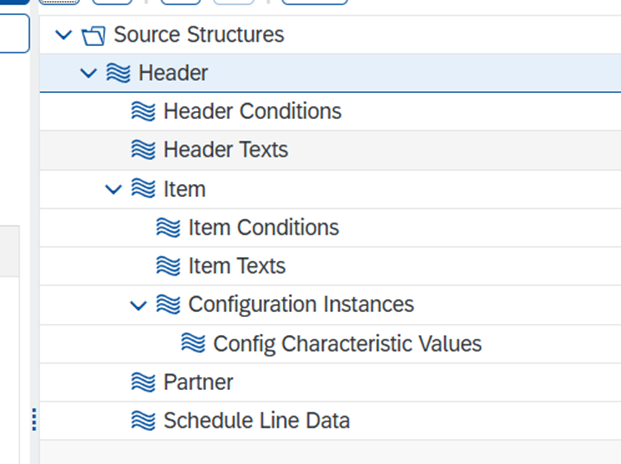
Transformation Mapping
| Mapping Table Name | Mapping Table Description |
|---|---|
Will be updated once the transformation is confirm Ignore the below from previous version | |
Transformation Dependencies
List the steps that need to occur before transformation can commence| Item # | Step Description | Team Responsible |
|---|---|---|
| 1 | Source Data Integrity - Ensure extracted data is complete, accurate, and consistent. - Validate that data types and formats align with transformation requirements. | Synithi |
| 2 | Referential Integrity - Ensure dependent records are transformed together or in advance | Synithi |
| 3 | Transformation Logic and Mapping - Define data mapping rules between source and target schemas. | Data Team |
| 4 | Performance and Scalability Considerations - Optimize transformation processes for large datasets. - Ensure system resources can handle transformation workloads | Synithi |
| 5 | Logging and Error Handling - Maintain detailed logs of transformation activities. - Define error-handling procedures for failed transformations | Synithi |
Pre-Load Validation
Project Team
Completeness
| Task | Action |
|---|---|
Validate mandatory and key fields | Mandatory field check.
Check Business Partners Master Data
Check Material Master Data
Check Sales Order Item Consistency
Check Currency and Pricing Data
|
Reconciliation check | Record Count
Check Amount in Document Currency and Local Currency
Check Total Quantity
|
Accuracy
| Task | Action |
|---|---|
| Validate the transformation | Make sure all fields with transformation are populated with S/4 HANA values according to the mapping file. |
| Check Data Consistency |
|
Business
Completeness
| Task | Action |
|---|---|
| Conversion check | In legacy system, execute report Open Sales Orders List (e.g. via transaction code VA05 or equivalent custom report). Group the output of the report by Sales Organization and Sold-to Party using the subtotal function and compare the count in this report against the Open Sales Orders count in the pre-load file. The record count for Open Sales Orders may also be done at a more granular level. The recommended granular level or subtotal fields can consist of:
If any of the count is different, raise a defect and flag the relevant record as error. |
Accuracy
| Task | Action |
|---|---|
| Key fields check | Perform the following checks on a selected sample of open sales orders:
|
| Validate the transformation | Make sure all fields with transformation are populated with S/4 HANA values according to the mapping file. |
Load
The load process includes:
- Execute the automated data load into target system using load tool or product the load file if the load must be done manually
- Once the data is loaded to the target system, it will be extracted and prepared for Post Load Data Validation
Load Run Sheet
| Item # | Step Description | Team Responsible |
|---|---|---|
| 1 | Load Scope Definition - Identify the target system and database structure. - Define data objects (tables, fields, records) to be loaded. - Establish business rules for data validation. | Data team |
| 2 | Load Methodology - Specify the loading tools and technologies (Migration Cockpit, LSMW, custom loading program). | Synithi |
| 3 | Data Quality and Validation - Ensure data integrity checks (null values, duplicates, format validation). - Perform pre-load validations to verify completeness. - Define error handling mechanisms for load failures | Synithi |
| 4 | Load Execution Plan - Establish execution timelines and batch processing schedules. - Assign responsibilities for monitoring execution. - Document dependencies on other migration tasks | Synithi |
| 5 | Logging and Reporting - Maintain detailed logs of loading activities. - Generate summary reports on loaded data volume and quality. - Define escalation procedures for errors | Synithi |
Load Phase and Dependencies
Open Sales Orders will be loaded in the pre-cutover or cutover phase, depending on business cut-off.
Configuration
| Item # | Configuration Item |
|---|---|
1 | Order type |
2 | Item categories |
3 | Schedule lines categories |
4 | Pricing procedure |
5 | Number range settings for orders |
Conversion Objects
| Object # | Preceding Object Conversion Approach |
|---|---|
| 1034 | Sales Pricing Conditions |
| 1036 | Customer Material Information Records(CMIR) |
| 1042 | TM - Transportation Lanes |
| 1046 | Classes Type: 023 ( Batch) |
| 1047 | Batch Characteristics of Class Type: 023 |
| 1048 | Batch Master |
| 1051 | TM - Locations |
| 1052 | TM - Transportation Zones |
| 1053 | TM - Default Routes |
| 1058 | Batch Classification Data |
| 1062 | Batch Search Strategy |
| 1134 | Output determination for application V1/V3 |
| 1135 | Z tables (variant table) |
| 2001 | Material Listing and Exclusions |
| 2002 | Material Substitution |
| 2003 | Materials - Sales view with sales long text |
| 2005 | Materials - MRP view (4 views) |
| 2011 | Materials - WM Execution ( EWM ) |
| 2012 | Materials - Accounting 1 |
| 2013 | Materials - Costing 1 |
| 2014 | Materials - Accounting 2 |
| 2015 | Materials - Costing 2 |
| 2019 | Materials - Basic View |
| 2027 | Materials - Foreign Trade Views |
| 3003 | Business Partners - Customer (Sales and Service) - FLCU01 |
| 3007 | Business Partners - General (Role 000000) |
| 3010 | Business Partners - Relationship for contact person |
| 3011 | Business Partners - Contact Persons (BUP001) |
| 3017 | Business Partners - FI Customer (FLCU00) |
| 3019 | Business Partners - Credit Management (UKM000) |
| 3022 | Business Partners - Collection Management (UDM000) |
| 3027 | Business Partners - Plants/Intercompany Suppliers |
| 3039 | Business Partners - GTS Master |
| 3040 | Business Partners - Treasury |
Error Handling
| Error Type | Error Description | Action Taken |
|---|---|---|
| Configuration / Data Transformation | The value XXX for field XXX doesn't exist |
|
| Configuration | There is mandatory field XXX missing |
|
| Obsolete Master Data | Customer or material master data no longer exists in target system | Replaced or removed based on business input |
Post-Load Validation
Project Team
The following post-load validations will be performed by the Project Team.Completeness
| Task | Action |
|---|---|
Validate Record count | Total number of records loaded for Open Sales Orders will be generated in the post-load reports in the tool based on the target tables and fields mentioned in section target design. The reconciliation needs to be executed on the total number of 'valid' records and amounts per Sales Organization in the source compared to total number of records and amounts in S/4HANA. Record Count
Check Amount in Document Currency and Local Currency
|
Accuracy
| Task | Action |
|---|---|
| Validate Key Fields |
|
Business
Post-load validation is a critical step in data migration, ensuring that transferred data is accurate, complete, and functional within the target system.
1. Ensuring Data Integrity
After migration, data must be consistent with its original structure. Post-load validation checks for missing records, incorrect mappings, and formatting errors to prevent discrepancies.
2. Business Continuity
Faulty data can disrupt operations, leading to financial losses and inefficiencies. Validating post-load data ensures that applications function as expected, preventing downtime.
3. Error Detection and Resolution
By validating data post-migration, businesses can detect anomalies early, reducing the cost and effort required for corrections
Completeness
| Task | Action |
|---|---|
| Review Loaded Condition Records | Access the S/4HANA system (via transactions like VA05 or custom reports) to view loaded sales order |
Accuracy
| Task | Action |
|---|---|
Display Records | Pick up few random sales document number numbers, display with Tcode VA03 and validate the details |
Key Assumptions
- Adapting S4 cross instances direct delivery solutions, where a plant from a different S4 instance can be entered in the Sales Order.
- Adapting S4 cross instances inter-company Purchase Order solution. The subsequent Sales Order will be automatically created even though it's in a separate instance.
See also
Change log
Workflow history
| Title | Last Updated By | Updated | Status | |
|---|---|---|---|---|
| There are no pages at the moment. | ||||