


| Status | |
| Owner | Soumen Laru |
| Stakeholders |
Purpose
The purpose of this document is to define the conversion approach to migrate TB PY in S/4 HANA. This is the opening balance of FY '26 ( for Group 1 ) or opening balance of FY '27 ( for group 2 )
Amounts in legacy involve document currency, local currency and group currency. All currencies will be loaded accordingly unless there is a change in company design where local / group currency changes. Rates are as per the historical postings unless specific requirement calls for a fixed rate eg. group currency rate for consolidation purposes. Offsetting gl accounts in legacy documents will not be considered in this migration scope, they will be migrated in other objects scope eg. GL open item or GL balances.
Conversion Scope
The scope of this document covers the approach for converting active TB CY (Current year) from Legacy Source Systems into S/4HANA following the target design requirements.
As per the current plan, there are two go-lives - Group 1 and Group 2.
- Group 1 goes live on 1st July 2028 : TB Migration scope for this group is 1.5 Years worth of Balance starting from Opening Balance from January-2027
- Group 2 goes live on 1st January 2029 : TB Migration scope for this group is 1.5 Years worth of Balance starting from Opening Balance from January-2028
Trial balance of January is the opening balance of the relevant fiscal year and will be migrated as the prior year closing balance. Thereafter, a carry forward of TB will be carried out by business after migration completion. In other words, migration posting date of the opening balance of January-2027 will be 31-12-2026 and migration posting date of the opening balance of January-2028 will be 31-12-2027.
| Source | Scope | Source Approx No. of Records | Target System | Target Approx No. of Records |
|---|---|---|---|---|
| PF2 | TB PY | S4HANA | ||
| WP2 | TB PY | S4HANA |
Additional Information
Balance Sheet migration strategy is different based on the below GL Types -
Non-Open item managed Balance Sheet Account
Open Item managed Balance Sheet Account
Reconciliation (Control) Accounts (including Inventory Account)
Balance Sheet Account balances will be migrated as a two-step process -
Opening Balance as on 31st December '26
Year to date movement - Migrate year to date movement for each month until 31st December '26 for Group 1 company codes and until 31st June for Group 2 countries.
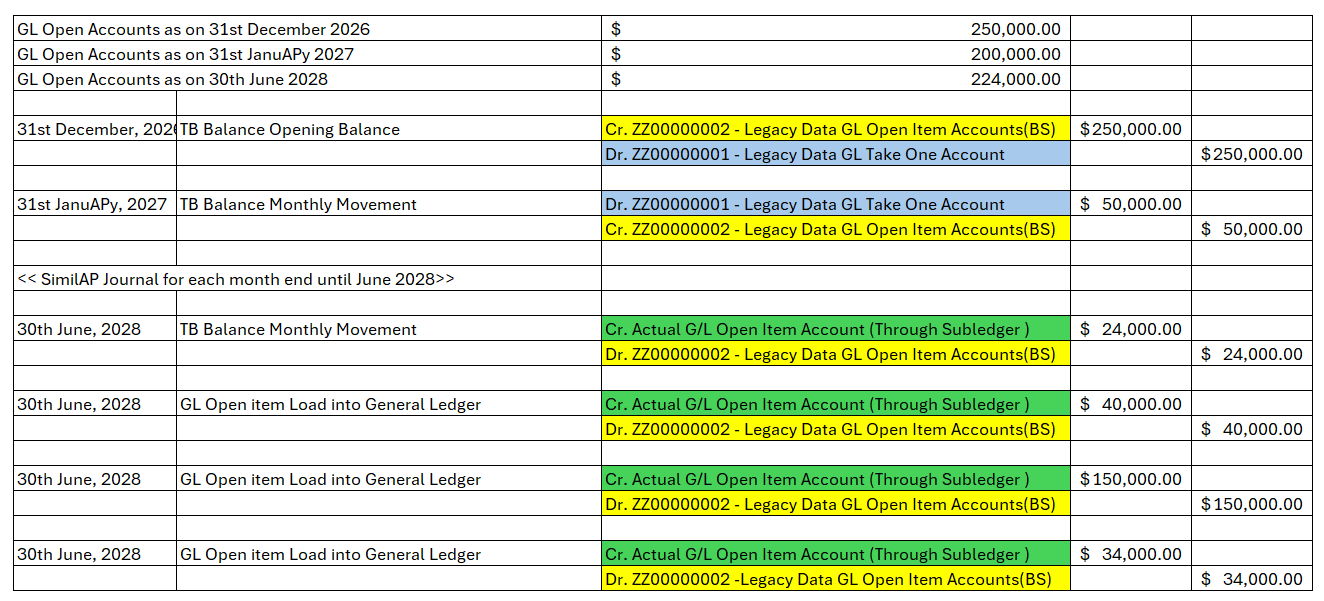
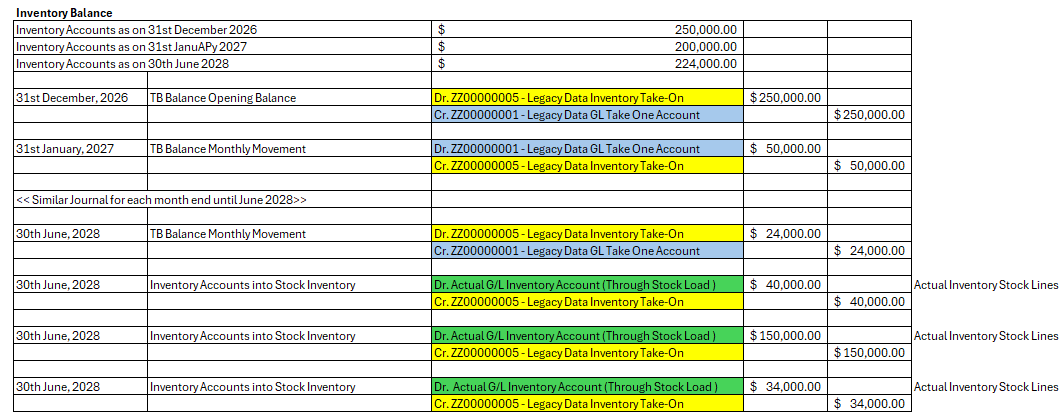
Balance of Reconciliation accounts, GL open item accounts and Inventory accounts will not be migrated against actual GL on 31st March/YTD. Instead, below take on account will be posted, and the actual account will be posted only on the cutover month end against subledger postings/open item postings.
- ZZ00000001 (TBD) GL Balance Take-On Account ( TB Migration Account )
ZZ00000002 (TBD) Legacy GL Open Item offset Take on Account
ZZ00000003 (TBD) Legacy Data AR Take on Account
ZZ00000004 (TBD) Legacy Data AP Take on Account
ZZ00000005 (TBD) Legacy Data Inventory Take on Account
ZZ00000006 (TBD) Legacy Data Assets Take on Account
Following illustrations show how TB and Sub-Ledger Financial data migration will be carried out.

AP Open Item migration with Respect to TB
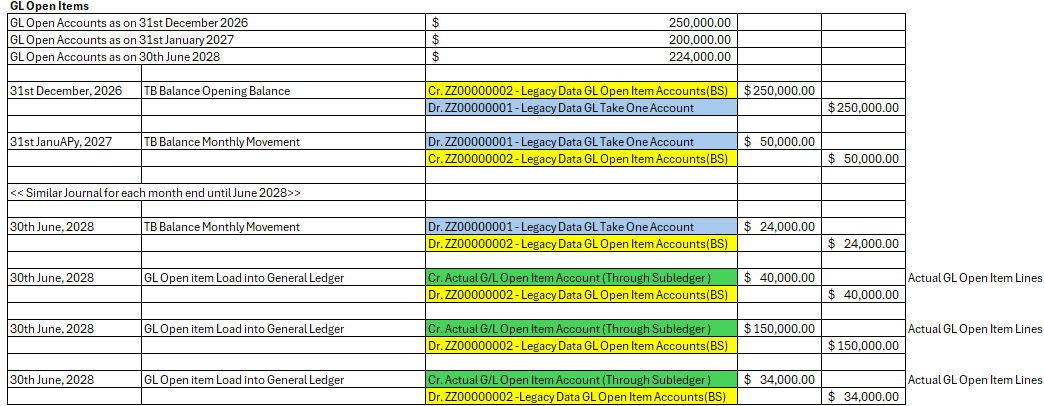
GL Open Item Migration with Respect to TB
Inventory Stock migration with Respect to TB
Fixed Asset Migration with Respect to TB

WBS AUC Balance Migration With Respect to TB

Multi-language Requirement
Document Management
Legal Requirement
Special Requirements
In ECC, parallel accounting was based on account approach.
e.g
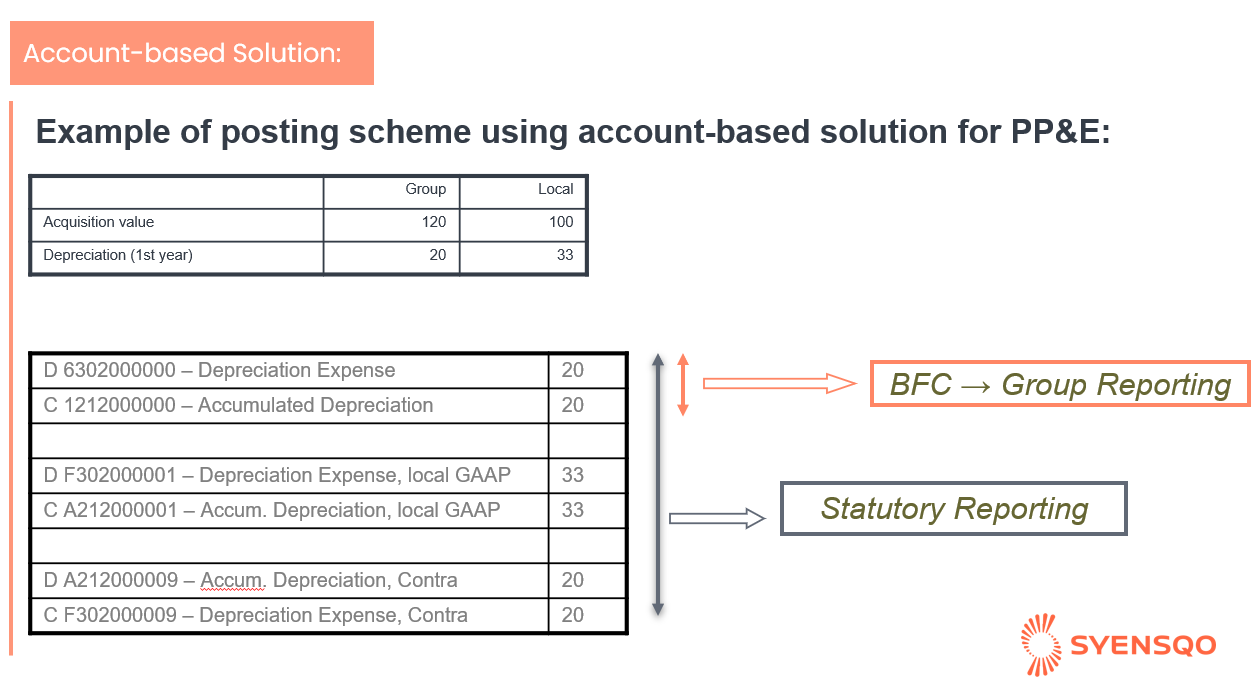
Parallel accounting in target S4 is ledger based approach. In ledger-based approach assigns each principle to its own dedicated ledger with a 1:1 ratio between ledgers and principles. The migration strategy typically involves a conversion from an existing classic G/L (often using the account approach) to the new G/L, then to S/4HANA.
for the same example above, migration to be done into local GAAP and IFRS ledger as below
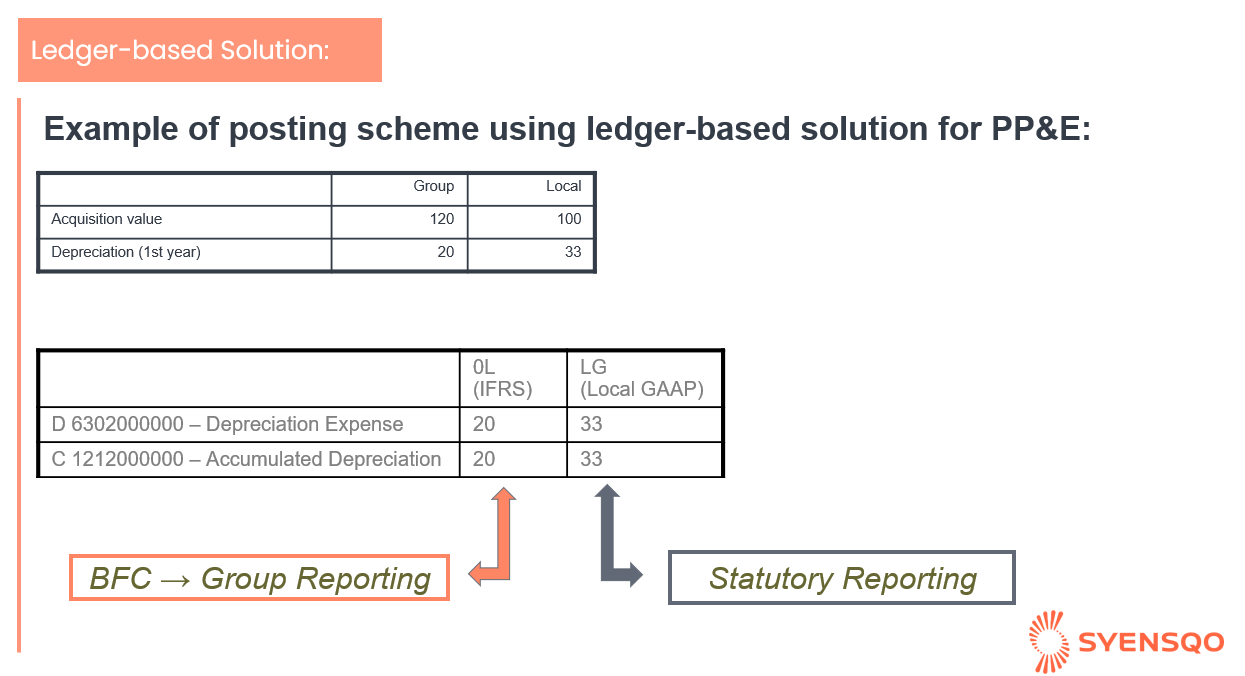
Therefore, accounts as illustrated above need to be migrated through ledger-specific postings. (e.g FB01L instead of FB01).
For the transfer of open items and Balance carryforward, the following applies:
You can only manage open items in common accounts because the transfer of open items always applies to all ledgers and is not specific to individual ledgers.
You have to transfer balances carried forward for individual ledgers, that is
Common accounts to all ledgers
Valuation-specific (parallel) accounts to the respective ledgers.
A list of accounts to be identified for which IFRS GAAP to be posted against directly using IFRS ledger selection like done in tcode FB01L.
Target Design
The technical design of the target for this conversion approach.
Table | Field | Data Element | Field Description | Data Type | Length (Decimals) | Requirement |
| ACDOCA | BUKRS | BUKRS | Company Code | CHAR | 30 | Mandatory Note: More details described in the Transformation Rules |
| ACDOCA | LDGRP | LDGRP | Ledger Group | CHAR | 30 | Mandatory Note: More details described in the Transformation Rules |
| ACDOCA | XBLNR | XBLNR | Reference Document Number | CHAR | 16 | Optional Note: More details described in the Transformation Rules |
| ACDOCA | DOCLN | DOCLN | Line Item Number | Number | 6 | Mandatory Note: More details described in the Transformation Rules |
| ACDOCA | HKONT | HKONT | G/L Account | CHAR | 30 | Mandatory Note: More details described in the Transformation Rules |
| ACDOCA | GKONT | GKONT | Offsetting Account | CHAR | 80 | Mandatory Note: More details described in the Transformation Rules |
| ACDOCA | BLART | BLART | Document Type | CHAR | 80 | Mandatory Note: More details described in the Transformation Rules |
| ACDOCA | BUDAT | BUDAT | Posting Date | Date | Mandatory Note: More details described in the Transformation Rules | |
| ACDOCA | BLDAT | BLDAT | Document Date | Date | Mandatory Note: More details described in the Transformation Rules | |
| ACDOCA | WWERT | WWERT | Translation Date | Date | Optional Note: More details described in the Transformation Rules | |
| ACDOCA | ACC_PRINCIPLE | ACC_PRINCIPLE | Accounting Principle | CHAR | 80 | Optional Note: More details described in the Transformation Rules |
| ACDOCA | BKTXT | BKTXT | Header Text | CHAR | 25 | Mandatory Note: More details described in the Transformation Rules |
| ACDOCA | SGTXT | SGTXT | Item Text | CHAR | 50 | Mandatory Note: More details described in the Transformation Rules |
| ACDOCA | WAERS | WAERS | Transaction Currency | CHAR | 80 | Mandatory Note: More details described in the Transformation Rules |
| ACDOCA | WRBTR | WRBTR | Amount | Number | 23 | Mandatory Note: More details described in the Transformation Rules |
| ACDOCA | HWAER | HWAER | Company Code Currency | CHAR | 80 | Mandatory Note: More details described in the Transformation Rules |
| ACDOCA | DMBTR | DMBTR | Amount | Number | 23 | Mandatory Note: More details described in the Transformation Rules |
| ACDOCA | HWAE2 | HWAE2 | Group Currency | CHAR | 80 | Mandatory Note: More details described in the Transformation Rules |
| ACDOCA | DMBE2 | DMBE2 | Amount | Number | 23 | Mandatory Note: More details described in the Transformation Rules |
| ACDOCA | HWAE3 | HWAE3 | Freely Defined Currency | CHAR | 80 | Mandatory Note: More details described in the Transformation Rules |
| ACDOCA | DMBE3 | DMBE3 | Amount | Number | 23 | Optional Note: More details described in the Transformation Rules |
| ACDOCA | RASSC | RASSC | Company ID of Trading Partner | CHAR | 80 | Optional Note: More details described in the Transformation Rules |
| ACDOCA | ZUONR | ZUONR | Assignment Number | CHAR | 18 | Mandatory Note: More details described in the Transformation Rules |
| ACDOCA | RMVCT | RMVCT | Transaction Type | CHAR | 80 | Optional Note: More details described in the Transformation Rules |
| ACDOCA | PERNR | PERNR | Personnel Number of Employee | CHAR | 80 | Optional Note: More details described in the Transformation Rules |
| ACDOCA | VALUT | VALUT | Value Date | Date | Optional Note: More details described in the Transformation Rules | |
| ACDOCA | HBKID | HBKID | Short Key for House Bank | CHAR | 80 | Optional Note: More details described in the Transformation Rules |
| ACDOCA | HKTID | HKTID | ID for Account Details | CHAR | 80 | Optional Note: More details described in the Transformation Rules |
| ACDOCA | KOSTL | KOSTL | Cost Center | CHAR | 80 | Conditional Note: More details described in the Transformation Rules |
| ACDOCA | PRCTR | PRCTR | Profit Center | CHAR | 80 | Conditional Note: More details described in the Transformation Rules |
| ACDOCA | FB_SEGMENT | FB_SEGMENT | Segment | CHAR | 80 | Optional Note: More details described in the Transformation Rules |
| ACDOCA | PSPNR | PSPNR | WBS Element | CHAR | 80 | Optional Note: More details described in the Transformation Rules |
| ACDOCA | AUFNR | AUFNR | Order Number | CHAR | 80 | Optional Note: More details described in the Transformation Rules |
Data Cleansing
ID | Criticality | Error Message/Report Description | Rule | Output | Source System |
TBD |
Conversion Process
The high-level process is represented by the diagram below:

Data Privacy and Sensitivity
Extraction
Extract data from a source into . There are 2 possibilities:
- The data exists. connects to the source and loads the data into . There are 3 methods:
- Perform full data extraction from relevant tables in the source system(s).
- Perform extraction through the application layer.
- Only if ; cannot connect to the source, data is loaded to the repository from the provided source system extract/report.
- The data does not exist (or cannot be converted from its current state). The data is manually collected by the business directly in . This is to be conducted using DCT (Data Collection Template) in
The agreed Relevancy criteria is applied to the extracted records to identify the records that are applicable for the Target loads
Extraction Run Sheet
Req # | Requirement description | Team responsible |
1. | Ensure source tables GLPCT, GLT0, COEP are extracted in tool according to the agreed cut-off date in the project plan | Data team |
2. | Perform preliminary completeness check documented in section 5.2.8.1.1 | Data team |
3. | Raise issues as defects if Req # 1 to 2 are not met | Data team |
4. | Repeat Req # 1 to 3 if required | Data team |
5. | Report extraction result to person in charge of APOI conversion | Data team |
Selection Screen
| Selection Ref Screen | Parameter Name | Selection Type | Requirement | Value to be entered/set |
|---|---|---|---|---|
Data Collection Template (DCT)
Target Ready Data Collection Template will be created for data with exception of some fields which require transformation as mentioned in the transformation rule.
DCT Rules
DCT is not applicable
Suggestion to add:
Decimal validation - Check table TCURX for the document currency key and if Decimals (TCURX-CURRDEC) is ‘0’, validate that no decimal value is populated.
Extraction Dependencies
Item # | Step description | Team responsible |
1. | Any period / year end close activities have been fully completed | Business |
2. | Reconciliation for intercompany payables have been completed, and adjustment made in legacy SAP system | Business |
3. | Reconciliation of migrated Purchase Order is completed before the extraction of Accounts Payable Open Items | Business and Data |
Transformation
The Target fields are mapped to the applicable Legacy field that will be its source, this is a 3-way activity involving the Business, Functional team and Data team. This identifies the transformation activity required to allow to make the data Target ready:
- Perform value mapping and data transformation rules.
- Legacy values are mapped to the to-be values (this could include a default value)
- Values are transformed according to the rules defined in
- Prepare target-ready data in the structure and format that is required for loading via prescribed Load Tool. This step also produces the load data ready for business to perform Pre-load Data Validation
Transformation Run Sheet
Item # | Step description | Team responsible |
1. | Ensure all the fields that require value mapping, as stipulated Mapping tables, have the latest signed-off mapping files imported into toolMigrate. | Data team |
2. | In tool, select the Trial Balance object PY. | Data team |
3. | Go to Process Area Launch and Process the Object - Trial Balance object - R4 Trial Balance PY. | Data team |
4. | Launch the Objects to execute transformation. | Data team |
5. | Monitor the transformation progress and ensure performance and completion is within allowed timeframe | Data team |
6. | Generate Pre-Load reports . | Data team |
7. | Generate data load count. | Data team |
8. | Log errors as defects, if any and address resolutions. Close defects. | Data team |
9. | Re-transform and re-validate the Pre-load reports if necessary. | Data team |
10. | Validate the transformed file as part of pre-load validation, raise data defects or provide the pre-load sign-off. | Business |
11. | Analyse and resolve any pre-load defects logged by business. | Data team |
12. | Repeat steps 6 to 11 if necessary | Data team |
13. | Proceed to pre-load validations | Data team |
Transformation Rules
Note:
Periodic balances of GL Accounts to be read from GLPCT/GLT0.
Note: for Each GL balance in scope of migration, an offset line to be created with the same GL Account.
For the Field mapping transformation rules, wherever Rule 1 and Rule 2 denoted in the transformation logic column, please note that Rule 1 applies to main line ( GL Balance line ) and Rule 2 applies to offset line.
Rule # | Source system | Source Table | Source Field | Source description | Target system | Target Table | Target Field | Target description | Transformation logic |
| 1 | ECC | BKPF | BUKRS | Company Code | S/4HANA | ACDOCA | BUKRS | Company Code | Map Company Code from ECC to S4 |
| 2 | ECC | BSIS | LDGRP | Ledger Group | S/4HANA | ACDOCA | LDGRP | Ledger Group | To Be kept Blank |
| 3 | ECC | BSIS | XBLNR | Reference Document Number | S/4HANA | ACDOCA | XBLNR | Reference Document Number | Copy as is |
| 4 | ECC | BSIS | DOCLN | Line Item Number | S/4HANA | ACDOCA | DOCLN | Line Item Number | Copy as is |
| 5 | ECC | BSIS | HKONT | G/L Account | S/4HANA | ACDOCA | HKONT | G/L Account | Map Old GL Account to new GL Account Note: For each Sub-ledger Accounts ( Fixed Asset, Customer, Vendor, GR/IR Open items, Inventory Accounts), standard mapping to be replaced with Take-on Accounts. In the GL Account Mapping File, additional target mapping will be given to contain take-on account. |
| 6 | ECC | BSIS | GKONT | Offsetting Account | S/4HANA | ACDOCA | GKONT | Offsetting Account | Default to Migration GL Open Item Account. |
| 7 | ECC | BKPF | BLART | Document Type | S/4HANA | ACDOCA | BLART | Document Type | Default to 'UE' |
| 8 | ECC | BKPF | BLDAT | Document Date | S/4HANA | ACDOCA | BLDAT | Document Date | Copy as is |
| 9 | ECC | BSIS | WWERT | Translation Date | S/4HANA | ACDOCA | WWERT | Translation Date | Not used |
| 10 | ECC | BSIS | ACC_PRINCIPLE | Accounting Principle | S/4HANA | ACDOCA | ACC_PRINCIPLE | Accounting Principle | Not used |
| 11 | ECC | BKPF | BKTXT | Header Text | S/4HANA | ACDOCA | BKTXT | Header Text | Rule 1: Copy as is, for the Open item line Rule 2: Company Code ( BUKRS ), Fiscal Period( to be derived from ledger table) and Legacy GL Account |
| 12 | ECC | BSIS | SGTXT | Item Text | S/4HANA | ACDOCA | SGTXT | Item Text | Copy as is |
| 13 | ECC | BSIS | WAERS | Transaction Currency | S/4HANA | ACDOCA | WAERS | Transaction Currency | Copy as is |
| 14 | ECC | BSIS | WRBTR | Amount | S/4HANA | ACDOCA | WRBTR/TSL | Amount | This is for currency type 00 Rule 1: Copy as is with Signage as '-' if the posting key is 50 or else '+' Rule 2: for offset line, please make the amount from debit to credit , credit to debit and apply above logic. |
| 15 | ECC | BSIS | HWAER | Company Code Currency | S/4HANA | ACDOCA | HWAER | Company Code Currency | Automatic |
| 16 | ECC | BSIS | DMBTR | Amount | S/4HANA | ACDOCA | DMBTR/HSL | Amount | This is for currency type 10 Rule 1: Copy as is with Signage as '-' if the posting key is 50 or else '+' Rule 2: for offset line, please make the amount from debit to credit , credit to debit and apply above logic. |
| 17 | ECC | BSIS | HWAE2 | Group Currency | S/4HANA | ACDOCA | HWAE2 | Group Currency | Automatic ( TBD ) |
| 18 | ECC | BSIS | DMBE2 | Amount | S/4HANA | ACDOCA | DMBE2/KSL | Amount | Group Currency 2 This is for currency type 30 ( Global currency / Group currency ) Note: Currently, legacy does not have group currency amount, the plan is let exchange to populate this. Rule 1: Copy as is with Signage as '-' if the posting key is 50 or else '+' Rule 2: for offset line, please make the amount from debit to credit , credit to debit and apply above logic. |
| 19 | ECC | BSIS | HWAE3 | Freely Defined Currency | S/4HANA | ACDOCA | HWAE3 | Freely Defined Currency | Automatic |
| 20 | ECC | BSIS | DMBE3 | Amount | S/4HANA | ACDOCA | DMBE3/VSL | Amount | Group Currency 2 This is for currency type 31 ( Freely Defined currency type 2 ) Note: Currently, legacy does not have group currency amount, This is yet to be confirmed as to how this will be derived, Rule 1: Copy as is with Signage as '-' if the posting key is 50 or else '+' Rule 2: for offset line, please make the amount from debit to credit , credit to debit and apply above logic. |
| 21 | ECC | BSIS | RASSC | Company ID of Trading Partner | S/4HANA | ACDOCA | RASSC | Company ID of Trading Partner | Copy as is |
| 22 | ECC | BSIS | ZUONR | Assignment Number | S/4HANA | ACDOCA | ZUONR | Assignment Number | to be kept empty |
| 23 | ECC | BSIS | RMVCT | Transaction Type | S/4HANA | ACDOCA | RMVCT | Transaction Type | to be kept empty |
| 25 | ECC | BSIS | VALUT | Value Date | S/4HANA | ACDOCA | VALUT | Value Date | to be kept empty |
| 26 | ECC | BSIS | HBKID | Short Key for House Bank | S/4HANA | ACDOCA | HBKID | Short Key for House Bank | to be kept empty |
| 27 | ECC | BSIS | HKTID | ID for Account Details | S/4HANA | ACDOCA | HKTID | ID for Account Details | to be kept empty |
| 28 | ECC | BSIS | KOSTL | Cost Center | S/4HANA | ACDOCA | KOSTL | Cost Center | Map Old Cost Centre to New Cost Centre |
| 29 | ECC | BSIS | PRCTR | Profit Center | S/4HANA | ACDOCA | PRCTR | Profit Center | Map Old Profit Centre to New Profit Centre |
| 30 | ECC | BSIS | FB_SEGMENT | Segment | S/4HANA | ACDOCA | FB_SEGMENT | Segment | to be kept empty |
| 31 | ECC | BSIS | PSPNR | WBS Element | S/4HANA | ACDOCA | PSPNR | WBS Element | to be kept empty |
| 32 | ECC | BSIS | AUFNR | Order Number | S/4HANA | ACDOCA | AUFNR | Order Number | to be kept empty |
How to derive profit centres for various GL balance components:
- Inventory Balance Take-on Account:
- PF2:
- Stock balance data will be derived and structured at the profit centre level to ensure alignment with the target S/4HANA organisational structure.
- This dataset will provide stock balances at the material and plant level, which in turn will be mapped to the corresponding profit centres based on the material–plant–company code–profit centre mapping logic.
- The same distribution key (comprising Company Code, Profit Centre, and Stock Balance) will be applied to allocate the stock-related take-on GL account balances, derived from the source ECC GL balance data, ensuring accurate and consistent inventory take-on balances at the profit centre level.
- WP2:
- Stock balance data will be derived and structured at the profit centre level to ensure alignment with the target S/4HANA organisational structure.
- This dataset will provide stock balances at the material and plant level, which in turn will be mapped to the corresponding profit centres based on the material–plant–company code–profit centre mapping logic.
- The same distribution key (comprising Company Code, Profit Centre, and Stock Balance) will be applied to allocate the stock-related take-on GL account balances, derived from the source ECC GL balance data, ensuring accurate and consistent inventory take-on balances at the profit centre level.
- PF2:
Transformation Mapping
Mapping Table Name | Mapping Table Description |
Company Code | Mapping of legacy company codes to target system value |
GL Account | Mapping of legacy GL accounts to target system value |
Profit Centre | Mapping of legacy Profit Center to target system value |
Business Partner | Mapping of legacy vendor accounts to target system value |
Trading Partner | Mapping of legacy trading partners to target system value |
Currency Key | Mapping of legacy currency keys to target system value |
Special G/L Indicator | Mapping of legacy special GL indicator to target system value |
Payment Block Key | Mapping of legacy payment block key to target system value |
Payment Method | Mapping of legacy payment method to target system value |
Open Purchase order cross references | Mapping of legacy PO to target system value |
Transformation Dependencies
List the steps that need to occur before transformation can commence| Item # | Step Description | Team Responsible |
|---|---|---|
| 1 | Ensure all the fields that require value mapping, as stipulated. Mapping tables, have the correct values mapped and imported into tool. | Data team |
Pre-Load Validation
Project Team
Completeness
Task | Action |
Generation of | Mandatory field check. Check if records have all mandatory fields filled and mapped, otherwise they should be flagged as error. Check GL Accounts are extended to required company code Field combination of SAKNR and BUKRS to be checked against SKB1. Cost-Centre Validity Period Check KOSTL against CSKS-DATBI>= Cut-Over Date ( Parameter Based ) Check signage of amount.
|
Reconciliation of total | Record Summation Check the sum of record count of the TB Balance ( PY ) in the load file is the same as source. The record count for TB Balance ( PY ) will be done on the group basis. The fields in the group are consist of: Company Code, GL Account, Profit Centre Check Amount in Document Currency and Local Currency Check the sum of the amount in Document Currency and Local Currency in load file is the same as source. If any of the sum is different, flag the record as error. |
Accuracy
Task | Action |
Mandatory field mapping and transformation | Obtain a list of the fields to be populated with values from mapping files and ensure all these fields contain S/4HANA values. |
Business
Completeness
| Task | Action |
|---|---|
| Verify record count in Pre-load reports by region | In legacy system, execute report AP Line Item Display (t/code: FS10N ) with selection parameters stated in section 7.2. Group the output of the report by Company Code, GL Account and Profit Centre using subtotal function and compare the count in this report against the TB Balance ( PY ) count in the pre-load file. The record count for TB Balance ( PY ) may also be done on the more granular level. The recommended granular level or the subtotal fields can consist of: Company Code, Vendor, Profit Centre, Document Currency Key, Company ID for Trading Partner. If any of the count is different, raise defect and flag the relevant record as error. |
Accuracy
| Task | Action |
|---|---|
| Conversion accuracy | Verify TB Lines are transformed accurately as per endorsed transformation/mapping rules. Review error reports in tool for any mismatch or missing transformed values. In legacy system, execute report Trial Balance Display (t/code: FS10N ) with selection parameters. If any of the sum is different, raise defect and flag the relevant record as error. |
| Business partner balance on Company code and profit center level | Check the total open item amount on Business partner at Company Code and Profit center level, against the total in legacy by Document, Local and Group currency. Apply currency rules where applicable |
oad
The load process includes:
- Execute the automated data load into target system using load tool or product the load file if the load must be done manually
- Once the data is loaded to the target system, it will be extracted and prepared for Post Load Data Validation
Load Run Sheet
Item | Step description | Team responsible |
1 | Ensure the load tools are transported into the correct tool instance. | Data team |
2 | Ensure DCTs and all required mappings are submitted and complete | Data team |
3 | Ensure Pre-load sign-offs are obtained. | Data team |
4 | Execute tool Trial Balance Upload | Data team |
5 | Generate the post load reports in tool. | Data team |
6 | Log errors as defects, if any and address resolutions. Close defects. | Data team |
7 | Resolve defects by reupload and re-generate post load reports if necessary. | Data team |
8 | Business to validate the post load files as part of post-load validation, raise data defects or provide the post-load sign-off. | Business |
9 | Repeat steps 5 to 7 if necessary. | Data team |
Load Phase and Dependencies
Configuration
Item # | Configuration item |
1. | Company code-related configuration (posting period variant). |
2. | Finance posting (document types, document number ranges, special gl indicator) |
3. | Currencies (currency keys, decimal places in currencies) |
Conversion Objects
| Object # | Preceding Object Conversion Approach |
|---|---|
| 1067 | GL Account Operational CoA (incl. secondary CE) |
| 1073 | Profit center |
Error Handling
Error type | Error description | Action taken |
Posting Period Error | Posting period is blocked for posting | Review project / cutover plan and ensure posting periods can be opened for postings |
Profit Centre does not exist | Profit centre does not exist in company code | Ensure the profit centre mapping is correct and or create the profit centre if it is valid |
Post-Load Validation
Project Team
Completeness
| Task | Action |
|---|---|
| Reconciliation of Record Count | Total number of records loaded for TB Balance ( PY ) will be generated in the Post-load reports in tool based on the target table and fields mentioned in section 3. The reconciliation needs to be executed on the total number of ‘valid’ records and currency amount per company code in the source compared to total number of records and currency amount in S/4HANA Record Count Check the sum of record count of the open items in the load file is the same as S/4HANA. The record count for TB Balance ( PY ) will be done on the group basis. The fields in the group are consist of: Company Code, Vendor Account Check Amount in Document Currency and Local Currency Check on line item level that the sum of the amount in Document Currency and Local Currency in the load file is the same as posted in S/4HANA. If any of the sum is different, flag the record as error. |
Accuracy
| Task | Action |
|---|---|
| Check values in key fields for accuracy | Post-load reports will have the same structure as the load file and some additional columns as required to facilitate the post load validation. Leverage on tool to create a Post Load report that reports S/4HANA loaded records along with the legacy values side-by-side to allow for 100% check of all these fields in the shortest possible time. Any mismatch will be reported under the Post Load - Error report. |
Business
Completeness
| Task | Action |
|---|---|
| Record Count Check | Review the record count report from the Data Team and ensure it is correct by cross-checking with the record count confirmed during Pre-load Business Validations |
Accuracy
| Task | Action |
|---|---|
| Open items totals | Check business partner open item totals by Business partner, Company code, profit centre. Totals should be checked in Document, Local and Group currency. |
| Spot check | Business should choose some business partners and perform comprehensive check of open items, payment terms etc Such partners should have huge number of open items or be critical for payment runs in S4 or have certain complexity in conversion. |
Key Assumptions
- Master Data Standard is up to date as on the date of documenting this conversion approach and data load.
- is in scope based on data design and any exception requested by business.
Change log
Workflow history
| Title | Last Updated By | Updated | Status | |
|---|---|---|---|---|
| There are no pages at the moment. | ||||