


| Status | Approved |
|---|---|
| Owner | |
| Stakeholders |
Purpose
The purpose of this document is to define the conversion approach to create Materials - International Trade Views in S/4 HANA and GTS.
The International Trade view in SAP S/4HANA is designed to support companies in managing all regulatory and compliance requirements related to cross-border trade. It replaces the classic "Foreign Trade" views from SAP ECC and centralizes key data needed for customs, export, and import processes.
Conversion Scope
The scope of this Materials - International Trade Views document covers the approach for converting active Material Foreign Trade data from Legacy Source Systems into S/4HANA Material International Trade data and GTS following the Materials - International Trade Views Master Data Design Standard: DD-FUN-050 Master Data Standard_2029-Materials - International Trade Views.
This is to meet the Legal and Regulatory requirements for Plants with Plant Country Brazil and India.
For Brazil:
Control Code: Stores the NCM (Mercosur Common Nomenclature) code used for customs classification, tax determination, and fiscal reporting. This field is mandatory for all materials involved in taxable transactions in Brazil. This requirement is applicable to all material types for Brazil.
CFOP Category: Defines the CFOP category (Fiscal Operation Code) associated with the material. The CFOP determines the nature of the transaction (such as sale, return, import, or transfer) and is required for proper tax calculation and electronic fiscal document (NF-e) generation in Brazil. This requirement is applicable to all material types for Brazil.
For India:
Control Code: Store HSN (Harmonized System Nomenclature) used for GST determination, Tax access sequence and supports statutory reporting requirements like GSTR-1 and GSTR-3B, where HSN-wise tax summaries are needed.
From the current system landscape, Materials - International Trade Views exist in both legacy systems - PF2 and WP2 (Foreign Trade: Export Data and Foreign Trade: Import Data). Harmonization and validation are required to ensure the accurate and consolidated data in S/4HANA and GTS. While PF2 and WP2 serve as source systems, a mapping and transformation logic will be necessary to produce properly formatted load templates in line with the target design.
The data from legacy system includes:
- Material Basic Data View is migrated as per CNV-2019 Materials - Basic Data View.
- The Plant for Materials - International Trade Views has country = BR (Brazil) or IN (India) and is within the scope of S/4HANA.
- No flag for deletion at Plant level (MARC-LVORM)
| Source | Scope | Source Approx No. of Records | Target System | Target Approx No. of Records |
|---|---|---|---|---|
| PF2 | Materials - International trade views | 2,000 | S/4HANA ROW/ China/ CUI | 2,000 |
| WP2 | Materials - International trade views | 20,000 | S/4HANA ROW/ China/ CUI | 20,000 |
Additional Information
Multi-language Requirement
N/A
Document Management
N/A
Legal Requirement
Material CFOP category: is used to determine the proper CFOP. The CFOP determines the nature of the transaction (such as sale, purchase, return, import, or transfer) and is required for proper tax calculation and electronic fiscal document (NF-e) generation in Brazil.
Control Code - BR: NCM codes are required for materials used in company codes to comply with tax and legal reporting. The NCM code determines applicable federal taxes (e.g., IPI, PIS, COFINS) and is printed on the nota fiscal.
Control Code - IN: HSN codes are required for materials used in India company codes to comply with GST tax determination and legal reporting.
Special Requirements
Due to compliance requirement, there will be one SAP instance for Rest of the World (ROW), one for China and one for CUI. For Materials - International Trade Views, the same data will be created in all 3 SAP instances as it is Tier 1 object with central data governance and maintenance rule.
For Material Control Code records, it will also be migrated to GTS.
After Go-Live, this Material Control Code would come from GTS through an enhancement, as GTS is responsible for populating and maintaining the control code to ensure compliance with international trade regulations. This is a field commonly used in S/4 for tax determination but also leveraged in GTS for customs controls, embargo checks, and legal regulation alignment.
Target Design
Materials - International Trade Views Data strictly adheres to the Master Data Standard. The complete information of the key fields that hold the Materials - International Trade Views information follows the Master Data Standard document.
The technical design of the target for this conversion approach.
| Table | Field | Data Element | Field Description | Data Type | Length | Requirement |
|---|---|---|---|---|---|---|
| MARC | MATNR | MATNR | Material | CHAR | 40 | Mandatory |
| MARC | WERKS | WERKS_D | Plant | CHAR | 4 | Mandatory |
| MARC | INDUS | J_1BINDUS3 | Material CFOP category | CHAR | 2 | Mandatory for Brazil only |
| MARC | STEUC | STEUC | Control code for consumption taxes in foreign trade | CHAR | 16 | Mandatory |
Data Cleansing
All data cleansing should take place in the data source system as defined in this document, unless system limitations prevent it.
Materials - International Trade Views
ALL Data Cleansing should be after Relevancy Rule
| ID | Criticality | Error Message/Report Description | Rule | Output | Source System |
|---|---|---|---|---|---|
| 2029-001 | C1 | Material no flag for deletion at Plant level and have records in Control Code but CNV-2019 Materials - Basic Data View not migrated | Material for Plant in-scope and plant country = BR or IN, where Control Code (MARC-STEUC) = NOT Blank but not included in CNV-2019 Materials - Basic Data View | Source System/ Material No./ Material Description/ Plant/ Plant Name/ Plant Country/ Control Code/ Control Code Description/ GBU as per Sales Organization | PF2/ WP2 |
| 2029-002 | C1 | Material no flag for deletion at Plant level and have records in CFOP Category but CNV-2019 Materials - Basic Data View not migrated | Material for Plant in-scope and plant country = BR, where CFOP Category (MARC-INDUS) = NOT Blank but not included in CNV-2019 Materials - Basic Data View | Source System/ Material No./ Material Description/ Plant/ Plant Name/ Plant Country/ CFOP Category/ CFOP Category Description/ GBU as per Sales Organization | PF2/ WP2 |
| 2029-003 | C1 | Material with Control Code = Blank | Material for Plant in-scope and plant country = BR or IN, where the Control Code (MARC-STEUC) = Blank | Source System/ Material No./ Material Description/ Plant/ Plant Name/ Plant Country/ Control Code/ Control Code Description/ GBU as per Sales Organization | PF2/ WP2 |
| 2029-004 | C1 | Material with CFOP Category = Blank | Material for Plant in-scope and plant country = BR, where the CFOP Category (MARC-INDUS) = Blank | Source System/ Material No./ Material Description/ Plant/ Plant Name/ Plant Country/ CFOP Category/ CFOP Category Description/ GBU as per Sales Organization | PF2/ WP2 |
| 2029-005 | C1 | Same Material, multiple plant in the same country should have the same Control Code | Material with multiple Plant in-scope and plant country = BR, where the Control Code (MARC-STEUC) is not the same. Material with multiple Plant in-scope and plant country = IN, where the Control Code (MARC-STEUC) is not the same. Display material in all plant for the same country. | Source System/ Material No./ Material Description/ Plant/ Plant Name/ Plant Country/ Control Code/ Control Code Description/ GBU as per Sales Organization | PF2/ WP2 |
| 2029-006 | C1 | Same Material, multiple plant in the same country should have the same CFOP Category | Material with multiple Plant in-scope and plant country = BR, where the CFOP Category (MARC-INDUS) is not the same. Display material in all plant for the same country. | Source System/ Material No./ Material Description/ Plant/ Plant Name/ Plant Country/ CFOP Category/ CFOP Category Description/ GBU as per Sales Organization | PF2/ WP2 |
Conversion Process
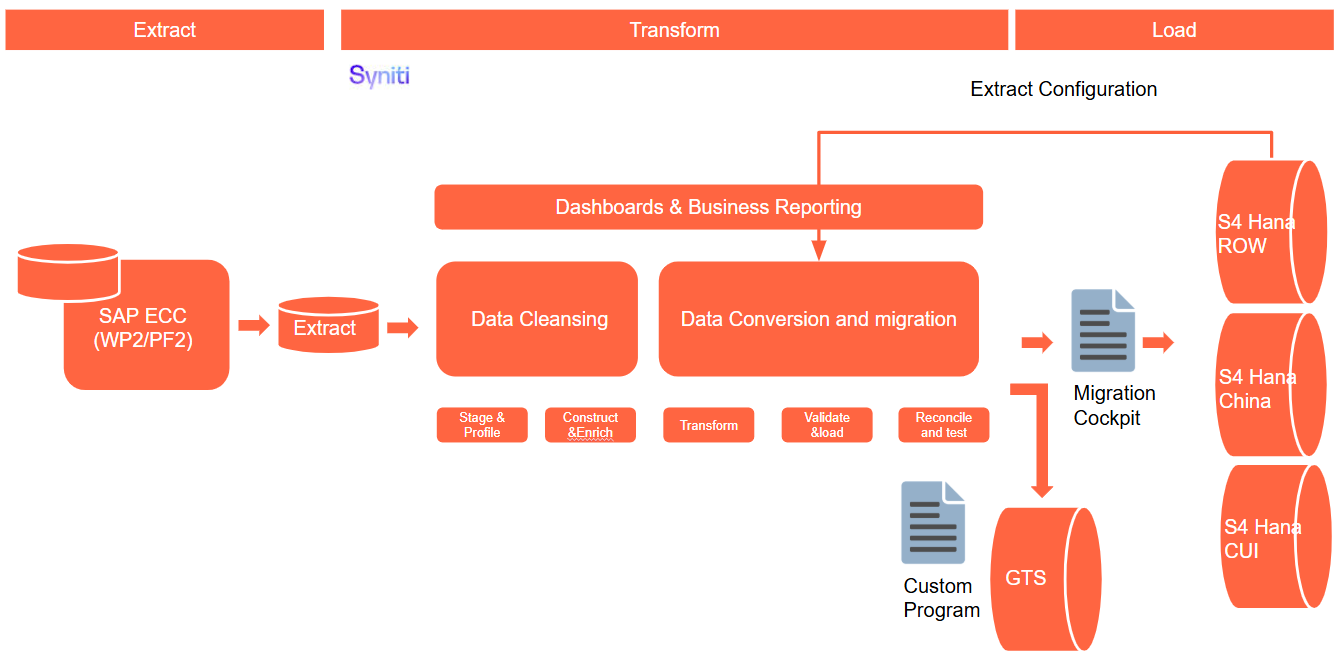
The high-level process is represented by the diagram below:
The ETL (Extract, Transform, Load) process is a structured approach to data migration and management, ensuring high-quality data is seamlessly transferred across systems. Here’s a breakdown of its key components:
1. Extraction
The process begins with extracting metadata and raw data from source systems, such as Syensqo ECC system WP2 and PF2. The extracted data is then staged for transformation.
2. Transformation
Once extracted, the data undergoes cleansing, consolidation, and governance. This step ensures data integrity, consistency, and compliance with business rules. The transformation process includes:
- Data validation to remove inconsistencies.
- Standardization to align formats across datasets.
- Business rule application to refine data for operational use.
3. Loading
The transformed data is then loaded into the target S/4HANA system.
Data Privacy and Sensitivity
N/AExtraction
Extract data from a source into Syniti Migrate for SAP ROW and SAP China relevant entities. There are 2 possibilities:
- The data exists. Syniti Migrate connects to the source and loads the data into Syniti Migrate. There are 3 methods:
- Perform full data extraction from relevant tables in the source system(s).
- Perform extraction through the application layer.
- Only if Syniti Migrate; cannot connect to the source, data is loaded to the repository from the provided source system extract/report.
- The data does not exist (or cannot be converted from its current state). The data is manually collected by the business directly in Syniti Migrate. This is to be conducted using DCT (Data Collection Template) in Syniti Migrate.
The agreed Relevancy criteria is applied to the extracted records to identify the records that are applicable for the Target loads
Extraction Run Sheet
| Req # | Requirement Description | Team Responsible |
|---|---|---|
| 2029-001 | - Identify the source systems and databases involved. - Define the data objects (tables, fields and records) to be extracted. - Establish business rules for data selection. | L2C Data team |
| 2029-002 | - Specify the extraction approach (full, incremental, or delta extraction). - Determine the tools and technologies used. - Define data filtering criteria to exclude irrelevant records. | Syniti |
| 2029-003 | - Establish execution timelines and batch processing schedules. - Assign responsibilities for extraction monitoring. - Document dependencies on other migration tasks. | Syniti |
| 2029-004 | - Define error handling mechanisms for extraction failures. | Syniti |
Selection Screen
| Selection Ref Screen | Parameter Name | Selection Type | Requirement | Value to be entered/set |
|---|---|---|---|---|
| Plant | Multiple | Valid Plant for extraction | In-scope Plant and Plant Country = Brazil or India | |
Data Collection Template (DCT)
Target Ready Data Collection Template will be created for Materials - International Trade Views data with exception of some fields which require transformation as mentioned in the transformation rule.
Materials - International Trade Views
DCT for when data not available in ECC, e.g. service material master data (table: ASMD), service material for WP2/ PF2 billing via Finance to S/4 billing via SD, new plant in scope with legacy system non-ECC, etc.
Business to manually fill-up/ update all required fields.
Note: all rules specified below should be documented as a tooltip in the DC Page.
| Field Name | Field Description | Data Type | Length | Requirements | Rule |
|---|---|---|---|---|---|
| MATNR | Material | CHAR | 40 | Mandatory | Material number as per uploaded via CNV-2019 Materials - Basic Data Views |
| WERKS | Plant | CHAR | 4 | Mandatory | List from Plant in-scope |
| INDUS | Material CFOP category | CHAR | 2 | Mandatory for Brazil only | Only applicable for Plant country = BR - Brazil The CFOP category is used to determine the proper CFOP. The CFOP determines the nature of the transaction (such as sale, purchase, return, import, or transfer) and is required for proper tax calculation and electronic fiscal document (NF-e) generation in Brazil. Must be validated against the CFOP table maintained by the Tax team. Any change requires approval from Indirect Tax. |
| STEUC | Control code for consumption taxes in foreign trade | CHAR | 16 | Mandatory | Plant country = Brazil NCM codes are required for materials used in company codes to comply with tax and legal reporting. The NCM code determines applicable federal taxes (e.g., IPI, PIS, COFINS) and is printed on the nota fiscal. Must be aligned with the official NCM codes published by Receita Federal (Brazilian Federal Revenue) Plant country = India HSN codes are required for materials used in India company codes to comply with GST tax determination and legal reporting. |
Extraction Dependencies
| Item # | Step Description | Team Responsible |
|---|---|---|
| 1 | Source System Availability
| Syensqo IT |
| 2 | Data Structure
| Syniti |
| 3 | Referential Integrity
| Syniti |
| 4 | Extraction Methodology
| Syniti |
| 5 | Performance and Scalability Considerations
| Syniti |
| 6 | Security and Compliance
| Syniti |
Transformation
The Target fields are mapped to the applicable Legacy field that will be its source, this is a 3-way activity involving the Business, Functional team and Data team. This identifies the transformation activity required to allow Syniti Migrate to make the data Target ready:
- Perform value mapping and data transformation rules.
- Legacy values are mapped to the to-be values (this could include a default value)
- Values are transformed according to the rules defined in Syniti Migrate
- Prepare target-ready data in the structure and format that is required for loading via prescribed Load Tool. This step also produces the load data ready for business to perform Pre-load Data Validation
Transformation Run Sheet
| Item # | Step Description | Team Responsible |
|---|---|---|
| 1 | Identify target S/4HANA fields and determine applicable legacy source fields from ECC system (PF2/ WP2). | Functional Team (L2C) + Data Team (L2C) |
| 2 | Map legacy field values to S/4HANA target values (including field-level mapping and technical names) | Data Team (L2C), Data Team (Syniti) |
| 3 | Map legacy field values to GTS target values (including field-level mapping and technical names) | Data Team (L2C), Data Team (Syniti) |
| 4 | Define value mapping rules for fields requiring standardization or harmonization across the source systems | Functional Team (L2C) + Data Team (L2C) |
| 5 | Identify and agree on default values where legacy data is incomplete or inconsistent | Business Team + Functional Team (L2C) |
| 6 | Configure transformation rules in Syniti Migrate | Data Team (Syniti) |
| 7 | Review transformation logic and mappings with Business for confirmation | Business Team + Functional Team (L2C) |
| 8 | Perform initial transformation run and generate draft target-ready dataset | Data Team (Syniti) |
| 9 | Review draft target-ready data for structure and completeness | Data Team (L2C), Functional Team (L2C) |
| 10 | Share transformed data with Business for Pre-load Validation | Business Team |
| 11 | Incorporate feedback from Business and refine mappings or transformation logic as needed | Data Team (L2C) |
| 12 | Finalize and approve transformed data as Target Ready Load File | Business + Functional (L2C) + Data Team (L2C) |
| 13 | Handover final file to Load Team or trigger the load via Syniti Load Workbench | Data Team (Syniti), Data Load Team |
| Rule # | Source system | Source Table | Source Field | Source Description | Target System | Target Table | Target Field | Target Description | Mapping Table | Transformation Logic |
|---|---|---|---|---|---|---|---|---|---|---|
| Materials - International Trade Views | ||||||||||
Data Extraction Logic for Materials - International Trade Views 1. Process by Source System 2. Extract Materials - International Trade Views - Data | ||||||||||
| 2029-001 | WP2/ PF2 | MARC | MATNR | Material | S/4HANA | MARC | MATNR | Material | MAP_MATNR | Mapping |
| 2029-002 | WP2/ PF2 | MARC | WERKS | Plant | S/4HANA | MARC | WERKS | Plant | MAP_WERKS | Mapping |
| 2029-003 | WP2/ PF2 | MARC | INDUS | Material CFOP category | S/4HANA | MARC | INDUS | Material CFOP category | Copy | |
| 2029-004 | WP2/ PF2 | MARC | STEUC | Control code for consumption taxes in foreign trade | S/4HANA | MARC | STEUC | Control code for consumption taxes in foreign trade | Copy | |
| 2029-005 | WP2/ PF2 | MARC | MATNR | Material | GTS | /SAPSLL/PNTPR | PRVSY | Material | MAP_MATNR | Mapping |
| 2029-006 | WP2/ PF2 | MARC | WERKS | Plant | GTS | BUT100 | PARTNER | Plant (Legal Unit) | NOT USED in GTS Filter by Role SLLSIT (RLTYP) Product classification in GTS is primarily country specific and assigned at the material level only, not directly to a plant so NO need the plant object for GTS here (is a standalone object from this topic). | |
| 2029-007 | WP2/ PF2 | MARC | STEUC | Control code for consumption taxes in foreign trade | GTS | /SAPSLL/CTSNUM | CCNGN | Control Code (Commodity Code) | IF the Material exist in multiple PF2 and WP2 Plants with the same Plant Country; for GTS, only transform into 1 line and take the first entry. There is cleansing report for the Business to make sure that the records in all the Plants are the same. Logic to upload in GTS: (part1) The GUID_PR of /SAPSLL/PNTPR (PRVSY) is the link between /SAPSLL/PRCTS-(GUID_CTSNUM) and /SAPSLL/CTSNUM, where product-classification is stored. (part 2) Filter by STCTS (numbering scheme) assigned for BR and IN (e.g HTSBR, HTSIN) | |
| Source Field | Source Description | Target System | Target Table | Target Field | Target Description | Mapping Table | Transformation Logic |
|---|---|---|---|---|---|---|---|
| MATNR | Material | S/4HANA | MARC | MATNR | Material | Direct Mapping DCT should get the material number once CNV-2019 uploaded | |
| WERKS | Plant | S/4HANA | MARC | WERKS | Plant | Direct Mapping | |
| INDUS | Material CFOP category | S/4HANA | MARC | INDUS | Material CFOP category | Direct Mapping | |
| STEUC | Control code for consumption taxes in foreign trade | S/4HANA | MARC | STEUC | Control code for consumption taxes in foreign trade | Direct Mapping | |
| MATNR | Material | GTS | /SAPSLL/PNTPR | PRVSY | Material | Direct Mapping | |
| WERKS | Plant | GTS | BUT100 | PARTNER | Plant (Legal Unit) | NOT USED in GTS Filter by Role SLLSIT (RLTYP) Product classification in GTS is primarily country specific and assigned at the material level only, not directly to a plant so NO need the plant object for GTS here (is a standalone object from this topic). | |
| STEUC | Control code for consumption taxes in foreign trade | GTS | /SAPSLL/CTSNUM | CCNGN | Control Code (Commodity Code) | IF the Material in DCT has multiple Plants with the same Plant Country; for GTS, only transform into 1 line and take the first entry. There is cleansing report for the Business to make sure that the records in all the Plants are the same. Logic to upload in GTS: (part1) The GUID_PR of /SAPSLL/PNTPR (PRVSY) is the link between /SAPSLL/PRCTS-(GUID_CTSNUM) and /SAPSLL/CTSNUM, where product-classification is stored. (part 2) Filter by STCTS (numbering scheme) assigned for BR and IN (e.g HTSBR, HTSIN) |
List of Custom Target Reports for this object is maintained here: Conversion Specification - Custom Reports Register.
Transformation Mapping
| Mapping Table Name | Mapping Table Description |
|---|---|
| MAP_MATNR | ECC (PF2/ WP2) to S/4HANA Material No. Mapping Table |
| MAP_MATNR | ECC (PF2/ WP2) to GTS Material No. Mapping Table |
| MAP_WERKS | ECC (PF2/ WP2) to S/4HANA Plant Mapping Table |
Transformation Dependencies
List the steps that need to occur before transformation can commence| Item # | Step Description | Team Responsible |
|---|---|---|
| 1 | Source Data Integrity - Ensure extracted data is complete, accurate, and consistent. - Validate that data types and formats align with transformation requirements. | Syniti |
| 2 | Referential Integrity - Ensure dependent records are transformed together or in advance | Syniti |
| 3 | Transformation Logic and Mapping - Define data mapping rules between source and target schemas. | Data Team |
| 4 | Performance and Scalability Considerations - Optimize transformation processes for large datasets. - Ensure system resources can handle transformation workloads | Syniti |
| 5 | Logging and Error Handling - Maintain detailed logs of transformation activities. - Define error-handling procedures for failed transformations | Syniti |
Pre-Load Validation
Project Team
The following pre-load validations will be performed by the Project Team.Completeness
| Task | Action |
|---|---|
| Compare Data Counts | 1. Verify row counts in the source databases. 2. Identify missing or duplicated records. |
| Validate the mandatory fields | Validate there is value for all the mandatory fields |
| Validate Primary Keys and Unique Constraints | 1. Check for duplicate or missing primary key values, i.e. if there is same sales organization, distribution channel and material number. 2. Ensure unique constraints are maintained. |
| Test Referential Integrity | Confirm dependent records exist in related tables. |
Accuracy
| Task | Action |
|---|---|
| Validate the transformation | Validate the fields which require transformation have the value after transformation instead of the original field value |
| Check Data Consistency | 1. Compare field values across systems 2. Validate data formats and structures |
Business
The following pre-load validations will be performed by the business.Completeness
| Task | Action |
|---|---|
| Compare Data Counts | 1. Verify row counts in the source databases. 2. Identify missing or duplicated records. |
| Review populated templates for missing or incorrect values | Use checklists to verify completeness and correctness before submission. |
Accuracy
| Task | Action |
|---|---|
| Conversion Accuracy | Business Data Owner/s to verify that all the data in the load table/ file is accurate as per endorsed transformation/ mapping rules (and signed-off DCT data). |
Load
The load process includes:
- Execute the automated data load into target system using load tool or product the load file if the load must be done manually
- Once the data is loaded to the target system, it will be extracted and prepared for Post Load Data Validation
Load Run Sheet
| Item # | Step Description | Team Responsible |
|---|---|---|
| 1 | Confirm readiness of final approved data sets for each ECC source system WP2 and PF2 | Business / Functional Team |
| 2 | Validate transformation rules and mappings in Syniti tool | Data Team (L2C-Data) |
| 3 | Generate target-ready load files based on S/4HANA material international trade view format | Data Team (Syniti) |
| 4 | Generate target-ready load files based on GTS material international trade view format | Data Team (Syniti) |
| 5 | Review and approve load files before execution | Business / Functional Team |
| 6 | Execute the upload program in the S/4HANA system | Data Load Team |
| 7 | Monitor load progress and capture load statistics (records loaded, errors, duplicates, etc.) | Data Team (Syniti) / Technical Team |
| 8 | Extract loaded data from S/4HANA for post-load validation | Data Team (Syniti) |
| 9 | Perform post-load data validation (compare target data with source/ approved files) for all loaded material sales view with sales long text | Data Team (L2C-Data) |
| 10 | Log and resolve any data load errors or mismatches identified during validation | Data Team (Syniti and L2C-Data) + Functional Team |
| 11 | Obtain business sign-off on successful load and validation | Business Team |
| 12 | Archive load logs, error reports, and validation results for audit/compliance | Data Team (L2C-Data) / Data Team (Syniti) / PMO |
Load Phase and Dependencies
The Materials – International Trade Views will be loaded in the pre-cutover period.
Before loading, it will have dependency on the configuration and 2019 - Materials-Basic View. The configuration needs to be transported into the respective system first, including the manual configuration such as the number range set up. And 2019 Materials-Basic View have to be uploaded into the respective system first.
Configuration
| Item # | Configuration Item |
|---|---|
| 1 | Plant |
| 2 | NCM Codes |
| 3 | CFOP Codes |
| 4 | Nota Fiscal |
Conversion Objects
| Object # | Preceding Object Conversion Approach |
|---|---|
| 2019 | Materials - Basic View |
Error Handling
| Error Type | Error Description | Action Taken |
|---|---|---|
| Configuration/ Data Transformation | The value XXX for field XXX doesn't exist | 1. Check the mapping/ conversion is done properly in the loading file 2. Validate the target value is configured/ transported in the target system 3. Reach out to functional team to validate the configuration |
| Configuration | There is mandatory field XXX missing | 1. Validate MDS if the fields are set as mandatory 2. Validate if there is value in the pre-loading file 3. Validate if the configuration for the mandatory fields are done properly |
| Data Error | The Material Master were not defined | Validate the Material Master - Basic View were migrated. |
Post-Load Validation
Project Team
The following post-load validations will be performed by the Project Team.Completeness
| Task | Action |
|---|---|
| Validate Record count | Validate all tables has the same records as the loading file |
| Perform Source-to-Target Comparisons | 1. Validate that migrated data matches source records count. 2. Check for discrepancies in numerical values, text fields, and timestamps. |
Accuracy
| Task | Action |
|---|---|
| Execute Sample Queries and Reports | 1. Run queries to validate business logic. 2. Generate reports to compare expected vs. actual results |
| Conduct Post-Migration Reconciliation | Generate reports comparing pre- and post-migration data. |
| Perform Manual Testing | Pick up a few random sample for each material type. |
Business
Post-load validation is a critical step in data migration, ensuring that transferred data is accurate, complete, and functional within the target system.
1. Ensuring Data Integrity
After migration, data must be consistent with its original structure. Post-load validation checks for missing records, incorrect mappings, and formatting errors to prevent discrepancies.
2. Business Continuity
Faulty data can disrupt operations, leading to financial losses and inefficiencies. Validating post-load data ensures that applications function as expected, preventing downtime.
3. Error Detection and Resolution
By validating data post-migration, businesses can detect anomalies early, reducing the cost and effort required for corrections
Completeness
| Task | Action |
|---|---|
| Perform Source-to-Target Comparisons | 1. Validate that migrated data matches source records count. 2. Check for discrepancies in numerical values, text fields, and timestamps |
| Conduct Post-Migration Reconciliation | Go through post-load validation reports comparing pre- and post-migration data. |
Accuracy
| Task | Action |
|---|---|
| Perform Manual Testing | Conduct manual spot-checks for additional assurance. |
Key Assumptions
- Materials - International Trade Views Master Data Standard is up to date as on the date of documenting this conversion approach and data load.
- Materials - International Trade Views is in scope based on data design and any exception requested by business.
- There will be 3 SAP instances, one for ROW, one for China and one for CUI only.
- And 1 GTS instance.