


| Status | Approved |
| Owner | |
| Stakeholders |
Issue
Syensqo is embarking on a full greenfield Salesforce implementation, which means that no legacy Salesforce org, configuration, or data model will be reused. This fresh start offers important advantages—such as the freedom to design a clean architecture, adopt best practices from the beginning, and avoid technical debt—but it also introduces a fundamental question: which Salesforce Cloud(s) should be selected as the foundation of the solution?
Choosing the right Salesforce Cloud is a critical architectural decision because each cloud comes with its own functional coverage, licensing implications, data model assumptions, and extensibility boundaries. The selection must be driven first and foremost by the business capabilities required by Syensqo: process automation, customer engagement, case management, lead-to-cash workflows, partner interactions, service operations, and more. However, this capability matching cannot be done in isolation. It must be balanced with strategic principles such as prioritizing standard features over heavy customization, maximizing long-term maintainability, and controlling both licensing cost and implementation cost.
The challenge lies in navigating the trade-offs between clouds that provide strong native support for certain business processes and alternative clouds that would require extensive customization to deliver similar outcomes. Therefore, a structured evaluation is needed to align the Syensqo’s required capabilities with the intrinsic strengths of each Salesforce Cloud, ensuring that the chosen foundation supports a scalable, cost-efficient, and future-proof architecture.
Recommendation
The current Syensqo’s CRM fragmentation reduces efficiency. A unified Salesforce platform with standard modules will simplify operations and align the business with Salesforce’s roadmap. The recommendation is outlined below:
Business Domain | Recommended Clouds |
CRM Sales | Manufacturing Cloud for Sales |
CPQ | Revenue Cloud & Manufacturing Cloud for Sales |
CRM Service | Service Cloud |
eCommerce & Portal | B2B Commerce + Experience Cloud on 1 Unified Portal |
Marketing | Marketing Cloud Next & Data Cloud |
Reporting | Standard SF Reporting (Mandatory) + Tableau Next/Data Cloud (Optional) |
The intent is to build upon Salesforce’s native capabilities by leveraging recent platform solutions (built on the core salesforce stack) that are fully integrated, scalable, and strategically aligned with Salesforce’s product roadmap.
By prioritizing standard Salesforce modules over custom or legacy alternatives, this approach aims to:
- Maximize platform consistency by ensuring all capabilities operate within the same Salesforce data model and security framework.
- Enhance robustness and maintainability by relying on modules natively supported and continuously improved by Salesforce.
- Accelerate innovation readiness by adopting solutions that are part of Salesforce’s strategic investments — particularly those leveraging AI, automation, and data unification through Agentforce and Data Cloud.
- Optimize total cost of ownership (TCO) through reduced customization needs, streamlined upgrades, and simplified governance.
Background & Context
Following the strategic separation from Solvay and the establishment of Syensqo as an independent entity, the organization inherited a complex CRM environment shaped by years of growth, acquisitions, and adaptation to diverse business needs. This landscape, while functional, reflects a history of siloed decision-making, varied business models across Global Business Units (GBUs), and a reliance on custom and legacy processes that were often designed to meet immediate tactical demands rather than enabling long-term strategic goals.
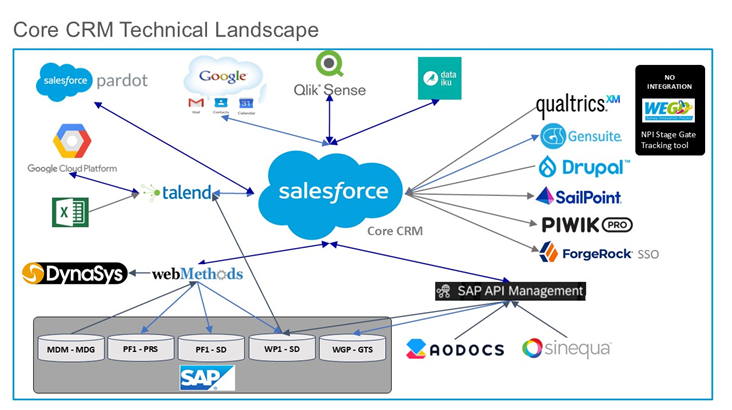
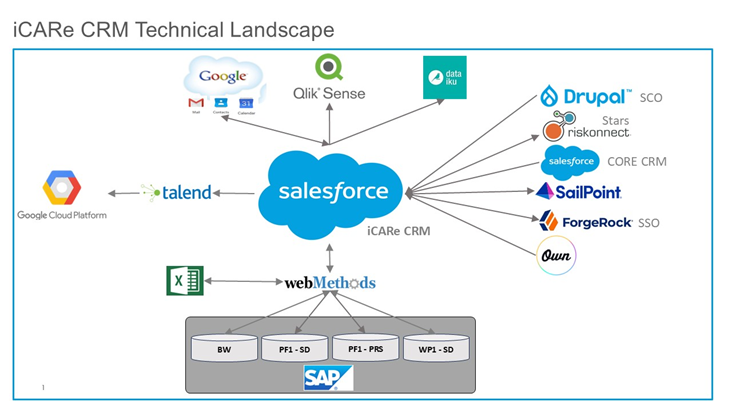
See below two links for existing integration landscape:
Core CRM interface provider.pdf
Core CRM interfaces consumer.pdf
Today, Syensqo’s CRM systems are characterized by:
- Multiple legacy solutions and custom-built components resulting from historical mergers and region- or unit-specific requirements.
- Fragmented data models and process inconsistencies across Sales, Service, Commerce, Marketing, and Revenue Management functions.
- Siloed GBUs, each often operating with separate workflows, limited data sharing, and differing standards for customer engagement, reporting, and compliance.
- High maintenance overhead due to aging integrations, duplicated effort, and manual workarounds.
- Reactive rather than proactive innovation, where complex change management and technical debt inhibit adoption of new features or industry best practices.
This patchwork approach has, over time, created increasing challenges around growth, efficiency, and the ability to deliver a seamless customer and employee experience.
The decision to go to a Greenfield approach building a new CRM solution cross GBUs has been taken in the following KDD: KDD040 - CRM Platform Approach
Assumptions
- Business Requirements : The assessment has been done based on the collected input from the different CRM workshops. If critical business or technical information changes, recommendations and analysis may need to be revisited.
- Salesforce Capabilities: Evaluation has been done based on the current salesforce available capabilities.
- Standardization: There is a shared organizational preference for maximizing standard (out-of-the-box) solution usage, with customizations being justified case by case.
- Contract Authoring capabilities of Revenue Cloud is not considered as part of this KDD due to ongoing discussion (Revenue Cloud vs Icertis)
- Salesforce Feedback Management: We assume that the same licenses as the ones currently used in the AS IS are needed and it is not subject to discussion in this KDD. Should a more detailed analysis be needed, this will be covered separately.
- Agentforce Licenses : We assume that Agentforce (AI) licenses will be needed based on the requirement collected and it is not subject to discussion in this KDD.
- Einstein Activity Capture: We assume that Microsoft Exchange integration will be done through the standard Salesforce connector being Einstein Activity Capture and it is not subject to discussion in this KDD
- Own Backup: We assume that the same licenses as the ones currently used in the AS IS are needed and it is not subject to discussion in this KDD.
- Pricing Setup: Currently Revenue Cloud does not offer any standard capabilities regarding pricing setup. The decision on the tool to be used is out of scope of this KDD however, discussions are ongoing to decide the next steps. Regardless, the selection and usage of a pricing tool will not influence the requirements document in this KDD in relation to pricing and how salesforce will fulfil those requirements
- Rebate Management: Rebates will be done in S4/Hana and therefore it is assumed we don't need the capability in Salesforce. An integration will have to be built for this.
- Salesforce License: Syensqo is responsible for managing the License provisioning and negotiations terms with Vendor Salesforce. Currently we assumed that Licenses Cost negotiated by Syensqo will land on an acceptable price in line with the business case. Should this not be the case, recommendation will have to be reviewed.
- Detailed TCO and Business case: While high level TCO impact is considered in the KDD, the detailed TCO calculation and Business case refinement is considered out of scope. The KDD is mostly focusing in assessing the good fit of the Cloud Solution with the Syensqo requirements. What will follow is a detailed negotiation with SalesForce and the Syensqo procurement team. If, as an outcome of the negotiations, some modules are not commercially viable, then this KDD will be revisited. But for now, the KDD is focused 100% on Syensqo business requirements an the OOTB modules of salesforce that meet those.
- Enterprise VS Unlimited Edition: This KDD provides an overview of the key difference between both editions and the key attention points for Syensqo when discussing this KDD. However we cannot do any recommendation on this topic since this is something to be aligned and negotiated with Salesforce.
- Cross system reporting : any reporting done across platforms/systems will be done using MS Fabric and Power BI
Constraints
In making the cloud platform decision, Syensqo should be mindful of the following constraints:
- Adopt Standard Salesforce Processes: Going for an Out of the box approach allows to speedup the time to market and reduce the TCO, however it will come with some constraints in term of capabilities and an appropriate governance will be needed in order to balance the need of customization versus the adoption leveraging the SaaS CRM standard capabilities and reducing the need of maintenance.
- License and Contract Terms: Each Salesforce Cloud module usually comes with a license cost to be considered in order to take the final decision
Impacts
Selecting the most appropriate cloud platform (e.g., Salesforce Sales Cloud, Service Cloud, Marketing Cloud, or alternatives) will have important, strategic consequences for Syensqo’s business transformation:
- Speed to Value: Standard modules and accelerators available in each cloud may determine how quickly new capabilities can be rolled out to business users and with limited customization efforts.
- Change Management: Given the green field nature of the new CRM and the selection of Clouds not already used by the business, change management will be key to get the adoption.
- License Costs: Leveraging specialized cloud will come with extra cost but should decrease the implementation TCO and enable a future proof architecture.
- Product Knowledge: The proper skills and knowledge around the new selected clouds will be needed during the implementation (implementation team) and post go live (maintenance) in order to properly leverage those cloud capabilities.
- Vendor Locking: The strategy to go for all the CRM related capabilities in the Salesforce Technology induced of course a vendor locking risk. However this impact is not related to this KDD but to the decision to go for Salesforce as the CRM platform (KDD040)
Business Rules
At this stage, specific business rules are not defined within this document. Platform and cloud selection will be based on high-level business requirements and anticipated rules complexity. Detailed business logic, validations, and approval processes will be captured and validated during subsequent Detailed Design Phase.
Financial Impact
For the current Salesforce Cloud selection, we have proceeded with the assumption that Syensqo will negotiate a competitive pricing structure aligned with the established business case.
Should the final commercial agreement deviate from these projections, this Key Decision Document (KDD) will be formally refined to reflect the updated financial impact once the negotiation outcome is available.
Salesforce Cloud Options
Manufacturing Cloud for Sales
Objective: To leverage Salesforce Manufacturing Cloud for managing long-term sales commitments, optimizing sales performance, and streamlining commercial operations within manufacturing organizations, rather than building custom solutions on Sales Cloud.
Option A: Manufacturing Cloud for Sales
Manufacturing Cloud offers a specialized, out-of-the-box solution tailored specifically for the complex sales and account management needs for companies such as Syensqo, providing industry-specific features like Sales Agreements and forecasting.
Key Advantages:
- Sales Agreement Management: Consolidates long-term sales commitments, enabling tracking of planned vs. actual revenue and quantity metrics, automatic performance updates, and a single source of truth for renewals and operational planning.
- Performance Management: Allows account managers and sales representatives to monitor actual order volumes against planned quantities for accurate sales process oversight.
- Price Change Notification: Facilitates sending price change documents to customers within the Sales Agreement when updates occur after the initial order.
- Extension of Salesforce Core: Specifically designed for manufacturing organizations, Manufacturing Cloud extends Sales Cloud functionality to better align sales, planning, and operations with advanced features, reducing implementation effort and technical debt.
- Future-Ready: Leveraging standard features ensures access to future product updates and innovations without the need for custom development.
Key Challenges:
- Transitioning from custom-built solutions in Sales Cloud to standard features in Manufacturing Cloud may require process adjustments and change management.
- Integrating rebate management with external systems such as SAP S/4 HANA or forecasting with Kinaxis Maestro could present technical and operational complexities.
- Adapting existing workflows to new features like Sales Agreements may require additional training for account managers and field representatives.
- Aligning commercial operations across sales, planning, and operations teams to fully leverage Manufacturing Cloud’s advanced capabilities.
See below the key capabilities from Manufacturing Cloud identified for Syensqo:
| Manufacturing Cloud for Sales Features* | Description | High Level Fit | Explanation of the Fit | Next Steps |
|---|---|---|---|---|
| Visit Management | Visit Management is designed to help the sales team plan, execute, and analyze field-based or in-person interactions with customers, partners, distributors, or store locations. | Low |
|
|
| Sales Agreement | Sales agreements is a way to create structured arrangement for commercial organizations that provide visibility into planned and actual sales volumes, revenues, and product commitments next to legal contract document. The key benefit is to monitor the performance and help commercial organizations manage predictable, ongoing business relationships rather than one-off transactions. | High |
|
|
Advanced Account Forecasting | Create a unified, highly accurate and granular sales forecasts by blending customer-level data from multiple sources. | Medium |
|
|
Account Manager Targets | Convert your organization’s growth plans into measurable targets that you can assign to your team members and distribute them per customers or products. | Low |
| |
Program-based business | Program based business allows you to define your products and your customer’s products and create relationships between them. Therefore, it can automatically translate the customer product build rates into precise material requirements, ensuring the production plans align with volatile customer schedules and track related sales accordingly | Medium |
|
|
Rebates | Automate, manage, track, and calculate complex volume-based incentives and channel program payouts offered to customers or partners. | Low |
| |
Non functional requirements |
| High |
| |
Other Relevant capabilities |
| Medium |
|
Option B: Leverage Sales Cloud and Build Custom on Top
This approach uses the highly flexible core Sales Cloud platform and requires additional custom development to build and maintain the specific manufacturing-related features needed to meet unique business requirements
Key Advantages:
- Maximum Flexibility & Control: Offers the freedom to design and build a solution that precisely matches every unique and specific Syensqo business requirement and existing process.
Key Challenges:
- Higher TCO: Requires ongoing investment in development resources for building, maintaining, testing, and updating the custom code with every Salesforce platform release.
Evaluation
| Criteria | Option A: Manufacturing Cloud for Sales | Option B: Leverage Sales Cloud and Build Custom on Top |
|---|---|---|
| Alignment with "Simplification and Standardization principles" |  Manufacturing Cloud offers out of the box features such as Sales Agreements and Advanced Account forecasting using standard objects and processes. Adopting a standard feature comes with less variations and simplified system setup and use. Manufacturing Cloud offers out of the box features such as Sales Agreements and Advanced Account forecasting using standard objects and processes. Adopting a standard feature comes with less variations and simplified system setup and use. |  All the processes not standard in Sales Cloud will have to be customized with the risk of increased complexity and variations, exceptions across stakeholder groups All the processes not standard in Sales Cloud will have to be customized with the risk of increased complexity and variations, exceptions across stakeholder groups |
| User Adoption and Experience | Features such as Sales Agreement offer capabilities and views that provide a better User Experience (e.g. table/matrix like structures with less clicks to get to an overview or make bulk updates | Building custom experiences opens up the possibility to provide flexibility in building something tailored exactly for Syensqo but this will have a significative cost impact in implementation and maintenance |
| Scalability & Future-Proofing | Salesforce handles regular feature innovation and upgrade, ensuring the platform automatically evolves with technology and industry standards without incurring constant internal development costs | Building customization on the top of the platform is not allowing to benefit of future upgrade/ extract capabilities that would be provided by the platform in the future. |
| Feature Fit & Implementation Cost | Full leverage on Manufacturing Cloud out of the box capabilities (including the features highlighted in the table above with a high or medium fit) reducing the implementation cost. | Higher cost of implementation in order to custom build the capabilities needed to cover the business requirements which have a fit with the Manufacturing Cloud features. |
| Solution Maturity | As a relatively new product, there is a current limitation in the number of publicly documented and well-established use cases available. |
|
| Licenses/Subscription Cost | Manufacturing Cloud for Sales cost to be foreseen | Cheaper License Cost |

Revenue Cloud
Objective: To unify and optimize product management and pricing processes by leveraging Salesforce Revenue Cloud, enabling structured, automated, and scalable configuration, price execution, and quoting, and replacing manual, fragmented approaches with a future-ready, integrated solution. The capabilities and requirements outlined below assume that pricing will be provided by a pricing tool, process or capability. The requirements and features documented below are unlikely going to be affected by what ever price setting approach is decided. It is noted that Syensqo have an inhouse built price setting solution and the assessment below in relation to revenue cloud will not be impacted by what ever outcome comes from the decision around the price setting tool.
Option A: Revenue Cloud
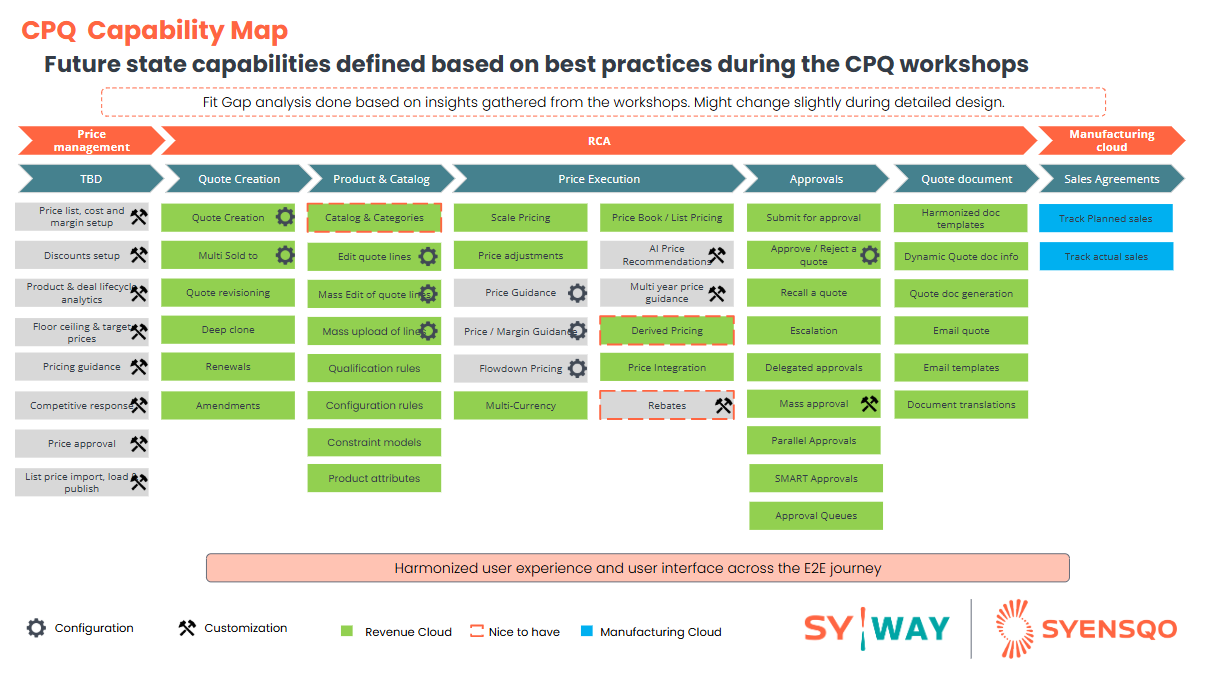
Based on Syensqo requirements, the recommendation is to go for Revenue Cloud solution in regards to the consideration that majority of the requested features are OOTB with some requiring further configuration and few that needs customization (see the capability map).
Key Advantages:
- Quote management: Different use cases require different workflows. Quote management is tailored to the relevant business industry and way of working. Room for harmonization and localization where needed.
- Centralized Product Catalog Management: Dynamic, integrated product data from Master Data Governance Tool or SAP S/4 Hana (yet to be decided). Streamlined Catalog management for product administrators. Qualification rules and constraint models to drive harmonized product visibility.
- Structured Price Execution: Attribute-driven pricing for scalability and consistency. Flexible price execution to support both cost/margin and price driven execution. Option for reduced complexity and more granular definition of attribute driven pricing to improve accuracy and reduce redundancy.
- Price Deviation Tracking: Price waterfall analysis for transparency. Automated flagging of unusual discounts or markups based on pre defined triggers and corresponding thresholds. Proactive monitoring of margin leaks and price fluctuations.
- Streamlined Approvals: Proactive monitoring of margin leaks and price fluctuations. Dedicated approval triggers, thresholds and approval flows configurable per business unit. Improved transparency on approval needs. Improved cycle time through SMART Approvals
- Document Harmonization: Reduced admin work through harmonized dynamic document generation. Dynamic sections allow for localization where needed. Improved document quality and consistency through enhanced document configuration.
- Native Salesforce Integration: Seamless interoperability with Sales, Manufacturing, and Service Clouds. Unified data and simplified upgrades. Enhanced scalability and maintainability.
- Automated Processes: Automated approvals, price execution and quote-to-cash workflows. Reduced manual intervention and improved compliance.
- Future-Readiness: Ongoing access to new features and automation capabilities. Simplified upgrades and scalable adoption.
Key Challenges:
- Learning Curve & Complexity: The implementation and maintenance of complex product rules and pricing constraints requires specialized knowledge.
- User Adoption: Without proper training and buy in of Business SME Leads, GBU leads & pilot users, adoption rates remain low. A prerequisite to an easy adoption is program validation of the solution.
- Customization vs. Standardization: Balancing standard features with necessary customizations is a common challenge
Capability Map:
The below table is the CPQ Capability map for Syensqo requirements highlighting the fit-gap analysis with the available available capabilities within Revenue Cloud.
Business sub-process | Key Optimizations | Business Benefits & Impacts |
Quote creation |
|
|
Product catalog |
|
|
Price Execution |
|
|
Price deviation tracking |
|
|
Streamlined Approvals |
|
|
Harmonized Document Generation |
|
|
Revenue Cloud full license vs Revenue Cloud Growth license
For Syensqo context, discussions are still ongoing with business (sessions to happen in Jan 2026 with legal team related to Contract authoring, negotiation and signature) to decide between SF CLM vs Icertis.
Revenue Cloud Growth:
If the decision is to use Icertis for CLM, the recommendation is to go for Revenue Cloud Growth license.

Revenue Cloud Advanced (full license):
If the Group legal decides to perform Contract authoring, negotiation and signature part inside Salesforce and not Icertis, then the recommendation is to go for Revenue Cloud full license as business would like to then use contract lifecycle management (already included in the full license).

Option B: Custom Build CPQ
Build the new CPQ fully custom not leveraging any Salesforce Cloud
Key Advantages:
- Tailored to Business Needs: A custom CPQ solution (existing Syensqo solution) can be designed to match unique product catalog, pricing rules, and approval workflows. Customization ensures that the quoting process reflects your exact business model.
- Enhanced User Experience: A custom solution streamlines navigation, reduces unnecessary clicks, and presents only the most relevant options, making the process smoother for the account managers.
Key Challenges:
- Cost & Resource Burden: Developing and maintaining a custom CPQ requires skilled Salesforce developers and admins. This can be costly compared to leveraging Salesforce’s standard Revenue Cloud CPQ features
- Implementation Complexity: A custom CPQ requires significant effort to design pricing rules, product bundles, approval workflows and quote document generation (also keeping in mind the need from different GBUs)
- Scalability Concerns: As businesses grow, product catalogs and pricing structures become more complex. A custom CPQ may struggle to scale efficiently if not architected with future growth in mind.
- Technical Debt & Maintenance: Syensqo is fully responsible for all bug fixes, security updates, and ensuring the custom code remains compatible after every Salesforce platform release.
Evaluation
Criteria | Option A: Revenue Cloud | Option B: Custom Build CPQ |
Alignment with "Simplification, Harmonization and Standardization principles" |
|
|
User Experience and Adoption |
|
|
Scalability & Future-Proofing |
|
|
Implementation Cost |
|
|
Licenses/Subscription Cost |
|
|
Service Cloud
Objective: To transition existing service functionalities currently managed through Salesforce Sales Cloud to Salesforce Service Cloud, enabling access to advanced service capabilities, improved efficiency, and scalable support for complex service operations.
Option A: Service Cloud
Fully leverage the service cloud capabilities of Salesforce in order to bring value to Syensqo.
General Considerations About Service Cloud
Key Service Capability Value (Applicable Regardless of License Tier)
Salesforce natively supports Case Management as part of the Sales Cloud license (from a technical perspective), meaning that the organization can already track and process complaints and requests within Salesforce without requiring Service Cloud licenses. This includes:
- Basic case creation from Accounts and Contacts
- Routing to queues and teams
- Status tracking and ownership for accountability
- Linking cases to Opportunities, Orders, or Products for traceability
When Service Cloud Adds Value
Syensqo's use cases for the service cloud are mostly focused on the automation, AI and the SLA management of the cases. Since Syensqo has very clear definitions of the major case types that we will use cases for (including, Samples, customer complaints, restitution, etc), the added case lifecycle capabilities of the service cloud are what Syensqo will likely make use off.
Service Cloud licensing becomes beneficial if the service operating model requires more structured service processes, higher throughput, or multi-channel interaction. This includes scenarios such as:
- Advanced Omni-Channel routing across email, web, phone, and portals to balance workload and ensure SLA coverage.
- Guided workflows, automated SLAs, entitlement rules, and escalations to support regulated complaint handling or high-volume service environments.
- Knowledge Base, Macros, and Screen Flows for agent efficiency and consistency of response.
- Additional Licensing Costs: Transitioning to Service Cloud requires purchasing Service Cloud licenses, increasing overall costs.
- Contractual/Legal Risks: While Syensqo could decide to prioritize only basic requirements (not technically requiring the Service Cloud license), there is a contractual risk that Service Cloud license is still required. This has to be discussed with Salesfroce.
Capability Map:

Option B: Sales Cloud leveraging service capabilities
Key Advantages:
- No extra license costs: Avoid paying any extra license cost for service agents. Those licenses cost currently being paid in the AS IS, can be swapped to other licenses.
Key Challenges:
- Legal/Commercial: While technically Sales Cloud licenses provides access to some Service cloud capabilities, there is a risk of not being commercially compliant. This should be discussed with Salesforce during license negotiations.
- Future Locks: This will prevent to easily onboard extra Service Cloud capabilities (not needed today) and license will have to be renegotiated with Salesforce.
Evaluation
| Criteria | Option A: Service Cloud | Option B: Sales Cloud leveraging service capabilities |
|---|---|---|
| Capabilities | Service Cloud provides a set of extra capabilities such a SLA management which have been identified as Syensqo business need. Those extra capabilities as currently not used (AS IS) but it might bring extra value to implement those capabilities | Extra capabilities offered by Service Cloud are not available and business will not be able to leverage those extra feature staying in the AS IS situation from a Service perspective. |
| Legal/Commercial | Fully compliant with Salesforce positioning. | While technically Sales Cloud licenses provides access to some Service cloud capabilities, there is a risk of not being commercially compliant. This should be discussed with Salesforce during license negotiations. |
| License Cost | Extra License Cost | Reduce the license cost |
B2B Commerce Cloud (LWR - Lightning Web Runtime) for one single customer portal
Objective: To improve customer experience, streamline operations, and align with Salesforce’s strategic roadmap, we recommend Syensqo consolidate its multiple portals into a single, unified portal built on Salesforce B2B Commerce Cloud. This transition will provide a scalable, future-proof, and fully supported e-commerce platform.
Key Advantages:
Unified Platform and Branding: Replaced four legacy solutions with a single, unified platform for a simplified customer journey and easier maintenance (one login, catalog, order, and document experience).
Enhanced Customer Autonomy & Efficiency:
Embedded a capable AI agent (e.g., populating carts from POs, guiding search, retrieving documents).
Extended self-service capabilities (e.g., samples, documents, order tracking), freeing up frontline time.
Drive Growth and Broader Sales: Enabled customers to seamlessly buy a wider range of products through guided search, fast quote requests, and effortless ordering.
Centralized and Consistent Data Management: Unified and standardized data across systems, creating a single source of truth for customers, products, pricing, and orders.
Modern, Scalable, and Future-Proof Architecture: Built on a cloud-native platform (Salesforce) that supports future innovations (like predictive ordering) and ensures simplified maintenance and ongoing upgrades.
Key Challenges:
- Some components can be leveraged OOTB, other will be extended. Some features will have to be custom. Tracked in column F
- See detailed capability map below for the split
- /!\ This capability Map reflects the external user/front-end view → in the internal view (Salesforce back-end), we leverage the standard data model & Apex.
B2B Commerce Cloud Capability Map:

Business Endorsements
- The Portal user will benefit from a Cross-GBU Portal experience (“One Syensqo” UX/UI)
- Target audience: Key Accounts, Critical Accounts, Standard Accounts, Key Distributors, Standard Distributors and SCP.
- The portal will consume the Account hierarchy stored in Salesforce: The contact/user will be linked to a child account (sold to). Some contacts (e.g. SCP) will be linked to more than 1 child account to order across GBU (Ship to).
- Commerce will leverage the product hierarchy from the Master Data Governance Tool or SAP S/4 Hana (yet to be decided)
- (replicated in the Product Catalog of CPQ) to create entitlement policies. However, the SAP Category hierarchy will not be displayed in the catalogue for the customers/distributors.
- Commerce will use the SAP Market Segmentation (GBU, Market, Region, Country) to drive the product visibility per Account -> general rules. Exception rules will be handled via specific entitlement policies (& related buyer group).
- Only commercialized version of a product will be available in the portal for the user to request an order, a quote or a sample.
- The user will never be blocked from requesting an order. Besides, all orders placed by the child account (sold-to) should be accessible in MyOrder (i.e. not only the ones placed in the Portal). if the Financial or GTS checks fail, the user will be sent a notification, and a failed order would appear in My Order section
- Sample & Quote are requests (cases) sent to SF backend with assignment rules & managed by the CSR/Account Managers.
Evaluation
- Future-focused solution : the decision to exclusively pursue Salesforce B2B Commerce Cloud (on Lightning) is a necessity because the prior solution, CloudCraze, is considered a legacy platform with a limited future.
- Salesforce has redirected all innovation and support efforts to the new, native B2B Commerce on the Lightning platform. Continuing with the CloudCraze architecture would mean operating on an unsupported system that receives no new features, limited security updates, and is not natively integrated with modern Salesforce capabilities like AI, Experience Cloud, or the latest UX/UI. This shift guarantees long-term sustainability, better performance, and seamless integration with the rest of the Salesforce Customer 360 platform.
- Licenses
- Today : The Webshop has the Customer Community Plus License (Experience Cloud). There is on top the CloudCraze license to allow user to purchase/place orders.
- In the future , it is similar → we need the B2B commerce cloud license AND the customer community plus license (experience cloud) → they bundle together.
- By default all users should be able to place orders → Without the B2B Commerce Cloud license (i.e. only experience cloud license), users do not have access to crucial commerce objects and Store components (product entitlements, cart, checkout, etc)
- Experience cloud features are not sufficient since they allow to build external user site without the transactional part → all the self service (other than product search, cart, checkout, order placement) can come under the experience builder cost and not additional SF cost needed.
- more info on license costs here https://help.salesforce.com/s/articleView?id=commerce.comm_b2b_licenses.htm&type=5
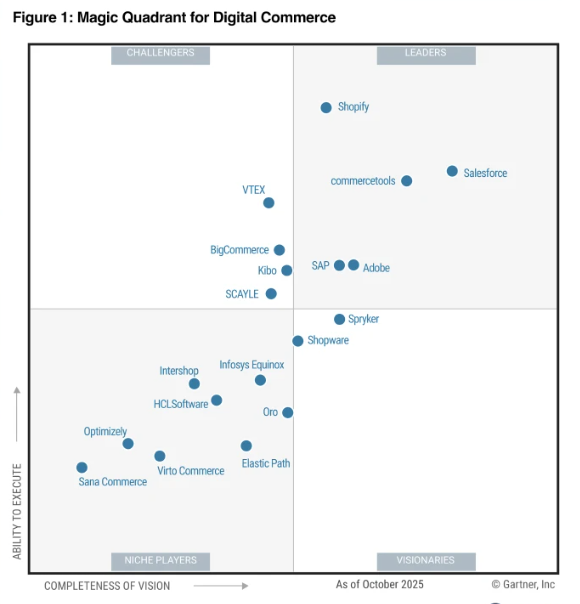
- .Gartner Recognition : Salesforce has been named a Leader in Gartner® Magic Quadrant™ for Digital Commerce for the 10th Consecutive Year (November, 2025) https://www.salesforce.com/news/stories/gartner-magic-quadrant-digital-commerce-2025/
4. The rebranding of Salesforce B2B Commerce Cloud to Agentforce Commerce directly supports the Syensqo Portal's strategic need for enhanced self-service capabilities beyond simple transactions. Salesforce Announces New Agentforce Commerce Capabilities - Salesforce
For the future portal, we will leverage the Agentforce Service Agent (normally used by internal users ex: CSR) and leverage it for external users (customer and distributor accessing the portal). In other words, we will not use the Merchant/Commerce agent as it does not fulfill Syensqo/customers specific needs.
- These are the current features already configured
OOTB capabilities: case creation (standard record type), guided shopping, order status check, reorder
Custom: download of documents from a third party (e.g. certificates,SDS,TDS), create sample request (non standard case record types)
- High Level Configuration steps (examples)
- For generate document. create a topic which has serval instructions: which determines when this should topic should be launched, if it is launched it next instruction is to get the product sku for the pdf to generate. if it has the sku it will execute a piece of code which retrieves the pdf and saves in salesforce and give the url in the chat back to the user.
- For sample request: updating the existing flow to define the record type with it and linking the product id to the case
Marketing Cloud Next/Data Cloud
Objective: To align with Salesforce’s platform-first strategy and ensure long-term scalability, it is recommended to transition from Pardot (Account Engagement) to Marketing Cloud Next (On Core).
Option A: Marketing Cloud Next
Key Advantages:
- Natively built on the core Salesforce platform, enabling direct connection to CRM data and eliminating the need for data syncing.
- Supports real-time customer engagement across multiple channels (Syesnqo’s requirement is to enable SMS and WhatsApp channels, too).
- Simplifies system setup and enables users to leverage the same platform (e.g. to notify Sales team when a lead becomes MQL or has a bounced email address).
- Has advanced engagement, fit and marketing scoring model available by default.
- Unlocks powerful Flow automation and leverages Data Cloud for Unified Customer Profiling leveraging Matching and Reconciliation rules. This is useful to identify the same individual from AI prospects, Leads, and website visitors data sources.
- Provides AI-driven personalization and event-triggered journeys based on any Salesforce object, allowing for tailored experiences throughout the customer lifecycle.
- Ensures consistent messaging, easier governance, and stronger collaboration between Marketing, Sales, and Service teams through native integration and multichannel capabilities.
- Keeps the organization future-ready and aligned with Salesforce’s ongoing investments in AI, automation, and data unification.
- Avoids the limitations of Pardot, which would require additional integration efforts, limit the number of communication channels and restrict access to new innovations.
Key Challenges:
- This is the newest Marketing Automation solution from Salesforce, and some third-party software vendors do not have an integration layer yet.
Marketing Cloud Capability Map:
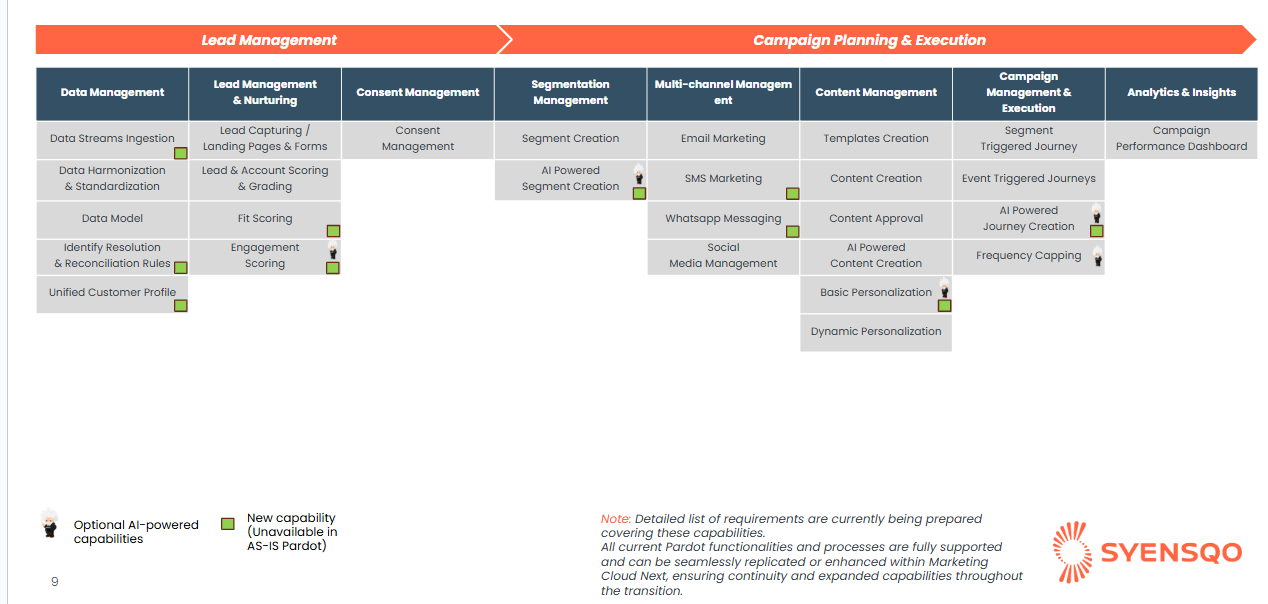
Option B: Pardot
Key Advantages:
- Platform has capabilities to grade, score and provide insight through Pardot Einstein on when and how to best nurture leads to highlight most engaged prospects.
- Strong content management capabilities and ability to create local and global reusable component for scalability & sharing across business units & Salesforce CRM using “Files”.
- Enterprise native, managed and extensible bi-directional near-time and real-time connector. Same ecosystem. However, not all Custom Objects are accessible from Pardot.
- Strong capability for inbuilt forms & landing pages development, including template, dynamic content across web & email & real-time actions on submissions.
- Wide range of native standard connectors for Facebook Ads, LinkedIn & Google Ads.
- System lacks capability to export detailed engagement data to external platforms e.g. datalakes.
Key Challenges:
- Limited to email as only native communication channel. Third party apps can be integrated to deliver SMS and other channels.
- Receives less updates and new releases than Marketing Cloud Next.
- Does not leverage Salesforce’s newest Agentforce (AI) features.
Evaluation
Marketing Cloud Next represents Salesforce’s next-generation marketing solution, natively built on the core Salesforce platform. Unlike Pardot, which only supports email as a channel and operates as a separate data environment, Marketing Cloud Next connects straight to your CRM data leveraging the power of Data Cloud. This means no more integration setup needed, a simpler system setup, and the ability to engage customers in real time across multiple channels — not just email.
With Marketing Cloud Next, your marketing teams can unlock powerful Flow automation and leverage Data Cloud to generate a 360 view on your customers using Unified Profiles. Plus, it offers AI-driven personalization and AI Agents that support MC users in campaign building and content generation, event-triggered campaign flows based on any Salesforce CRM or Data Cloud object. Marketing Cloud Next uses these features to deliver truly tailored experiences at every stage of the customer lifecycle.
Thanks to its native integration and Omni-Channel capabilities, Marketing Cloud Next ensures consistent messaging, easier governance, and stronger collaboration between Marketing, Sales, and Service teams.
By adopting Marketing Cloud Next, the organization ensures it remains future-ready and aligned with Salesforce’s ongoing investments in AI, marketing automation, and data unification. Continuing with Pardot would noticeably limit access to these innovations and require additional integration effort to maintain parity with Salesforce’s strategic direction.
The decision to recommend Marketing Cloud Next (often referred to as Marketing Cloud On Core) over Pardot (now Marketing Cloud Account Engagement) is driven by the need for a truly omnichannel, high-volume, and future-ready engagement platform. While Pardot remains Salesforce's B2B marketing automation solution, its architecture is inherently focused on lead nurturing and email, relying on a connector for CRM data integration.
Marketing Cloud Next, however, is built for complex, multi-channel customer journeys across email, SMS, WhatsApp, social media, offering a modular, enterprise-grade framework that better leverages advanced features like Campaign Flows, Agentforce capabilities (AI-driven campaign management and content creation), large-scale data segmentation and Unified Profile creation. Opting for the more advanced Marketing Cloud Next future-proofs the investment by aligning with the long-term vision of a unified, data-driven customer experience platform, which is essential for scaling complex, personalized communications beyond just the lead-to-opportunity pipeline.
| Criteria | Option A: Marketing Cloud Next | Option B: Pardot |
|---|---|---|
| Capabilities |
|
|
| Scalability & Future Proofing |
|
|
| Deployment Lifecyle | Test Environments (Sandboxes) are supported and can be deployed automatically using data kits. |
|
| Integration | Marketing Cloud Next is built on Core, and has access to all CRM objects via Data Cloud without a need for integration. Besides non CRM data can be easily made available leveraging standard Data Cloud connectors. |
|
| User Experience & Usability | Ease of use – Marketing Cloud Next has the same user interface as Salesforce CRM and gives a unified user experience cross-clouds. |
|
| Compliance & Security | Data Cloud has a concept of data spaces (data segregation) managing data visibility access and content workspaces (content segregation: Template, Images, ...). |
|
| License Model |
|
|
| Skills |
|
|
| Product Maturity |
|
|
Tableau Next/Data Cloud
Objective: Tableau Next moves beyond the static, object-based reporting of standard Salesforce by using Agentic AI and a unified data layer (Data Cloud) to deliver personalized, contextual, and actionable insights to users across the business, directly in their workflow.
This is fully aligned and integrated with the guidance and the decision made by the SyWay reporting team meaning that the data from SF will be replicated into the official data lake in Microsoft Fabric with Power BI on top as reporting tool to cover cross system reporting. The scope of reports covered in the section below only regards to pure Salesforce data enabling the users to take care of their key actions thanks to the reports supporting them.
In the case Tableau Next is activated, Data Cloud will also be present not to be used as a Data lake but just to enable the tool to function as it should (modeling the data to feed the dashboards)
cfr : SAP Analytics Approach - SyWay Project - Syensqo - Wiki knowledge base
Dependency:
- There's a broader question on the use of GenAI features within the different systems as we will have that functionality available within Microsoft, SAP and Salesforce. There is a need to get a guidance from the Syensqo.AI and Data & Analytics team on their vision.
- Data cloud will be needed to enable Tableau Next to operate.
Option A: CRM Reporting Done with a combination of Standard Reporting and Tableau Next
Based on the reporting needs and the expected experience we would go for Standard report/dashboard or Tableau Next :
- Standalone basic KPIs would be handled by Standard report & dashboard. As limited dynamic interactions is needed, we will leverage Standard report & dashboard to deliver those high level KPIs. It can give a quick overview of the state of a customer or open actions for approval.
- Detailed analysis where we want to be able to cross filter and possibly drill down to find trends or root causes would be supported by Tableau Next
Key Advantages:
- Rich, AI-powered analytics and unified data: Tableau Next adds a semantic layer + agent-based AI (“Agentic Analytics”) that can automate data prep, detect trends/exceptions, answer natural-language queries, and surface actionable insights — making analytics more powerful, contextual and accessible across the business.
- 3 out of the box agent to support the activity of the business and the data analyst users :
- Concierge : Enable trusted Q&A with your own data.
- Inspector : offers proactive data monitoring and insights by continuously tracking your data for key changes, analyzing trends, and predicting improvements.
- Data Pro : is your intelligent data preparation assistant. Instead of manually cleaning and transforming your data, Data Pro provides smart suggestions and automatically handles some of the complicated changes for you.
- Tableau Pulse : enables each user to follow KPIs linked to their activities and are able to get automatic summary what your tracking. You can also setup alerts just by talking with the agent to monitor any deviation on the KPIs that matter to your scope.
- Accelerated development of new KPIs and reports with the support the Agentforce within the development cycle
- Tableau Next has an interoperability concept which mean that whatever was build in Tableau, CRM Analytics or Salesforce report/dashboard can be leveraged into the tool natively. That allows Syensqo not to integrate directly with the legacy of reports already built and to avoid rebuild effort.
- Key Challenges:
- Additional complexity and cost: implementing Tableau Next means building/maintaining a data layer, semantic models, governance, integrations.
- “Growing pains”: some advanced dashboarding or deep analytics capabilities are not yet as mature as traditional BI tools, and for very complex dashboards the tool may still feel “light”.
- License cost that is on a token based consumption
- OOTB assets catalogue is quite limited today
- Additional effort in training to educate the users
- Visibility Rule mechanism in Tableau Next is different from the Salesforce one and fully reproduce the Salesforce one might be challenging
Option B: CRM Reporting Done with Standard Reporting only
Key Advantages:
- Seamless and secure: Because it’s built into Salesforce, everything respects existing security/permission settings and works directly on live CRM data with no extra infrastructure needed.
- Quick and simple for basic needs: Ideal for standard lead-to-cash metrics without substantial setup efforts (dashboards and scheduled reports are ready with minimal configuration)
- Large amount of OOTB reports that need limited configuration to be implemented. Limiting the cost of development
- Limited cost
- Already known solution by most of the users
Key Challenges:
- Limited flexibility and depth: Cross-object joins, complex aggregations visualizations and analytics stay basic.
- Scalability constraints and UI quirks: For large datasets or many reports/dashboards, performance or maintenance issues may arise; dashboard component, filter and sharing limits may become restrictive.
- User experience is outdated with no dynamic filtering that modern visualization tools offers
Evaluation
Key differentiator to opt for Tableau Next is the GenAI capabilities from talk to your data to actionability. There are couple of identified reports that are either complex or required deep dive analysis, cross filtering and dynamic experience would be enabled by Tableau Next or Power BI (if Tableau Next not available)
| Criteria | Option A: Standard Reporting & Tableau Next | Option B: Standard Reporting only |
|---|---|---|
| Capabilities |
|
|
| User Experience |
|
|
| Visibility & Security |
|
|
| License Model |
|
|
| Development effort |
|
|
Enterprise VS Unlimited Salesforce Edition
Objective: The objective of this section is not to provide a detailed analysis and a recommendation of the Edition to be selected by Syensqo given that in between edition can also be negotiated by Syensqo.
The key purpose is to provide an overview of the key differences between Enterprise and Unlimited Edition and highlight the key attention points that Syensqo should have in mind while negotiating the licenses with Salesforce.
Comparison Table
Feature/Area | Enterprise Edition (EE) | Unlimited Edition (UE) |
Best For | Mid-sized to large businesses with complex workflows and integration needs. | Large enterprises demanding maximum scale, customization, and premium support. |
Typical Price for Sales Cloud: (per user/month, billed annually) | ≈$165−$175 | ≈$325−$330 |
Custom Apps (Lightning) | 25 | Unlimited |
Sandboxes Included | Developer Sandbox = 25 (Data Storage = 200MB) Partial Sandbox = 1 (Data Storage = 5MB) | Developer Sandbox = 100 (Data Storage = 200MB) Developer Pro Sandbox = 5 (Data Storage = 1GB) Partial Copy Sandbox = 1 (Data Storage = 5MB) Full Sandbox = 1 (Data Storage = Same as prod) |
Customer Support | Standard Support (Business hours/Basic) | Premier Support (24/7/365 access, faster response times) |
Storage Limits | 10 GB (Base) + 20 MB per user | 10 GB (Base) + 120 MB per user |
Active validation rules per object | 100 | 500 |
Custom apps | 260 | Unlimited |
Custom fields per object | 500 | 800 |
Custom objects | 200 | 2000 |
Lightning Apps | 260 | Unlimited |
Dynamic Dashboard | 5 | 10 |
Maximum number of platform event definitions that can be created in an org. See note. | 50 | 100 |
Maximum number of concurrent CometD clients (subscribers) across all channels and for all event types. See note. | 1000 | 2000 |
Event Delivery: maximum number of delivered event messages in the last 24 hours, shared by all clients. | 25.000 | 50.000 |
Standard Event Delivery: maximum number of delivered event messages in the last 24 hours, shared by all CometD clients1 | 25.000 | 50.000 |
We have highlighted in the table above the key areas where the Enterprise Edition might not be enough.
Extra Feedback specify for Syensqo
Sandboxes:
Based on the Release Management workshops and discussion, our recommendation in term of sandboxes is the following.
This is the minimal setup that would be needed in order to handle the release correctly.
- 1 Full (Ideally 2 but probably not realistic from a pricing perspective)
- 1 Partial
- 3 Dev Pro
- 7 Dev
Customer Support:
For such a global implementation Premier Support is typically recommended.
Syensqo should discuss this with Salesforce to take a proper decision.
Custom Objects:
While the mindset of Syway is to go back to standard, the As Is analysis shows that a high number of custom objects are used (109 in iCare and 71 in Core). Based on those numbers we can assess that 200 custom objects seems enough. However this dimension remains important while negotiating the licenses with Salesforce.
Storage:
Based on Syensqo feedback on the As Is, it is expected to reduce the data being migrated and we could assume:
- CORE: Going from 18.3 GB to 10GB-15GB
- iCARe: Going from 87.9 GB to 20GB to 25GB
So while the current total storage is around 105 GB the target storage after data migration should be around 40 GB.
Of course, this is still to be validated and contingency should be considered while negotiating the storage with Salesforce.
Taking this into consideration we would recommend purchasing at least 200 GB to be around 20% initial storage capacity at go live.
Assuming 2452 Users this will give:
Enterprise: 58 GB (Not enough)
Unlimited: 298 GB (Should be on the Safe side)
Dynamic Dashboards:
Dynamic dashboard is a powerful feature for standard Reporting. A limit of 5 might be low given the global scope.
Lighting Apps:
While the Enterprise limit is more than enough, we want to highlight a recommended number of apps at minimum 15 allowing more flexibility in case of negotiation to Unlimited Restricted.