

| Status | Approved |
| Owner | WENNINGER-ext, Sascha |
| Stakeholders | ITHURALDE, Mariano Khedir, Nicolas Swance, Chad ANCORA, Marco AVRIL, Damien JAIN, Andrea CUENDET, Michael Goujard, Filipa Michel Morand, Francine Claustre |
Issue
The creation of a new set of enterprise systems by the SyWay program provides an opportunity to revisit historical decisions about the hosting locations of IT systems which were made in a time of on-premises data centres and were potentially influenced by acquisitions of businesses or other legacy Solvay concerns. This is done to better leverage available cloud technologies and SaaS and PaaS components, improve security and data protection, improve end user experience, and enhance compliance with relevant regulations.
Recommendation
This document recommends continuing the current practice of using the European Union as the primary hosting location for global IT systems serving the Syensqo group as a whole. There are no architectural reasons to recommend building the new enterprise systems in the other viable alternative of the United States. A European location is expected to confer somewhat lower expected network latencies for the average end user, and a lower carbon footprint of the computing infrastructure. However most significant are legal and regulatory considerations that provide significant barriers to the use of a location outside of the EU, and would require at a minimum, the creation of internal contractual frameworks to ensure compliance with relevant data protection and export controls. The recommended option of hosting the systems inside the EU is also referred to as Option B in this document.
For both commercial and regulatory reasons, Ireland was selected as the specific hosting location for the SAP S/4HANA system in the RISE construct.
In addition to the above, the Executive Leadership Team of Syensqo decided in December 2024 that for strategic reasons, a separate SAP S/4HANA instance is required in China to serve the parts of Syensqo operating inside that country.
Background & Context
Geographic footprint
Historically most of Solvay's global IT systems have been located in on-premises data centres in Civirieux (north of Lyon in France), or AWS and GCP regions in Europe (predominantly Ireland, Netherlands, and Germany). Global SaaS applications have followed this allocation, with Salesforce and other global SaaS instances being placed in the EU. For the purposes of this document, the countries of the EU are treated as a single geopolitical entity, with no distinction being made between countries of the Union. One exception to this is the discussion on network latency, where geographical 'Europe' designation is used. This includes other geographically proximate countries not in the Union, e.g. the UK, Switzerland.
The map below shows the geographic distribution of Syensqo staff across the world, followed by a pie chart summarising allocation across major geographic regions.


CMMC Regulations
A review of Syensqo's IT systems landscape as it pertains to compliance with the US-originated CMMC v2 requirements concluded in December 2025 and determined that Syensqo's ERP systems do not contain any Controlled Unclassified Information (CUI). As a result, SAP ECC, and thus also its successor SAP S/4HANA, are treated as a Out-Of-Scope Assets (OOSA) for the purposes of CMMC compliance.
The determination that information inside SAP systems, including technical information such as Bills of Material and Routings, is not CUI removes the requirement (from DFARS 252.204-7012) to locate the system inside a FedRAMP-certified cloud environment. In the SAP RISE model, the only such environment is provided by SAP's sovereign cloud offering SAP NS2. This determination thus removes a constraint on the location decision and in turn enables the implementation of the recommended Option B (locating the system in the EU), provided that adequate security controls are implemented. The use of NextLabs DAE for granular data protection, along with strong and well-managed authorizations, encryption and key management practices, provides some of these controls.
Irish Export Controls
The Irish Department of Enterprise, Trade and Employment confirmed that hosting export-controlled data in Ireland will not automatically make it subject to Irish jurisdiction, provided that all of the following conditions are met at all times:
- the data remains encrypted, and
- access authorization is appropriately managed, and
- the data is not viewed, retrieved or modified in Ireland (e.g., by an Irish employee of Syensqo).
Assumptions
- The SyWay program aims to, where possible, deploy a single, global instance of every enterprise system in scope of the program.
- Due to strategic considerations, the Executive Leadership Team of the company decided in December 2024 to use a separate SAP S/4HANA system for the business in China.
- Syensqo users located in mainland China are able to access various other business systems not being deployed locally into China, including SaaS systems such as Salesforce or SuccessFactors, via Syensqo-managed VPN tunnels regardless of the physical location of these systems. See also Specific architecture for China.
- There are no technical barriers which currently limit access of Syensqo staff to the jurisdictions being considered for hosting the enterprise systems.
- The European Union is treated as a single contiguous geopolitical region for the purposes of this document.
- Syensqo does not have a requirement to locate infrastructure inside the borders of Belgium.
- Syensqo enterprise systems do not contain any data that is formally Classified by the government of the US or any other nation.
- Hosting in the EU satisfies export control requirements by the UK, EU, China, and other countries to whose regulations Syensqo is exposed to, potentially via export licenses, because Syensqo's existing ERP systems are hosted in the EU and thus presumably data export to the EU and storage inside the EU has been authorised.
- ITAR is generally more restrictive than the US Export Administration Regulation ("EAR") covering dual-use products. Any solution that is sufficient for ITAR will also be sufficient for EAR.
- One known exception to this assumption is the requirement for FIPS 140-2-certified encryption modules. ITAR does not require FIPS 140-2, deeming "equivalent or better than AES128" to be sufficient (22 CFR 120.54(a)(5)(iii)), while EAR does require FIPS 140-2 certification (15 CFR 734.18(a)(5)(iii)). Historically the use of the Voltage Format-Preserving Encryption module was required inside the NextLabs DAE solution due to its certification, however since 2025 NextLabs provides native support without third-party add-ons.
- Data subject to UK export controls must also be encrypted using the same mechanisms that are used for ITAR and EAR data when stored outside of the UK.
- Adopting the recommendation described in this document would entail an export from the US to the EU of information beyond that which is governed by export controls such as ITAR and EAR, because the existing "BOM Vault" system WPX contains information that is not subject to the export controls of ITAR and EAR, but may be covered by other regulations, such as US data privacy regulations. It is assumed that no regulatory obstacles exist to the export of such data. The WPX system contains no personal data that is not already in EU-hosted systems.
Constraints
- Due to the incumbency of the European Union as both the physical location for Syensqo's existing enterprise systems and data processing (e.g. by Shared Services staff in Portugal, management staff in Belgium and France), Syensqo does not have a comprehensive internal contractual framework for the export of various data from the EU to other jurisdictions. Scoping and implementing such a framework is a prerequisite for the implementation of enterprise systems outside of the EU. It may not be possible to fully implement the required contracts and processes within the timeline of the SyWay program.
- Locating the core business systems in the EU precludes these from hosting any Controlled Unclassified Information (CUI), as no FedRAMP-certified SAP RISE hosting environments exist in Europe as of December 2025. This is however not an issue since a comprehensive review of Syensqo's CMMC posture and CUI footprint in 2025 concluded that information inside SAP is not CUI. This constraint must be considered when considering:
- any future initiatives that expand the functional scope of the business systems, or
- expansion of business activities into new markets or customer segments exposed to regulation, or
- new or updated regulations enter into force.
Impacts
- The use of a single-instance SAP S/4HANA system located in Europe requires careful implementation of additional technical controls to ensure continued compliance with the data export restrictions imposed by ITAR and EAR. The use of NextLabs DAE is foreseen to provide field-level encryption of export-controlled data inside S/4HANA (and potentially also SAP GTS). Although the relevant details are out of scope of this document, in summary, when protected by encryption end-to-end, ITAR/EAR-relevant data can be transmitted and stored outside of the USA without being considered to have been exported (for ITAR, see US CFR § 120.54 and explanatory notes by the Department of State; for EAR see 15 CFR 734.18). For more details on NextLabs, please refer to Logical Architecture of NextLabs DAE. The design using NextLabs DAE to protect ITAR/EAR-relevant data in systems physically hosted outside of the US has also been reviewed by external legal firm Arnold & Porter, who deemed this design to be in compliance with ITAR and EAR requirements (see memo and additional clarifying memo).
- Since S/4HANA is treated as an Out-Of-Scope Asset for the purposes of CMMC, controls must be implemented to prevent the insertion of CUI data into SAP S/4HANA. This is expected to be achieved through process controls which define how CUI that is received from customers must be handled.
- Inside S/4HANA, export control classification statuses must be maintained separately for both Products and Bills of Material, and this classification information must be used by NextLabs to selectively encrypt export-controlled data in line with the relevant regulations.
- The NextLabs environment that controls the encryption keys and policies used to protect export-controlled data ("Access information") must be managed by Syensqo; management cannot be outsourced to third parties, nor be performed by non-US persons under ITAR.
Business Rules
- When entering into agreements for software systems provided as SaaS, PaaS, or IaaS to the Syensqo group globally, preference must be given to the use of the EU as the physical hosting location unless adequate contractual and legal safeguards and controls are in place.
- During the process of creating new products, the export controls applicable to the product and its Bill of Materials must be determined, and the outcome of this determination recorded as part of the master data inside S/4HANA. The export control status of a product may differ from that of its associated Bill of Material, hence these attributes must be maintained separately inside S/4HANA.
- Information designated as CUI (Controlled Unclassified Information) must not be stored inside the S/4HANA systems as these are considered to be Out-Of-Scope Assets for the purposes of CMMC, and are thus not authorised to store or process CUI.
- Users located in China must use the S/4HANA system located in China, as well as other ancillary systems which exist in China to support the S/4HANA system resident there.
Options considered
The scope of this discussion is limited to globally-used instances of enterprise systems, such as S/4HANA, SAP Datasphere, Salesforce, etc. Local site-based applications in the Manufacturing Execution Systems, Laboratory Management Systems, and R&I domains are not covered by this document, and should continue to be deployed in line with operational requirements and applicable data protection and data export control requirements. The creation of a separate system in China, for businesses operating in China, was mandated by the Executive Leadership of Syensqo and is thus not further considered for evaluation.
Option A: Build Syensqo's new global business systems in the USA
This option would seek to build all new enterprise systems in data centre locations in the USA. Relocation of existing SaaS systems would be considered on a case-by-case basis depending on integration requirements and data residency and export control requirements. If possible, systems would be located on the East Coast of the continental United States to maximise geographical proximity to Europe, and thus reduce latency from the approx. 42% of Syensqo employees based in that geography.
Option B: Continue to locate global systems in the EU
This option continues the current practice of the use of the EU as the primary location for enterprise IT systems used globally by the Syensqo group. New systems being established by the SyWay program would be located in the EU.
Option C: Continue to locate global systems in the EU, and build a US-resident system for businesses handling CUI data
This option is a hybrid of options A and B: The EU would continue to be the default hosting location for global systems used by all Syensqo businesses outside of China; however a specific exception is created for businesses processing CUI (Controlled Unclassified Information), which must use US-based cloud environments due to the requirement to host CUI inside FedRAMP-certified clouds. FedRAMP certification is only available for US-based environments, such as Microsoft Azure GovCloud or SAP NS2, thus this option necessitates the creation of a separate environment in the US. In order to tightly define the scope of this separate US-based environment, the following rules are applied:
- Company codes will not be split across environments - each legal entity is represented inside the SAP landscapes by one company code which resides in exactly one SAP environment; and
- Plants belong to one company code. If a Plant handles CUI, then it, and its parent Company code, are operated from the US-based environment.
- If a Plant operating in the global environment expects to develop products subject to CUI controls, then a new Company code and Plant must be created in the US-based environment. All R&I activities and product development must be confined to that Plant and Company code, and must occur in the US-based environment.
Evaluation
The EU and USA are approximately equivalently beneficial hosting locations from a technical perspective. Europe presents a marginally more beneficial location from a network latency perspective for the 18% of Syensqo users who are located in greater Asia (China, India, South Korea, Thailand); otherwise the user experience obtained via network latency is deemed immaterially different. Both locations offer great breadth of available technology solutions, with multiple "hero regions" of AWS, Azure, and SAP present in each location, thus offering early access to new technologies and sufficient depth of infrastructure to ensure resiliency and scalability.
However Syensqo's historical choice of the EU as primary hosting location means the company is well-equipped to handle data protection and export controls in this legislative regime, and is ill-equipped to do the same when systems are hosted in the US. As there is no compelling technical reason to deviate from the existing use of the EU, while there are significant and currently largely unknown, legal complexities, this document recommends to continue to use the EU as the primary hosting location (i.e. Option B below).
The use of a separate instance of S/4HANA and associated systems in China, for all parts of the business operating in China, is common to all three options as a result of an executive mandate.
Option A: | Option B: Located in EU, plus separate instance in China | Option C: Located in the EU, plus a separate US-based system for any businesses handling CUI, plus separate instance in China | |
|---|---|---|---|
| Legal/regulatory requirements for data localisation |
|
|
|
| Internal legal support, inc. data export and data processing agreements |
|
|
|
| Implementation Cost & Complexity |
|
|
|
| Operating Cost & Complexity |
|
|
|
| Availability of SaaS applications |
An analysis of SAP's Data Center listing (see also below) shows that all SAP SaaS and PaaS services relevant for Syensqo are available in the EU and USA. While SAP's region strategy is less well known than the strategies of AWS and Azure, it appears to be clear that both geographies receive new services upon release, and provide an equivalent degree of hosting location and provider diversity as evidenced by major SaaS and PaaS applications being available in multiple locations in each geography. An analysis of Salesforce's public documentation reveals no significant differences in the regional coverage between the EU and USA for their core product. The exception to this is the Data Cloud product whose only EU-based hosting option is Frankfurt, although this is spread across multiple AWS Availability Zones for DR purposes. | ||
| Depth and breadth of technology platform components |
AWS and Azure operate multiple "hero regions" in both the EU and USA; these are generally the first locations to receive new features and products, offer the largest number of Availability Zones for redundancy, and largest infrastructure footprints to ensure infrastructure is available when needed. This bears greater importance to cutting-edge features such as AI/ML functions than commoditised server and storage services, because delays of a year or more are not uncommon between deployment to hero regions and products reaching smaller locations. | ||
| Network latency impact for end users |
An analysis of network latency data between the capital cities of countries with a Syensqo presence and the two most-likely hosting locations of Asheville, Virginia (USA), and Amsterdam (EU), when weighted by headcount in each country, reveals that the average latency for the US location is 44% higher than for the EU location. Syensqo's user base is heavily weighted towards Europe (42%) and North America (36%), followed by Asia (18%). Only 3% of the Syensqo user base is located outside these regions. The Asian geography has generally materially lower latencies to Europe than to North America; India and South Korea can expect to incur latency penalties of up to 120ms when connecting to North America rather than Europe. From a latency perspective, a European location is thus marginally more favourable for the Asian user base. |
| |
| Carbon footprint |  The electricity grid in major EU data center locations (e.g. Netherlands) tends to be marginally less CO₂-intensive than in major US locations (e.g. Virginia) when judged on an annual basis. For example, in the year 2025, the CO₂ intensity of the Dutch grid on a consumption basis was 335gCO₂eq/kWh vs. 415gCO₂eq/kWh for Virginia. The electricity grid in major EU data center locations (e.g. Netherlands) tends to be marginally less CO₂-intensive than in major US locations (e.g. Virginia) when judged on an annual basis. For example, in the year 2025, the CO₂ intensity of the Dutch grid on a consumption basis was 335gCO₂eq/kWh vs. 415gCO₂eq/kWh for Virginia. | ||
| A caveat to this analysis is that all major IaaS providers purchase electricity directly from power generators via direct purchase agreements that favour renewable energy, rather than obtaining power from the national grid. They also tend to purchase renewable energy offsets for a large part of their operations (e.g. AWS offsets 100% of carbon emissions in most Regions in 2023; Azure will offset 100% of emissions by 2025). Their actual CO₂ footprint is likely much lower to that of the respective national grids. | |||
 ...merely locating a server in the USA does not by itself ensure compliance with ITAR or EAR if non-US Residents are also able to access export-controlled data. If personnel who are not US residents must access the system (e.g. IT personnel for administration or maintenance), then mechanisms such as field-level encryption via
 Below follows a summary analysis of the effect of various combinations of system location and use of NextLabs DAE on the ease of compliance with export controls of the US and EU, as well as EU data protection regulations.
The conceptual architecture of NextLabs DAE integration into SAP systems is depicted on the separate page Logical Architecture of NextLabs DAE.
| Located in USA | Located in EU | |||
|---|---|---|---|---|
| With NextLabs DAE | Without NextLabs DAE | With NextLabs DAE | Without NextLabs DAE | |
| US Export Controls (i.e. ITAR, EAR) |
| |||
| EU Export Controls (inc. German BAFA) | ||||
| Data Protection regulations (e.g. GDPR) | ||||
| US CMMC (for protection of CUI) | Detailed investigations in 2025 determined that SAP systems do not process or store CUI information, and that the SAP systems are outside of the CMMC boundary. Export controls continue to apply, but controls specific to systems storing and processing CUI need not be implemented for SAP S/4HANA and associated systems being deployed by SyWay. | |||
See also
Maps showing the carbon intensity of the electricity grid by geography
Regional coverage of relevant SAP SaaS and PaaS Solutions
A summary of the List of SAP Data Centres for SAP Cloud Services for products and services relevant for Syensqo is represented below. Numbers indicate the number of physical locations (i.e. data centres or IaaS regions) in which each product or service is available. Availability of a product or service in only a single region in a particular geography may limit the Disaster Recovery options available for that service. This is thus represented as a paler shade of green in the table below. The information for this summary table was retrieved in December 2025, using the then-current version v.12-2025 of the document. The latest-available version can be retrieved at List of SAP Data Centres for SAP Cloud Services.
Product | EU | US | China |
|---|---|---|---|
AI | 2 | 3 | 1 |
Application Development and Automation | 6 | 10 | 2 |
Customer Data Solutions | 2 | 2 | 1 |
Data and Analytics | 7 | 10 | 2 |
Data Custodian KMS | 1 | 2 | 0 |
Foundation / Cross-Services | 7 | 10 | 2 |
Integration | 7 | 10 | 2 |
Miscellaneous | 7 | 10 | 2 |
RISE with S/4HANA, Private Edition | 21 | 18 | 7 |
SAP Advanced Financial Closing | 1 | 1 | 0 |
SAP Ariba | 2 | 3 | 1 |
SAP Asset Performance Management | 2 | 2 | 0 |
SAP Business Network | 2 | 2 | 1 |
SAP Cloud ALM | 2 | 1 | 1 |
SAP Cloud Identity Access Governance | 2 | 4 | 0 |
SAP Concur | 1 | 1 | 1 |
SAP Green Ledger | 1 | 0 | 0 |
SAP Risk and Assurance Management | 1 | 0 | 0 |
SAP SuccessFactors | 5 | 7 | 1 |
SAP Sustainability Control Tower | 1 | 1 | 0 |
SAP Sustainability Footprint Management | 1 | 2 | 0 |
SAP Test Automation by Tricentis | 1 | 1 | 0 |
Salesforce Locations
Salesforce documentation provides a list of data centre locations from which their application is served. Salesforce maintains 3 separate data centre locations in the USA, and 4 inside the EU (plus one in the UK). Each location provides multiple separate data centres with separate, completely redundant infrastructure. Salesforce additionally leverages AWS locations to deliver the Hyperforce and Data Cloud services. Despite a Dec. 2023 press release announcing the availability of core products on Alibaba Cloud in China, available documentation including those linked below, do not mention hosting locations in China.
| EU | US | China | |
|---|---|---|---|
| Salesforce-managed data centers | 4 | 3 | ? |
| Hyperforce locations (hosted in AWS) | 4 | 3 | ? |
| Data Cloud | 1 | 2 | ? |
See also the Salesforce Security, Privacy, and Architecture documents for Salesforce Services and Hyperforce.
Technical Resources related to Network Latency
WonderNetworks - latency data for many locations around the world
CloudPing - measure latency to various IaaS locations
Submarine Cable map - showing routes of fiberoptic cables carrying internet services
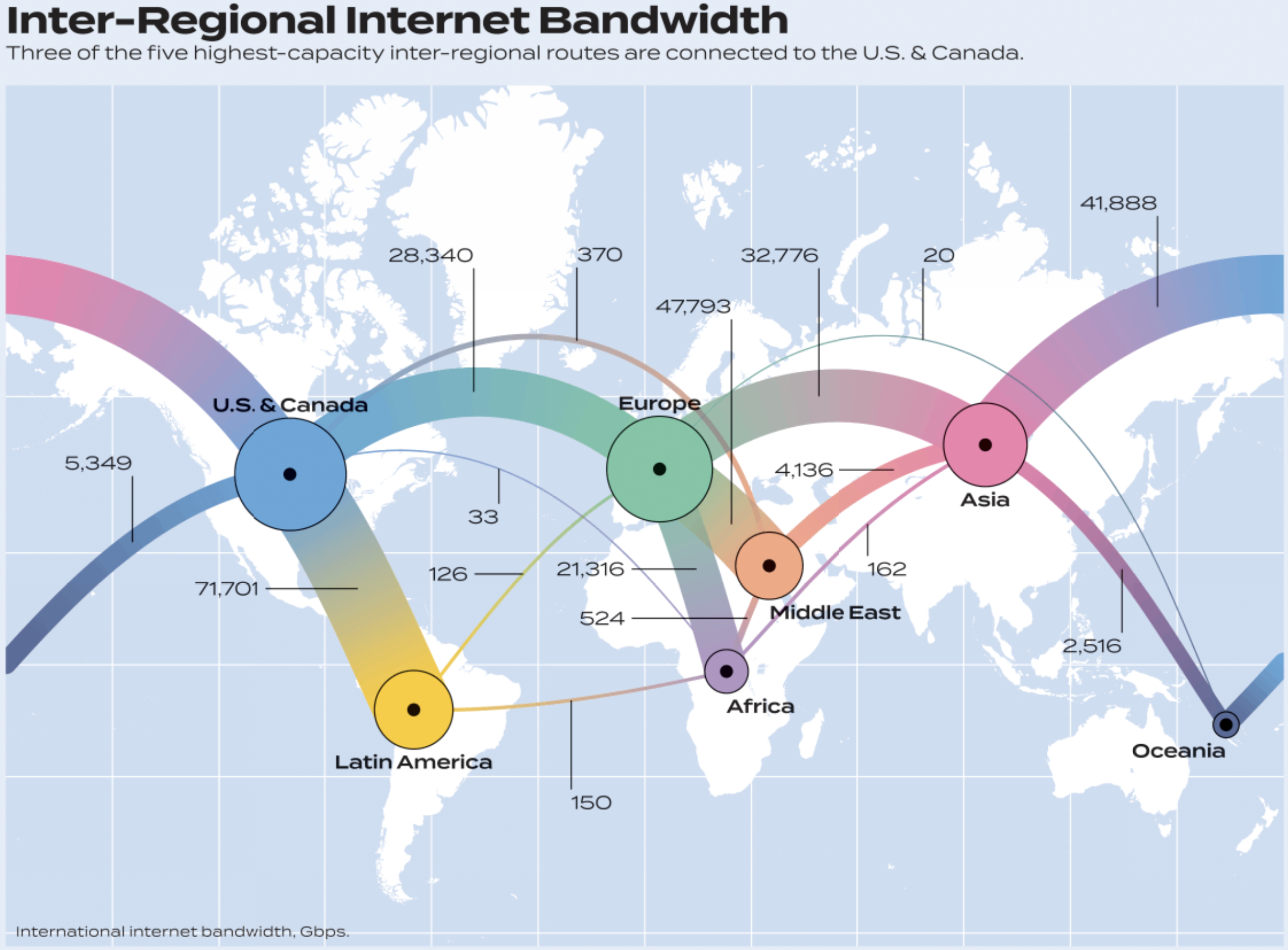
Excerpt from the 2022 Global Internet Map, published by Telegeography, showing aggregate internet bandwidth between major geographies:
6 Comments
ITHURALDE, Mariano
Hi Sascha,
Here are my comments:
Regards,
Mariano
WENNINGER-ext, Sascha
Thank you Mariano. I believe all items have been addressed via updates to the document and subsequent meetings.
WARD, Robert
Your presentation is well written and organized. I saw you captured the needed discussion (as Mariano requested) on both the ITAR and EAR carve out rules (the key to permitting U.S. export controlled data to reside on servers in the EU). The fact the EU (Germany in particular) do not offer such a carve out rule, not to mention the GDPR compliance concerns, all militate to a decision to run with the EU as host. I understand this and agree.
You did a great job showing personnel and available resources across the different geographical locations (the discussion on latency issues not to mention the carbon footprint, were fascinating). I could not help but wonder if we should analyze the company's revenue by region too. Is it possible to layer that in?
One final analysis to consider is relative penalty exposure for getting things wrong. Should we do a risk comparison between the U.S. versus EU on penalty exposure? The U.S. also has the ability to deny a company's export privileges, which would be devastating for Syensqo (do the EU and/or its member states have anything like this)?
I think you will come to the same conclusion, but these additional matters may need to be considered too when considering where company assets should be concentrated.
PARKER, John
I understand the rationale for consolidation to 2 SAP servers (China + ROW), with the ROW based in EU as the latest ruling on CMMC/CUI does not require a US instance. However, I'm not clear on the Nextlabs process as it relates to ITAR/Dual USe controls and how that will work. I understand the basic premise of encrypting the data per the FIPS 140 standard, but I'm not clear that we've completed a full risk review of this solution, a well as understand how this will impact the individual user interface. As Mariano mentioned, our ITAR impact is low, but we do have a fair amount of dual use materials that may be impacted by this solution.
TANG, Betty
Sascha,
For clarity, the recommendation from the team is for Option B, EU and CN instances with NextLabs DAE implemented. Is that correct?
Is the Nextlabs DAE applicable to the SAP S4 / Hana landscape - including extractions, reporting/dashboards, etc?
The solution specifies the data is encrypted at rest. Does the data need to be unencrypted to be processed or transported (such as running MRP, for extraction, etc.).
Has anyone looked at the level of effort to sustain field level security/encryption?
WENNINGER-ext, Sascha
Hi Betty,
Correct, this document recommends Option B. NextLabs will not be required in the China system as this does not contain ITAR/EAR data.
NextLabs DAE is an add-on to S/4HANA only and will act on data inside the S/4HANA database regardless of access mechanism (SAP transaction, Fiori app, interfaces, etc.)
The way NextLabs DAE works is described in a separate document here: Logical Architecture of NextLabs DAE
The level of effort to sustain this solution is not materially different from the effort of using NextLabs DAM in WPX and NextLabs DAE in WP2 today.