

Fatigue tests are typically represented by Wöhler curve which shows the relationship between Stresses to Number of cycles to failure (hence SN relation). When plotted on a log-log scale1, the Wöhler curve generally appears as a straight line, with Stress values2 (σmax or σa) in Y-axis and Number of cycles to failure (Nf) in X-axis.
To establish an SN relationship, fatigue tests are should preferably performed at multiple stress levels, not including repetitions3, which are conducted at the same stress levels. Therefore a simple Design Of Experiments (DOE) is required for every fatigue test request (example request document).
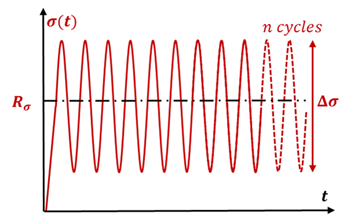
Example test request: Determine the SN relationship for a Syensqo SSP PARA grade Ixef 1022 with 50% GF, using ISO 527-1BA dry as molded (DAM) samples at 0 degree orientation, at temperature close to glass transition, Tg (hence 65°C), with a frequency of 5 Hz, and a loading ratio of R = 0.14. Tests should be conducted at eight different stress levels (80%, 70%, 75%, ..., 45% of σUTS, Ultimate Tensile Strength) with four repetitions at each level, except for the lower stress level (45% of σUTS), where only two repetitions are sufficient. Strain measurements are not required for this tests5. Figure III.1.c, shown the experimental data generated based on the request (scatter due to variability not included).
a. Force / Stress controlled sinus cyclic loading |
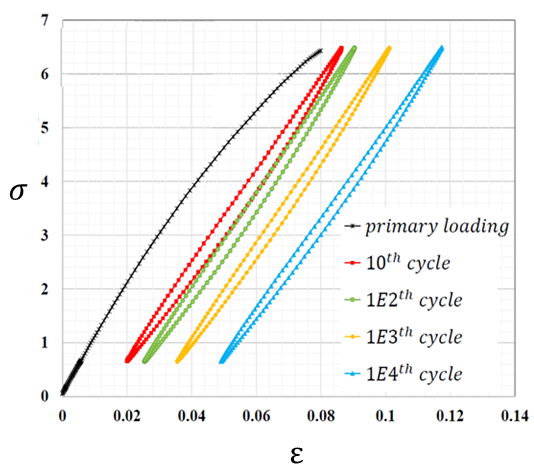
b. Illustration of Stress - Strain relation due to cyclic loadings, a.k.a. Hysteresis cycles |
c. Stress amplitude Vs Number of cycles to failure, SN relation |
| Figure III.1, A Basic Fatigue test | ||

Foot-notes:
1. Some data are also expressed in semi log scale (Y in linear & X in log), a common practice to make the stresses scale in Y axis visible.
2. Stresses can be represented as both maximum stress, σmax or stress amplitude, σa
3. Repetitions between 2-5 (less repetitions at low stress levels to save time and cost) are chosen to account for variability, which are inherent for any material (both plastics and metals).
4. Loading ratio of R 0.1 is generally chosen as default loading case. Please be aware that a part can experience loading cases much wider than mere R0.1, (R=1 is Creep loading).
5. For a basic fatigue test, strain measurements are not included unless requested. These are useful only if you are investigating macroscopic mechanical behavior of the composite.