


| Status | Revision in Progress |
|---|---|
| Owner | |
| Stakeholders |
Purpose
The purpose of this document is to define the conversion approach to create 1057 - QM Master Inspection Characteristics in S/4 HANA.
Master Inspection Characteristics are a fundamental element of SAP Quality Management (QM) used to define the parameters, specifications, and methods for quality inspections. MICs provide a standardized definition of what is to be inspected and how it should be measured, ensuring uniformity and consistency across inspection plans and quality processes. MICs can be maintained as Quantitative (numeric specifications such as measurement ranges and tolerances) or Qualitative (descriptive specifications such as defect classes or codes).
In SAP S/4HANA, the structure and usage of MICs remain consistent with SAP ECC, typically defined by key combinations such as plant, characteristic name, and characteristic type. MICs may include additional settings such as selected sets for qualitative characteristics, catalog assignments, default inspection methods, target values, upper and lower specification limits, and sampling procedures.
In SAP ECC, aside from the standard MIC structures, there may be additional configurations, such as plant-independent characteristics, characteristics linked to custom catalogs, or MICs with special control indicators and custom fields. Certain legacy systems may also include MICs with obsolete catalog references, inactive units of measure, or unused selected sets (pending MDS review), which must be validated before conversion.
This conversion aims to migrate active and relevant MIC records, along with their associated control indicators, selected sets, catalog assignments, default inspection methods, and specification limits, from existing ECC systems into S/4HANA. The migration will apply the required transformation logic using Syniti as the data migration and transformation platform. The converted records will be loaded into the target S/4HANA system using standard SAP mechanisms such as BAPIs (e.g., BAPI_INSPOPER_RECORDRESULTS for linking to inspection operations, or QS21 transaction for creation), IDOCs, or direct table loads where applicable, ensuring data integrity, compliance, and reusability across inspection plans.
Conversion Scope
The scope of this document covers the approach for converting active Master Inspection Characteristic (MIC) from Legacy Source Systems into S/4HANA following the Master Inspection Characteristic Master Data Design Standard.
The data from legacy system includes:
Active MICs used within the last three (3) years in inspection plans or inspection lots.
MICs without deletion flag.
Plant-specific and global MICs that will be migrated to the To-Be Plant Mapping (taking into consideration the To-Be definition of Plants).
MICs referenced in active inspection plans, sampling procedures, or inspection methods.
- MICs with valid configuration, including:
- Inspection Plan
- Sampling Procedure
- Inspection Method
- MICs with complete multilingual descriptions (short texts and, if available, long texts) in required business languages.
The data from legacy system excludes:
Inactive MICs not used in inspection plan for more than three (3) years.
MICs marked for deletion in ECC.
MICs belonging to deleted plants (per To-Be Plant mapping).
Obsolete or duplicate MICs that are no longer relevant, such as:
MIC replaced by harmonized corporate standards
- Local variations with identical configuration
- Test or training MICs not intended for productive use
- MICs with invalid references, such as:
- Links to deleted Sampling Procedures
- Links to inactive or obsolete Inspection Methods
- MICs with incomplete setup, including:
Missing UoM or decimal places for quantitative MICs
Missing catalog/code group for qualitative MICs
Missing description in mandatory languages
| Source | Scope | Source Approx No. of Records | Target System | Target Approx No. of Records |
|---|---|---|---|---|
| PF2 & WP2 | Master Inspection Characteristic will be extracted from PF2 and WP2 | PF2 =10145 records WP2 = 41526 records | S/4 HANA | 11722 records |
| DCT | Master Inspection Characteristics for Plant / Inspection Plan combinations which do not have data existing from PF2 and WP2 (Delta/new builds) | TBD | S/4 HANA | TBD |
Additional Information
Multi-language Requirement
Master Inspection Characteristic description will be maintained in English by default.
Since multi-language support is available for Master Inspection Characteristic, users logging in with a different language will see the description displayed in their logon language, provided that the corresponding language key has been maintained in the on Characteristic.
Document Management
Not applicable
Legal Requirement
Not applicable
Special Requirements
Not applicable
Target Design
The technical design of the target for this conversion approach.
| Table | Field | Data Element | Field Description | Data Type | Length | Requirement |
|---|---|---|---|---|---|---|
| QPMK | VERWMERKM | VERWMERKM | Master Inspection Characteristic (MIC) | CHAR | 18 | R |
| QPMK | VERSION | VERSION | MIC Version | NUMC | 2 | R |
| QPMK | WERKS | WERKS_D | Plant (plant-specific MIC) | CHAR | 4 | R |
| QPMK | SPRAS | SPRAS | Language Key | LANG | 1 | R |
| QPMK | KURZTEXT | KURZTEXT | Short Text (MIC name/description) | CHAR | 40 | R |
| QPMK | QUALI | QUALI | Qual/Quant Indicator (blank = qualitative, ‘1’ = quantitative) | CHAR | 1 | R |
| QPMK | PRUEFME | MSEHI | Unit of Measure (for quantitative MIC) | UNIT | 3 | R for Quantitative MIC |
| QPMK | ANZSTELL | ANZSTELL | Decimal Places | NUMC | 2 | R for Quantitative MIC |
| QPMK | MWERTS | MWERTS | Target Value (Default) | DEC | 15 | C |
| QPMK | MWERTU | MWERTU | Lower Spec Limit (Default) | DEC | 15 | C |
| QPMK | MWERTO | MWERTO | Upper Spec Limit (Default) | DEC | 15 | C |
| QPMK | TOLKZ | TOLKZ | Tolerance Indicator | CHAR | 1 | C |
| QPMK | KATALOGART | KATALOGART | Catalog Type (for qualitative MIC) | CHAR | 3 | R for Qualitative MIC |
| QPMK | CODEGRP | CODEGRP | Code Group (qualitative default) | CHAR | 8 | C |
| QPMK | AUSWMENGE | AUSWMENGE | Selected Set (qualitative default) | CHAR | 8 | C |
| QPMK | STICHPRVER | STICHPRVER | Sampling Procedure (default) | CHAR | 8 | C |
| QPMK | PRFGEB | PRFGEB | Inspection Method (default) | CHAR | 12 | C |
| QPMK | PRFGVER | PRFGVER | Inspection Method Version | NUMC | 2 | C |
| QPMK | STEUERKZ | STEUERKZ | Control Indicators (packed flags) | CHAR | 30 | C |
| QPMK | ERSTELLER | ERNAM | Created By | CHAR | 12 | C |
| QPMK | DATUMERST | ERDAT | Created On | DATS | 8 | C |
| QPMK | AENDERER | AENAM | Last Changed By | CHAR | 12 | C |
| QPMK | DATUMAEND | AEDAT | Last Changed On | DATS | 8 | C |
| QPMK | LOEKZ | LOEKZ | Deletion Flag (MIC) | CHAR | 1 | C (leave blank for active) |
| QPMT | VERWMERKM | VERWMERKM | MIC (text object link) | CHAR | 18 | R |
| QPMT | VERSION | VERSION | MIC Version | NUMC | 2 | R |
| QPMT | SPRAS | SPRAS | Language | LANG | 1 | R |
| QPMT | KURZTEXT | KURZTEXT | Short Text (language-dependent) | CHAR | 40 | C |
Data Cleansing
| ID | Criticality | Error Message/Report Description | Rule | Output | Source System |
|---|---|---|---|---|---|
| C1 | MIC not used in last 3 years | All MICs not referenced in any inspection plan (PLMK) or inspection lot in the last 3 years won’t be migrated. | Active MICs used within last 3 years | PF2/WP2 | |
| C1 | MIC flagged for deletion | All MICs with deletion indicator (QPMK-LOEKZ = X) won’t be migrated. | Active MICs without deletion flag | PF2/WP2 | |
| C1 | MICs in Plants that are Out of Scope | MICs created in plants not part of the To-Be Plant Mapping won’t be migrated. | MICs valid in active plants (To-Be mapping) | PF2/WP2 | |
| C1 | Inconsistent Qualitative/Quantitative setup | MICs with QUALI indicator inconsistent with catalog assignments (qualitative) or missing UoM/specification limits (quantitative) won’t be migrated. | MICs with valid setup (qualitative/quantitative) | PF2/WP2 | |
| C1 | Missing or invalid Sampling Procedure reference | MICs linked to sampling procedures (QDSV) that don’t exist or are obsolete won’t be migrated. | MICs with valid sampling procedure references | PF2/WP2 | |
| C1 | Missing or invalid Inspection Method reference | MICs linked to inspection methods (QMTB) that don’t exist or are obsolete won’t be migrated. | MICs with valid inspection method references | PF2/WP2 | |
| C2 | MIC without description in required languages | MICs missing short text (QPMK-KURZTEXT) in business languages won’t be migrated. | MICs with complete multi-language descriptions | PF2/WP2 | |
| C2 | Duplicate MICs | MICs with duplicate name/version across same plant will be consolidated or excluded. | Unique MICs per plant/version | PF2/WP2 | |
| C3 | Obsolete or unused selected sets/catalog codes | MICs referencing obsolete catalogs or code groups won’t be migrated. | MICs with valid catalog/code group | PF2/WP2 | |
| C3 | Audit data inconsistent | MICs with invalid created/changed dates or missing user info will be cleansed or flagged. | MICs with valid audit trail | PF2/WP2 |
Conversion Process
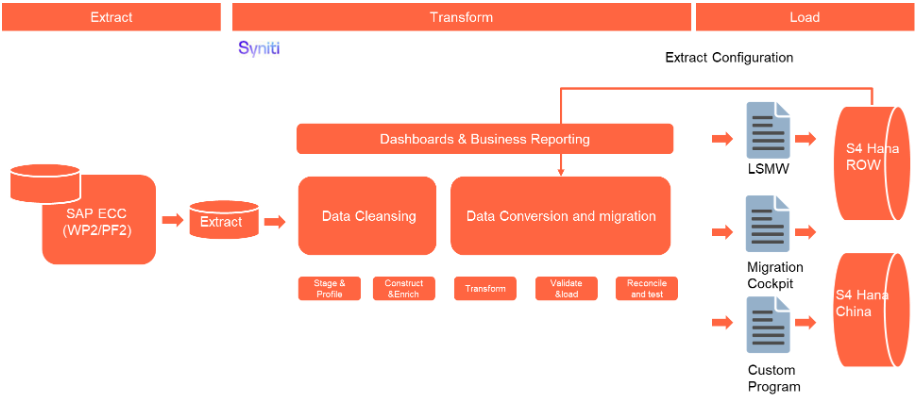
The high-level process is represented by the diagram below:
The ETL (Extract, Transform, Load) process is a structured approach to data migration and management, ensuring high-quality data is seamlessly transferred across systems. Here’s a breakdown of its key components:
1. Extraction
The process begins with extracting metadata and raw data from source systems, such as Syensqo ECC system (i.e. WP2/PF2) periodically. The extracted data is then staged for transformation.
2. Transformation
Once extracted, the data undergoes cleansing, consolidation, and governance. This step ensures data integrity, consistency, and compliance with business rules. The transformation process includes:
- Data validation to remove inconsistencies.
- Standardization to align formats across datasets.
- Business rule application to refine data for operational use.
3. Loading
The transformed data is then loaded into the target S/4HANA system.
Data Privacy and Sensitivity
Not applicableExtraction
Extract data from a source into . There are 2 possibilities:
- The data exists. connects to the source and loads the data into . There are 3 methods:
- Perform full data extraction from relevant tables in the source system(s).
- Perform extraction through the application layer.
- Only if ; cannot connect to the source, data is loaded to the repository from the provided source system extract/report.
- The data does not exist (or cannot be converted from its current state). The data is manually collected by the business directly in . This is to be conducted using DCT (Data Collection Template) in
The agreed Relevancy criteria is applied to the extracted records to identify the records that are applicable for the Target loads
Extraction Run Sheet
| Req # | Requirement Description | Team Responsible |
|---|---|---|
| Extraction Scope Definition | - Identify the source systems and databases involved. - Define the data objects (tables, fields, records) to be extracted. - Establish business rules for data selection. | Syniti / LTC Data team |
| Extraction Methodology | - Specify the extraction approach (full, incremental, or delta extraction). - Determine the tools and technologies used. - Define data filtering criteria to exclude irrelevant records. | Syniti |
| Extraction Execution Plan | - Establish execution timelines and batch processing schedules. - Assign responsibilities for extraction monitoring. - Document dependencies on other migration tasks. | Syniti |
| Data Quality and Validation | - Define error handling mechanisms for extraction failures. | Syniti |
Selection Screen
| Selection Ref Screen | Parameter Name | Selection Type | Requirement | Value to be entered/set |
|---|---|---|---|---|
Data Collection Template (DCT)
Target Ready Data Collection Template will be created for Master Inspection Characteristic data with exception of some fields which require transformation as mentioned in the transformation rule.Master Inspection Characteristic DCT Rules
| Field Name | Field Description | Rule |
|---|---|---|
| Pending MDS and number of data in source system | ||
Extraction Dependencies
| Item # | Step Description | Team Responsible |
|---|---|---|
| 1 | Source System Availability
| Syensqo IT |
| 2 | Data Structure
| Syniti |
| 3 | Referential Integrity
| Syniti |
| 4 | Extraction Methodology
| Syniti |
| 5 | Performance and Scalability Considerations
| Syniti |
| 6 | Security and Compliance
| Syniti |
Transformation
The Target fields are mapped to the applicable Legacy field that will be its source, this is a 3-way activity involving the Business, Functional team and Data team. This identifies the transformation activity required to allow to make the data Target ready:
- Perform value mapping and data transformation rules.
- Legacy values are mapped to the to-be values (this could include a default value)
- Values are transformed according to the rules defined in
- Prepare target-ready data in the structure and format that is required for loading via prescribed Load Tool. This step also produces the load data ready for business to perform Pre-load Data Validation
Transformation Run Sheet
| Item # | Step Description | Team Responsible |
|---|---|---|
| 1 | Obtain DCT Sign-off from Business | SyWay Data Team |
| 2 | <Add steps from Syniti Migrate here> | SyWay Data Team |
| 3 | Review and Validate Error and Preload Reports | SyWay Data Team |
| 4 | Generate Load Files | SyWay Data Team |
Transformation Rules
| Rule # | Source system | Source Table | Source Field | Source Description | Target System | Target Table | Target Field | Target Description | Transformation Logic |
|---|---|---|---|---|---|---|---|---|---|
| 1 | PF2, WP2 | QPMK | VERWMERKM | MIC Name | S4 HANA | QPMK | VERWMERKM | MIC Name | Direct transfer; harmonize naming per corporate standard |
| 2 | PF2, WP2 | QPMK | VERSION | MIC Version | S4 HANA | QPMK | VERSION | MIC Version | Direct transfer; default “00” if missing |
| 3 | PF2, WP2 | QPMK | WERKS | Plant | S4 HANA | QPMK | WERKS | Plant | Map from Old Plant to New Plant (To-Be Plant Mapping) |
| 4 | PF2, WP2 | QPMK | KURZTEXT | Short Text | S4 HANA | QPMK | KURZTEXT | Short Text | Direct transfer; cleanse special characters; ensure language-dependent text available |
| 5 | PF2, WP2 | QPMT | SPRAS | Language Key | S4 HANA | QPMT | SPRAS | Language Key | Map to target system language codes (EN, ZH, ID etc.) |
| 6 | PF2, WP2 | QPMT | KURZTEXT | Text (per language) | S4 HANA | QPMT | KURZTEXT | Text (per language) | Direct transfer; validate for completeness in key business languages |
| 7 | PF2, WP2 | QPMK | QUALI | Quantitative / Qualitative Indicator | S4 HANA | QPMK | QUALI | Quantitative / Qualitative Indicator | Direct transfer; ensure consistency with catalog assignments (qualitative) or limits (quantitative) |
| 8 | PF2, WP2 | QPMK | PRUEFME | Unit of Measure | S4 HANA | QPMK | PRUEFME | Unit of Measure | Map UoM via standard T006 conversion |
| 9 | PF2, WP2 | QPMK | ANZSTELL | Decimal Places | S4 HANA | QPMK | ANZSTELL | Decimal Places | Direct transfer for quantitative MICs; default = 0 if qualitative |
| 10 | PF2, WP2 | QPMK | MWERTS | Target Value | S4 HANA | QPMK | MWERTS | Target Value | Direct transfer if quantitative; blank for qualitative |
| 11 | PF2, WP2 | QPMK | MWERTU | Lower Spec Limit | S4 HANA | QPMK | MWERTU | Lower Spec Limit | Direct transfer if quantitative; blank for qualitative |
| 12 | PF2, WP2 | QPMK | MWERTO | Upper Spec Limit | S4 HANA | QPMK | MWERTO | Upper Spec Limit | Direct transfer if quantitative; blank for qualitative |
| 13 | PF2, WP2 | QPMK | KATALOGART | Catalog Type | S4 HANA | QPMK | KATALOGART | Catalog Type | Direct transfer if qualitative MIC |
| 14 | PF2, WP2 | QPMK | CODEGRP | Code Group | S4 HANA | QPMK | CODEGRP | Code Group | Direct transfer if qualitative MIC; validate existence in target |
| 15 | PF2, WP2 | QPMK | AUSWMENGE | Selected Set | S4 HANA | QPMK | AUSWMENGE | Selected Set | Direct transfer if qualitative MIC |
| 16 | PF2, WP2 | QPMK | PRFGEB | Inspection Method Ref. | S4 HANA | QPMK | PRFGEB | Inspection Method Ref. | Map to new Inspection Method IDs in S/4 (if harmonized) |
| 17 | PF2, WP2 | QPMK | STICHPRVER | Sampling Procedure Ref. | S4 HANA | QPMK | STICHPRVER | Sampling Procedure Ref. | Map to active Sampling Procedures in S/4 (validated against QDSV) |
| 18 | PF2, WP2 | QPMK | STEUERKZ | Control Indicators | S4 HANA | QPMK | STEUERKZ | Control Indicators | Direct transfer; align with S/4 customizing for MIC flags |
| 19 | PF2, WP2 | QPMK | LOEKZ | Deletion Flag | S4 HANA | QPMK | LOEKZ | Deletion Flag | Exclude flagged records (set during cleansing, not migrated) |
| 20 | PF2, WP2 | QPMK | ERNAM / ERDAT | Created By / On | S4 HANA | QPMK | ERNAM / ERDAT | Created By / On | Audit info migrated for traceability |
| 21 | PF2, WP2 | QPMK | AENAM / AEDAT | Changed By / On | S4 HANA | QPMK | AENAM / AEDAT | Changed By / On | Audit info migrated for traceability |
Transformation Mapping
| Mapping Table Name | Mapping Table Description |
|---|---|
Transformation Dependencies
List the steps that need to occur before transformation can commence| Item # | Step Description | Team Responsible |
|---|---|---|
Pre-Load Validation
Project Team
Completeness
| Task | Action |
|---|---|
Accuracy
| Task | Action |
|---|---|
Business
Completeness
| Task | Action |
|---|---|
Accuracy
| Task | Action |
|---|---|
Load
The load process includes:
- Execute the automated data load into target system using load tool or product the load file if the load must be done manually
- Once the data is loaded to the target system, it will be extracted and prepared for Post Load Data Validation
Load Run Sheet
| Item # | Step Description | Team Responsible |
|---|---|---|
Load Phase and Dependencies
Configuration
| Item # | Configuration Item |
|---|---|
Conversion Objects
| Object # | Preceding Object Conversion Approach |
|---|---|
| list the exact title of the conversion object of only the immediate predecessor – this will then confirm the DDD (Data Dependency Diagram) | |
Error Handling
| Error Type | Error Description | Action Taken |
|---|---|---|
Post-Load Validation
Project Team
Completeness
| Task | Action |
|---|---|
Accuracy
| Task | Action |
|---|---|
Business
Completeness
| Task | Action |
|---|---|
Accuracy
| Task | Action |
|---|---|
Key Assumptions
- Master Data Standard is up to date as on the date of documenting this conversion approach and data load.
- is in scope based on data design and any exception requested by business.
See also
Change log
Workflow history
| Title | Last Updated By | Updated | Status | |
|---|---|---|---|---|
| There are no pages at the moment. | ||||