Let’s say that you are invited to a meeting, and you want to know who are the people that will be joining. It would be funny if all the pictures were of animals, nature, cartoons… but in the end, it would not help you. A professional picture has a huge impact in someone’s first impression. It doesn’t have to be boring, of course, but it must show who you are, like a brand. When it comes to having your picture in the organizational charts, or your google email, the keyword here is PROFESSIONAL. It should be a portrait of you, and not pets, children or objects (let’s save those for other social networks). Take off your mask and show the company your big smile! To sum up, the photo should be of you and only you, as you would come to work. And remember, it’s available for everyone at the company to see. Need some tips on how to have a great profile picture? Check this video. But… What if you don’t like pictures?Well, let’s go to option B: Keep the avatar as is.
Below you can find the steps you need to follow if you want to change your picture/avatar. |
Step 1: Go to Syensqo The Hub and click on the My HR Services tile 
Step 2: Click on ‘Home’ and select ‘My Profile’ or you can directly access the ‘My Profile’ tile on the homepage 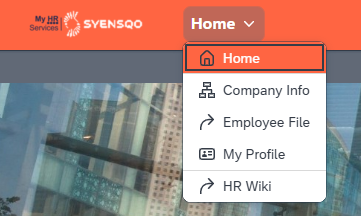
Step 3: Now place your mouse cursor over the picture, there will be ‘Update Profile Picture’ message pop up, Click on it. 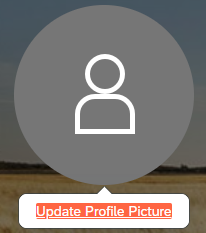
Step 4: Select your profile picture and Save 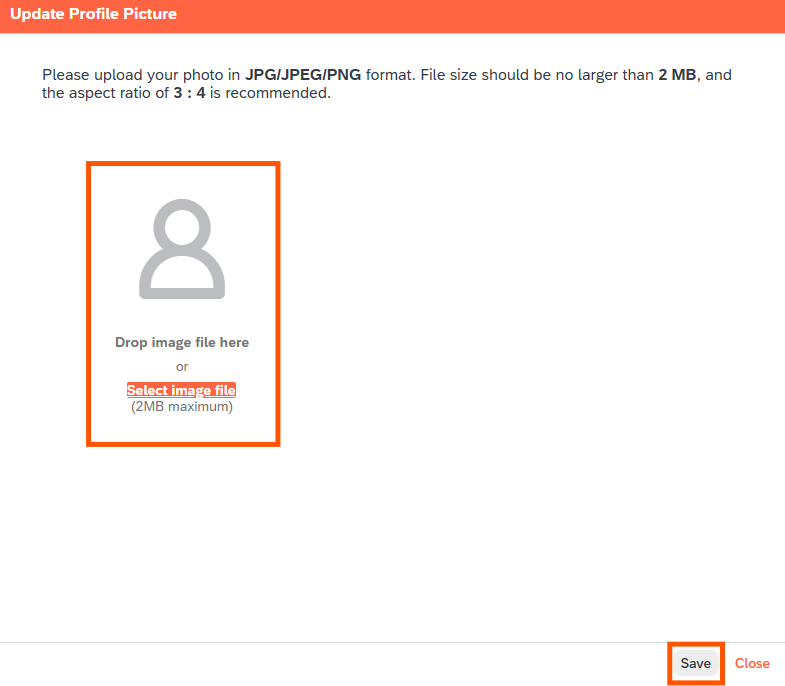
Now, the picture will be available on your Employee Profile. |
You can also edit your background profile image! Would you like to personalize a little more your profile? It’s possible by editing your background. Please remember that your profile is available for any Syensqo employee, so choose wisely. - In the top right corner of your screen click on "Header" and click on "Update Background image":
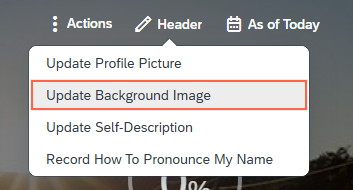
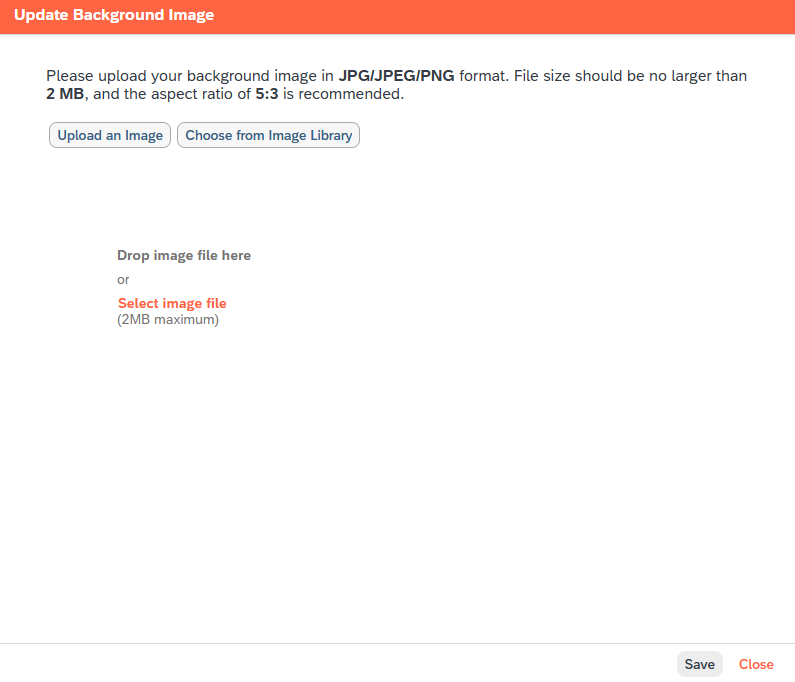
- You can choose to upload from an Image Library such as the Syensqo’s Library (make sure you have your VPN connection on) or Upload from your drive (just make sure not to upload any internet pictures for intellectual property reasons).
- Click "Save" to implement the change.

|
| Video Tutorials | | | Further Reading Material | |
|
|
|
Want to Use the HR Tools in your Language?All sources of HR information - SyRa and HR Wiki have automated translation capabilities to let you enjoy the content in the language of your preference. Translate to your language - You can chose to use the platform and chat in your own language. How to Change the Language in SyRa SyRa: Go to your profile→Preferences→Select your language→Sign into the tool again. 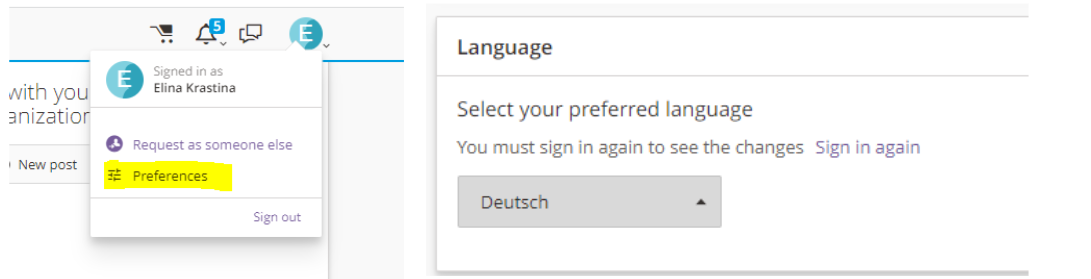
*Please note that this option will not translate the Service Catalogue and Knowledge articles. To interact fully in local language you can enable Google translate functionality. See the information below.
How to Enable Google Translate in SyRa To translate some content in SyRa you can use Google translate functionality. Right click on the screen→Select Translate to→Choose language→Read in your language. WATCH THE VIDEO TUTORIAL
How to Translate the HR Wiki?Click on Translate tab in the header→Select your language→Read content in your language WATCH THE VIDEO TUTORIAL
* Please note that images/photos, presentations and other embedded documents that are in English will not be translated. |
The Employee File is a place where you can find all of your HR related documents in one place. This space will contain your documents that have already been loaded in your profile in My HR Services. Note: Documents will be captured here as of go-live forward. Documents stored locally will be gradually migrated over time. Please note that due to legal constraints, Bulgaria and Russia are out of scope. |
You access your personal Employee File via My HR Services. Here you will find a tile under My Information called Employee File. 
Just select this tile and you will be led to your personal workspace as shown below. Each of the tabs are explained below. 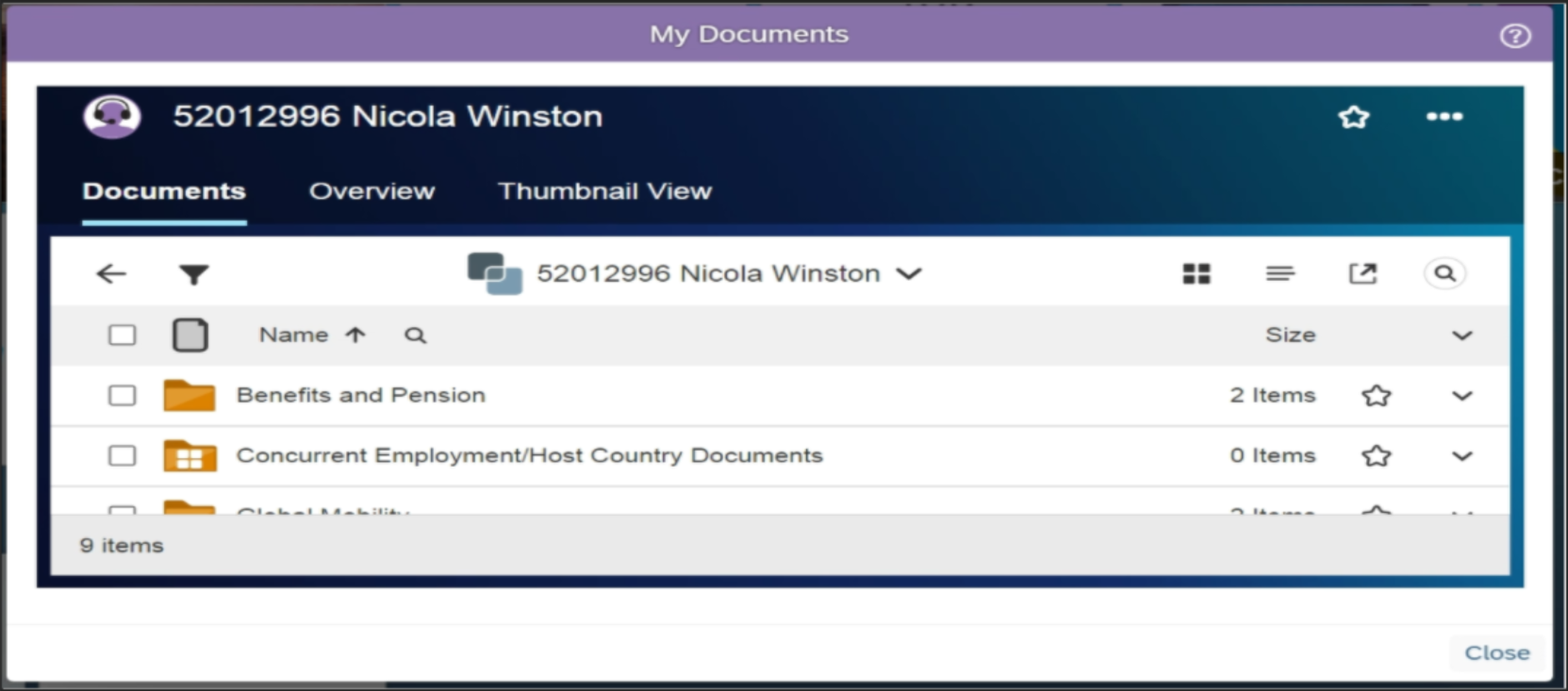
|
Documents Tab - Here you will find a folder structure for the different document categories and within each the related sub-categories. Simply click on the folder to open and see what is inside and then click on the name of the document to open it. Folder | Sub Folder | Description | Document Examples |
|---|
Benefits and Pension | Health and Welfare benefits | Documents related to Health and Welfare benefits provided to the employee and their family. | Health Insurance Forms, Short or Long term Disability, Life Insurance, Meal Allowances, Company car, Participation in Langzeitkonto (DE), Usage of tariff related benefits (Zukunfts Beitrag) (DE), etc. | | Retirement benefits | Documents related to the different types of pension funds and retirement benefits/plans. | Pension fund letter leaver/retiree , Pension fund leaver/retiree calculation, 401k, Seniority Jubilee (calculation), Pension Schemes/Program, Participation in PKDW, AFORE Document,Individual liquidation statement - (pre)retiree and leaver, etc. | Global Mobility
| Agreements & Packages | Documents containing all the information about expatriation. | Secondment Agreement, Assignment Extension, Assignment Termination, Remuneration Package, Cost of Living Calculations, etc. | | Administrative Documents | Documents about tax administration for expats: | Reports on Taxes & Deductions etc. | Learning and Development
| Development Plans | Includes career development and skill building plans. |
| | Training Records | Documents showing the training history of the employee and related certifications. |
| Payroll and Compensation
| Payroll Forms & Documents |
| W4, W2, annual tax statements, local bonuses, recurrent deductions, garnishment, etc. | | Compensation |
| Compensation statements, promotion statements, bonuses, long term incentive | Performance and Talent Management
| Performance Assessment | All types of performance reviews or assessments. |
| | Feedback | Feedback received by the employee from others in the organization. |
| | Discipline & Improvement Plans | Official communication to the employee when performance and/or behaviors are not in line with expectations. | Performance improvement plans, disciplinary letters, praises etc. | Personnel Administration
| Employee Personal Documents | Documents that contain information about the employee and there dependents and are needed to maintain employee data across several HR systems for several purposes, such as permissions, check-ups etc | Copies of passport, national ID card, driver’s license, Work Permit/Immigration Forms, Security Clearance documents, Form I-9, Religious orientation, birth certificate, marriage certificate, verification of employment, certificate of salary and employment status/contract type, Proof of Address, bank account, RFC, CPF (Cadastro de Pessoas Físicas or Natural Persons Register), CURP, etc. | | Company Issued Documents & Agreements | Documents that include information relating to the employment and employment contract of an employee, as well as several acknowledgements and declarations signed by the employee. | Labour contract, Offer letter, Confidentiality Agreement, non-competition agreement, Letter of Assurance, Labour book, NDA Agreement, GDPR declaration, Industrial Agreement acknowledgment, Acceptance of the collective accident insurance, Confirmation acceptance work regulations, Declaration for received documents such as Code of Business integrity, Safety procedures, etc | | Medical | Documents containing medical related information that is NOT maintained by HSE. | Hiring / Leaving Medical Clearance Form, Medical accommodation, Medical certificate | | Union Documentation | Documentation related to union topics that is employee specific. | Arbitrations / Grievances | Recruitment | Candidate Documents | Documents related to the candidate's profile for the position and professional qualifications:. | CV and Application, assessment results, recommendation letter, School Diploma/Degree, licences etc. | | Time Management | Absence & Attendance Related Documents | Documents that are needed to justify/approve absences paid or unpaid. | Absences related to sickness, work accident, parental leave, furloughs, disciplinary, strike, etc. |
Overview Tab - Here you can quickly access any folders or documents you mark as Favorite as well as Recently Accessed documents. Thumbnail Tab - Here you can view the Thumbnail of documents in your Employee File. |
Searching for a DocumentThe magnifying glass icon on the right side of the screen enables you to search for a document regardless of which folder it is stored in. Simply type the name or key word in the name of the document and click on the document name to open the document. - Your search result will appear in one of two formats that you can toggle between by clicking the related icon:
- Standard View -
 - Tabular View -

A) Standard view: 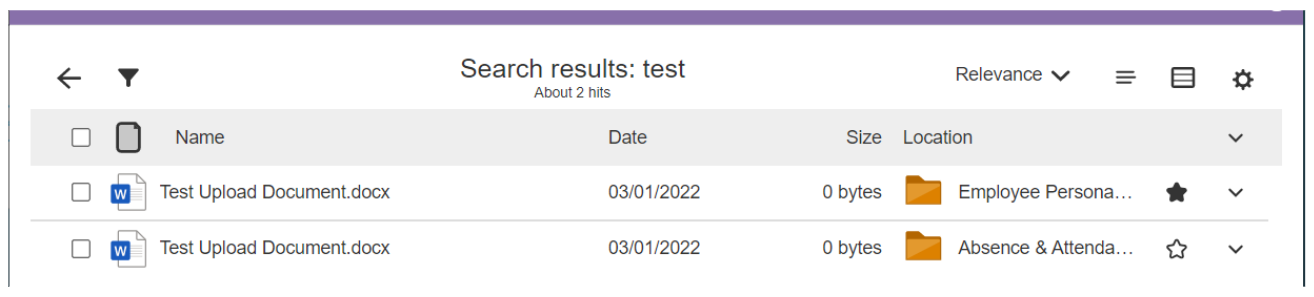
B) Tabular view: 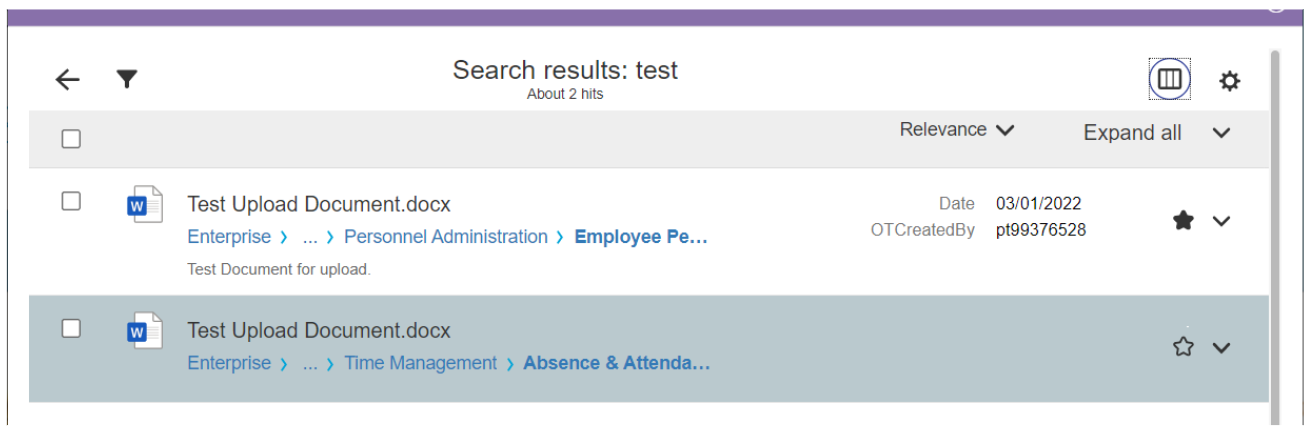
In Tabular View under each document name you will find the storage path of that document. In the example above you see this document is stored in the “Personnel Administration” folder and then a sub-folder “Emplo…”. To see the full path you can reduce the zoom level to 80% by clicking ctrl - and can enlarge by clicking ctrl +.

C) By Clicking on this  icon you can add the associated document to your Favorites which is displayed on the Overview tab. icon you can add the associated document to your Favorites which is displayed on the Overview tab.
NOTE: The magnifying glass icon shown on the left directly above the folders searches only what is visible on this screen so not particularly helpful in our context. - You can filter documents stored in the files by clicking on the filter icon
 . From here you can refine the filter further. This can be a useful tool if you are looking for a particular type of document such as pdf or you are not sure of a key word in the name of the document. . From here you can refine the filter further. This can be a useful tool if you are looking for a particular type of document such as pdf or you are not sure of a key word in the name of the document. - List View and Grid View - Click on the
 icon to change to grid view and click on the icon to change to grid view and click on the  icon to revert to the list view. icon to revert to the list view. - Display the folder descriptions by clicking on the
 icon. icon. - Maximize the widget view by clicking on the
 icon icon - STAR icon enables you to indicate that item as a Favorite. Favorites are displayed on the Overview tab.
- 3 Dots (top right corner). Clicking here gives you two options. One is “Copy Link” which you can then share via email, chat, etc. The second is “Mail as Link” - this functionality is not yet enabled for Syensqo. NOTE: Any link you share will only work if the recipient has the authorization to access your Employee File.
Marking Favorite Documents You can mark Favorites at the document, folder and workspace level. Step 1: Navigate to the document you want to mark as favorite as shown below and click on the star button: 
Step 2: A pop-up similar to below will be displayed. You can either leave the name as is or change it and click on "Add" as shown below: 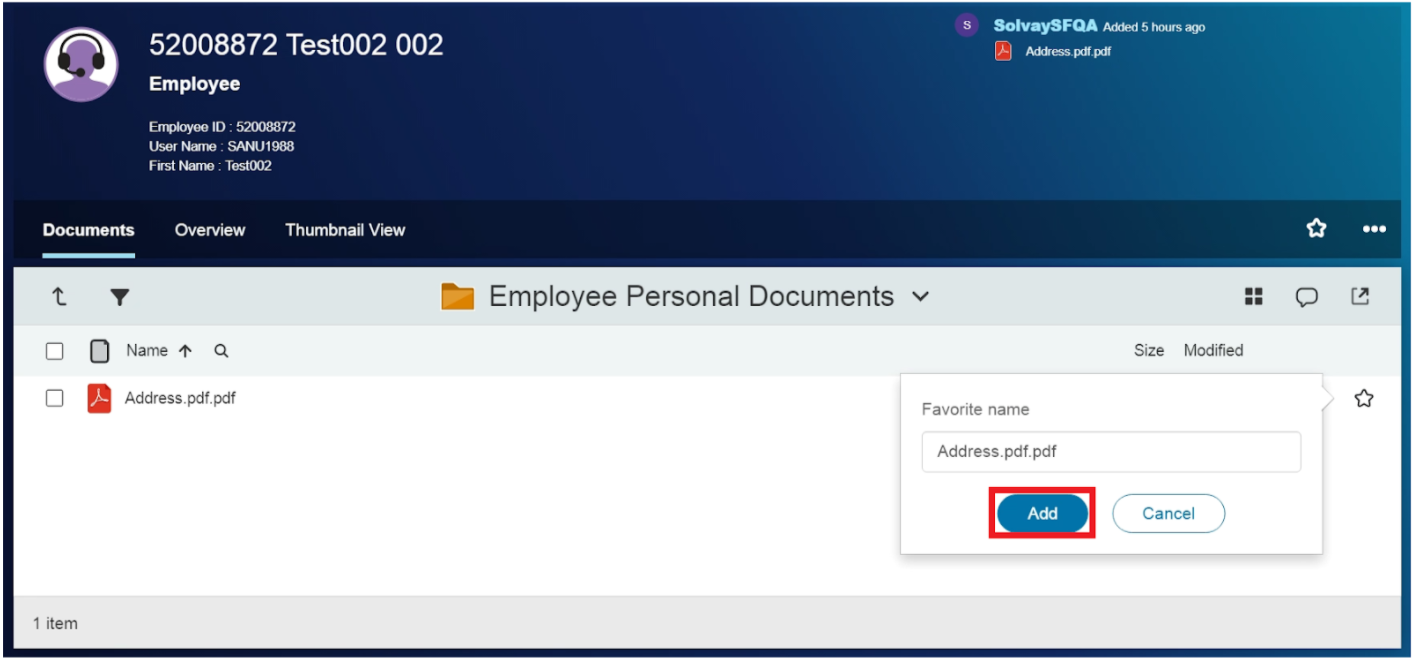
The icon in front of the document will change from to  and the document will now be included in the Favorites section on the Overview tab. and the document will now be included in the Favorites section on the Overview tab.
Additional Actions with DocumentsWhen you select a document by checking the box to the left of the name, additional actions will be displayed just above. These are explained below. 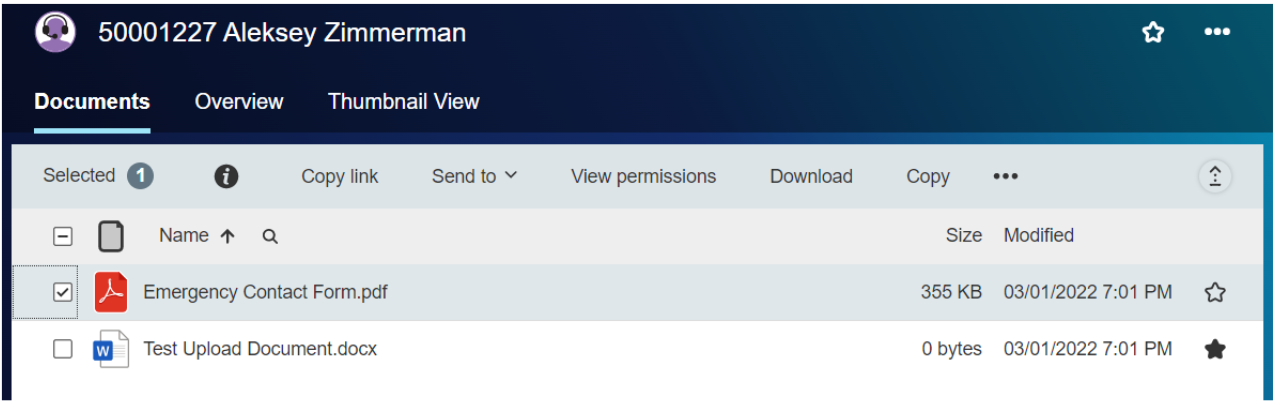
 - Displays the properties of the document. - Displays the properties of the document.
Copy link - Copies the link of the document to clipboard. You can share this link with others however it will only work for them if they have the relevant permissions. View Permission - Displays the permissions of the document. Download - Can be used to download the document into your local system. Copy, Delete Workflow, Sand end to/Mail as link - Please disregard. |
An employee can have one or multiple assignments assigned to them during the course of their career. There are two distinct types: Concurrent Employment and Global Assignment. If you are in one or both of these categories you can access the related documents via a single profile. Concurrent EmploymentConcurrent employment is when an employee is assigned to more than one assignment at the same time. In such a case, the documents related to each assignment would be maintained separately. Find below a screenshot of the layout and folder structures. 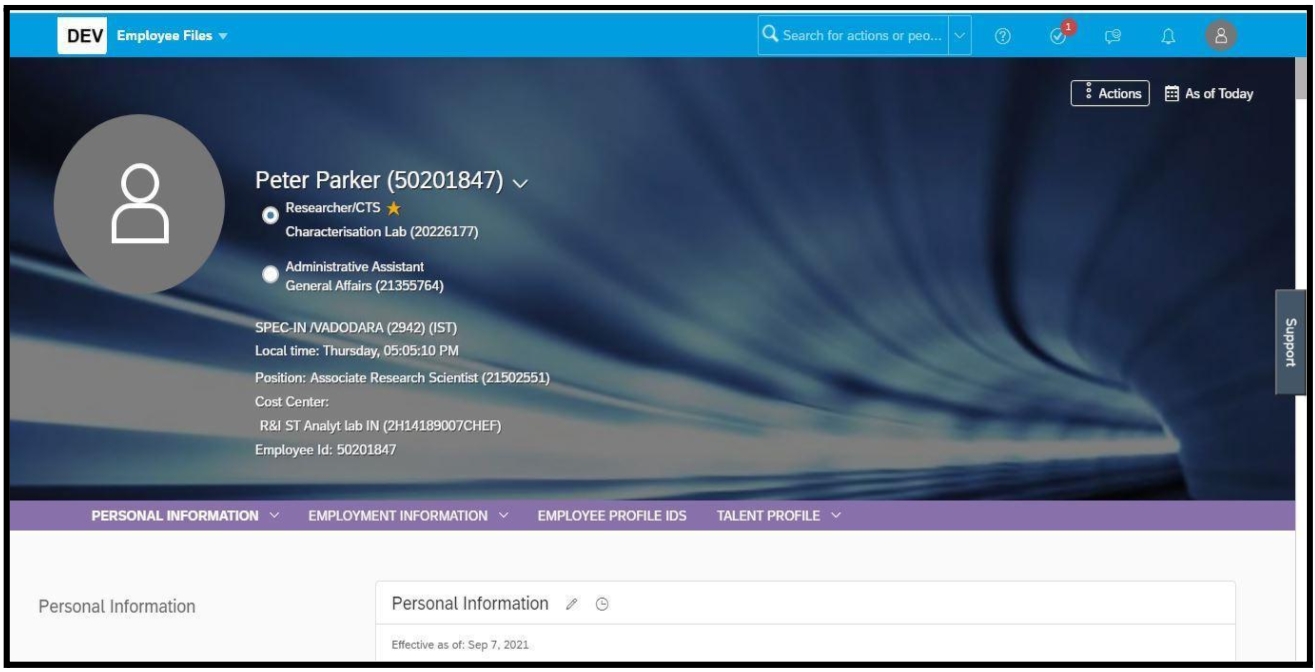
Using the Employee File tile under My Information, go to your Personal Employee File to see the folder structure. When you click on the “Concurrent Employment/Host Country Documents” folder then you will see your other assignment (Concurrent assignment in this case). 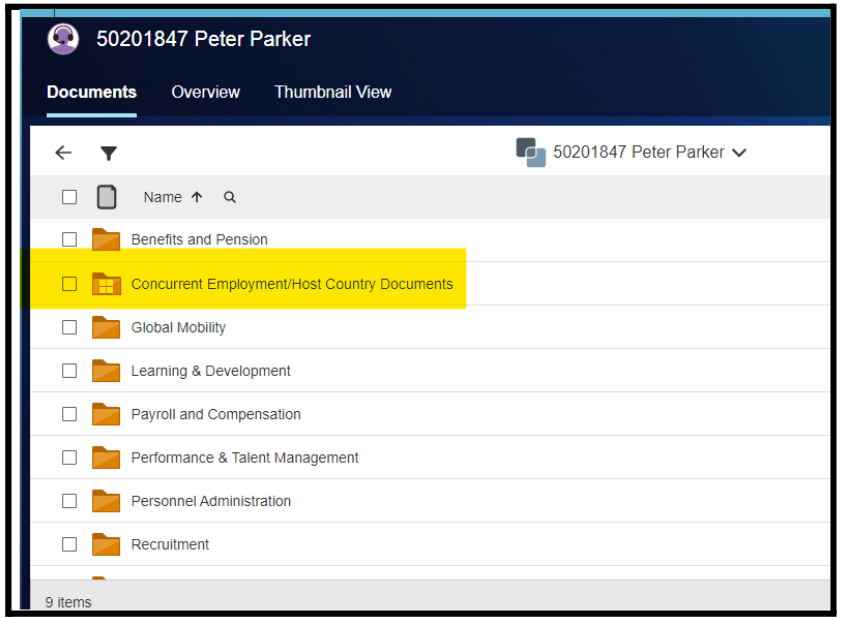
After clicking on Concurrent assignment, you will see the folder structure of your Concurrent Assignment as shown below.
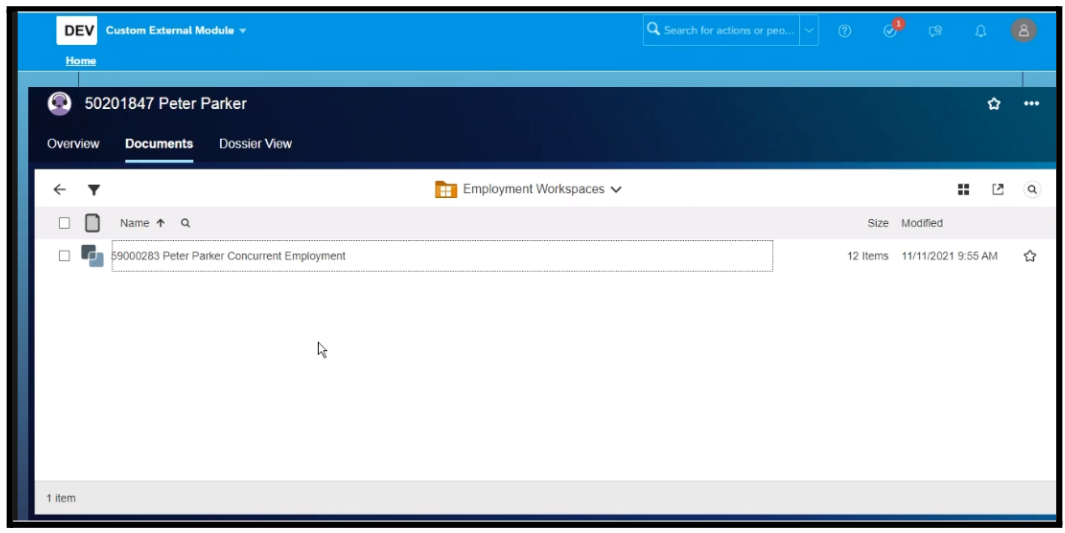
To go back to the folder structure of your other assignment click on the “Primary Assignment Workspace” folder from the list. 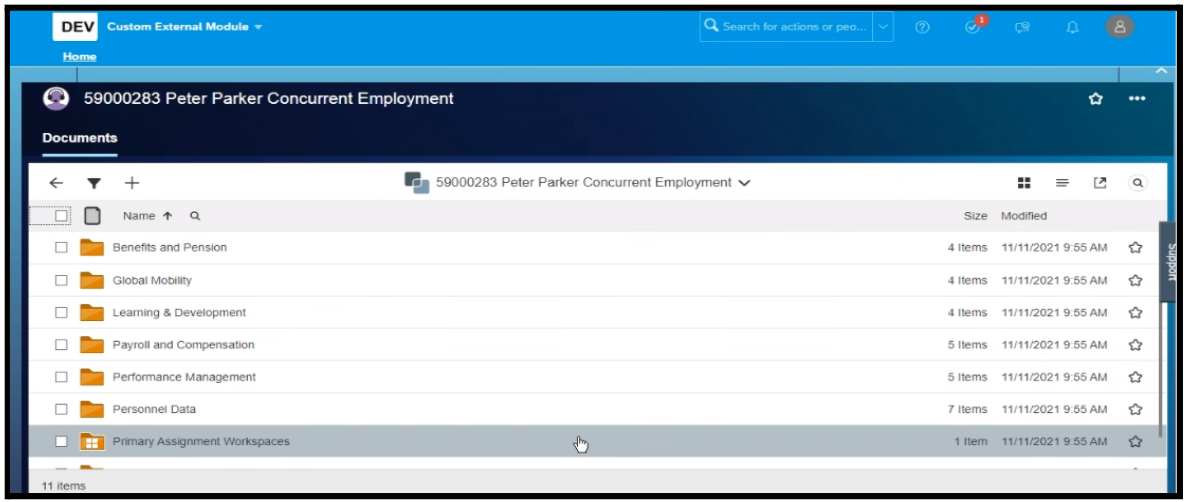
Global AssignmentsIf you need assistance accessing any of your personal HR documents or those of anyone you manage, please contact our HR Service team who are available to support you with this.
|
|
|
In this article you will find out how to update your Personal Information on your Profile in My HR Services. Your personal data can be consulted and edited on your Employee profile in My HR Services, such as: - Personal information (Names, Marital Status, Gender, Nationality, etc.)
- Personal contact Information
- Address
- National ID
- Work Permit
- Bank Account
- Dependents
Note: If you require a Biological information change please open a ticket through Service One. Note: If you need to update your E-mail or Business Contact, please open a ticket to the Service Desk through this link. |
- Go to My HR Services and click on My profile
From there, you can edit the information you need to update.
2. To update your information, follow these steps: 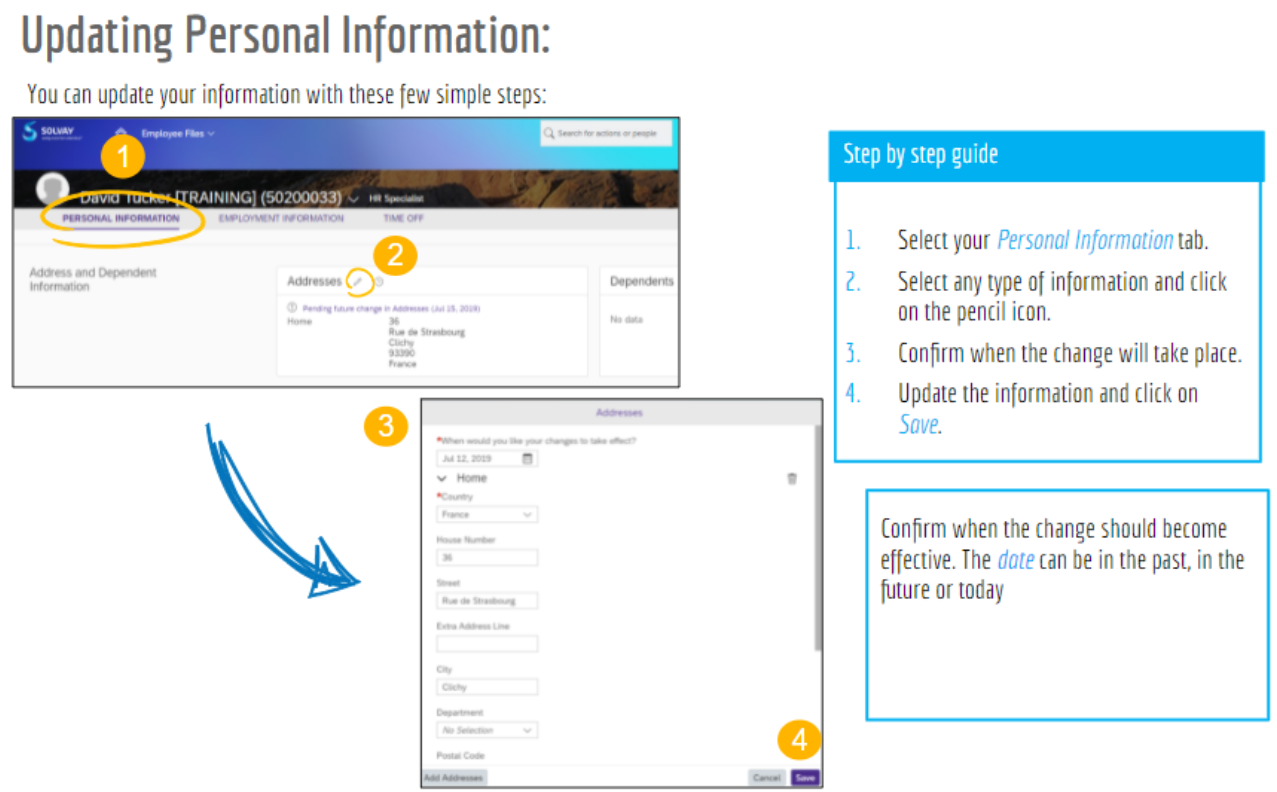
Notes : - Some changes requested will be submitted to the approval of HR Admin Teams. The change will show as “Pending approval” until it’s finally approved. You will be notified by email when your request was approved.
- On this tile, you will find your pending requests:
 - Please ALWAYS add the proper documentation when prompted by the tool, according to your request, so the HR Admin Teams can review and approve it.
FOR MORE INFORMATION CONSULT THE MANUAL BELOW
For Email Address Change or Concerns, please get IT support or call your regional helpdesk's phone number that you can find here.
|
|
|

We know it is never easy to memorize dates so it’s with great pleasure that we announce the creation of a Payroll Calendar for your country! The purpose of this Google Calendar is to allow all employees in the country to consult the most relevant Payroll dates. With this calendar you will be able to identify the last day to record data in your HR tools, to remember the day of your salary payment and more. But this calendar also comes in handy for more specific populations, like Finance to capture the Posting file dates. So… How do you add this calendar to your google calendar list? At the launch of each Payroll Country Calendar you will receive an email, inviting you to add your country’s calendar (including newcomers, as each calendar will be linked to all employees locally). If for any reason you didn’t receive this email or wish to add another country calendar, you will find below a list of Payroll Calendars per country. Just select the one you want to see and that’s it!
There are calendars for more countries being worked on. Note: All events are created based on a full-day event. This means that we need to consider the country's time zone. Example: If a payslip is delivered on the 23rd of December in Canada, on a Portugal view this will cover two days because of the different time zone). |
|
|
The Employee File workspace enables Human Resource professionals to access and manage the documents of the employees in their scope. Please note that due to legal constraints, Bulgaria and Russia are out of scope. Employee file access is open to Employees, Managers and HR professionals. Your HR access to the Employee Files is based on your role in HR and scope. Employee File tile in My HR Services will lead you to your own workspace. 
To access Employee files for employees in your scope click on Employee File item in the Home menu: 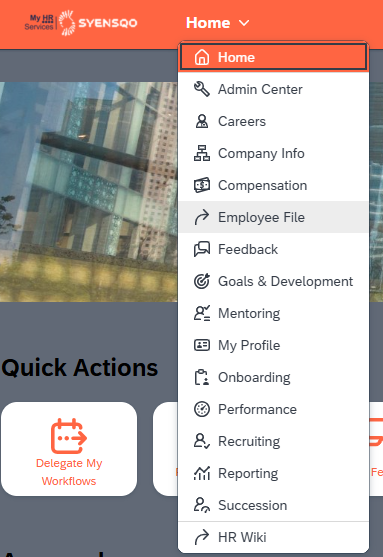
This will lead you to the Employee File Workspace as shown below. Here you can search for an employee, search for a document, view Favorites, and access employee documents for those in your scope. This space also displays recently accessed employee files and documents. 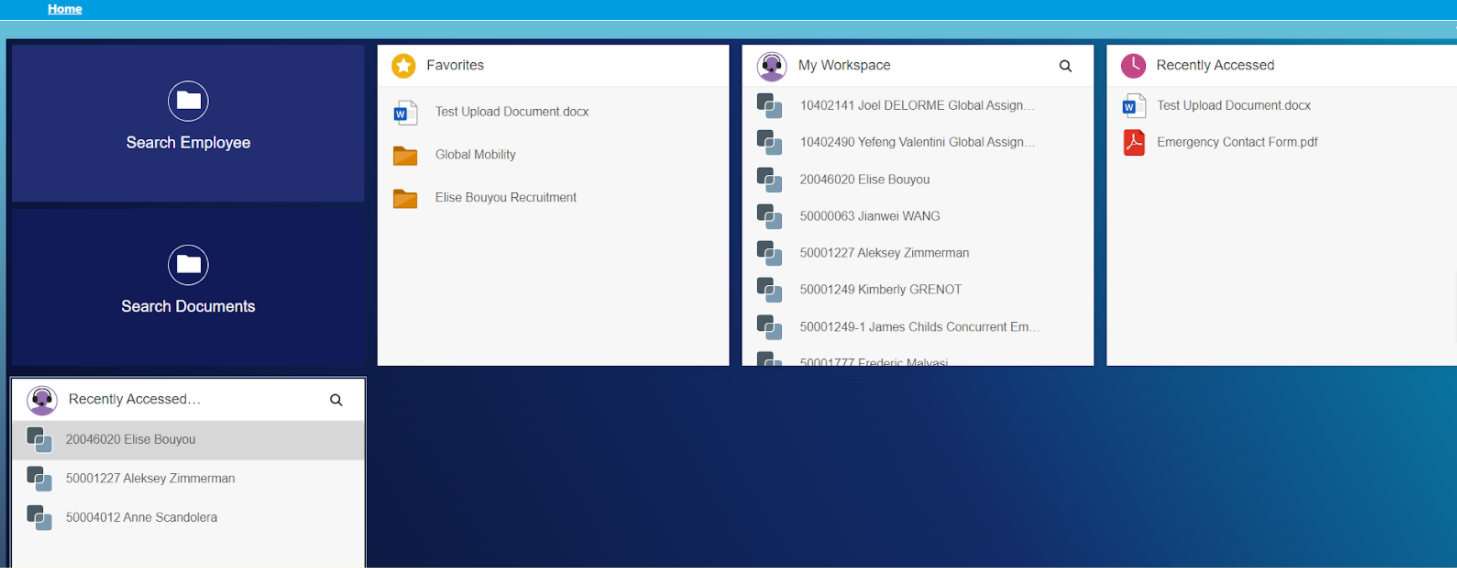
If you identify any issues, have any questions or need general support, please either submit a request through SyRa or call our HR Operations colleagues. |
Documents are organized by main categories and sub-categories. Simply click on the folder to open and see what documents are inside. Folder | Sub Folder | Description | Document Examples |
|---|
Benefits and Pension | Health and Welfare benefits | Documents related to Health and Welfare benefits provided to the employee and their family. | Health Insurance Forms, Short or Long term Disability, Life Insurance, Meal Allowances, Company car, Participation in Langzeitkonto (DE), Usage of tariff related benefits (Zukunfts Beitrag) (DE), etc. | | Retirement benefits | Documents related to the different types of pension funds and retirement benefits/plans. | Pension fund letter leaver/retiree , Pension fund leaver/retiree calculation, 401k, Seniority Jubilee (calculation), Pension Schemes/Program, Participation in PKDW, AFORE Document,Individual liquidation statement - (pre)retiree and leaver, etc. | Global Mobility
| Agreements & Packages | Documents containing all the information about expatriation. | Secondment Agreement, Assignment Extension, Assignment Termination, Remuneration Package, Cost of Living Calculations, etc. | | Administrative Documents | Documents about tax administration for expats: | Reports on Taxes & Deductions etc. | Learning and Development
| Development Plans | Includes career development and skill building plans. |
| | Training Records | Documents showing the training history of the employee and related certifications. |
| Payroll and Compensation
| Payroll Forms & Documents |
| W4, W2, annual tax statements, local bonuses, recurrent deductions, garnishment, etc. | | Compensation |
| Compensation statements, promotion statements, bonuses, long term incentive | Performance and Talent Management
| Performance Assessment | All types of performance reviews or assessments. |
| | Feedback | Feedback received by the employee from others in the organization. |
| | Discipline & Improvement Plans | Official communication to the employee when performance and/or behaviors are not in line with expectations. | Performance improvement plans, disciplinary letters, praises etc. | Personnel Administration
| Employee Personal Documents | Documents that contain information about the employee and there dependents and are needed to maintain employee data across several HR systems for several purposes, such as permissions, check-ups etc | Copies of passport, national ID card, driver’s license, Work Permit/Immigration Forms, Security Clearance documents, Form I-9, Religious orientation, birth certificate, marriage certificate, verification of employment, certificate of salary and employment status/contract type, Proof of Address, bank account, RFC, CPF (Cadastro de Pessoas Físicas or Natural Persons Register), CURP, etc. | | Company Issued Documents & Agreements | Documents that include information relating to the employment and employment contract of an employee, as well as several acknowledgements and declarations signed by the employee. | Labour contract, Offer letter, Confidentiality Agreement, non-competition agreement, Letter of Assurance, Labour book, NDA Agreement, GDPR declaration, Industrial Agreement acknowledgment, Acceptance of the collective accident insurance, Confirmation acceptance work regulations, Declaration for received documents such as Code of Business integrity, Safety procedures, etc | | Medical | Documents containing medical related information that is NOT maintained by HSE. | Hiring / Leaving Medical Clearance Form, Medical accommodation, Medical certificate | | Union Documentation | Documentation related to union topics that is employee specific. | Arbitrations / Grievances | Recruitment | Candidate Documents | Documents related to the candidate's profile for the position and professional qualifications:. | CV and Application, assessment results, recommendation letter, School Diploma/Degree, licences etc. | | Time Management | Absence & Attendance Related Documents | Documents that are needed to justify/approve absences paid or unpaid. | Absences related to sickness, work accident, parental leave, furloughs, disciplinary, strike, etc. |
|
Content & Access Rights for HRThe content you can see and the actions you can take with content varies based on your HR role.
| TYPE OF ACCESS |
|---|
FOLDER | Site HR/ Country HR/HR | HR Payroll | HR OPS | SBS - Recruiting | SBS - Global Mobility | GPP & SBS - Learning | GPP - Total Rewards | | Benefits and Pension |
View, Write & Delete
|
View, Write & Delete
|
View, Write, Delete/Legal Hold/Modify
View, Write, Delete/Legal Hold/Modify
|
None
None |
None
|
None
|
View
| Health and Welfare benefits | Retirement benefits | Global Mobility |
View | Agreements & Packages | Administrative Documents | Learning and Development |
None |
None
None |
View |
None | Development Plans | Training Records | Payroll and Compensation |
View, Write & Delete |
None
None | Payroll Forms & Documents | Compensation | View | Performance and Talent Management |
None |
None
| Performance Assessment | Feedback | None | Discipline & Improvement Plans |
View, Write & Delete | Personnel Administration |
View, Write & Delete | Employee Personal Documents | Company Issued Documents & Agreements | | Medical | Union Documentation | Recruitment | View | Candidate Documents | Time Management |
None
| Absence & Attendance Related Documents |
|
Search FunctionalityThis can be used to locate the file of a specific employee or to locate specific documents. As an HR you can access the Employee Files for all employees in your scope based on your authorization in SuccessFactors.
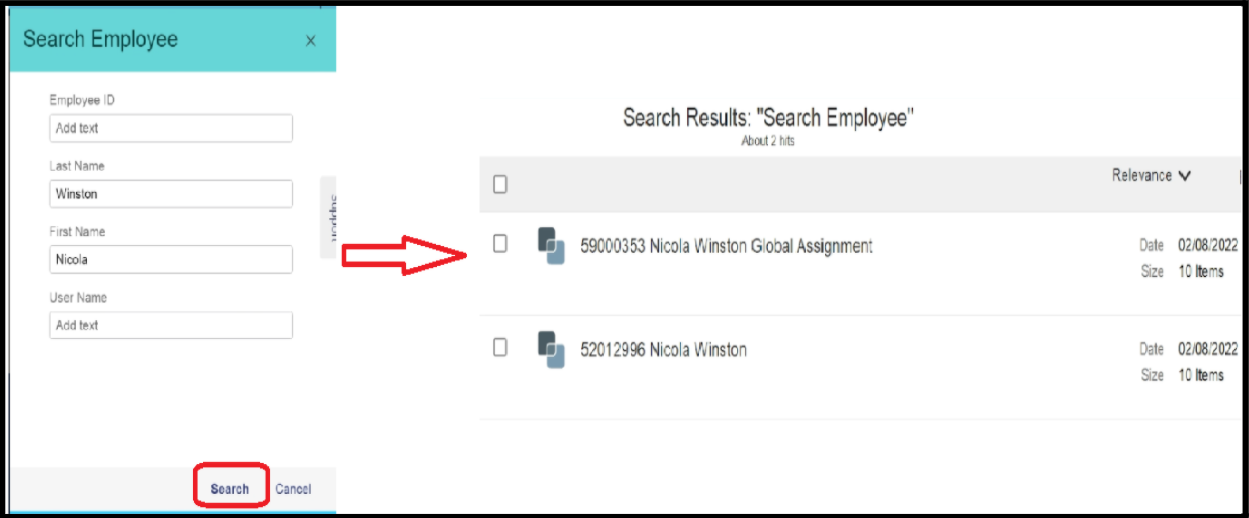
Search EmployeesYou can search for an employee’s file using Employee ID, Last Name, First Name or User Name as shown below.
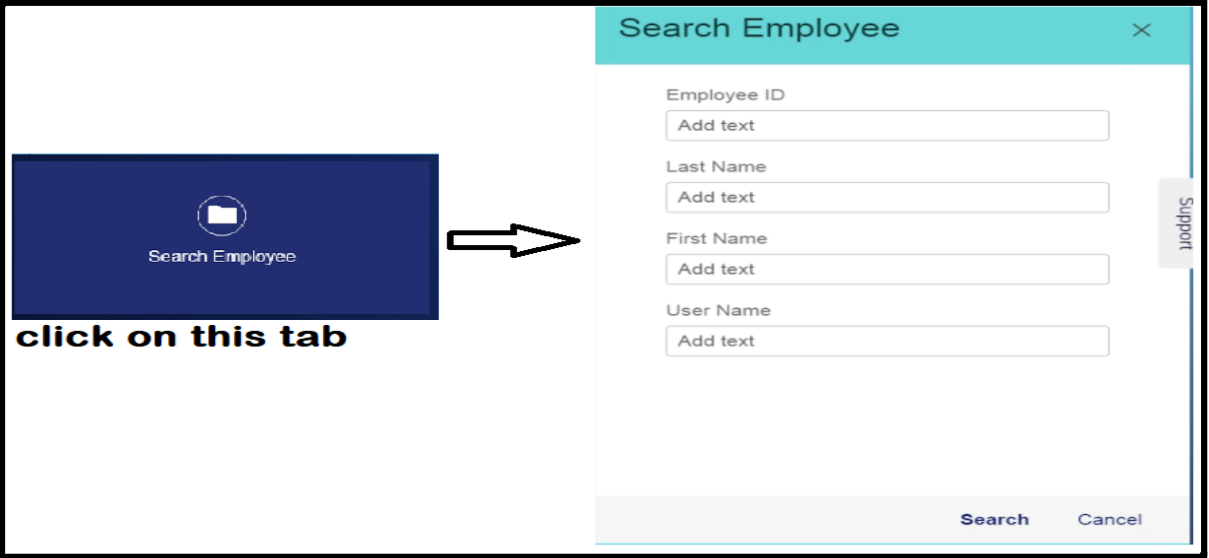
- In the Search for Employee dialog, you must specify at least one search criteria.
- Click the Search button at the bottom right and it will take you to the Search Result page as shown below.
- You are able to further refine your search by completing open fields in the box on the left.
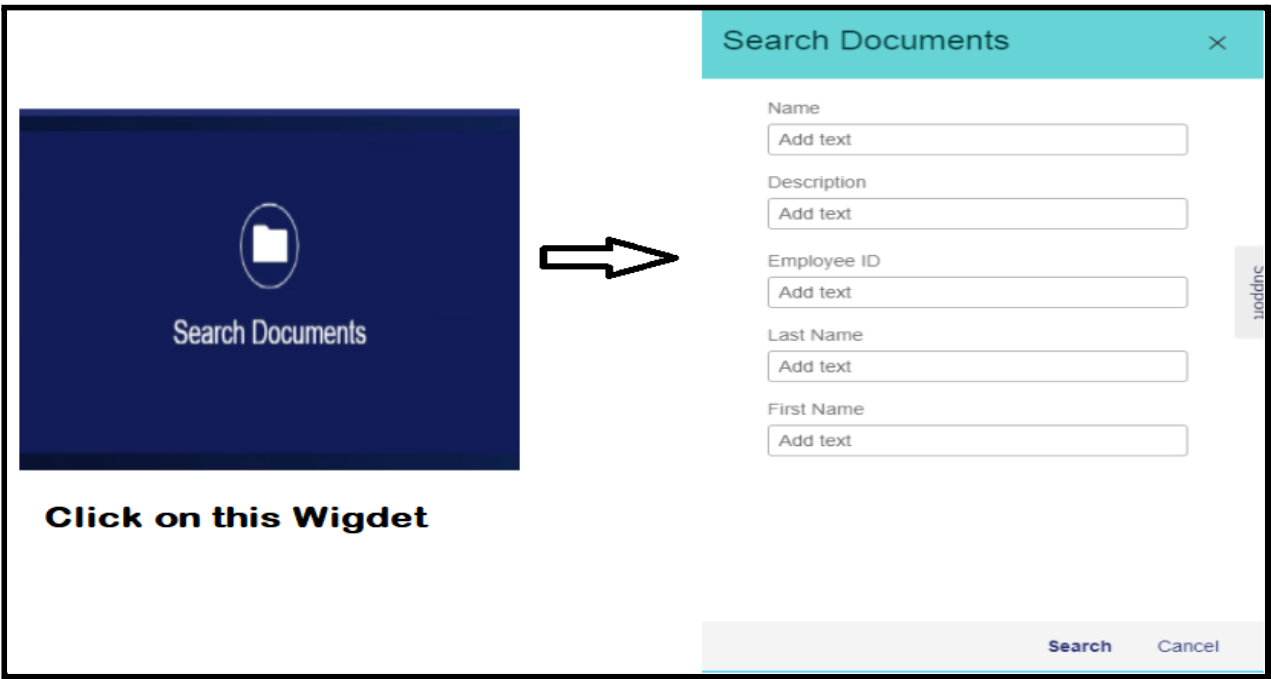
Search Documents You can search for a particular document of an Employee using the available fields in the search box and then selecting the Search button at the bottom right corner of the screen. - Name - This searches based on the name of the document and works with one or multiple words used in the name.
- Description - If a document received a description upon upload, you can search using a keyword from this description.
- Employee ID, Last Name, and First Name enable you to search for all documents associated with the criteria you enter in one of these fields.
- You are able to further refine your search by completing open fields in the box on the left.
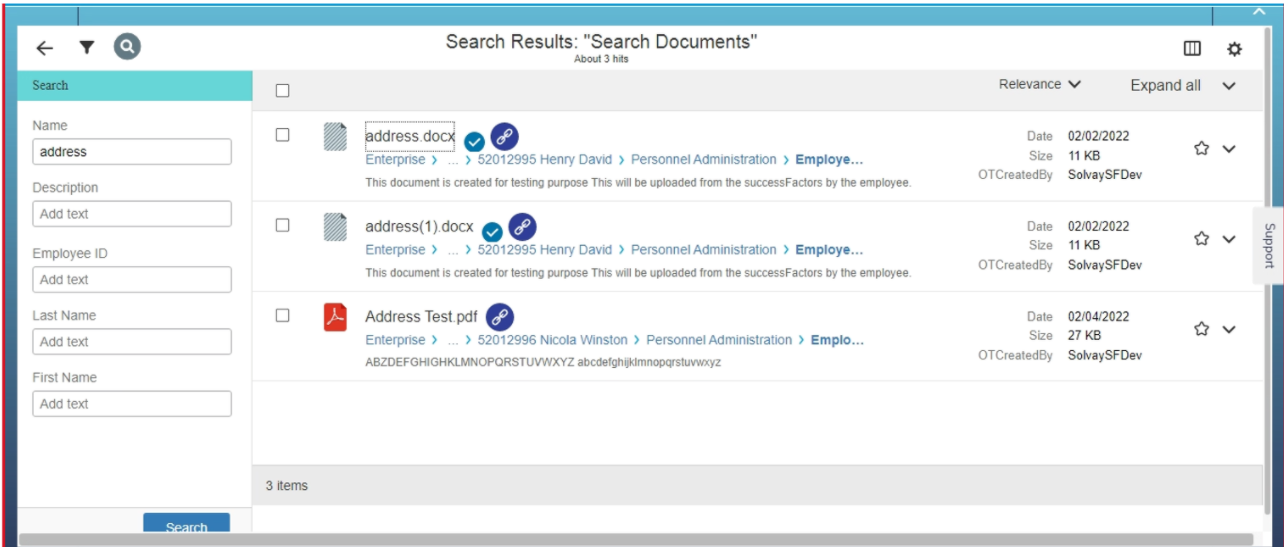
- This highlighted part below is the storage path of the document. From here you can identify to whom this Document belongs to and where in the folder structure it is stored. To see the full path you can reduce the zoom level by clicking ctrl - and can enlarge by clicking ctrl +.
In this example, the document belongs to Nicola Winston and it is stored in the Personnel Administration folder. 
- Click on the Tabular Search View icon to change the view as shown here:
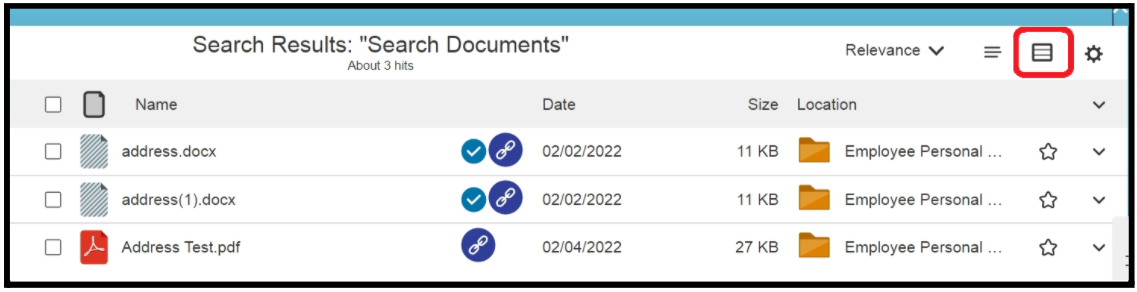
- Click on the above highlighted icon to revert back to Standard Search view.
- By Clicking on this icon You can add the associated document to your Favorites Widget.
- To view the official Record Details of a particular document, click on the
 icon. It will open the detail page as shown below. icon. It will open the detail page as shown below.
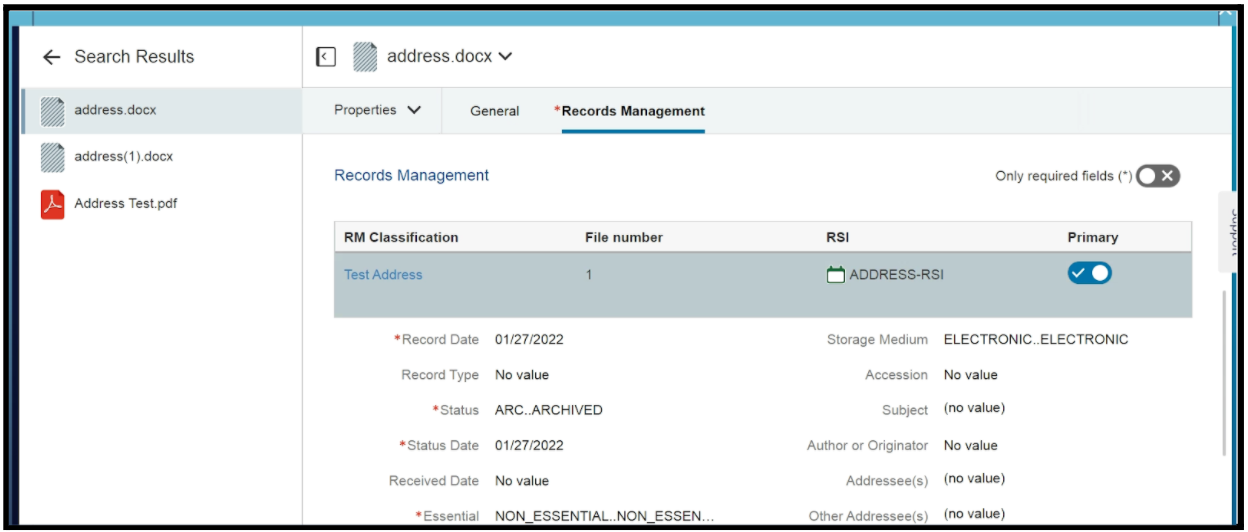
- This icon
 indicates that the document has been uploaded directly from Success Factors. indicates that the document has been uploaded directly from Success Factors.
|
|
FavoritesThis is a place where you can store documents and folders for quick access. To mark as a favorite, click on. A pop-up will be displayed enabling you to change the name of the favorite if you wish. There is no limit to the number of items you can mark as “favorite.” My WorkspaceThis section contains the personal workspaces for all the employees in your scope. From here you can search for the employee and open the employee’s file. Recently AccessedThis section provides a list of the documents recently viewed by you. It will display up to 25 of the most recently viewed documents. Recently Accessed WorkspacesThis section provides a list of employee files recently viewed by you. There is no limit defined to the number of objects in this list. |
When you select a document by checking the box to the left of the name, additional actions will be displayed just above. These are explained below.
- Displays the properties of the document. Copy link - Copies the link of the document to clipboard. You can share this link with others however it will only work for them if they have the relevant permissions. View Permission - Displays the permissions of the document. Download - Can be used to download the document into your local system. Delete Workflow - GPP and SBS Service Teams should disregard as this feature is not operational for you. Copy and Send to/Mail as link - Please disregard. |
An employee can have one or multiple assignments assigned to them during the course of their career. There are two distinct types: Concurrent Employment and Global Assignment. If an employee is in one or both of these categories, you can access the related documents for the assignment(s) that is in your scope as their HR. As HR Ops has global access they will always be able to see all assignments.
Concurrent employment is when an employee is assigned to more than one assignment at the same time. In such a case, the documents related to each assignment would be maintained separately. Find below a screenshot of the layout and folder structures.
Enter the Employee File workspace of the individual and click on the “Concurrent Employment/Host Country Documents” folder then you will see the other assignment (Concurrent assignment in this case).
After clicking on Concurrent assignment, you will see the folder structure of the employee's Concurrent Assignment as shown below.
To go back to the folder structure of the other assignment click on the “Primary Assignment Workspace” folder from the list.
Global Assignment is when an employee is sent to a different geographical location for the fulfillment of an assignment. In such a case, on their My Profile page both the assignments would appear. However, one assignment would be paused (the “home” assignment) while they are active in the other assignment (“global” assignment”). Below is the example of an employee profile on Global Assignment: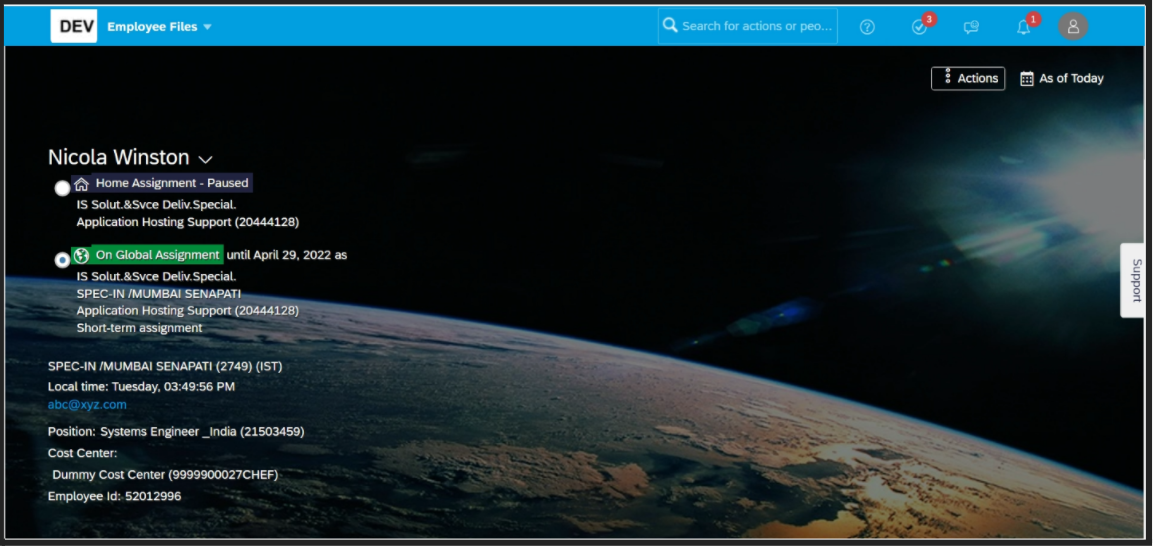
Toggling between assignmentsStep 1: On the My HR Services home page, click on the highlighted icon as shown below to toggle between home assignment and global assignment. 
A menu like the one shown below will be displayed. 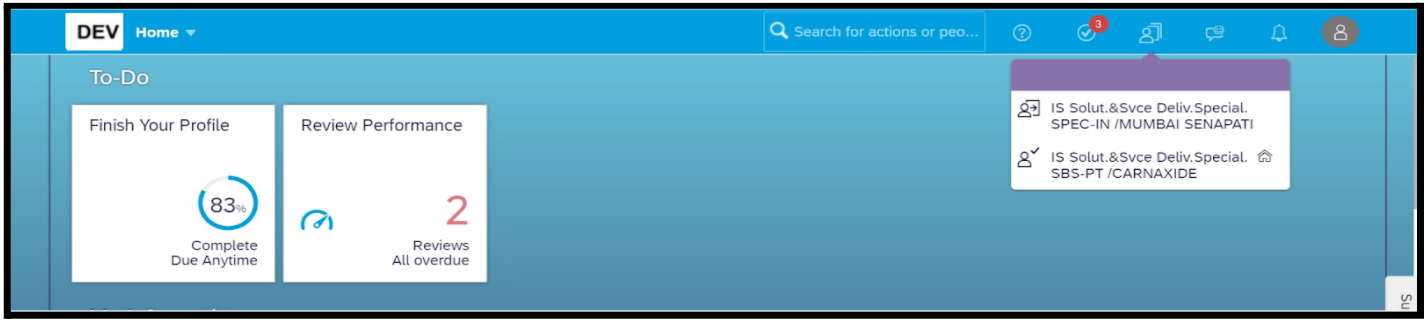
You can switch between the two assignments to access the accounts. The account you are currently viewing is indicated by this  icon and the other account which you are not viewing is indicated by this icon and the other account which you are not viewing is indicated by this  icon. icon.
Accessing Personal Employee FileOnce you have selected between the above options, you can access the Employee File workspace as shown below. The example below is for the Global Assignment which is indicated by the highlighted box as shown below. 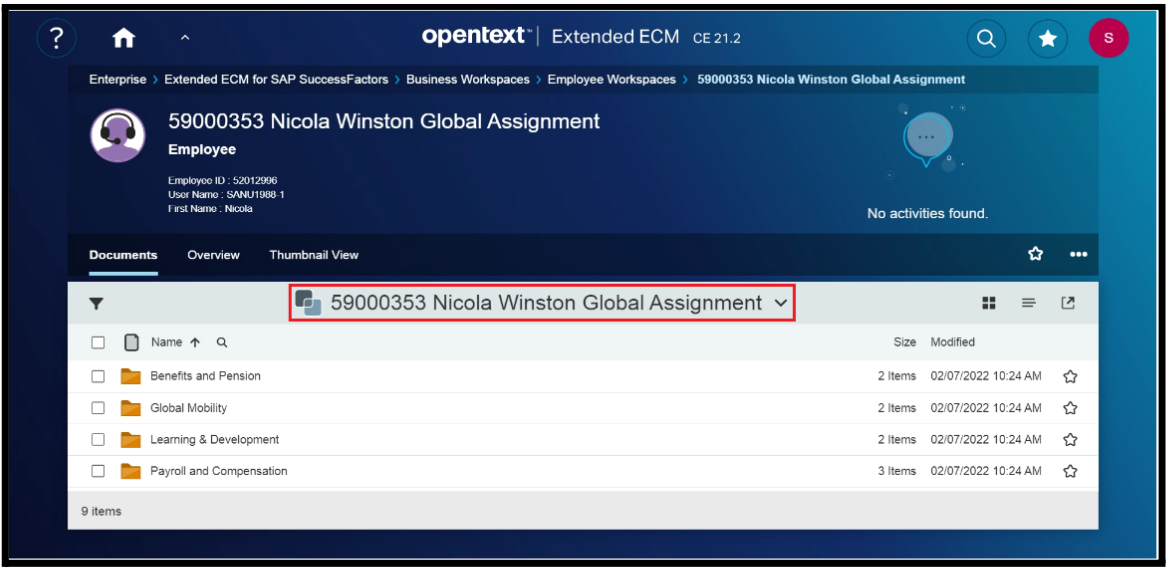
The folders here will contain the documents associated with the global assignment. You can access the primary assignment workspace by clicking on Primary Assignment Workspaces as shown below. 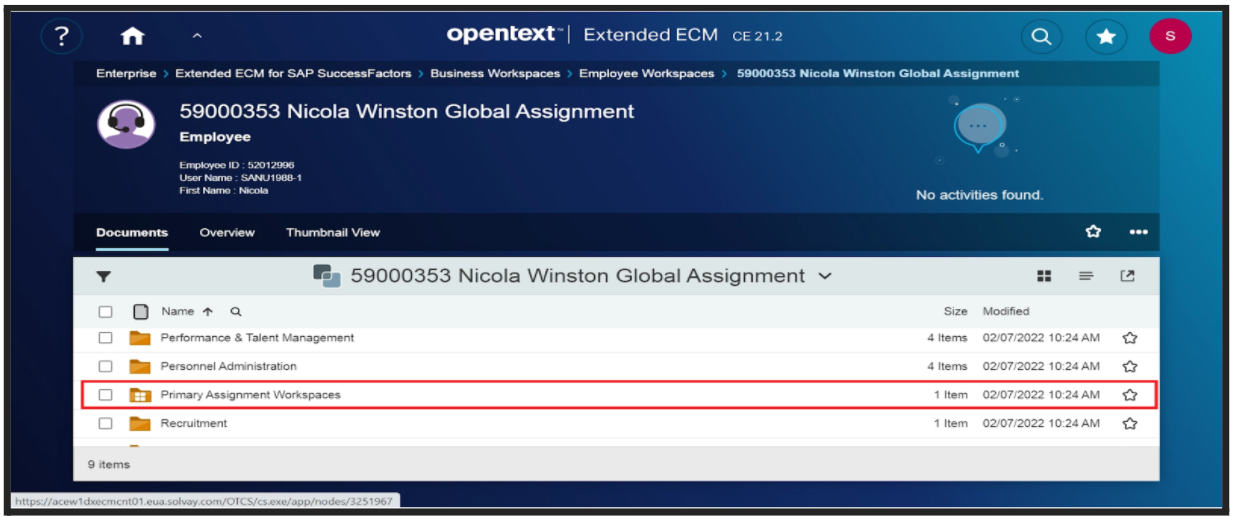
You can see the primary assignments as shown below. Now, click on the primary workspace as highlighted below. 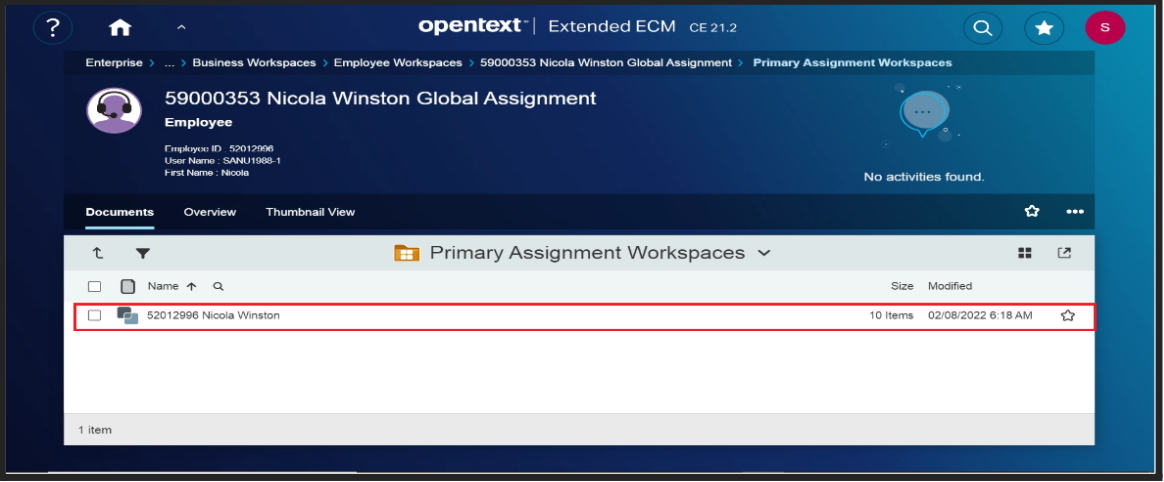
You will be taken to the primary workspace as shown below. 
You can go back to the global assignment workspace by clicking on Concurrent Employment Country Documents as shown below . 
You can see a list of the global assignment workspaces. Click on the workspace as shown below. 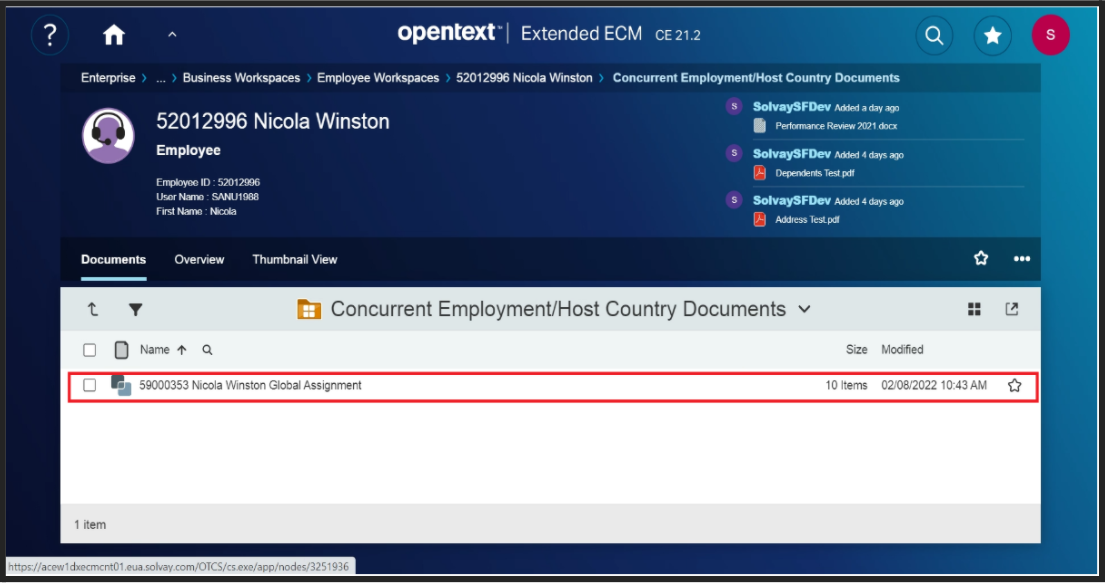
You will be taken to the global assignment workspace as shown below. 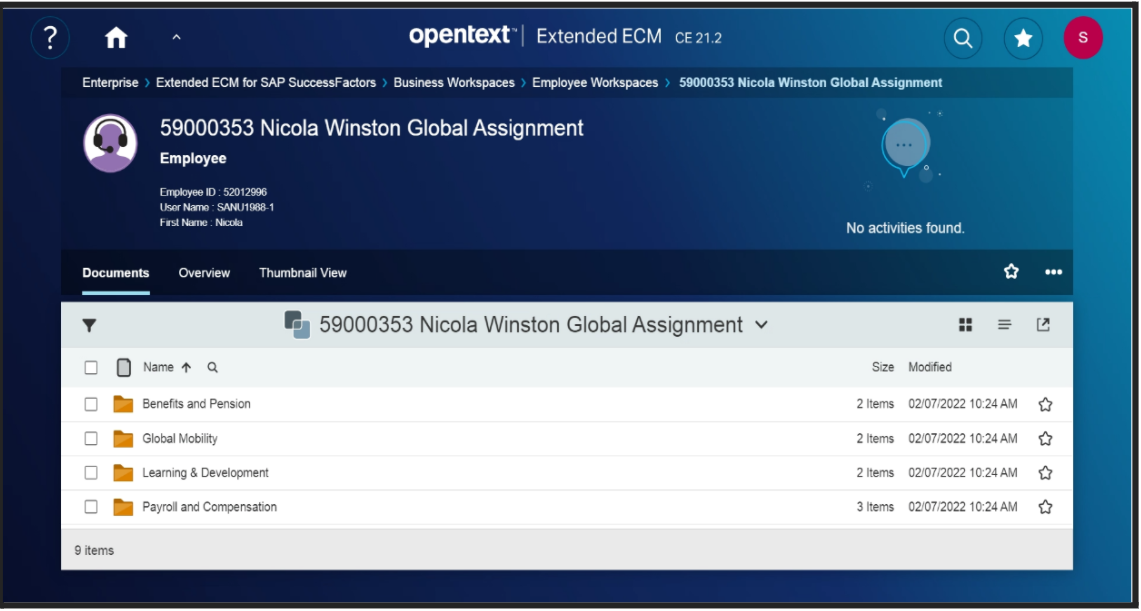
|
When an HR uploads or deletes a document in OpenText, it is initially placed in a staging folder called 999 Inbox within the Employee file workspace. This will not be visible in the Folder structure. Whenever an uploaded document (fromSuccessFactors/OpenText) is not available in the respective folder inside the Employee file workspace, search for the 999 inbox using the below instructions, - Inside the Employee file workspace (for whom you uploaded the document) use the below highlighted search option to find 999 inbox.
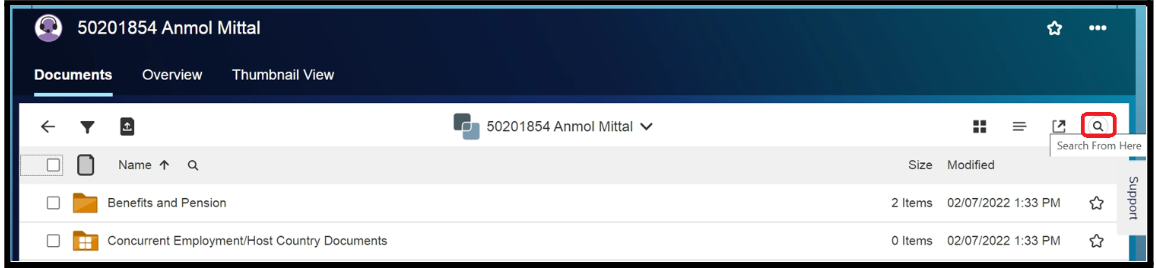
- Now type 999 inbox in the search bar as shown below and click enter.
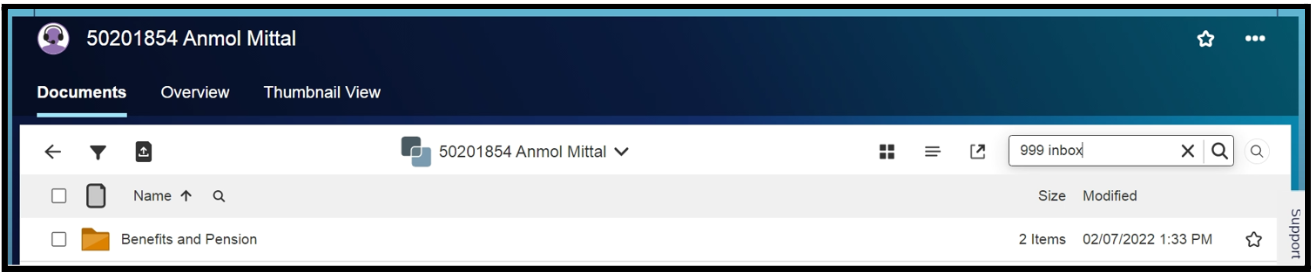
- It will take you to the result page as shown below, And now click the folder.

- After opening this, it will open the 999 inbox as shown below.
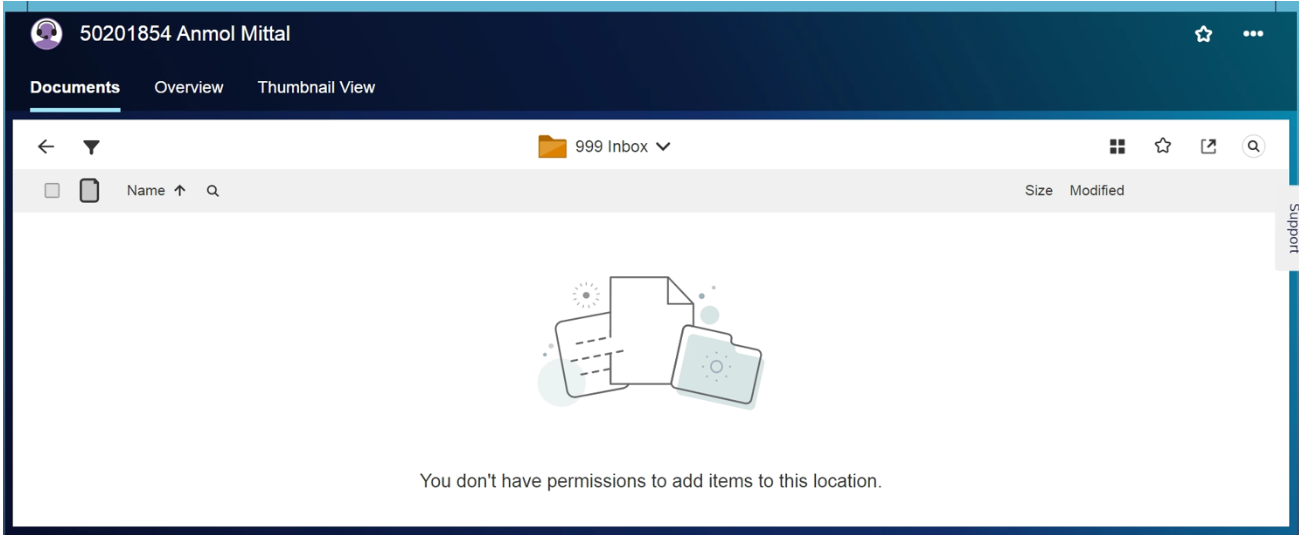
- If you find that document inside the 999 Inbox folder you can conclude that the document has lost its classification and therefore needs to be reloaded. To have the misclassified document deleted, a ticket will need to be submitted to IT via a ServiceOne request using the catalog category of “Report an IT Application/Software Incident”. When you select Submit Request a form will open that you can complete with the related details. In the Affected Application Section, please reference: OpenText Extended ECM Platform.
|
Uploading Documents for Employees
As an HR you are able to upload documents for an Employee if you are in one of the following roles: Site HR, Country HR, HR SBP, Payroll, and HR Operations. As a HR you will get the below highlighted icon which is what you use to upload documents. Please note that this is the only place from which you can load documents within the workspace. IMPORTANT TO REMEMBER: You cannot drag and drop documents or add them directly into the subfolders. You must select the file destination via the dropdown menu as described below. 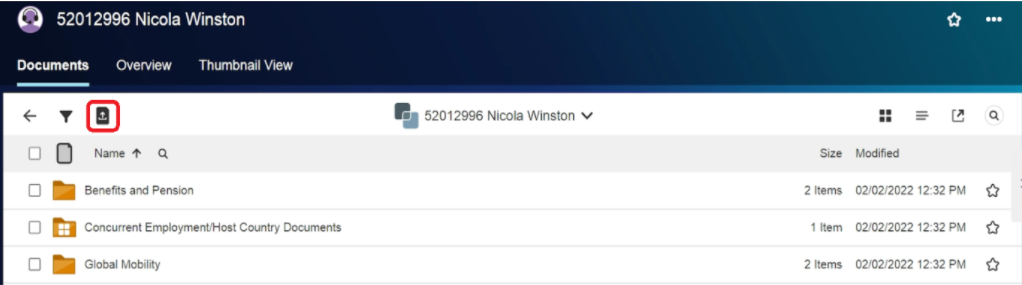
- Click on this
 icon to upload a document. icon to upload a document. - After clicking on it you will see a popup to select the document as shown below.
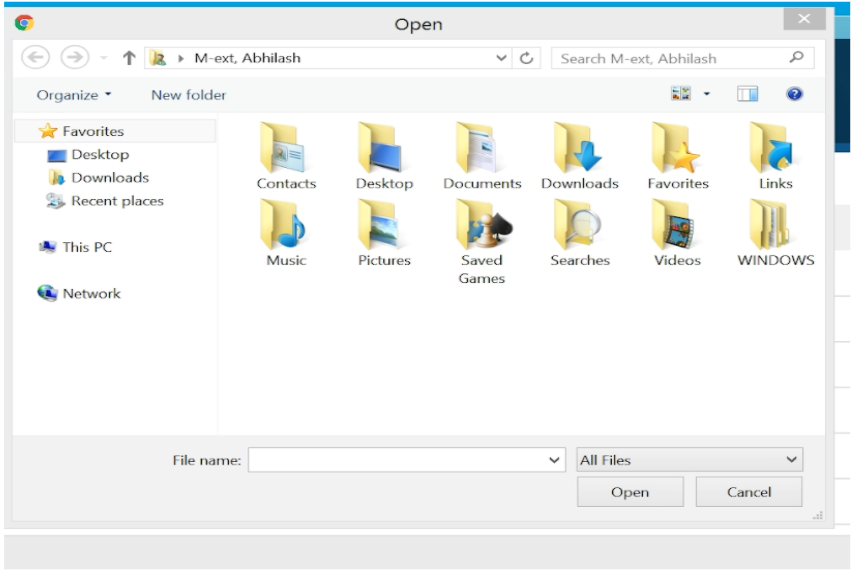
- Select the document from your local system (note that we are not able to upload directly from Google Drive) and then click on the open button. You will get the popup screen shown below.
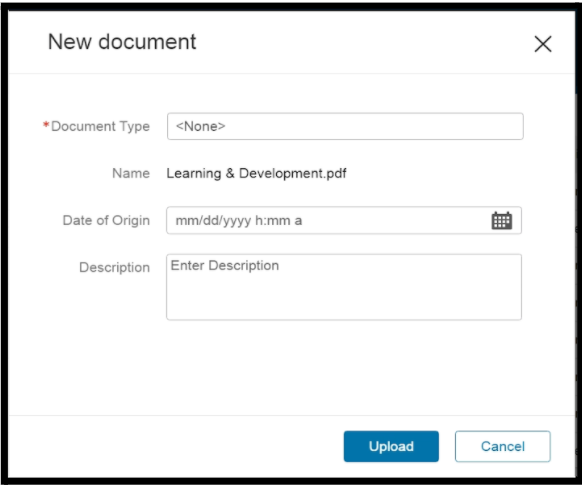
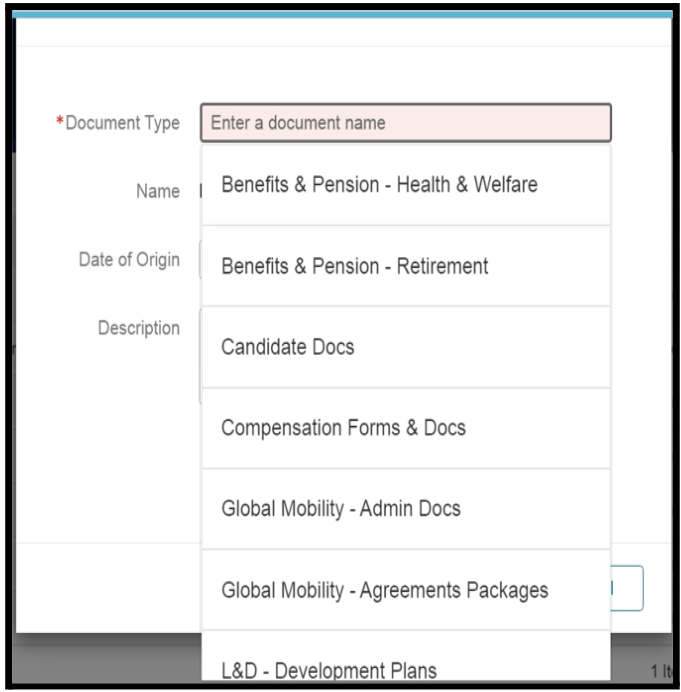
- In the “Document Type” field, select the folder to which you want the document saved to using the drop down list provided.
- Click here for the Folder descriptions in the section called "Navigating through your personal employee file workspace".
- You have the option to enter a date in the field called “Date of Origin” as well as a description of the document in the field called “Description”. Once all the details are entered click on “Upload” and the document will be saved in the designated Folder.
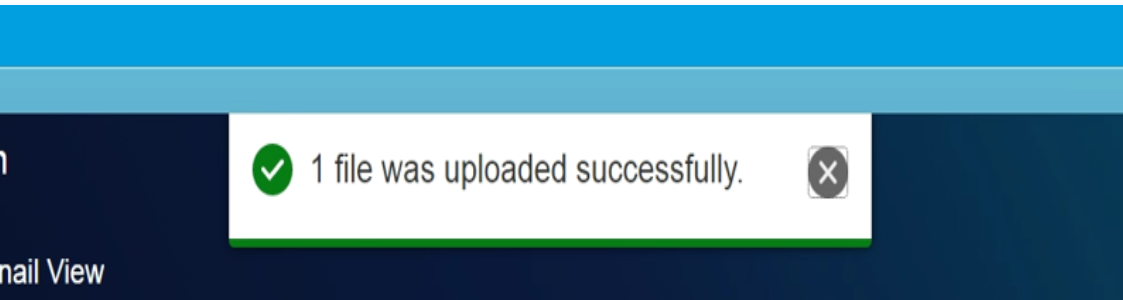
- After finishing the above steps click on the Upload button. You will get a Success popup message like this:
Deleting Documents from an Employee's File
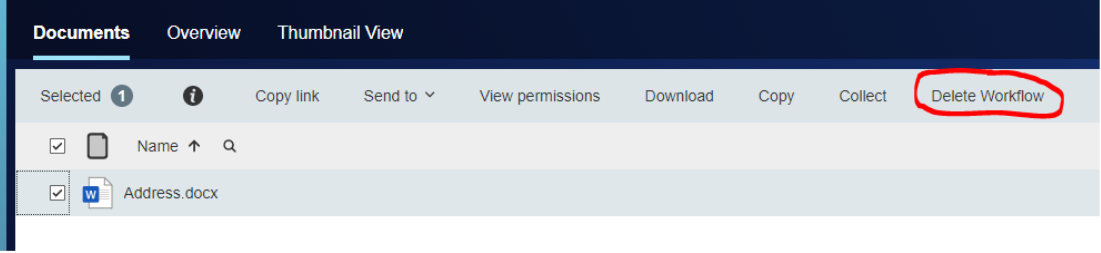
As an HR you are able to remove or delete documents from an Employee’s file if you are in one of the following roles: Site HR, Country HR, HR SBP, Payroll. - Select the document you wish to delete and select “Delete Workflow” from the menu options as shown here:
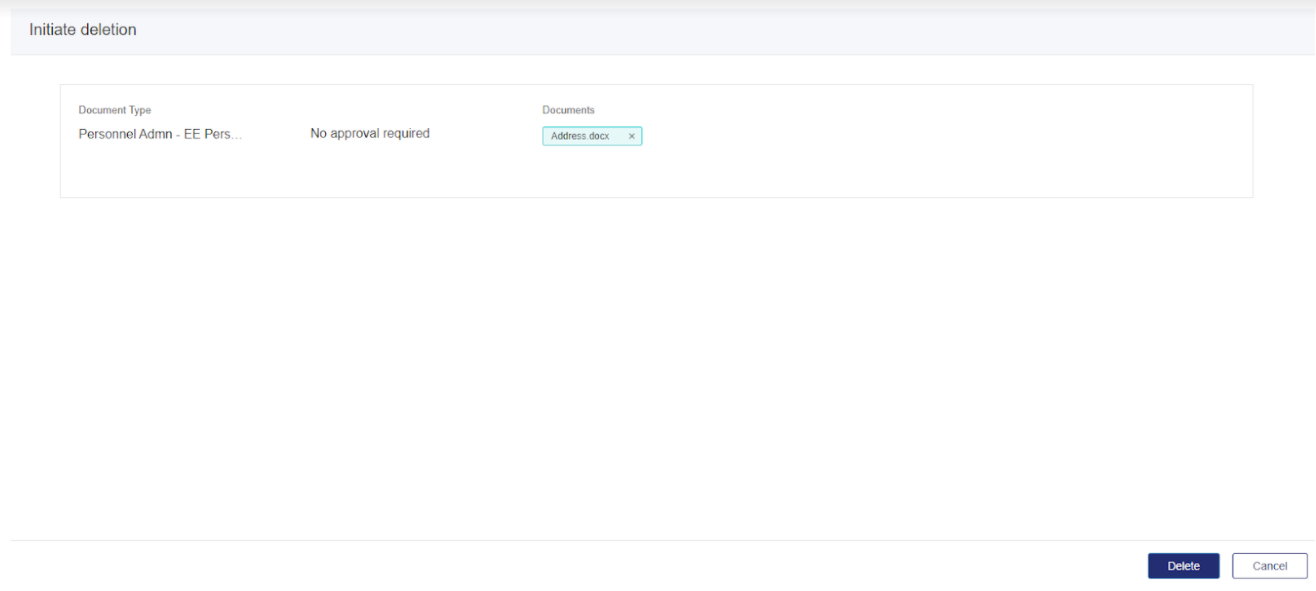
- This will open the Deletion screen as shown below:
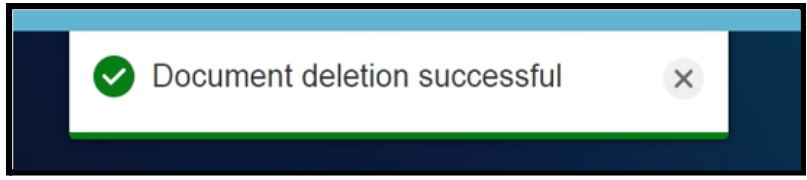
- If you click on the Delete button it will remove the document from the workspace and a success message will appear as shown below.
|
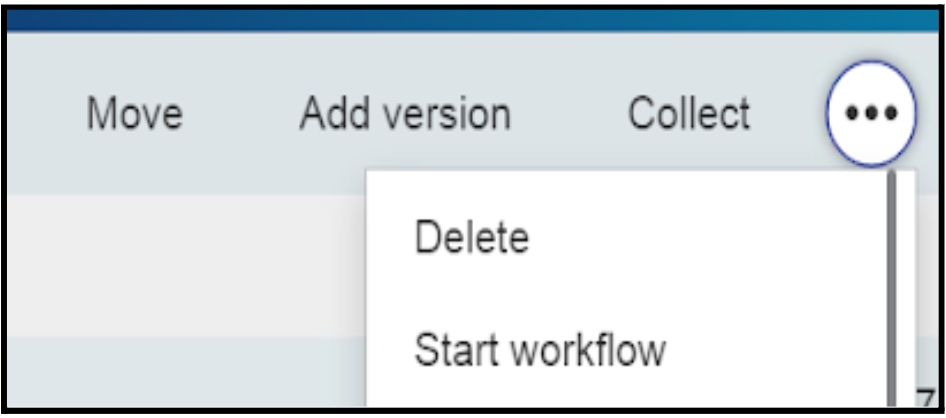
This article is specific to functionality for members of the People Services team. Please note that due to certain permissions, you might observe that you are able to rename or modify the folder names or even delete a folder. Kindly refrain from doing such modifications as it will cause product failures. More details below: DO NOT DO THIS PLEASE! This function allows you to modify the name of the Sub-Folders however doing so will break the mapping of documents from SuccessFactors. DO NOT DO THIS PLEASE! This function allows you to move a document from the current folder to another and cannot be undone. If it is confirmed that a document is in a folder where it does not belong, it should be deleted from that folder and then uploaded to the correct folder rather than “moving” it. DELETING A DOCUMENTAs HR Operations you are able to remove or delete documents from an Employee’s file. - Select the document you wish to delete and click on the DELETE icon as shown below:
- This will open the Deletion screen as shown below:
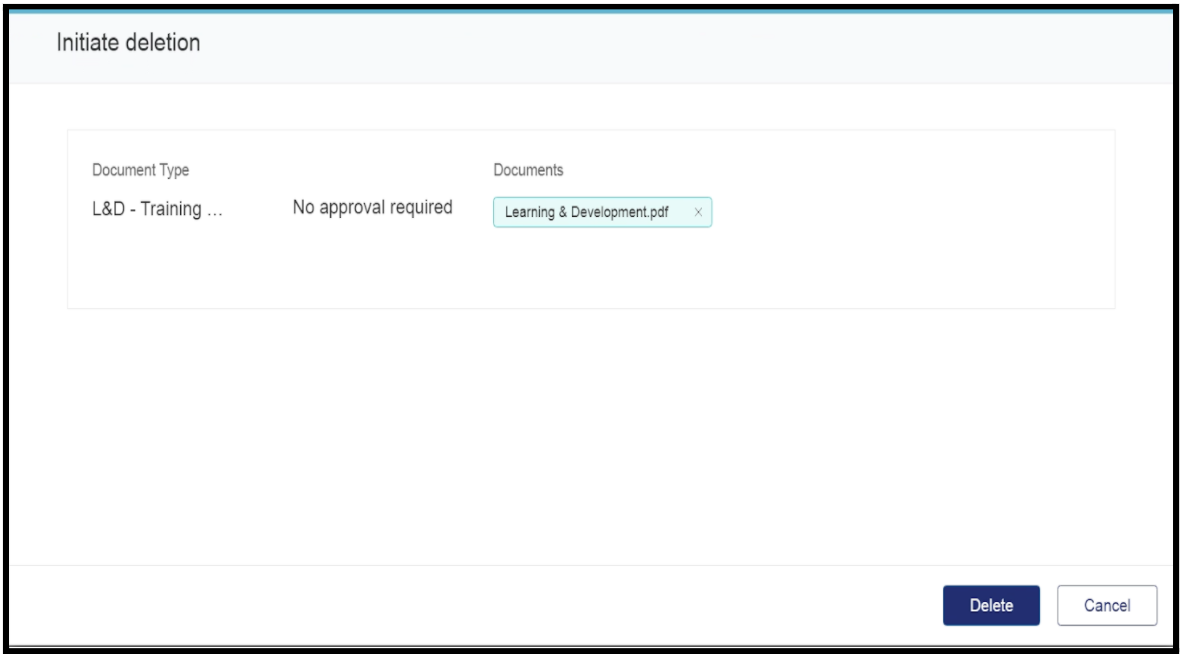
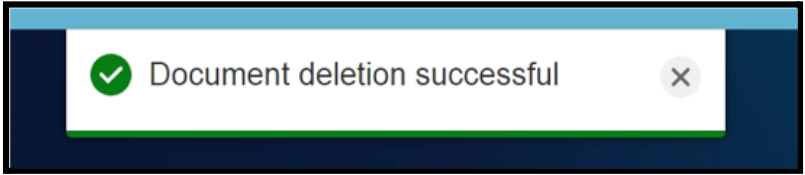
- If you click on the Delete button it will remove the document from the workspace and a success message will appear as shown below:
|
The Legal department is responsible for notifying HR when a Legal Hold is required and again when it should be removed. HR Operations will apply or remove the hold based on the direction received though generally a legal hold should be applied at the workspace level. The request should be submitted via an HR Service Request using ServiceOne by either the requesting lawyer or Site HR. Technically within Open Text, a Legal Hold can be applied and removed at the Workspace level (all folders/all documents), the Folder level or the Document level though typically it would be managed at the Workspace level. Instructions for each of these levels is provided below. A confirmation pop up will appear as shown below. Capture the name of the person providing the instruction to remove the legal hold, the date this was effective, and the associated ticket number. Then click on Yes. If a file has a Legal Hold applied and someone tries to delete it, an error message pops up as shown below. 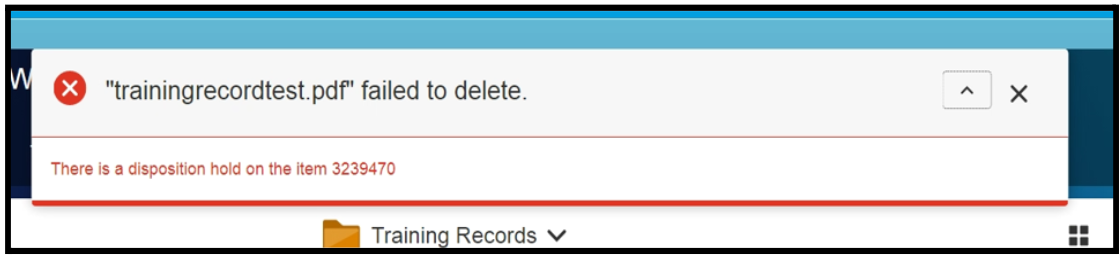
Applying a Legal Hold at the Workspace LevelOpen the workspace to which the Hold is to be applied, and Click on the breadcrumb next to the employee name as shown below. You will have various options. Choose APPLY HOLD as highlighted below: 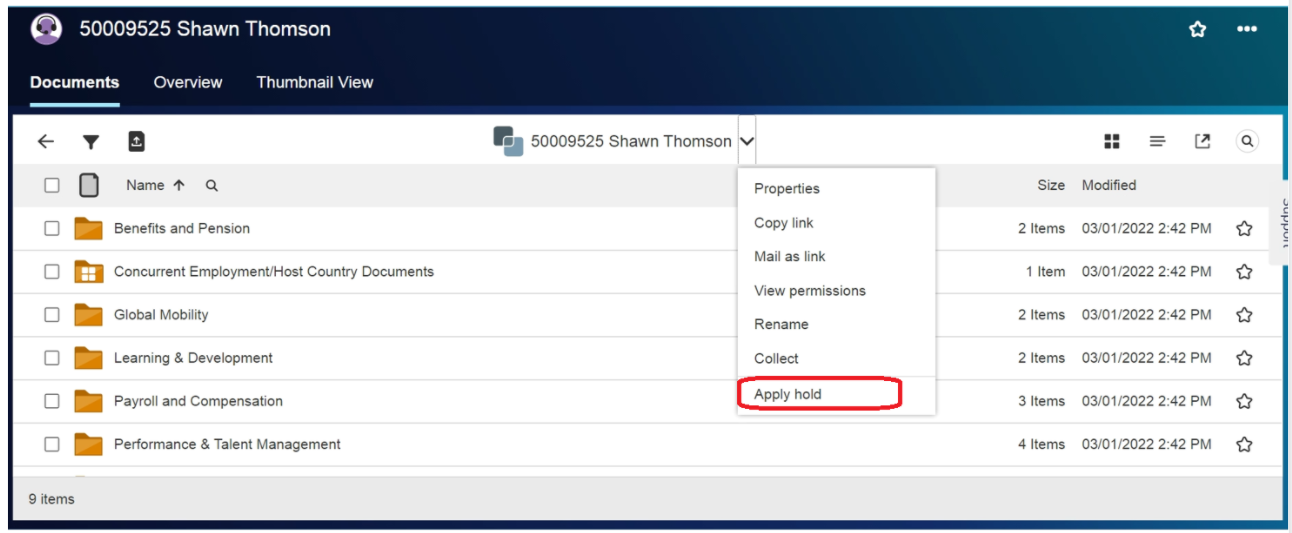
- In the next screen, select LEGAL HOLD and click on Apply as shown below:
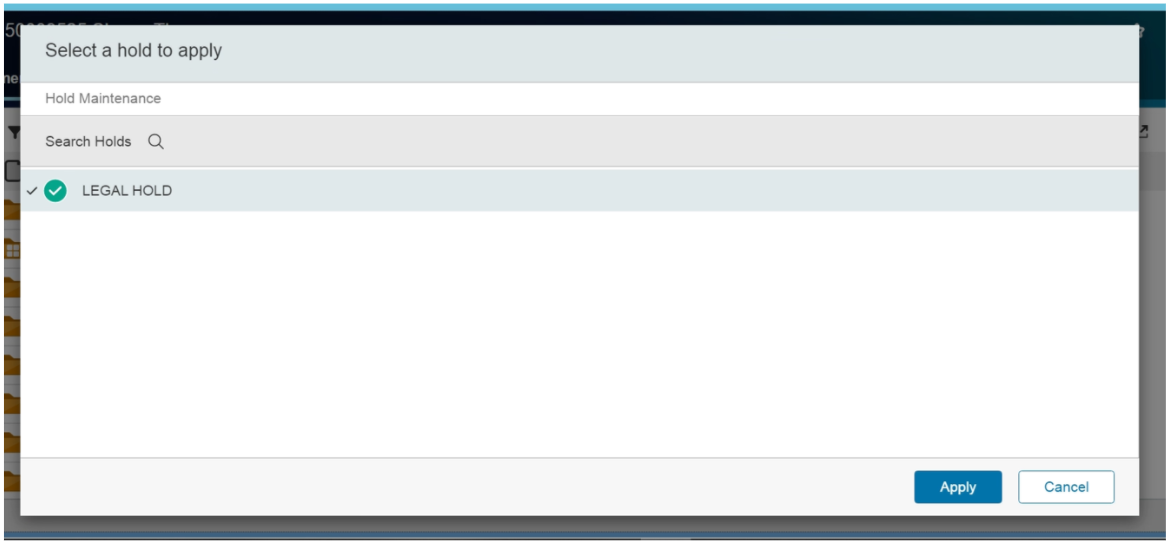
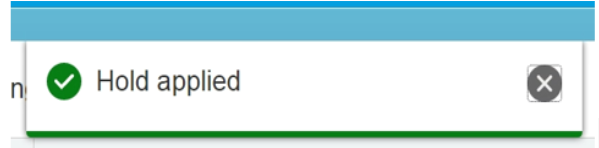
- A pop up message will appear confirming the successful hold application as shown below:
Removing a Legal Hold at the Workspace Level- To remove the Legal Hold for the workspace, click on the breadcrumb as shown below and choose “Properties” as shown below:
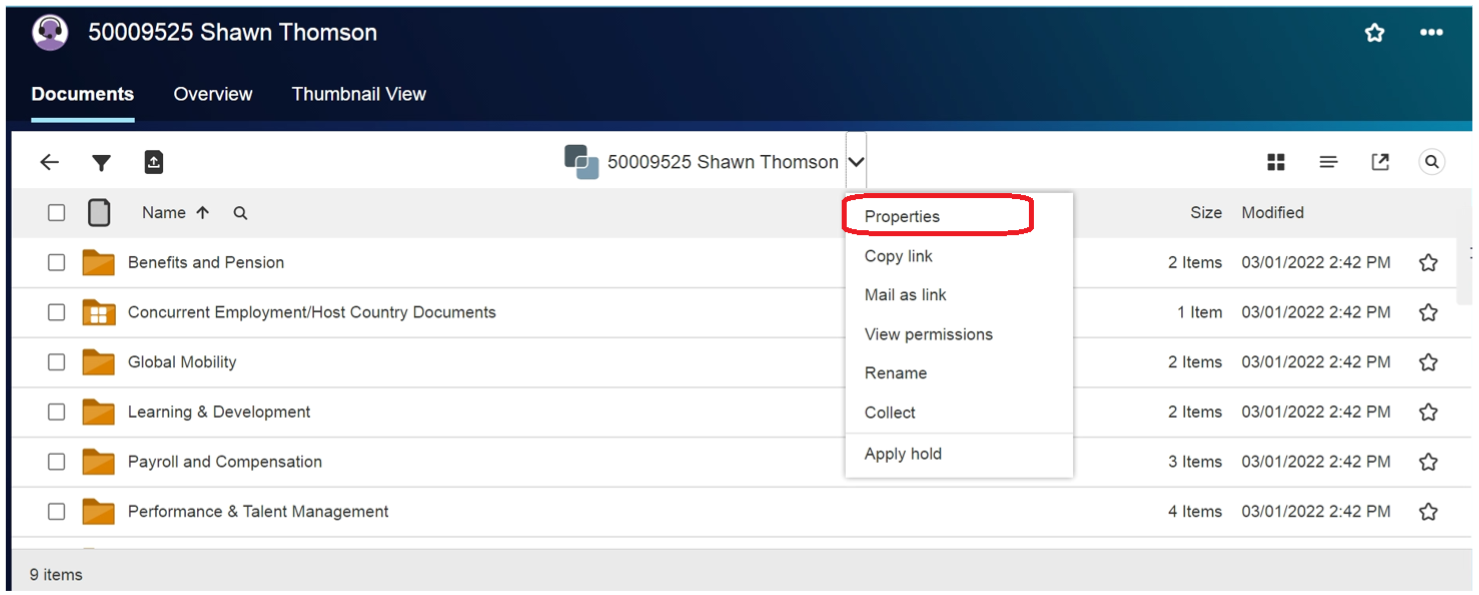
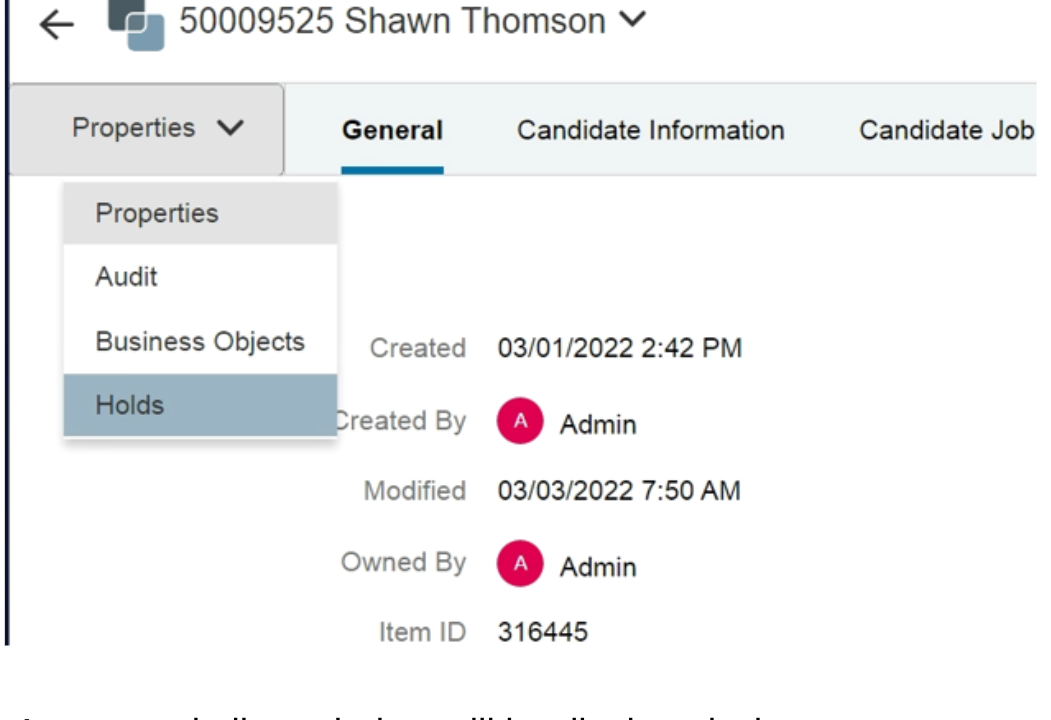
- You will be directed to the properties screen, there click on the breadcrumb next to Properties and choose HOLDs as shown below:
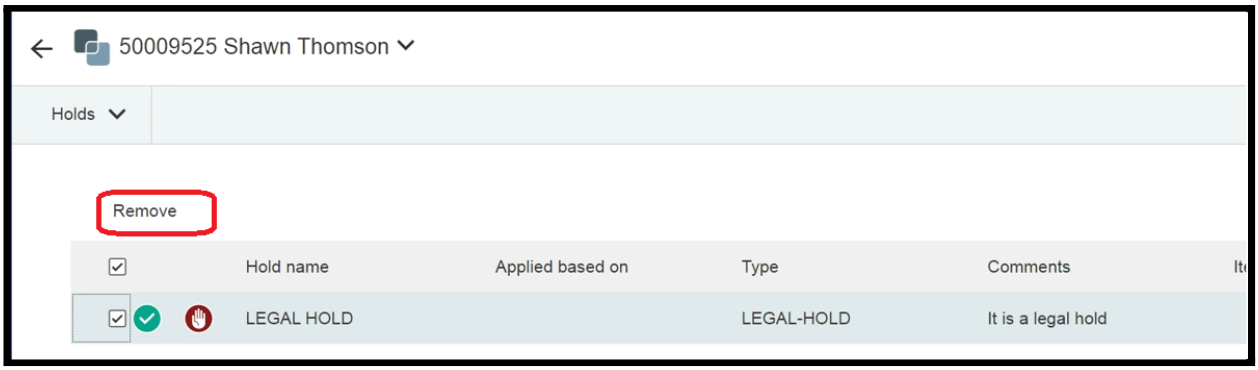
- A screen similar to below will be displayed where you can see the type of hold applied on the file. Now, select the hold you wish to remove as shown below:
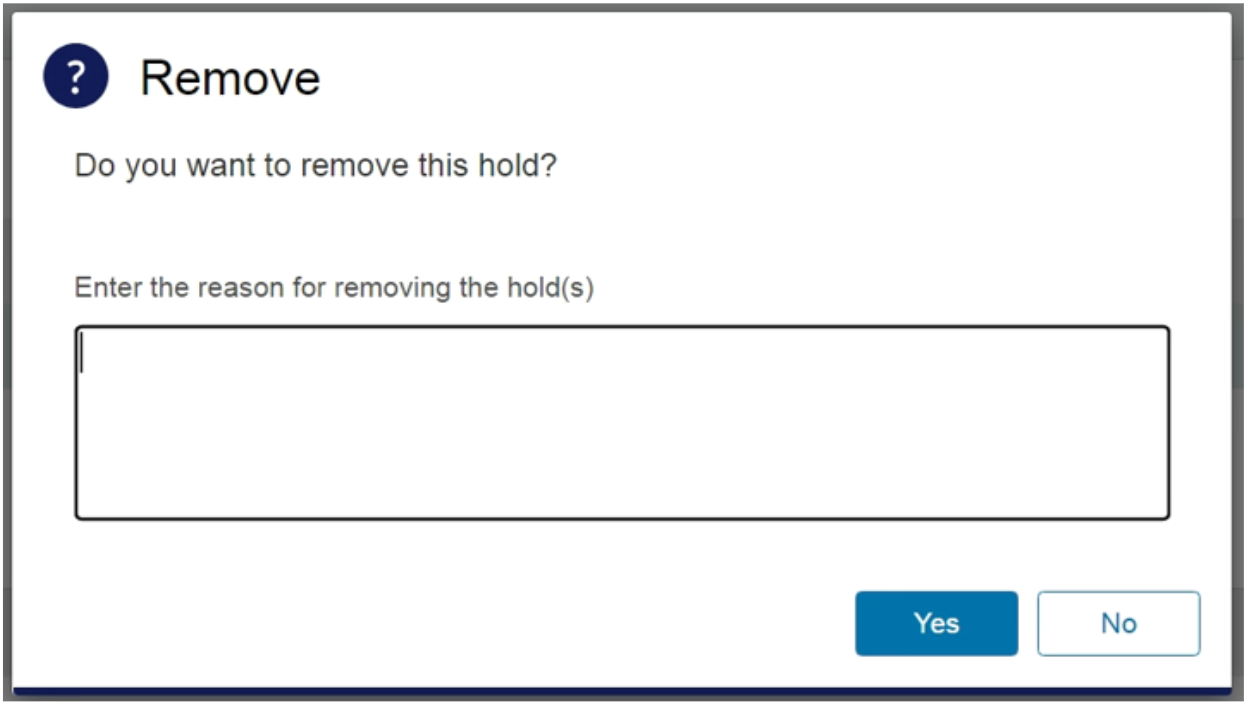
- A confirmation pop up will appear as shown below. Capture the name of the person providing the instruction to remove the legal hold, the date this was effective, and the associated ticket number. Then click on Yes.
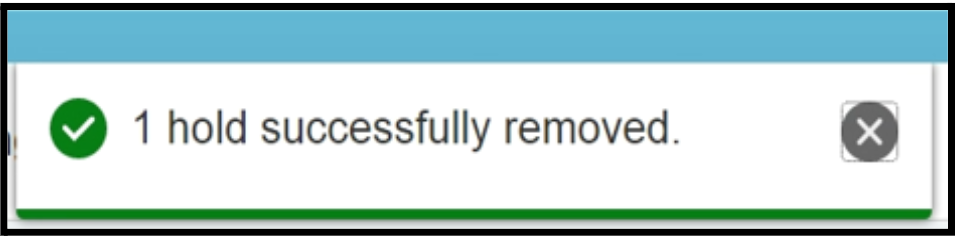
- A message appears confirming the removal of hold as shown below. Henceforth, the file can be deleted and no error message will pop up.
|
Applying a Legal Hold at the Folder LevelOpen the Folder to which the Legal Hold should be applied and Click on the breadcrumb next to the employee name as shown below. You will have various options. Choose APPLY HOLD as highlighted in below: 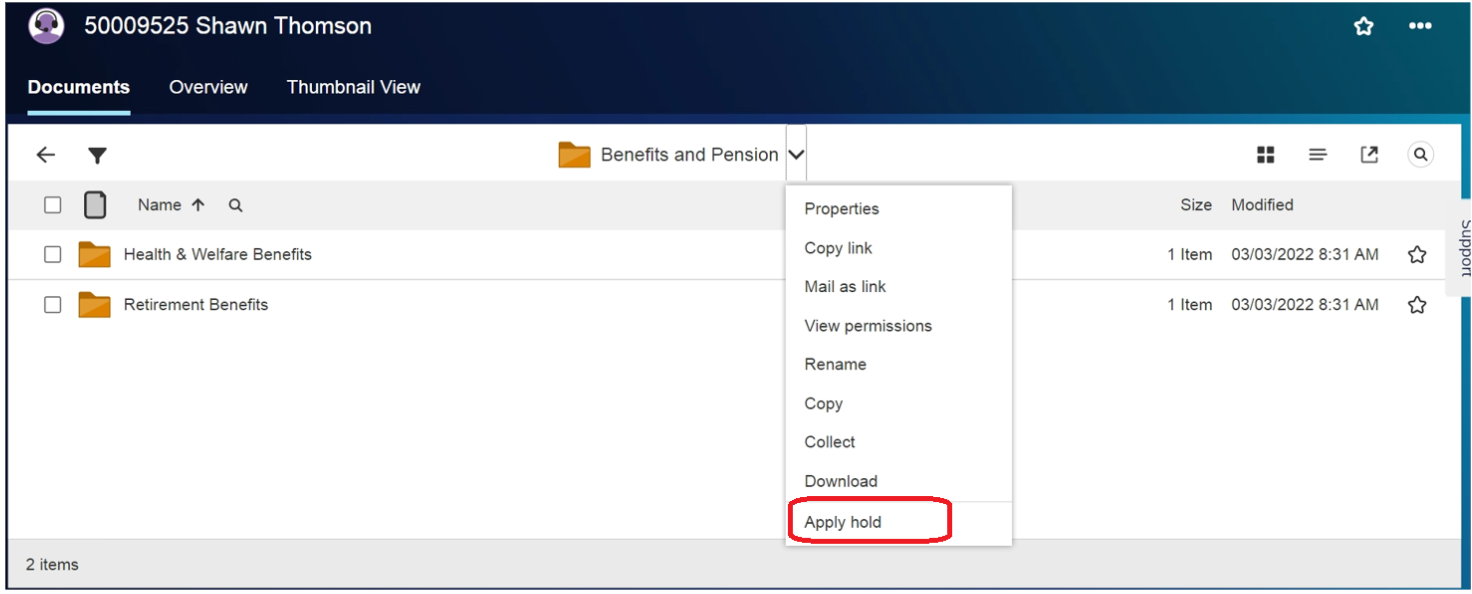
- Select Legal Hold and click on Apply as shown below:
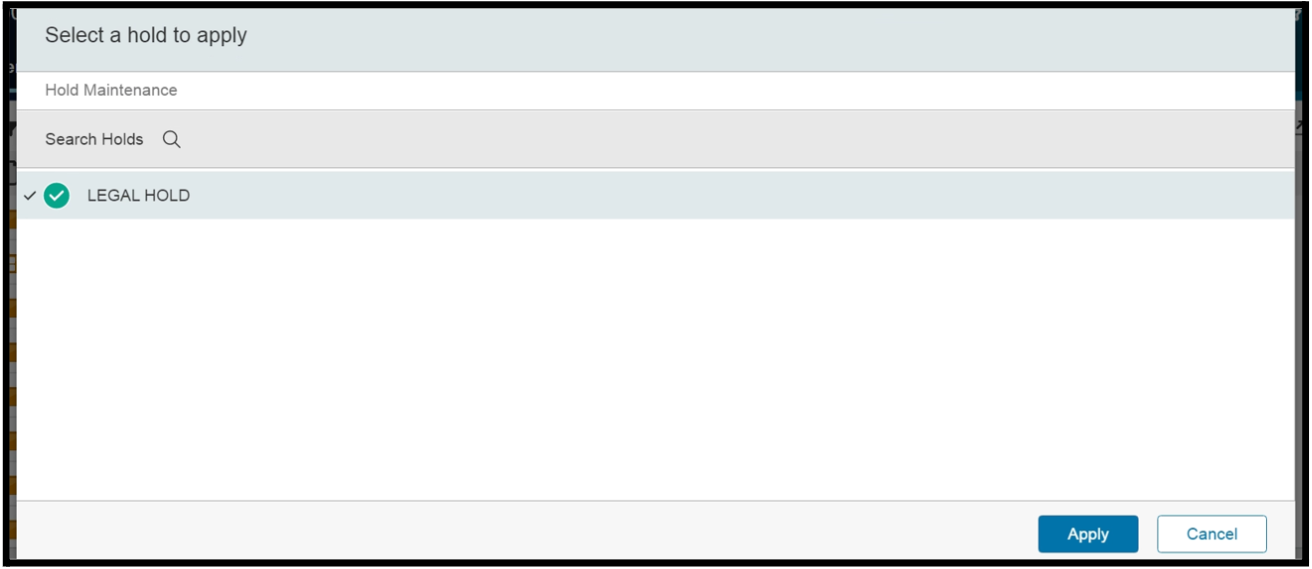
- A pop up message will appear confirming the successful hold application as shown below:
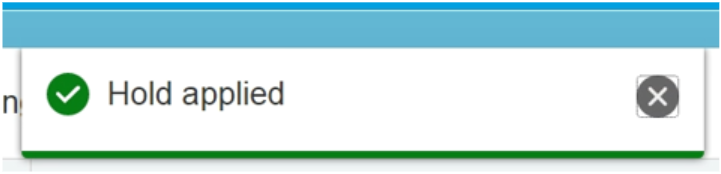
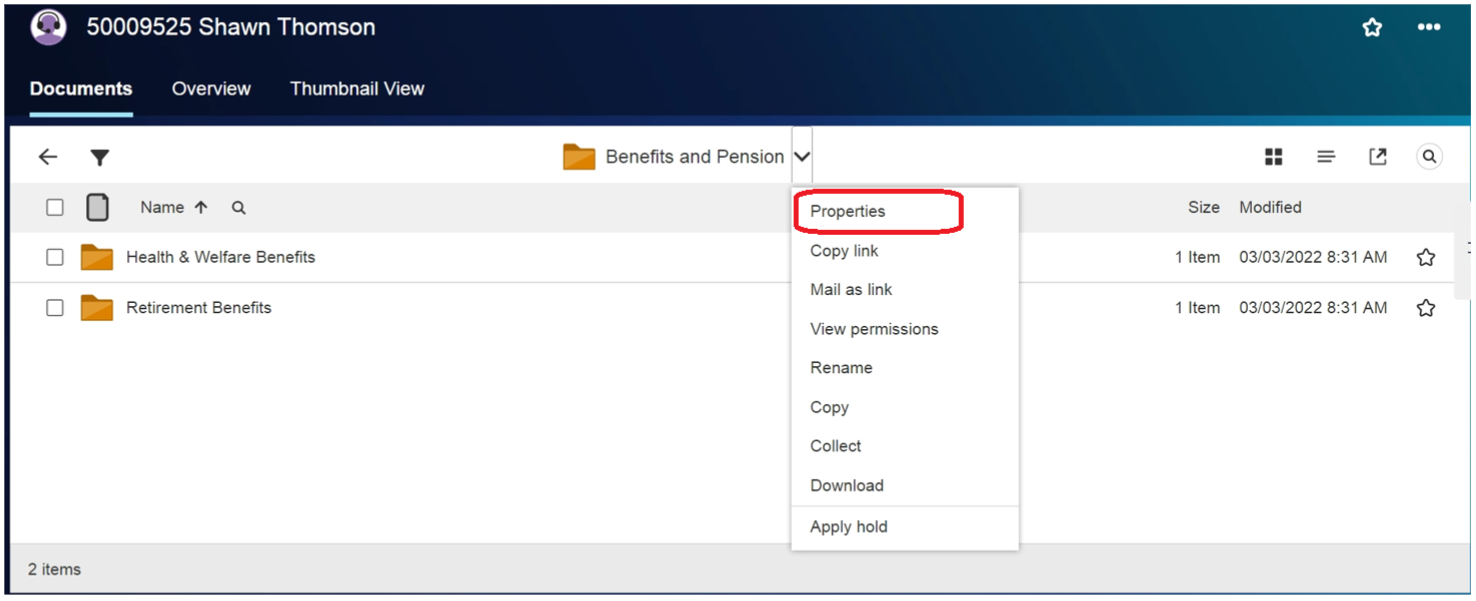
Removing a Legal Hold at the Folder Level- To remove the Legal Hold at the Folder level, select the folder with the hold and click on the breadcrumb and choose “Properties” as shown below:
- You will be directed to the properties screen. Click on the breadcrumb next to Properties and choose HOLDs as shown below:
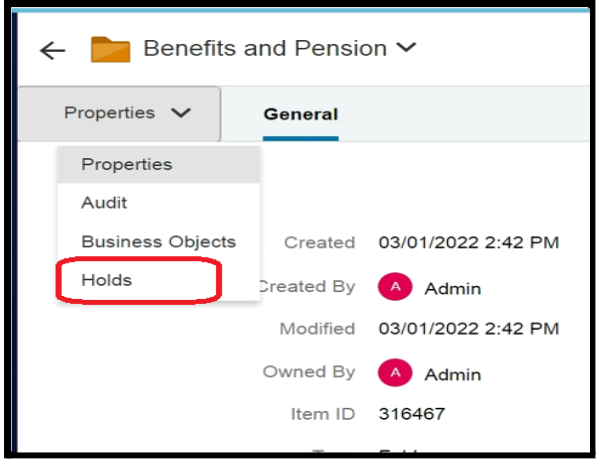
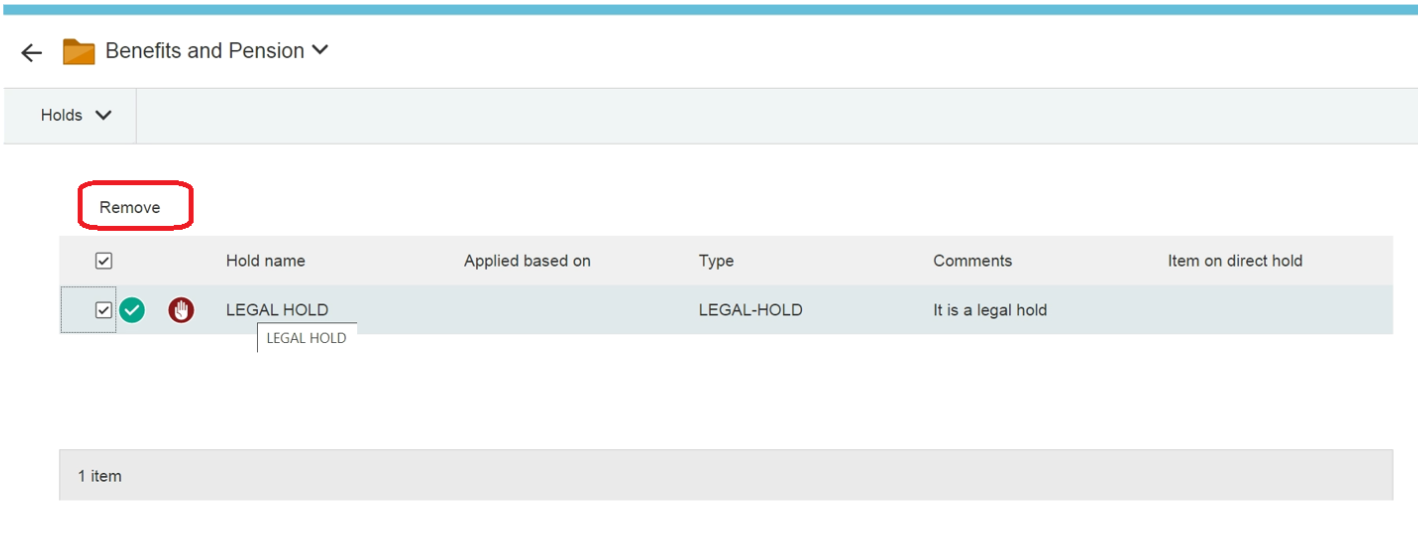
- A screen similar to below will be displayed where you can see the type of hold applied on the file. Now, select the hold you wish to remove as shown below.
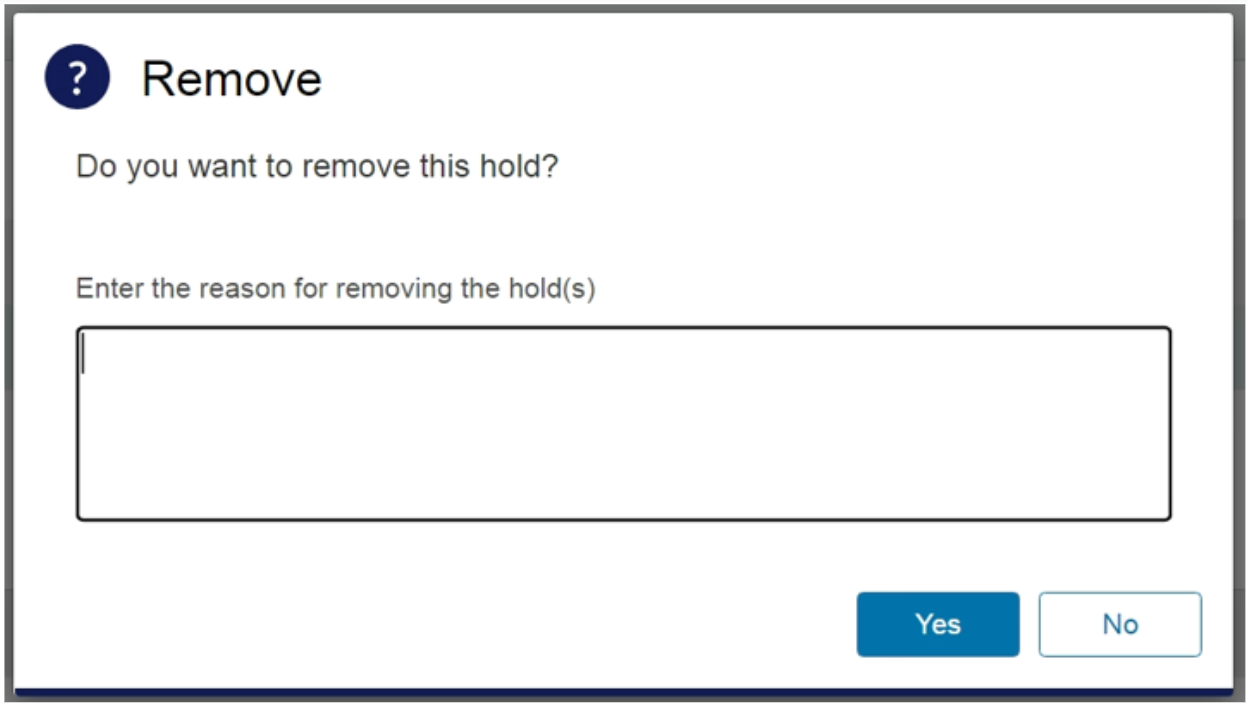
- A confirmation pop up will appear as shown below. Capture the name of the person providing the instruction to remove the legal hold and the date this was effective and then click on Yes.
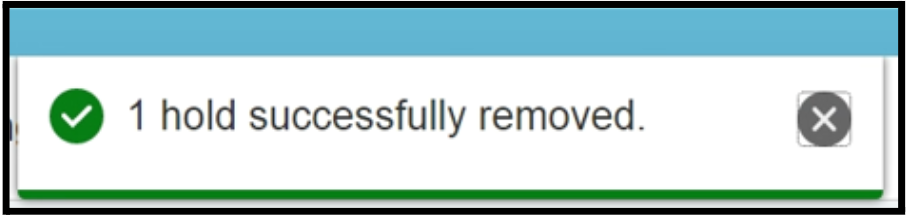
- A message appears confirming the removal of hold as shown below. Henceforth, the file can be deleted and no error message will pop up.
|
Applying a Legal Hold at the Document Level- Select the document to be put on legal hold and click on the “Properties” icon as shown below:
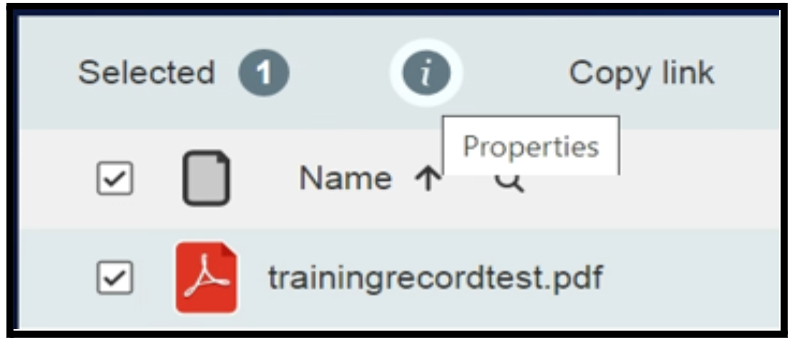
- You will see the properties of the file as shown below:
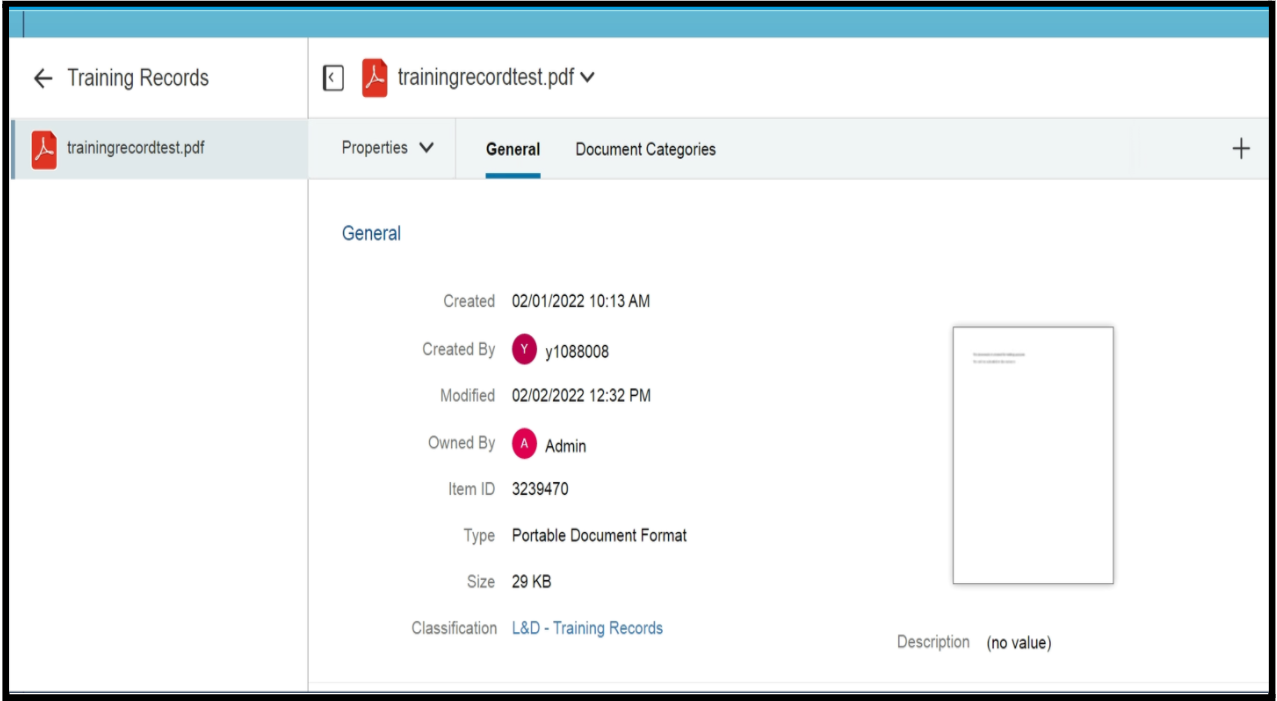

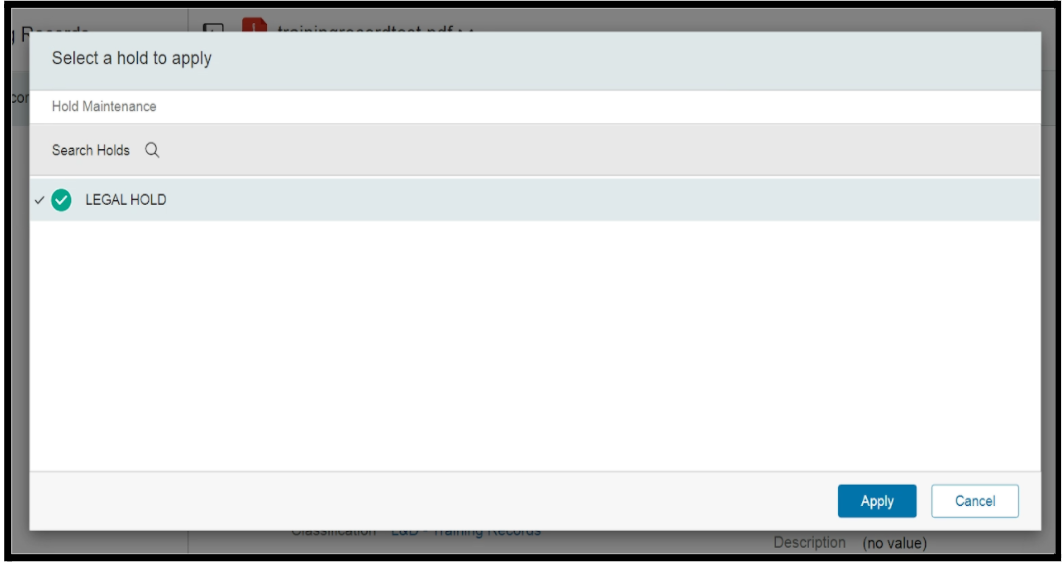
- A pop up message will appear confirming the successful hold application as shown below:

Removing a Legal Hold at the Document Level- To remove the Legal Hold at the Document level, select the document with the hold and click on the properties icon as shown below. Now select Holds.

- A screen similar to below will be displayed where you can see the type of hold applied on the file. Now, select the hold you wish to remove as shown below:
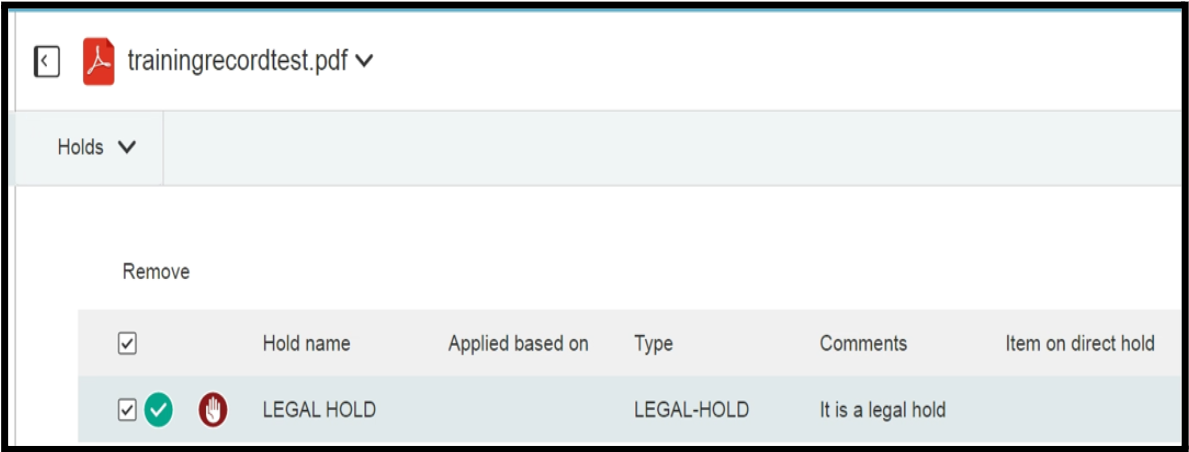
- A confirmation pop up will appear as shown below. Capture the name of the person providing the instruction to remove the legal hold and the date this was effective and then click on Yes.
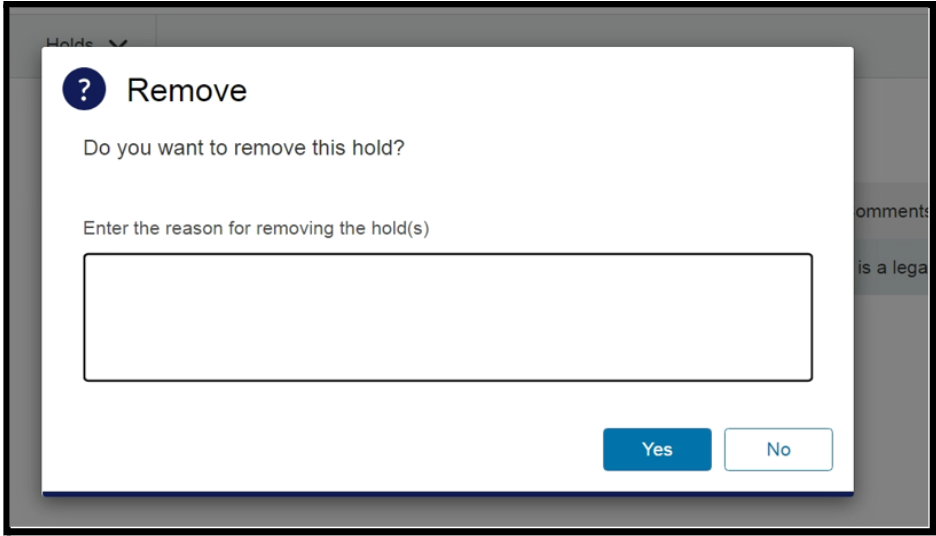
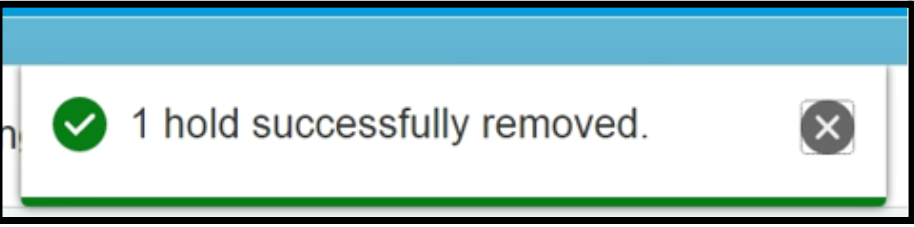
- A message appears confirming the removal of hold as shown below. Henceforth, the file can be deleted and no error message will pop up.
|
If you identify any issues, have any questions or need general support, please either submit a request through SyRa to our People Services colleagues.
|
|
|
Data protection reflexes have to be applied by each of us, at Group level. As an employer, Syensqo collects and processes its employees’ personal data. The European General Data Protection Regulation (GDPR) is an opportunity to adapt and improve our way of working as Human Resources, not only for Europe based HR. - Have you ever wondered which are the best practices on personal data storing, sharing and retention to implement in your day-to-day work?
Find the answers in the eLearning: Personal Data Protection for HR
- You are working closely with Site managers in Europe. Which questions should you ask yourself if you undertake a survey? What to do in case of control of the Data Protection Authority, risk of Data Breach?
Check out the eLearning: Data Privacy Awareness for Site Managers
|
When an employee accepts a new position or has a change in his or her work condition. This Data Change procedure is to be followed by the Site HR when there are changes such as: - Change from Full Time to Part Time
- Change from Part Time to Full Time
- Change in the Work Schedule
- Change in the Contract Dates
|
When a manager will manage employees’ from divisions different from the manager’s division, it is necessary to create a concurrent employment assignment for the manager. By doing so, the manager will have more than one active assignment. The main assignment which the manager already had will not be changed. The new assignment created due to the concurrent employment situation, will be allocated to the division of the employees who are in different divisions than the manager´s one.
To simplify, please see the examples below:Example A: - Manager John belongs to the division “A”
- Employee Sofia belongs to the division “B”
- Sofia will report to John
- A concurrent employment for manager John is created and assigned to division ¨B¨
- Sofia will report to John’s concurrent employment in division ¨B¨
Example B: - Manager John belongs to the division “A” and manages two employees: Kate (belonging to the division ¨A¨) and Sofia (belonging to the division ¨B¨) ; this means that John has a concurrent employment in division ¨B¨
- Kate reports to John´s main employment in division ¨A¨
- Sofia reports to John´s concurrent employment in division ¨B¨
It is the responsibility of the HR to identify situations where concurrent employment is needed, as well as to make sure that concurrent employments are correctly maintained. To create or maintain the information of concurrent employment, please open a ticket in SyRa. |
|
|
It has been shown that “Organisations combining technology and governance are 2.2 times more likely to see year-over-year revenue growth greater than 20 percent.” (ref US Tech). Syensqo has decided that data governance has an important part to play in our digital transformation, as it is critical that data is of the quality required to execute processes and deliver business value. Comprising both people and processes, a sound data governance program includes a combination of people, or in this case a governing body or council, a defined set of procedures, and a plan to execute those procedures. The roles in data governance include Data Owner and Data Steward, who are accountable and responsible for ensuring the quality of data in their domain.
WHY THIS MATTERS TO HR? HR is one of the first domains to use Data Governance and, as part of the Employee Digital Journey; the Data Owners and Data Stewards have been working on the top HR data quality issues, solving them through finding and eliminating the root cause of the problem before cleansing the poor quality data.
WHERE CAN I LEARN MORE ABOUT IT? Start discovering the HR DATA DOMAIN via this link. Explore the complete ENTERPRISE DATA GOVERNANCE Wiki page! |
Knowledge management is a global process of identifying, sharing, retiring and updating HR Knowledge within the organization. The knowledge management process starts when the need to create new or update existing knowledge is identified. End-users, knowledge contributors and knowledge reviewers collaborate to rate, create, update and review HR knowledge, as well as interact with the knowledge management team who then publishes or retires knowledge, as well as monitors and improves the knowledge management process based on feedback and metrics on a regular basis. The Knowledge Management Process for HR incorporates all HR related information that has to be accessed and used by employees, people managers and HR professionals within the organization, such as HR policies, processes and related topics. |
The HR Knowledge Management Team is your point of contact if you want to contribute/add information to the HR Wiki. You can propose to contribute new information that is not currently in the HR Wiki or you can update information that already exists. Also, let us know if you find that any information that is in the HR Wiki is outdated. You can do this via this ticket. Read the Global HR Knowledge Management Process below to know more about this process, the different actors involved and what you need to do. |
This Global HR Knowledge Management Policy aims to ensure a single source of truth for HR content which is available to all employees through easy to access channels. 
|
This Global HR Knowledge Management Process ensures that this HR Knowledge content is centralized, standardized, up to date and accessible to all employees, people managers and HR professionals within Syensqo. 
|
This Document Control Procedure outlines how the HR Knowledge Management Team manages the HR Knowledge Management Process and controls and protects the final and approved master documents before it publishes them in the HR Knowledge Library. This ensures that there is consistent and standardized document control according to the quality management system. 
|

If you are new to Syensqo's Wiki space, you may need to link your Google Drive in order to see embedded documents. |
|
|
|
|
|
|
|
|